Southwell Minster

Some years ago, whilst still living in Peterborough, I was privileged to join a small choir which, as well as performing concerts locally, also travelled to a few different cathedrals where we “stood in” for the resident choirs. So I got to sing in some really lovely places with a great group of people. We were small in number, at most about a dozen and it was hard work at times, but we all enjoyed it. One such place was Southwell Minster, which is both a minster and cathedral in Southwell, Nottinghamshire. It is situated six miles (9.7 km) from Newark-on-Trent and thirteen miles (21 km) from Mansfield. It is the seat of the Bishop of Southwell and Nottingham as well as the Diocese of Southwell and Nottingham. It is a grade I listed building. Much of the main fabric is ‘Romanesque’, or Norman in traditional English terminology but the Minster is most famous for the Gothic chapter house which was begun in 1288, with carved capitals representing different species of plants. To clarify, Minster is an honorific title given to particular churches in England, most notably York Minster in Yorkshire, Westminster Abbey in London and Southwell Minster here in Nottinghamshire.The term ‘minster’ is first found in royal foundation charters of the seventh century, when it designated any settlement of clergy living a communal life and endowed by charter with the obligation of maintaining the daily office of prayer. Widespread in tenth-century England, minsters declined in importance with the systematic introduction of parishes and parish churches from the eleventh century onwards. The term continued as a title of dignity in later medieval England, for instances where a cathedral, monastery, collegiate church or parish church had originated with an Anglo-Saxon foundation. Eventually a minster came to refer more generally to “any large or important church, especially a collegiate or cathedral church”. In the twenty-first century, the Church of England has designated additional minsters by bestowing the status on certain parish churches, the most recent elevation to minster status being St Mary Magdalene church in Taunton, Somerset on 13 March 2022, bringing the total number of current Church of England minsters to thirty-one. As for Southwell, the earliest church on the site is believed to have been founded in 627AD by Paulinus, the first Archbishop of York, when he visited the area whilst baptising believers in the River Trent. The legend is actually commemorated in the Minster’s baptistry window. In 956AD King Eadwig gave land in Southwell to Oskytel, Archbishop of York, on which a minster church was established. The Domesday Book of 1086 recorded the Southwell manor in great detail. The Norman reconstruction of the church began in 1108, probably as a rebuilding of the Anglo-Saxon church, starting at the east end so that the high altar could be used as soon as possible and the Saxon building was dismantled as work progressed. Many stones from this earlier Anglo-Saxon church were reused in the construction. The tessellated floor and late eleventh century tympanum in the north transept are the only parts of the Anglo-Saxon building remaining intact. Work on the nave began after 1120 and the church was completed by c.1150. The church was originally attached to the Archbishop of York’s Palace which stood next door but is now ruined. It served the archbishop as a place of worship and was a collegiate body of theological learning, hence its designation as a minster. The minster draws its choir from the nearby school with which it is associated. In my research I found a comment saying that the Norman chancel was square-ended, but I can find no relevance to this elsewhere. The chancel was replaced with another in the Early English style in 1234–51 because it was too small. The octagonal chapter house, built starting in 1288 with a vault in the Decorated Gothic style has naturalistic carvings of foliage. The elaborately carved ‘pulpitum’ or choir screen was built in 1320–40. The church suffered less than many others during the English Reformation as it was re-founded in 1543 by Act of Parliament. Southwell is where King Charles I surrendered to Scottish Presbyterian troops in 1646 during the English Civil War, after the third siege of Newark. The fighting saw the church seriously damaged and the nave is said to have been used as stabling. The adjoining palace was almost completely destroyed, first by Scottish troops and then by the local people, with only the Hall of the Archbishop remaining as a ruined shell. Then on 5 November 1711 the southwest spire was struck by lightning, and the resulting fire spread to the nave, crossing and tower destroying roofs, bells, clock and the organ. By 1720 repairs had been completed, now giving a flat panelled ceiling to the nave and transepts. In 1805, Archdeacon Kaye gave the Minster the Newstead lectern which was once owned by Newstead Abbey. It had been thrown into the abbey fishpond by the monks to save it during the Dissolution of the Monasteries, then later discovered when the lake was dredged! Then in 1818, Henry Gally Knight gave the Minster four panels of sixteenth century Flemish glass (which now fill the bottom part of the East window) which he had acquired from a Parisian pawnshop. In 1805 the spires were found to be in danger of collapse, they were re-erected in 1879–81 when the minster was extensively restored by Ewan Christian, an architect specialising in churches. The nave roof was replaced with a pitched roof and the quire was redesigned and refitted.
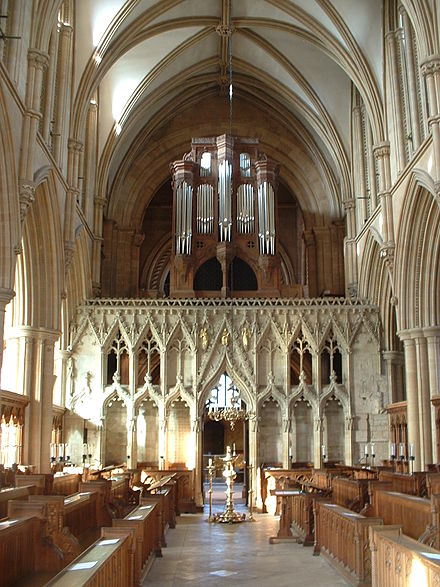
Southwell rood screen (pulpitum) from the choir.

The whole place has quite an ecclesiastical history, and Southwell Minster was served by prebendaries from the early days of its foundation. By 1291 there were sixteen Prebends of Southwell mentioned in the Taxation Roll. In August 1540, as the dissolution of the monasteries was coming to an end, and despite its collegiate rather than monastic status, Southwell Minster was suppressed specifically in order that it could be included in the plans initiated by King Henry VIII to create several new cathedrals. It appears to have been proposed as the see for a new diocese comprising both Nottinghamshire and Derbyshire as a replacement for Welbeck Abbey which had been dissolved in 1538 and which by 1540 was no longer owned by the Crown. The plan for the minster’s elevation did not proceed, so in 1543 Parliament reconstituted its collegiate status as before. In 1548 it again lost its collegiate status under the 1547 Act of King Edward VI which suppressed, amongst others, almost all collegiate churches. At Southwell, the prebendaries were given pensions and the estates sold, whilst the church continued as the parish church on the petitions of the parishioners. By an Act of Philip and Mary in 1557, the minster and its prebends were restored and in 1579 a set of statutes was promulgated by Queen Elizabeth I. The chapter operated under this constitution until it was dissolved in 1841. The Ecclesiastical Commissioners made provision for the abolition of the chapter as a whole such that the death of each canon after this time resulted in the extinction of his prebend. The chapter came to its appointed end on 12 February 1873 with the death of Thomas Henry Shepherd, rector of Clayworth and prebendary of Beckingham. Despite the plans to make Southwell Minster a cathedral in August 1540 not initially coming to fruition, 344 years later in 1884 Southwell Minster became a cathedral proper for Nottinghamshire and a part of Derbyshire including the city of Derby. In 1927 the diocese was divided and the Diocese of Derby was formed.

Compartments of the nave, interior and exterior.

Architecturally, the nave, transepts, central tower and two western towers of the Norman church which replaced the Anglo-Saxon minster remain as an outstanding achievement of severe Romanesque design. With the exception of fragments mentioned above, they are the oldest part of the existing church.

The nave is of seven bays, plus a separated western bay. The columns of the arcade are short and circular, with small scalloped capitals. The triforium has a single large arch in each bay and the clerestory has small round-headed windows whilst the external window openings are circular. There is a tunnel-vaulted passage between the inside and outside window openings of the clerestory, the nave aisles are vaulted, the main roof of the nave is a trussed rafter roof, with tie-beams between each bay, these being a late nineteenth century replacement. By contrast with the nave arcade, the arches of the crossing are tall, rising to nearly the full height of the nave walls. The capitals of the east crossing piers depict scenes from the life of Jesus. Two stages of the inside of the central tower can be seen at the crossing, with cable and wave decoration on the lower order and zigzag on the upper. The transepts have three stories with semi-circular arches, like the nave, but without aisles.

Rib vault of Southwell Minster choir.

The western facade has pyramidal spires on its towers – a unique feature today, though common in the twelfth century. The existing spires date only from 1880, but they replace those destroyed by fire in 1711, which are documented in old illustrations. The large west window dates from the fifteenth century. The central tower’s two ornamental stages place it high among England’s surviving Norman towers and whilst the lower order has intersecting arches, the upper order has plain arches. The north porch has a tunnel vault, and is decorated with intersecting arches. The choir is Early English in style, and was completed in 1241 and it has transepts, thus separating the choir into a western and eastern arm. The choir is of two storeys, with no gallery or triforium. The lower storey has clustered columns with multiform pointed arches, the upper storey has twin lancet arches in each bay. The rib vault of the choir springs from clustered shafts which rest on corbels. The vault has ridge ribs. The square east end of the choir has two stories each of four lancet windows.
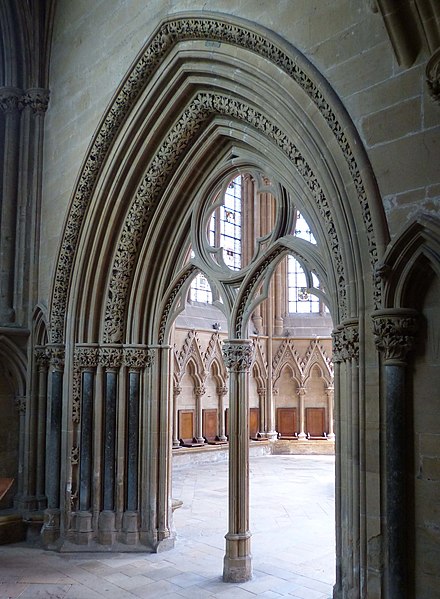
Entrance portal of the chapter house with the famous carved foliage.

In the 14th century the chapter house and the choir screen were added. The chapter house, started in 1288, is in an early decorated style, octagonal, with no central pier. It is reached from the choir by a passage and vestibule, through an entrance portal. This portal has five orders, and is divided by a central shaft into two subsidiary arches with a circle with quatrefoil above. Inside the chapter house, the stalls fill the octagonal wall sections, each separated by a single shaft with a triangular canopy above. The windows are of three lights, above them two circles with trefoils and above that a single circle with quatrefoil. This straightforward description gives no indication of the glorious impression, noted by so many writers, of the elegant proportions of the space, and of the profusion (in vestibule and passage, not just in the chapter house) of exquisitely carved capitals and tympana, mostly representing leaves in a highly naturalistic and detailed representation. The capitals in particular are deeply undercut, adding to the feeling of realism. Individual plant species such as ivy, maple, oak, hop, hawthorn can often be identified. The rood screen dates from 1320 to 1340, and is an outstanding example of the Decorated style. It has an east and west facade, separated by a vaulted space with flying ribs. The east facade, of two storeys, is particularly richly decorated, with niches on the lower storey with ogee arches, and openwork gables on the upper storey. The central archway rises higher than the lower storey, with an ogee arch surmounted by a cusped gable. The finest memorial in the minster is the alabaster tomb of Edwin Sandys, Archbishop of York, who died in 1588. As for choirs, the Cathedral Choir comprises the boy choristers, girl choristers, and lay clerks who, between them, provide music for seven choral services each week during school terms. The boys and girl choristers usually sing as separate groups, combining for particularly important occasions such as Christmas and Easter services, and notable events in the life of the minster. Regular concerts and international tours are a feature of the choir’s work. Services have been sung in Southwell Minster for centuries, and the tradition of daily choral worship continues to thrive. There was originally a college of vicars choral who took the lead as singers, one or two of whom were known as ‘rector chori’, or ‘ruler of the choir’. The vicars choral lived in accommodation where Vicars Court now stands, and lived a collegiate lifestyle.The current Cathedral Choir owes its form to the addition of boy choristers to the vicars choral, and the vicars themselves eventually being replaced by lay singers, known as lay clerks. For a large period of time, the format remained very similar, with a number of boy choristers singing with a mixture of lay clerks and vicars choral, slowly becoming a group of entirely lay singers. Eventually, in 2005, a girls’ choir was started by the Assistant Director of Music, who have now been formally admitted as girl choristers. All of the choristers are educated at the Minster School, a Church of England academy with a music-specialist Junior Department (years 3–6) for choristers and other talented young musicians. The Cathedral Choir has an enviable reputation for excellence, and has recorded and broadcast extensively over the years. Regular concerts and international tours are a feature of the choir’s work, alongside more local events such as civic services and the annual Four Choirs’ Evensong together with the cathedral choirs of Derby, Leicester and Coventry.

The Cathedral Choir can be heard singing at evensongs at 5.30 pm every weekday (except Wednesday), and on Saturdays and Sundays. In addition, there is ‘The Minster Chorale’, which is Southwell Minster’s auditioned adult voluntary choir, and is directed by the Minster’s Assistant Director of Music, Jonathan Allsopp. Founded in 1994, the Chorale’s purpose is to regularly sing for services, especially at times when the Cathedral Choir is not available. In particular, the Chorale sings for a mixture of services throughout the year. In addition to its regular round of services, one of the highlights of the Chorale’s year is its annual performance of Handel’s Messiah in the run-up to Christmas and this concert is a staple of the Minster’s Christmas programme, so is always packed out. The Chorale also regularly goes on tour, in recent years they have toured to the Channel Islands and the Scilly Isles. A 2020 tour to Schwerin, Germany was planned (together with Lincoln Cathedral Consort), but this was cancelled due to the Coronavirus pandemic. The Chorale also visits other cathedrals to sing services, and recently has been to York Minster. Southwell Minster Chorale rehearses weekly during term-time on a Friday from 7:45 pm – 9:15 pm. The Chorale also enjoys a good social life, with regular trips to the pub after rehearsals and for Sunday lunches.The minster is also home to the annual Southwell Music Festival, held in late August. However, as previously mentioned, many years ago I was able to sing the services as part of a visiting choir. We were small in number, so I had to sing up a bit – but we managed!


To end with, I have found a couple of old illustrations.
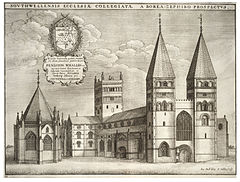
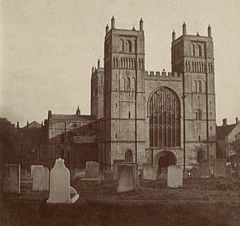
Southwell Minster before the original spires were destroyed by fire in 1711.
Without the spires, which were removed in 1805 and replaced in 1879-81.

This week… Dictators.

“Speaking openly about dictators is like stepping on the tail of a snake. Do so and it will turn and bite you. To kill it, you must chop off its head.” ~ Author unknown.

Click: Return to top of page or Index page
Chocolate

The history of chocolate began in an area known as Mesoamerica, which is a historical region and cultural area that begins in the southern part of North America and extends to most of Central America, thus comprising the lands of central Mexico, Belize, Guatemala, El Salvador, Honduras, Nicaragua, and northern Costa Rica. Fermented beverages made from chocolate date back to at least 1900 BC to 1500 BC. The Mexica, an indigenous people of the Valley of Mexico who were the rulers of the Aztec Empire, believed that cacao seeds were the gift of Quetzalcoatl, the god of wisdom, and the seeds once had so much value that they were used as a form of currency. Originally prepared only as a drink, chocolate was served as a bitter liquid, mixed with spices or corn puree. It was believed to be an aphrodisiac and to give the drinker strength. Today, such drinks are also known as ‘Chilate’ and are made by locals in the south of Mexico and the north triangle of Central America (El Salvador, Guatemala and Honduras). After its arrival to Europe in the sixteenth century, sugar was added to it and it became popular throughout society, first among the ruling classes and then among the common people. However, in the twentieth century chocolate was considered essential in the rations of United States soldiers during war. The word ‘chocolate’ comes from the Classical Nahuatl word ‘xocolātl’, which is of uncertain etymology, and entered the English language via the Spanish language. Cultivation, consumption, and cultural use of cacao were extensive in Mesoamerica where the cacao tree is native. When pollinated, the seed of the cacao tree eventually forms a kind of sheath, or ear, averaging some twenty inches long, hanging from the tree trunk itself. Within the sheath are thirty to forty brownish-red almond-shaped beans embedded in a sweet viscous pulp. Whilst the beans themselves are bitter due to the alkaloids within them, the sweet pulp may have been the first element to be consumed by humans. Cacao pods grow in a wide range of colours, from pale yellow to bright green, all the way to dark purple or crimson. The skin can also vary greatly. Some are sculpted with craters or warts, whilst others are completely smooth. This wide range in type of pods is unique to the cacao in that their colour and texture does not necessarily determine the ripeness or taste of the beans inside. Evidence suggests that it may have been fermented and served as an alcoholic beverage as early as 1400 BC. But cultivation of the cacao was not an easy process, and part of this was because cacao trees in their natural environment grow to sixty feet tall or more. When the trees were grown on a plantation however, they grew to around twenty feet tall. Whilst researchers do not agree on which Mesoamerican culture first domesticated the cacao tree, the use of the fermented bean in a drink seems to have arisen in North America, and scientists have been able to confirm its presence in vessels throughout the region by evaluating the chemical footprint detectable in the micro samples of the contents that remain. Ceramic vessels with residues from the preparation of chocolate beverages have been found at archaeological sites dating back to the Early Formative (1900 to 900 BC) period. For example, one such vessel found at an Olmec archaeological site on the Gulf Coast of Veracruz, Mexico dates chocolate’s preparation by pre-Olmec peoples as early as 1750 BC. On the Pacific coast of Chiapas, Mexico, a Mokayanan archaeological site provides evidence of cacao beverages dating even earlier, to 1900 BC. However a study, published online in Nature Ecology and Evolution, suggests that cacao, the plant from which chocolate is made, was domesticated or grown by people for food around 1,500 years earlier than previously thought. In addition, the researchers found cacao was originally domesticated in South America, rather than in Central America. A professor from the department of anthropology in the University of British Columbia wrote that “This new study shows us that people in the upper reaches of the Amazon basin, extending up into the foothills of the Andes in southeastern Ecuador, where harvesting and consuming cacao that appears to be a close relative of the type of cacao later used in Mexico, and they were doing this 1,500 years earlier”. The researchers used three lines of evidence to show that the Mayo-Chinchipe culture used cacao between 5,300 and 2,100 years ago, these being the presence of starch grains specific to the cacao tree inside ceramic vessels and broken pieces of pottery, residues of theobromine, a bitter alkaloid found in the cacao tree but not its wild relatives and fragments of ancient DNA with sequences unique to the cacao tree. In fact, Nature Ecology and Evolution reported what is believed to be the earliest cacao use from approximately 5,300 years ago recovered from the Santa Ana site in southeast Ecuador. Another find of chemically traced cacao was in 1984 when a team of archaeologists in Guatemala explored the Mayan site of Río Azul, where they discovered fifteen vessels surrounding male skeletons in the royal tomb. One of these vessels was beautifully decorated and covered in various Mayan glyphs. One of these glyphs translated to ‘kaka’, also known as cacao. The inside of the vessel was lined with a dark-coloured powder, which was scraped off for further testing. When the archaeologists took this powder to the Hershey Center for Health and Nutrition to be tested, it is said they found trace amounts of theobromine in the powder, a major indicator of cacao. This cacao was dated to some time between 460 and 480 AD. Cacao powder was also found in decorated bowls and jars in the city of Puerto Escondido. Once thought to have been a scarce commodity, cacao was found in many more of these jars than once thought. However, since this powder was only found in bowls of higher quality, it led archaeologists to believe that only wealthier people could afford such bowls, and therefore the cacao. These special jars are believed to have been a centrepiece to social gatherings between people of high social status.

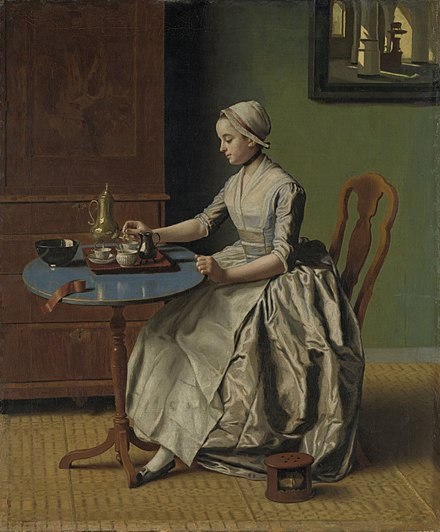
‘A Lady Pouring Chocolate’ by Jean-Étienne Liotard (1744).

Until the 16th century, the cacao tree was wholly unknown to Europeans. Christopher Columbus encountered the cacao bean on his fourth mission to the Americas on August 15, 1502, when he and his crew seized a large native canoe that proved to contain, amongst other goods for trade, cacao beans. His son Ferdinand commented that the natives greatly valued the beans, which he termed almonds, “for when they were brought on board ship together with their goods, I observed that when any of these almonds fell, they all stooped to pick it up, as if an eye had fallen.” But whilst Columbus took cacao beans with him back to Spain, it made no impact until Spanish friars introduced chocolate to the Spanish court. The Spanish conquistador, Hernán Cortés, may have been the first European to encounter chocolate when he observed it in the court of Montezuma in 1519. In 1568, Bernal Díaz, who accompanied Cortés in the conquest of the Aztec Empire, wrote of this encounter which he witnessed “From time to time, they served him (Montezuma) in cups of pure gold a certain drink made from cacao. It was said that it gave one power over women, but this I never saw. I did see them bring in more than fifty large pitchers of cacao with froth in it, and he drank some of it, the women serving with great reverence. José de Acosta, a Spanish missionary who lived in Peru and then Mexico in the later sixteenth century, described its use more generally as “Loathsome to such as are not acquainted with it, having a scum or froth that is very unpleasant taste. Yet it is a drink very much esteemed among the Indians, wherewith they feast noble men who pass through their country. The Spaniards, both men and women that are accustomed to the country are very greedy of this chocolate. They say they make diverse sorts of it, some hot, some cold, and some temperate, and put therein much of that ‘chili’; yea, they make paste thereof, the which they say is good for the stomach and against the catarrh”. After the Spanish conquest of the Aztecs, chocolate was imported to Europe. In the beginning, Spaniards would use it as a medicine to treat illnesses such as abdominal pain because it had a bitterness to it. Once sweetened, it transformed and quickly became a court favourite. It was still served as a beverage, but the addition of sugar or honey counteracted the natural bitterness. The Spaniards initially intended to recreate the original taste of the Mesoamerican chocolate by adding similar spices, but this habit had faded away by the end of the eighteenth century. At first, chocolate was largely a privilege of the rich whilst the lower class drank coffee, but once the steam engine was invented in the late 1700s, mass production became possible. Within about a hundred years, chocolate had established a foothold throughout Europe.

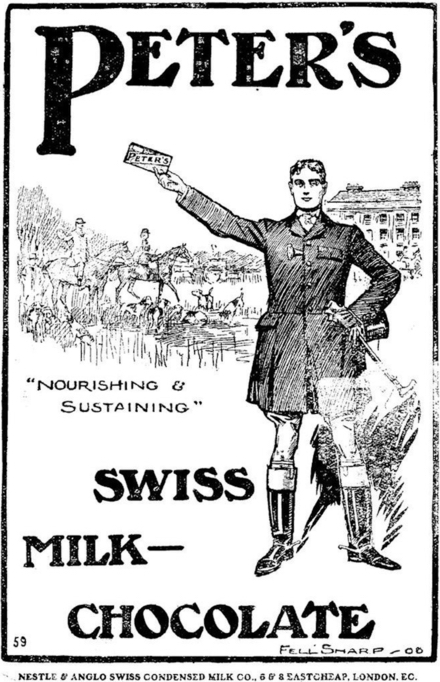
A 1909 Peter’s milk chocolate advertisement. It seems they were the company who produced the first successful milk chocolate bar.

The desire for chocolate created a thriving slave market, as between the early seventeenth and late nineteenth centuries the laborious and slow processing of the cacao bean was manual. Cacao plantations spread as the English, Dutch, and French colonised and planted. With the depletion of Mesoamerican workers, largely due to disease, cocoa beans production was often the work of poor wage labourers and enslaved Africans. In 1729 the first mechanical cocoa grinder was invented in Bristol, England. Walter Churchman petitioned the king of England for patent and sole use of an invention for the “expeditious, fine and clean making of chocolate by an engine” and the patent was granted by King George II to Walter Churchman for a water engine used to make chocolate. Churchman probably used water-powered edge runners for preparing cacao beans by crushing on a far larger scale than previously. The patent for a chocolate refining process was later bought in 1761 by Joseph Fry, who started the company that was to become J. S. Fry & Sons. Wind-powered and horse-drawn mills were used to speed up production, augmenting human labour. Heating the working areas of the table-mill, an innovation that emerged in France in 1732, also assisted in extraction. The Chocolaterie Lombart, created in 1760, claimed to be the first chocolate company in France. New processes that improved the production of chocolate emerged early in the Industrial Revolution. In 1815 a Dutch chemist introduced alkaline salts to chocolate, which reduced its bitterness and a few years after, in 1828, he created a press to remove about half the natural fat (cacao butter) from chocolate liquor, which made chocolate both cheaper to produce and more consistent in quality. This innovation, known as ‘Dutch cocoa’, introduced the modern era of chocolate and was instrumental in the transformation of chocolate to its solid form. In 1847 J. S. Fry & Sons learned to make chocolate mouldable by adding back melted cacao butter. Milk had sometimes been used as an addition to chocolate beverages since the mid-seventeenth century, but in 1875 Daniel Peter, a Swiss-French chocolatier who founded Peter’s Chocolate and who was also a neighbour of Henri Nestlé, invented milk chocolate by mixing in a powdered milk developed by Henri Nestlé. In 1879 the texture and taste of chocolate was further improved when Rodolphe Lindt invented the ‘conching’ machine which evenly distributes cocoa butter within chocolate. Lindt & Sprüngli AG, a Swiss-based concern with global reach, had its start in 1845 as the Sprüngli family confectionery shop in Zurich that added a solid-chocolate factory the same year the process for making solid chocolate was developed and later bought Lindt’s factory. Besides Nestlé, several chocolate companies had their start in the late nineteenth and early twentieth centuries. Cadbury was manufacturing boxed chocolates in England by 1868 and in 1893 Milton S. Hershey purchased chocolate processing equipment at the World Columbian Exposition in Chicago and soon began the career of Hershey’s chocolates with chocolate-coated caramels. Due to improvements in their machines, chocolate underwent a transformation from primarily a drink to food, and different types of chocolate began to emerge. At the same time, the price of chocolate began to drop dramatically in the 1890s and 1900s as the production of chocolate began to shift away from the New World to Asia and Africa. Therefore, chocolate could be purchased by the middle class. However, between 1900 and 1907 Cadbury’s fell into a scandal due to their reliance on West African slave plantations. Roughly two-thirds of the world’s cocoa is produced in Western Africa, with Ivory Coast being the largest source, producing a total crop of 1,448,992 tonnes. Ghana, Nigeria, and Cameroon are other West African countries among the top 5 cocoa-producing countries in the world. Like many food industry producers, individual cocoa farmers are at the mercy of volatile world markets. The price can vary from between £500 ($945) and £3,000 ($5,672) per ton in the space of just a few years. Whilst investors trading in cocoa can dump shares at will, individual cocoa farmers cannot simply ramp up production and abandon trees at anywhere near that pace. Only three to four percent of ‘cocoa futures’ contracts traded in the cocoa markets ever end up in the physical delivery of cocoa and every year, seven to nine times more cocoa is bought and sold on the exchange than exists. But chocolate is something which I think (and hope!) will always be with us.

This week… remember:
Earth without art is just “Eh”…

Click: Return to top of page or Index page
J. S. Bach’s Music

I have also found a list of compositions by Johann Sebastian Bach, but they are too numerous to list here so for those interested, this is a link to the Wikipedia page: List of compositions by Johann Sebastian Bach

A handwritten note by Bach in his copy of the Calov Bible.

The above note, written next to 2 Chronicles 5:13 reads: “NB Bey einer andächtigen Musiq ist allezeit Gott mit seiner Gnaden Gegenwart”, meaning ‘(N(ota) B(ene) In a music of worship God is always present with his grace’. From an early age, Bach studied the works of his musical contemporaries of the Baroque period and those of prior generations, and those influences were reflected in his music. Like his contemporaries Handel, Telemann and Vivaldi, Bach composed concertos, suites, recitatives, da capo arias, and four-part choral music. Some works employed a basso continuo which is used in baroque music as an accompanying part that includes a bass line and harmonies, typically played on a keyboard instrument and with other instruments such as cello or lute. The music of Bach was harmonically more innovative than his peer composers, employing surprisingly dissonant chords and progressions, often with extensive exploration of harmonic possibilities within one piece. The hundreds of sacred works Bach created are usually seen as manifesting not just his craft but also a truly devout relationship with God. He had taught Luther’s Small Catechism as the Thomaskantor in Leipzig, and some of his pieces represent it, in fact the Lutheran chorale was the basis of much of his work. In elaborating these hymns into his chorale preludes. He wrote more cogent and tightly integrated works than most, even when they were seen as massive and lengthy by some and the large-scale structure of every major Bach sacred vocal work is evidence of subtle, elaborate planning to create a religiously and musically powerful expression. For example, the St Matthew Passion, like other works of its kind, illustrated the Passion with Bible text reflected in recitatives, arias, choruses, and chorales. But in crafting this work, Bach created an overall experience that has been found over the intervening centuries to be both musically thrilling and spiritually profound, something I wholeheartedly agree with. Bach published or carefully compiled in manuscript many collections of pieces that explored the range of artistic and technical possibilities inherent in almost every genre of his time except opera. For example, The Well-Tempered Clavier comprises two books, each of which presents a prelude and fugue in every major and minor key, displaying a dizzying variety of structural, contrapuntal and fugal techniques.

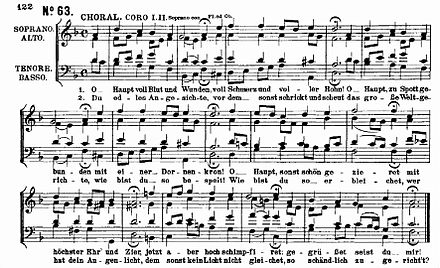
“O Haupt voll Blut und Wunden”: the four-part chorale setting as included in the St. Matthew Passion.

Four-part harmonies predate Bach, but he lived during a time when modal music in Western tradition was largely supplanted in favour of the tonal system. In this, a piece of music progresses from one chord to the next according to certain rules, each chord being characterised by four notes. The principles of four-part harmony are found not only in Bach’s four-part choral music, as he also prescribes it for instance for the figured bass accompaniment. The new system was at the core of Bach’s style, and his compositions are to a large extent considered as laying down the rules for the evolving scheme that would dominate musical expression in the next centuries. Some examples of this characteristic of Bach’s style and its influence may be seen when, in the 1740s, Bach staged his arrangement of Pergolesi’s Stabat Mater where he upgraded the viola part (which in the original composition plays in unison with the bass part) to fill out the harmony, thus adapting the composition to his four-part harmony style. Also, starting in the 19th century in Russia, there was a discussion about the authenticity of four-part court chant settings compared to earlier Russian traditions and Bach’s four-part chorale settings, such as those ending his Chorale cantatas, were considered as foreign-influenced models. Such influence was deemed unavoidable, however. Bach’s insistence on the tonal system and contribution to shaping it did not imply he was less at ease with the older modal system and the genres associated with it, more than his contemporaries (who had ‘moved on’ to the tonal system without much exception). Bach often returned to the then-antiquated modi and genres. In addition modulation, or changing key in the course of a piece, is another style characteristic where Bach goes beyond what was usual in his time. Baroque instruments vastly limited modulation possibilities, as with keyboard instruments, prior to a workable system of temperament, limited the keys that could be modulated to, and wind instruments, especially brass instruments such as trumpets and horns, about a century before they were fitted with valves, were tied to the key of their tuning. Bach pushed the limits, as he added ‘strange tones’ in his organ playing, confusing the singing. The major development taking place in Bach’s time, and to which he contributed in no small way, was a temperament for keyboard instruments that allowed their use in all available keys (12 major and 12 minor) and also modulation without retuning. His Capriccio on the Departure of a Beloved Brother, a very early work, showed a gusto for modulation unlike any contemporary work this composition has been compared to but the full expansion came with the Well-Tempered Clavier, using all keys, which Bach apparently had been developing since around 1720, the Klavierbüchlein für Wilhelm Friedemann Bach being one of its earliest examples.

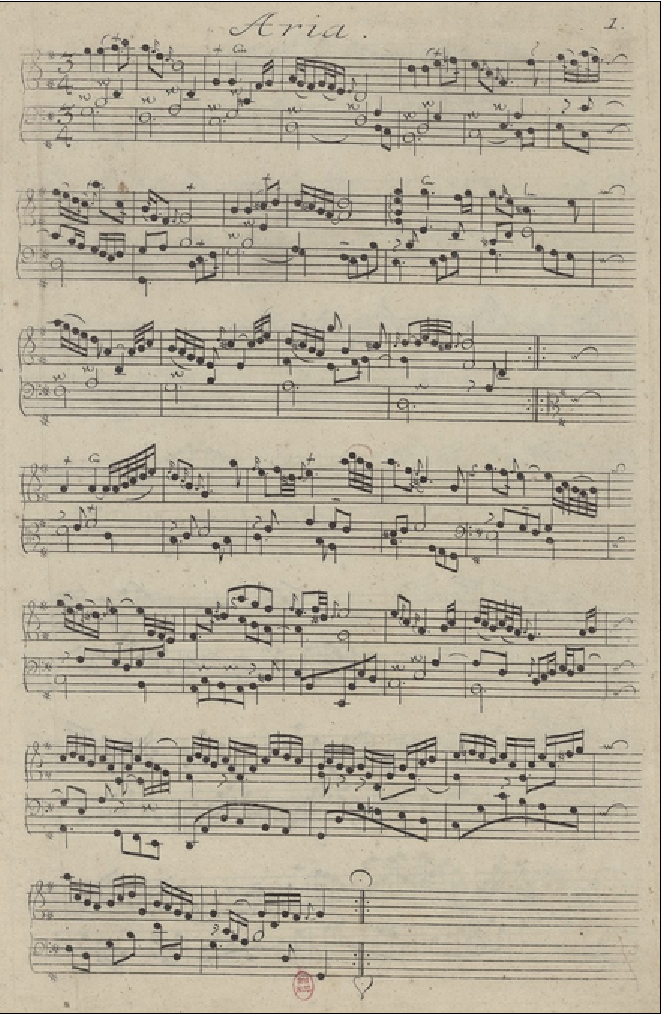
“Aria” of the Goldberg Variations, showing Bach’s use of ornaments.

The second page of this Klavierbüchlein für Wilhelm Friedemann Bach is an ornament notation and performance guide that Bach wrote for his eldest son, who was nine years old at the time. Bach was generally quite specific on ornamentation in his compositions (where in his time much of the ornamentation was not written out by composers but rather considered a liberty of the performer), and his ornamentation was often quite elaborate. For instance, the Aria of the Goldberg Variations has rich ornamentation in nearly every measure. Bach’s dealing with ornamentation can also be seen in a keyboard arrangement he made of Marcello’s Oboe Concerto, where he added explicit ornamentation, which some centuries later is played by oboists when performing the concerto. Although Bach did not write any operas, he was not averse to the genre or its ornamented vocal style. In church music, Italian composers had imitated the operatic vocal style in genres such as the Neapolitan mass. In Protestant surroundings, there was more reluctance to adopt such a style for liturgical music. For instance Kuhnau, Bach’s predecessor in Leipzig, had notoriously shunned opera and Italian virtuoso vocal music. Bach was less moved. One of the comments after a performance of his St Matthew Passion was that it all sounded much like opera. In concert playing in Bach’s time the basso continuo, along with instruments such as organ, viola da gamba or harpsichord, usually had the role of accompaniment, providing the harmonic and rhythmic foundation of a piece. From the late 1720s, Bach had the organ play ‘concertante’ (i.e. as a soloist) with the orchestra in instrumental cantata movements, a decade before Handel published his first organ concertos. Apart from the 5th Brandenburg Concerto and the Triple Concerto, which already had harpsichord soloists in the 1720s, Bach wrote and arranged his harpsichord concertos in the 1730s, and in his sonatas for viola da gamba and harpsichord neither instrument plays a continuo part as they are treated as equal soloists, far beyond the figured bass. In this sense, Bach played a key role in the development of genres such as the keyboard concerto. Bach wrote virtuoso music for specific instruments as well as music independent of instrumentation. For instance, the sonatas and partitas for solo violin are considered the pinnacle of what has been written for this instrument, only within reach of accomplished players. The music fits the instrument, pushing it to the full scale of its possibilities and requiring virtuosity of the player but without bravura. Notwithstanding that the music and the instrument seem inseparable, Bach made transcriptions for other instruments of some pieces of this collection. Similarly, for the cello suites, the virtuoso music seems tailored for the instrument, the best of what is offered for it, yet Bach made an arrangement for lute of one of these suites. The same applies to much of his most virtuoso keyboard music. Bach exploited the capabilities of an instrument to the fullest while keeping the core of such music independent of the instrument on which it is performed.
In this sense, it is no surprise that Bach’s music is easily and often performed on instruments it was not necessarily written for, that it is transcribed so often, and that his melodies turn up in unexpected places such as jazz music. Apart from this, Bach left a number of compositions without specified instrumentation. Another characteristic of Bach’s style is his extensive use of counterpoint, as opposed to the homophony used in his four-part Chorale settings, for example. Bach’s canons, and especially his fugues, are most characteristic of this style, which Bach did not invent but contributed to so fundamentally that he defined it to a large extent. Fugues are as characteristic to Bach’s style as, for instance, the Sonata form is characteristic to the composers of the Classical period. These strictly contrapuntal compositions, and most of Bach’s music in general, are characterised by distinct melodic lines for each of the voices, where the chords formed by the notes sounding at a given point follow the rules of four-part harmony. From about 1720, when he was thirty-five, until his death in 1750, Bach’s harmony consists in this melodic interweaving of independent melodies, so perfect in their union that each part seems to constitute the true melody, and here I think Bach excels all the composers in the world. At least, I have found no one to equal him in music known to me. Even in his four-part writing we can, not infrequently, leave out the upper and lower parts and still find the middle parts melodious and agreeable. Bach devoted more attention than his contemporaries to the structure of compositions. This can be seen in minor adjustments he made when adapting someone else’s composition, such as his earliest version of the “Keiser” St Mark Passion, where he enhances scene transitions, and in the architecture of his own compositions such as his Magnificat and Leipzig Passions. In the last years of his life, Bach revised several of his prior compositions, and often the recasting of such previously composed music in an enhanced structure was the most visible change, as in the Mass in B minor. Bach’s known preoccupation with structure led to various numerological analyses of his compositions, although many such over-interpretations were later rejected. The librettos, or lyrics, of his vocal compositions played an important role for Bach. He sought collaboration with various text authors for his cantatas and major vocal compositions, possibly writing or adapting such texts himself to make them fit the structure of the composition he was designing when he could not rely on the talents of other text authors. His collaboration with Picander for the St Matthew Passion libretto is best known, but there was a similar process in achieving a multi-layered structure for his St John Passion libretto a few years earlier.

In 1950, Wolfgang Schmieder published a thematic catalogue of Bach’s compositions called the Bach-Werke-Verzeichnis (Bach Works Catalogue). Schmieder largely followed the Bach-Gesellschaft-Ausgabe, a comprehensive edition of the composer’s works that was produced between 1850 and 1900. The first edition of the catalogue listed 1,080 surviving compositions indisputably composed by Bach. This BWV range of compositions comprised as BWV 1–224: Cantatas, BWV 225–231: Motets, BWV 232–243: Liturgical compositions in Latin, BWV 244–249: Passions and Oratorios, BWV 250–438: Four-part chorales, BWV 439–524: Small vocal works, BWV 525–771: Organ compositions, BWV 772–994: Other keyboard works, BWV 995–1000: Lute compositions, BWV 1001–1040: Other chamber music, BWV 1041–1071: Orchestral music, BWV 1072–1078: Canons and BWV 1079–1080: Late contrapuntal works. BWV 1081–1126 were added to the catalogue in the second half of the 20th century, whilst BWV 1127 and higher are 21st-century additions.

Bach’s autograph of the recitative with the gospel text of Christ’s death from St Matthew Passion (Matthew 27:45–47a).

Bach composed Passions for Good Friday services and oratorios such as the Christmas Oratorio, which is a set of six cantatas for use in the liturgical season of Christmas, whilst shorter oratorios include the Easter Oratorio and the Ascension Oratorio. With its double choir and orchestra, the St Matthew Passion is one of Bach’s most extended works and the St John Passion was the first passion Bach composed during his tenure as Thomaskantor in Leipzig. According to his obituary, Bach would have composed five year-cycles of sacred cantatas and additional church cantatas, for example weddings and funerals. Approximately 200 of these sacred works are extant, an estimated two thirds of the total number of church cantatas he composed. The Bach Digital website lists 50 known secular cantatas by the composer, about half of which are extant or largely reconstructable. Bach also wrote a range of cantatas, both church and secular. His A cappella music includes motets and chorale harmonisations but he is perhaps best known, certainly during his lifetime, as an organist, organ consultant, and composer of organ works in both the traditional German free genres (such as preludes, fantasias and toccatas as well as stricter forms such as chorale preludes and fugues. At a young age, he established a reputation for creativity and ability to integrate foreign styles into his organ works. A decidedly North German influence was exerted by Georg Böhm, with whom Bach came into contact in Lüneburg, and Dieterich Buxtehude, whom the young organist visited in Lübeck in 1704 on an extended leave of absence from his job in Arnstadt. Around this time, Bach copied the works of numerous French and Italian composers to gain insights into their compositional languages, and later arranged violin concertos by Vivaldi and others for organ and harpsichord. During his most productive period (1708–1714) he composed about a dozen pairs of preludes and fugues, five toccatas and fugues, and the Orgelbüchlein or “Little Organ Book”, an unfinished collection of 46 short chorale preludes that demonstrate compositional techniques in the setting of chorale tunes. After leaving Weimar, Bach wrote less for organ, although some of his best-known works (the six Organ Sonatas, the German Organ Mass in Clavier-Übung III from 1739, and the Great Eighteen Chorale Preludes, revised late in his life, were composed after leaving Weimar. Bach was also extensively engaged later in his life in consulting on organ projects, testing new organs and dedicating organs in afternoon recitals. The Canonic Variations on “Vom Himmel hoch da komm’ ich her” and the Schübler Chorales are organ works Bach published in the last years of his life. Bach wrote many works for harpsichord, some of which may also have been played on the clavichord or lute-harpsichord. Some of his larger works are intended for a harpsichord with two manuals, because performing them on a keyboard instrument with a single manual (like a piano) may present technical difficulties for the crossing of hands. In Books 1 and 2 of The Well-Tempered Clavier, each book consists of a prelude and fugue in each of the 24 major and minor keys, in chromatic order from C major to B minor. As a result, the whole collection is often referred to as ‘the 48’, and the term ‘Well-tempered’ in the title refers to the [temperament, or system of tuning. Many temperaments before Bach’s time were not flexible enough to allow compositions to utilise more than just a few keys. Bach’s best-known orchestral works are the Brandenburg Concertos, so named because he submitted them in the hope of gaining employment from Margrave Christian Ludwig of Brandenburg-Schwedt in 1721, however his application was unsuccessful. In his early youth, Bach copied pieces by other composers to learn from them. Later, he copied and arranged music for performance or as study material for his pupils.

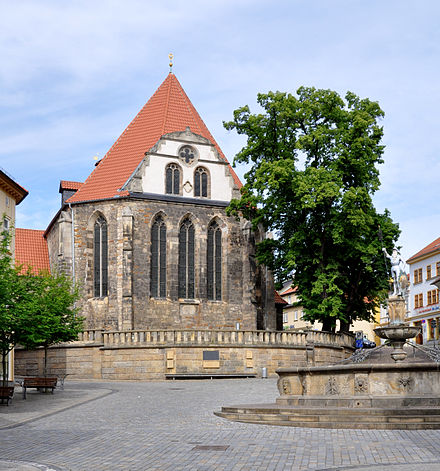
The church in Arnstadt where Bach had been the organist from 1703 to 1707.

In 1935 the church was renamed “Bachkirche”. Throughout the 18th century, appreciation of Bach’s music was mostly limited to distinguished connoisseurs. Then the 19th century started with publication of the first biography of the composer and ended with the completion of the publication of all of Bach’s known works by the Bach Gesellschaft. A Bach Revival had started from Mendelssohn’s performance of the St Matthew Passion in 1829. Soon after that performance, Bach started to become regarded as one of the greatest composers of all time, if not the greatest, a reputation he has retained ever since. A new extensive Bach biography was published in the second half of the 19th century. Bach was originally buried at Old St. John’s Cemetery in Leipzig. His grave went unmarked for nearly 150 years, but in 1894 his remains were located and moved to a vault in St. John’s Church. This building was then destroyed by Allied bombing during World War II, so in 1950 Bach’s remains were taken to their present grave in St. Thomas Church and it is sad that later research has called into question whether in fact the remains in the grave are actually those of Bach. I like to think they are his.

This week…remember.
A gossip is someone with a great sense of rumour.

Click: Return to top of page or Index page