Appreciating Ourselves

Over the last year or so I have been able to look more and more at the questions people ask online. I see astonishing ones and I wonder whether it is down to the teachers not teaching or the children not listening and I have come to the conclusion that it is probably a combination of the two. I know that when I was teaching, I would say to my students, no matter what age they were, that if one of you doesn’t understand what I am saying then probably others don’t either! That is not their fault, it is (in my humble opinion) the fault of the teacher for not checking for understanding. Having said that, if the teacher says “do you understand?” and everyone says yes they do, then the teacher will usually accept that and move on to the next item. Except if some students didn’t understand, then the next part of the lesson probably won’t make sense to them either and they’re lost. I have said before about a time when, as part of my teacher training, I was doing support teaching and I could see how one student was struggling. It seemed simple enough, but this student needed a bit of assistance so, after a quick chat with the tutor (because it is polite to do that) I asked this particular student a few questions. Because teaching is an art, there are many who can do things but not all have the capability to then effectively share that knowledge. The problem that this student had was linking their knowledge to actual practice. Many simply ‘see’ this naturally, others have to be taught it. So show a student a pencil and teach them to write, that is great. But they have to learn that the pencil, when used, will wear out. But they must also beware of the folk who try to be ‘clever’, for example I knew one teacher (who I didn’t exactly get on with!) was teaching a group of us. I was busy writing and my pen stopped working so I put my hand up and when asked by the teacher what my problem was, I said “Please miss, my pen has run out” – meaning of course it had no ink left. But the teacher replied “Well, you had better go and chase after it then, hadn’t you…” Utterly embarrassed, I put my hand down but after a few minutes I raised my hand and was again asked what I wanted, to which I replied, “Please miss, my pen is now devoid of ink. May I be provided with a replacement pen, so that I may continue with my written work please?”. The teacher, now herself unhappy, replied sharply “Come up here and get a new one”. I did so and politely thanked her. Life in that class was never good for me and my grades suffered that particular year. Thankfully the following year I moved up to a different class and my grades improved quite a bit. My education was in a secondary modern school, unlike some others who went first to grammar school then on to university. So I left school at sixteen and went directly into working in the offices of British Telecom. It really was an education to me as when I first started there it was still part of the Post Office (GPO) and a civil service environment, to the point where folk at higher grades had the luxury of sitting on a chair with arms, but at my basic grade I had a simple wooden chair without arms. Seniority was strict, especially in one office where holiday time (annual leave) was chosen in strict order, so if you were low on the list there was little choice of when you could have your holidays! However, things did change and in time the ‘civil service’ regime became less and less, managers were not addressed as ’sir’ or ‘mr’, with first names becoming more used. Not by all, though! The company I worked for also did change, it had to. I moved around the Midlands every few years and in fact I learned later that some of my work colleagues became concerned when they found out that I was moving to work with them, as it seemed that everywhere I went, after a few years changes of staff occurred and some offices were even closed completely! I have said before about this and I assure you it was nothing to do with me!
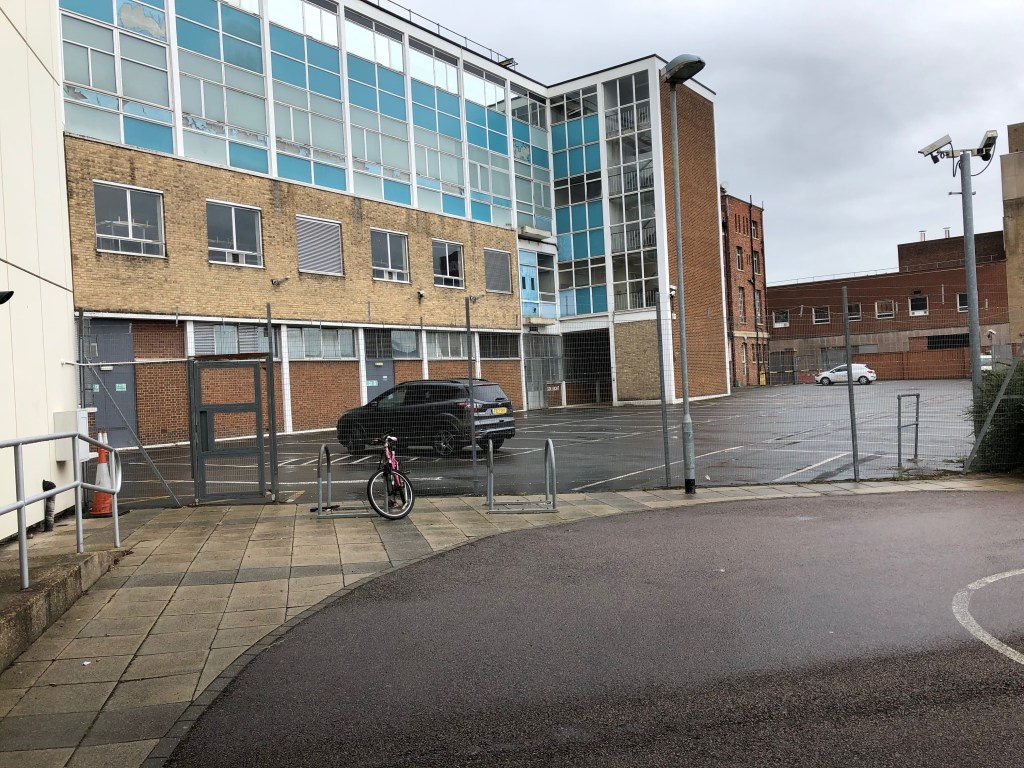
Peterborough Telephone Exchange – much has changed since I was there.

But what I did notice was a trend, a push towards more and more ‘higher education’, with students almost pushed into wanting to go to universities. It then seemed that they would get their degrees in one subject but then go and find jobs unrelated to what they had learned. It seems to me that not all want to gain a higher education, many are far better at learning practical skills in a more ‘hands-on’ environment. My father was a schoolteacher at a few different infant/junior schools and at one parent/teacher meeting Dad told a parent that their child was quick at learning practical skills, but was not quite as quick on the academic side of things. The parent apparently told my Dad that he was proud of his son, because the lad could drive a tractor a whole lot better than some of his older brothers and that between them they were able to manage all aspects of farm work. We all have differing roles to play in this life, not everyone can be the leader of the orchestra, as without the rest they would be nothing. Having said that, I do wonder at some of the apparent lack of knowledge displayed by some people, especially those who I would expect to know more than they seem to. I enjoy watching a few different television quiz shows and as part of one excellent programme, four tv personalities were given a map of the United Kingdom and asked to point out where certain places were. I was amazed when they seemed to know almost nothing from a geographical point of view, for example they did not know where Hadrian’s Wall was, or where certain cheeses came from such as Stilton or Cheddar. I could appreciate them perhaps not knowing where some places in the U.S.A. were, but here in the U.K.? That was a surprise. As many will know, I am a fan of the science-fiction series ’Star Trek’. There have been a few different series, with different life-forms appearing and one group are the Borg, aliens that appear as recurring antagonists in the Star Trek fictional universe. The Borg are cybernetic organisms (cyborgs) linked in a hive mind called “the Collective”. They co-opt the technology and knowledge of other alien species to the Collective through the process of ‘assimilation’, forcibly transforming individual beings into drones by injecting nano-probes into their bodies and surgically augmenting them with cybernetic components. The Borg’s ultimate goal is ‘achieving perfection’, by becoming almost one single ‘being’, with no individual thought for themselves. We are not all the same, far from it, but what I do notice in our world today is how very large companies seem to be taking over the smaller ones and using that money to maintain their industrial strength. To my mind this is having an adverse effect on life as a whole, by some people controlling what is done in the world, therefore selfishly enabling greater profits for themselves with no thought for the greater good of the world as a whole, along with all that is in it. In this day and age the Borg are portrayed as science fiction, but I do wonder if the writers of Star Trek are trying to get a point across to us. I really do wonder if some are trying to make us all behave and act the same! I am sure they are not, but we must surely make sure that we remember the skills that made us who we are today. I hear in the news of the potential for power cuts, I hope we do not get to that stage but I consider how so much of our lives is governed by electricity. At present I live in a Care Home, so how would us inmates (as I like to call us) manage if the power were to be turned off for just a few hours? I remember those days, back in the 1970’s.

Slide Rule.

So as I have said, it seems to me that more and more folk are being led towards educational qualifications and that is all very good, yet I still see questions on the internet on such things as how the Universe was formed. I realise many of us learn in a somewhat different way now to when I was at school, as in my day we had libraries with books and not computers, we used slide rules, we did not have pocket calculators. I’ve said before when I was learning mathematics and innocently questioned the need for me to know Pythagoras’s Theorem. The teacher told me “one day, you will”. The teacher was correct, although it took twenty years! I was working for British Telecom at the time and was learning how we calculated the radial distances between different telephone exchanges (an aspect we needed to know at the time) and I realised that it was indeed Pythagoras’s Theorem we used to do that. My mathematics teacher would have had a sly grin on his face had he known! But we still need to learn these skills, whether they be practical or not. I really like a particular television programme which is being shown at the moment on BBC1 called The Repair Workshop”, where people bring in different items, some large, some small, but they all require practical skills and happily these people at the workshop know them. But I also know that by their own admissions, they too are still learning, seeing how others have built and designed things, combining each others skills and knowledge. One lovely surprise for me was to see a recent episode where a man I actually knew brought in a small item to be repaired. I did not recognise him immediately, but I knew his voice. When I was a child, I was talking to our local vicar about how I was learning how big this world is. I was considering how many years us humans had been on Earth, that we all die after a time and so I said to the vicar, “With so many people dying, Heaven must be a very big place!” The vicar said to me, in his own, kindly way, “Andrew, you are considering spiritual things in Earthly terms”. At the time, I remember saying to him “Vicar, I don’t understand.”, to which he replied “In time my son, one day you will.” It took a few years to realise the difference between Earthly things and the spirit. The Internet has brought us access to information, yet still folk ask basic questions such as how the universe was formed. There was a recent one, asking about how it is that our universe is expanding. The answer given was that the universe is not itself expanding, but it is the elements within the universe which are going further and further from each other, unless they are close enough for gravity to affect them. But even then, the global elements such as our own galaxy is moving away from other galaxies. But that will take an extremely long time! I also saw an item about the ‘observable’ universe, meaning that there are stars that we will never see, no matter how long we or our descendants might live. It is impossible to imagine, but it is fascinating! So even if there are other life-forms out there that have learned to travel into space, the chances of us or our descendants meeting them is pretty small! Remember too that we are carbon-based life-forms, but why should life on other planets be like us, or have developed as we have? Not only that, our Sun is four and a half billion years old. Astronomers estimate that the sun has about 7 billion to 8 billion years left before it sputters out and dies. Before that, it will have expanded and life on Earth will be no more. Will we have learned to travel to other places by then? Perhaps. Either way, there’s time for another cuppa tea…

This week…
For me it is a time of remembrance. Not just for Remembrance Day, but also remembering my parents and grandparents, as well as all the help and support I have had following my heart attack in 2010. For all those we have loved and lost, both friends and family, we will remember them.

Click: Return to top of page or Index page

Bonfire Night

As this day approaches, we get ready to celebrate what could have been a disastrous event in our history. The night of November 5th is known by many names such as ‘Guy Fawkes Night’, ‘Guy Fawkes Day’, ‘Bonfire Night’ and ‘Fireworks Night and is an annual commemoration observed on November 5th each year, primarily in Great Britain, involving bonfires and firework displays. Its history begins with the events of November 5th, 1605 when Guy (a.k.a. Guido) Fawkes, a member of the Gunpowder Plot, was arrested whilst guarding explosives the plotters had placed beneath the House of Lords. The Catholic plotters had intended to assassinate the Protestant King James I and his parliament. Celebrating that the king had survived, people lit bonfires around London and months later the Observance of 5th November Act enforced an annual public day of thanksgiving for the plot’s failure. Within a few decades the ‘Gunpowder Treason Day’, as it was then known, became the predominant English state commemoration, but as it carried strong Protestant religious overtones it also became a focus for anti-Catholic sentiment. Puritans delivered sermons regarding the perceived dangers of ‘popery’, whilst during increasingly raucous celebrations common folk burnt effigies of popular hate-figures of the time, including the Pope. Towards the end of the 18th century reports appear of children begging for money with effigies of Guy Fawkes and 5 November gradually became known as Guy Fawkes Day. Towns such as Lewes and Guildford were scenes of increasingly violent class-based confrontations in the 19th century, fostering traditions those towns celebrate still, albeit peaceably. In the 1850s changing attitudes resulted in the toning down of much of the day’s anti-Catholic rhetoric, and the Observance of 5th November Act was repealed in 1859. Eventually the violence was dealt with, and by the 20th century Guy Fawkes Day had become an enjoyable social commemoration, although lacking much of its original focus. The present-day Guy Fawkes Night is usually celebrated at large organised events. Settlers exported Guy Fawkes Night to overseas colonies, including some in North America, where it was known as Pope Day, but those festivities died out with the onset of the American Revolution. Claims that Guy Fawkes Night was a Protestant replacement for older customs such as Samhain, a Gaelic festival marking the end of the harvest season and beginning of winter or ‘darker half’ of the year are disputed as England had no contemporary history of bonfires.

An effigy of Fawkes, burnt on 5 November 2010 at Billericay.

Guy Fawkes Night originates from the Gunpowder Plot of 1605, a failed conspiracy by a group of provincial English Catholics to assassinate the Protestant King James I of England and VI of Scotland and replace him with a Catholic head of state. In the immediate aftermath of the 5 November arrest of Guy Fawkes, caught guarding a cache of explosives placed beneath the House of Lords, King James’s Council allowed the public to celebrate the king’s survival with bonfires, so long as they were “without any danger or disorder”. This made 1605 the first year the plot’s failure was celebrated. The following January, days before the surviving conspirators were executed, Parliament, at the initiation of James I, passed the Observance of 5th November Act, commonly known as the ‘Thanksgiving Act’. It was proposed by a Puritan Member of Parliament, Edward Montagu, who suggested that the king’s apparent deliverance by divine intervention deserved some measure of official recognition, and kept 5 November free as a day of thanksgiving whilst in theory making attendance at Church mandatory. A new form of service was also added to the Church of England’s Book of Common Prayer, for use on that date. By the 1620s the Fifth was honoured in market towns and villages across the country, though it was some years before it was commemorated throughout England. Gunpowder Treason Day, as it was then known, became the predominant English state commemoration. Some parishes made the day a festive occasion, with public drinking and solemn processions. Concerned though about James’s pro-Spanish foreign policy, the decline of international Protestantism, and Catholicism in general, Protestant clergymen who recognised the day’s significance called for more dignified and profound thanksgivings each 5 November. What unity English Protestants had shared in the plot’s immediate aftermath began to fade when, in 1625, James’s son, the future Charles I, married the Catholic Henrietta Maria of France. Puritans reacted to the marriage by issuing a new prayer to warn against rebellion and Catholicism, and on 5 November that year, effigies of the pope and the devil were burnt, the earliest such report of this practice and the beginning of centuries of tradition. During Charles’s reign Gunpowder Treason Day became increasingly partisan. Between 1629 and 1640 he ruled without Parliament, and he seemed to support ‘Arminianism’, a controversial theological position within the Church of England particularly evident in the second quarter of the 17th century (the reign of Charles I of England) which was regarded by some Puritans as a step toward Catholicism. By 1636, under the leadership of the Arminian Archbishop of Canterbury William Laud, the English church was trying to use 5 November to denounce all seditious practices, and not just popery. Puritans went on the defensive, some pressing for further reformation of the Church. Bonfire Night, as it was occasionally known, assumed a new fervour during the events leading up to the English Interregnum. Although Royalists disputed their interpretations, Parliamentarians began to uncover or fear new Catholic plots. Following the execution of Charles I in 1649, the country’s new republican regime remained undecided on how to treat 5 November. Unlike the old system of religious feasts and State anniversaries it survived, but as a celebration of parliamentary government and Protestantism, not of monarchy. Commonly the day was still marked by bonfires and miniature explosives, but more formal celebrations resumed only with the Restoration, when Charles II became king. Courtiers, High Anglicans and Tories followed the official line that the event marked God’s preservation of the English throne, but generally the celebrations became more diverse. By 1670 London apprentices had turned 5 November into a fire festival, attacking not only popery but also “sobriety and good order”, demanding money from coach occupants for alcohol and bonfires. The burning of effigies, largely unknown to the Jacobeans, continued in 1673 when Charles’s brother, the Duke of York, converted to Catholicism. In response, accompanied by a procession of about 1,000 people, the apprentices fired an effigy of the Whore of Babylon, bedecked with a range of papal symbols and similar scenes occurred over the following few years. On 17 November 1677, anti-Catholic fervour saw the Accession Day marked by the burning of a large effigy of the pope and two effigies of devils ‘whispering in his ear’. Two years later an observer noted that “the 5th at night, being gunpowder treason, there were many bonfires and burning of popes as has ever been seen”. Violent scenes in 1682 forced London’s militia into action, and to prevent any repetition the following year a proclamation was issued, banning bonfires and fireworks. Fireworks were also banned under James II (previously the Duke of York), who became king in 1685. Attempts by the government to tone down Gunpowder Treason Day celebrations were, however, largely unsuccessful, and some reacted to a ban on bonfires in London (born from a fear of more burnings of the pope’s effigy) by placing candles in their windows, ‘as a witness against Catholicism’. When James was deposed in 1688 by William of Orange (who, importantly, landed in England on 5 November) the day’s events turned also to the celebration of freedom and religion, with elements of anti-Jacobean ways. Whilst the earlier ban on bonfires was politically motivated, a ban on fireworks was maintained for safety reasons, ‘much mischief having been done by squibs’.

From an issue of ‘Punch’, printed in November 1850.

The restoration of the Catholic hierarchy in 1850 provoked a strong reaction. King William III’s birthday fell on 4 November and for orthodox Whigs the two days therefore became an important double anniversary. William ordered that the thanksgiving service for 5 November be amended to include thanks for his ‘happy arrival and the Deliverance of our Church and Nation’. In the 1690s he re-established Protestant rule in Ireland, and the Fifth, occasionally marked by the ringing of church bells and civic dinners, was consequently eclipsed by his birthday commemorations. From the 19th century, 5 November celebrations there became sectarian in nature. Its celebration in Northern Ireland remains controversial, unlike in Scotland where bonfires continue to be lit in various cities. In England though, as one of 49 official holidays, for the ruling class 5 November became overshadowed by events such as the birthdays of Admiral Edward Vernon, or of John Wilkes, and under George II and George III , with the exception of the Jacobite Rising of 1745, it was largely ‘a polite entertainment rather than an occasion for vitriolic thanksgiving’. For the lower classes, however, the anniversary was a chance to pit disorder against order, a pretext for violence and uncontrolled revelry. In 1790, The Times reported instances of children ‘begging for money for Guy Faux’, and a report of 4 November 1802 described how ‘a set of idle fellows with some horrid figure dressed up as a Guy Faux’ were convicted of begging and receiving money, and committed to prison as ‘idle and disorderly persons’. The Fifth became ‘a polysemous occasion, replete with polyvalent cross-referencing, meaning all things to all men’. When I first read the two words ‘polysemous’ and ‘polyvalent’, I had to look them up as they were new to me. I have learned that the former simply means ‘having more than one meaning’, whilst the latter means ‘having or using a lot of different forms or features’. So, back to the story. Lower class rioting continued, with reports in Lewes of annual rioting, intimidation of ‘respectable householders’ and the rolling through the streets of lit tar barrels. In Guildford, gangs of revellers who called themselves ‘guys’ terrorised the local population, proceedings were concerned more with the settling of old arguments and general mayhem than any historical reminiscences. Similar problems arose in Exeter, originally the scene of more traditional celebrations and in 1831 an effigy was burnt of the new Bishop of Exeter, a High Church Anglican and High Tory who opposed Parliamentary reform and who was also suspected of being involved in ‘creeping popery’. A local ban on fireworks in 1843 was largely ignored, and attempts by the authorities to suppress the celebrations resulted in violent protests and several injured constables.

A group of children in Caernarfon in November 1962, standing with their Guy Fawkes effigy. The sign reads ‘Penny for the Guy’ in Welsh.

On several occasions during the 19th century ‘The Times’ reported that the tradition was in decline, being “of late years almost forgotten”, but in fact the civil unrest brought about by the union of the kingdoms of Great Britain and Ireland in 1800 resulted in Parliament passing the Roman Catholic Relief Act 1829, which afforded Catholics greater civil rights, continuing the process of Catholic emancipation in the two kingdoms. The traditional denunciations of Catholicism had been in decline since the early 18th century and were thought by many to be outdated, but the pope’s restoration in 1850 of the English Catholic hierarchy gave renewed significance to 5 November, as demonstrated by the burnings of effigies of the new Catholic Archbishop of Westminster as well as the pope. With little resistance in Parliament, the thanksgiving prayer of 5 November contained in the Anglican Book of Common Prayer was abolished, and in March 1859 the Anniversary Days Observance Act repealed the Observance of 5th November Act. As the authorities dealt with the worst excesses, public decorum was gradually restored. The sale of fireworks was restricted and the Guildford ‘Guys’ were neutralised in 1865, although this was too late for one constable, who sadly died of his wounds. Violence continued in Exeter for some years, peaking in 1867 when, incensed by rising food prices and banned from firing their customary bonfire, a mob was twice in one night driven from Cathedral Close by armed infantry. Further riots occurred in 1879, but there were no more bonfires in Cathedral Close after 1894. Elsewhere, sporadic instances of public disorder persisted late into the 20th century, accompanied by large numbers of firework-related accidents, but a national Firework Code and improved public safety has in most cases brought an end to such things. But one notable aspect of the Victorians’ commemoration of Guy Fawkes Night was its move away from the centres of communities, to their margins. Gathering wood for the bonfire increasingly became the province of working-class children, who solicited combustible materials, money, food and drink from wealthier neighbours, often with the aid of songs. Most opened with the familiar “Remember, Remember, the Fifth of November, Gunpowder Treason and Plot”.

Spectators gather around a bonfire at Himley Hall, Dudley on 6 November 2010.

Organised entertainments also became popular in the late 19th century, and 20th-century pyrotechnic manufacturers renamed Guy Fawkes Day as Firework Night. Sales of fireworks dwindled somewhat during the First World War, but resumed in the following peace. At the start of the Second World War celebrations were again suspended, resuming in November 1945. For many families, Guy Fawkes Night became a domestic celebration, and children often congregated on street corners, accompanied by their own effigy of Guy Fawkes, but this was sometimes ornately dressed and sometimes a barely recognisable bundle of rags stuffed with whatever filling was suitable! A survey found that in 1981 about 23% of Sheffield schoolchildren made Guys, sometimes weeks before the event. Collecting money was a popular reason for their creation, the children taking their effigy from door to door, or displaying it on street corners. But mainly, they were built to go on the bonfire, itself sometimes comprising wood stolen from other pyres and seen as ‘an acceptable convention’ that helped bolster another November tradition, Mischief Night. Rival gangs competed to see who could build the largest, sometimes even burning the wood collected by their opponents and in 1954 the Yorkshire Post reported on fires late in September, a situation that forced the authorities to remove latent piles of wood for safety reasons. Lately however, the custom of begging for a ‘penny for the Guy’ has almost completely disappeared. Generally, modern 5 November celebrations are run by local charities and other organisations, with paid admission and controlled access. In 1998 an editorial in the Catholic Herald called for the end of ‘Bonfire Night’, labelling it ‘an offensive act’. In my research I have found similarities with other customs, also that nowadays family bonfire gatherings are much less popular and many once-large civic celebrations have been given up because of increasingly intrusive health and safety regulations. I had no idea that in Northern Ireland, bonfires are lit on the Eleventh Night’ (11 July) by Ulster Protestants. There is of course another celebration involving fireworks, the five-day Hindu festival of Diwali (normally observed between mid-October and November) which I detailed last week. Gunpowder Treason Day was exported by settlers to colonies around the world, including members of the Commonwealth of Nations such as Australia, New Zealand, Canada, and various Caribbean nations. In Australia, Sydney (founded as a British penal colony in 1788) saw at least one instance of the parading and burning of a Guy Fawkes effigy in 1805, whilst in 1833, four years after its founding, Perth listed Gunpowder Treason Day as a public holiday. By the 1970s, Guy Fawkes Night had become less common in Australia, with the event simply an occasion to set off fireworks with little connection to Guy Fawkes. Mostly they were set off annually on a night called ‘cracker night’, which would include the lighting of bonfires. Some states had their ‘cracker night’ at different times of the year, with some being let off on 5 November, but most often, they were let off on the Queen’s birthday. After a range of injuries to children involving fireworks, Fireworks nights and the sale of fireworks was banned in all states except the Australian Capital Territory containing the national capital of Canberra and some surrounding townships until 1980, which saw the end of cracker night. Some measure of celebration remains in New Zealand, Canada, and South Africa, though on the Cape Flats in Cape Town, South Africa, Guy Fawkes Day has become associated with youth hooliganism. In Canada in the 21st century, celebrations of Bonfire Night on 5 November are largely confined to the province of Newfoundland and Labrador. The day is still marked in Saint Vincent and the Grenadines as well as in Saint Kitts and Nevis, but a fireworks ban by Antigua and Barbuda during the 1990s reduced its popularity in that country.

This week…
I decided to include the fact that there are many food items which are associated with Bonfire Night. Toffee apples, treacle toffee, black peas and Parkin or gingerbread cake, even jacket potatoes are traditionally eaten around Bonfire Night in parts of England. Also, some families eat soups to warm up on a cold night and toast marshmallows over the fire…

Click: Return to top of page or Index page

Diwali

Also known as Deepavali, this is a Hindu religious festival of lights and is one of the most important festivals within Hinduism. The festival usually lasts five days, or six in some regions of India, and is celebrated during the Hindu lunisolar month between mid-October and mid-November. One of the most popular festivals of Hinduism, Diwali symbolises the spiritual ‘victory of light over darkness, good over evil, and knowledge over ignorance’. The festival is widely associated with Lakshmi, their goddess of prosperity and Ganesha, their god of wisdom and the remover of obstacles, with many other regional traditions connecting the holiday to several Hindu gods and goddesses. In the lead-up to Deepavali, celebrants prepare by cleaning, renovating, and decorating their homes and workplaces with diyas (oil lamps) and rangolis (colourful art circle patterns). During Diwali, people wear their finest clothes, illuminate the interior and exterior of their homes with diyas and rangoli, perform worship ceremonies of Lakshmi, the goddess of prosperity and wealth, light fireworks, and partake in family feasts, where mithai (sweets) and gifts are shared. Originally a Hindu festival, Diwali has transcended religious lines and is also celebrated by Jains and Sikhs and is now a major cultural event for the Hindu, Sikh, and Jain peoples. The five-day long festival originated in the Indian subcontinent and is mentioned in early Sanskrit texts. Diwali is usually celebrated twenty days after the Hindu festival Vijayadashami, with Dhanteras, or the regional equivalent, marking the first day of the festival when celebrants prepare by cleaning their homes and making decorations on the floor, such as rangolis. There are then different festivities for each day, for example the third day is the day of ‘Lakshmi Puja’ and the darkest night of the traditional month. Some Hindu communities mark the last day as Bhai Dooj or the regional equivalent, which is dedicated to the bond between sister and brother, whilst other Hindu and Sikh craftsmen communities mark this day as Vishwakarma Puja and observe it by performing maintenance in their work spaces and offering prayers. Diwali festivities include a celebration of sights, sounds, arts and flavours, but the festivities vary between different regions. ’Diwali’ is from the Sanskrit ‘dīpāvali’ meaning ‘row or series of lights’. The term is derived from the Sanskrit words ‘dīpa’, meaning lamp, light, lantern, candle, that which glows, shines, illuminates or knowledge and ‘āvali’, a row, range, continuous line, series. The five-day celebration is observed every year in early autumn after the conclusion of the summer harvest. It coincides with the new moon and is deemed the darkest night of the Hindu lunisolar calendar. The festivities begin two days before ‘amāvasyā’, on Dhanteras, and extend two days after, on the second day of the month of Kartik. The darkest night is the apex of the celebration and coincides with the second half of October or early November in the Gregorian calendar. The festival climax is on the third day and is called the main Diwali. It is an official holiday in a dozen countries, whilst the other festive days are regionally observed as either public or optional restricted holidays in India. In historical terms, the Diwali festival is likely a fusion of harvest festivals in ancient India. King Harsha refers to Deepavali in the 7th century Sanskrit play ‘Nagananda’ as ‘Dīpapratipadotsava’, where ‘dīpa’ = light, ‘pratipadā’ = first day and ‘utsava’ = festival, where lamps were lit and newly engaged brides and grooms received gifts. Diwali was also described by numerous travellers from outside India. In his 11th century memoir on India, the Persian traveler and historian Al Biruni wrote of Deepavali being celebrated by Hindus on the day of the New Moon in the month of Kartika. The Venetian merchant and traveler Niccolò de’ Conti visited India in the early 15th-century and wrote in his memoir, “on another of these festivals they fix up within their temples, and on the outside of the roofs, an innumerable number of oil lamps… which are kept burning day and night” and that the families would gather, “clothe themselves in new garments”, sing, dance and feast. The 16th-century Portuguese traveler Domingo Paes wrote of his visit to the Hindu Vijayanagara Empire, where ‘Dipavali’ was celebrated in October with householders illuminating their homes, and their temples, with lamps. Publications from the British colonial era also made mention of Diwali, such as the note on Hindu festivals published in 1799 by Sir William Jones, a philologist known for his early observations on Sanskrit and Indo-European languages.

Diwali is celebrated in the honour of Lakshmi, the Hindu goddess of wealth.

Many Hindus associate the festival with goddess Lakshmi, the goddess of wealth and prosperity, and wife of Vishnu but the Hindus of eastern India associate the festival with the goddess Kali, who symbolises the victory of good over evil. Hindus from the Braj region in northern India, parts of Assam, as well as southern Tamil and Telugu communities view Diwali as the day the god Krishna overcame and destroyed the evil demon king Narakasura, in yet another symbolic victory of knowledge and good over ignorance and evil. Trade and merchant families and others also offer prayers to Saraswati, who to them embodies music, literature and learning and to Kubera, who symbolises book-keeping, treasury and wealth management. In western states such as Gujarat, and certain northern Hindu communities of India, the festival of Diwali signifies the start of a new year. Mythical tales shared on Diwali vary widely depending on region and even within Hindu tradition, yet all share a common focus on righteousness, self-inquiry and the importance of knowledge. It is thought that the telling of these tales are reminiscent of the Hindu belief that good ultimately triumphs over evil.

Lakshmi and Ganesha worship during Diwali.

During the season of Diwali, numerous rural townships and villages host melas, or fairs, where local producers and artisans trade produce and goods. A variety of entertainments are usually available for inhabitants of the local community to enjoy. The women, in particular, adorn themselves in colourful attire and decorate their hands with henna. Such events are also mentioned in Sikh historical records. Nowadays ‘Diwali mela’ are held at colleges, universities, campuses or as community events. At such times a variety of music, dance and arts performances, food, crafts, and cultural celebrations are featured. Economically, Diwali marks a major shopping period in India and is comparable to the Christmas period in terms of consumer purchases and economic activity. It is traditionally a time when households purchase new clothing, home refurbishments, gifts, gold, jewellery, and other large purchases particularly as the festival is dedicated to Lakshmi, the Hindu goddess of wealth and prosperity, and such purchases are considered auspicious. Many consider Diwali to be one of the major festivals where rural Indians spend a significant portion of their annual income, and is a means for them to renew their relationships and social networks. Other goods that are bought in substantial quantities during Diwali include confectionery and fireworks. Stock markets like NSE and BSE in India are typically closed during Diwali, with the exception of a Diwali Muhurat trading session for an hour in the evening to coincide with the beginning of the new year. Sadly however there have been issues at this festive time, as the use of fireworks also causes an increase in the number of burn injuries in India during Diwali. One particular firework called an ‘anar’ (fountain) has been found to be responsible for 65% of such injuries, with adults being the typical victims. Thankfully, most of the injuries sustained are only minor burns requiring outpatient care. In addition, concern has been raised in the use of firecrackers on Diwali increasing the concentration of dust and pollutants in the air. After firing, the fine dust particles get settled on the surrounding surfaces which can affect the environment and in turn, put people’s health at stake.

However, here in Leicester the celebration of Diwali is one of the biggest outside of India with everything from dance, fireworks, food and fashion making it the perfect place to enjoy Diwali. The festival began with the city’s famous lights switch-on on Sunday 9 October and culminated with a glorious fireworks display and entertainment on Diwali Day, Monday 24 October. There were also a wide selection of events taking place around the city during the fortnight including a Diwali Mela Bazaar, Rangoli exhibition and waterside celebrations. The festivities began with the illumination of the Diwali lights along Belgrave Road, on Leicester’s ‘Golden Mile’, on Sunday 9 October. Up to 40,000 people watched the lights switch on, which followed a vibrant programme of music and dance on the Belgrave Road stage, presented by the Leicester Hindu Festival Council and Leicester City Council. The stage programme for Diwali lights switch-on ran from 5.30pm to 8pm on Belgrave Road with the lights turned on at 7.30pm followed by the fireworks, which this year could be viewed from Belgrave Road. The Diwali Village on Cossington Street Recreation Ground featured a full stage programme showcasing local talent, children’s fun-fair rides and stalls including food and concessions, from 3pm to 9pm.
The Golden Mile is bathed in light throughout the festive period until Diwali Day, when the celebrations continue with events on Cossington Street Recreation Ground. On Diwali Day, Monday 24 October, the Diwali Village was again be on Cossington Street Recreation ground from 3pm along with a full stage programme of entertainment at 6pm presented by the Leicester Hindu Festival Council. This year Leicester’s Wheel of Light returns. The big wheel will be located on Belgrave Road from Friday 7 October to Sunday 6 November.

There is more that can be written about the individual events associated with Diwali but they are too much to be detailed here. Suffice it to say I hope you have all had a happy Diwali and look forward to the next ‘firework’ event which is of course November 5th!

This week… a White Elephant.
White elephants were once considered highly sacred creatures in Thailand and the animal even graced the national flag until 1917, but they were also wielded as a subtle form of punishment. According to legend, if an underling or rival angered a Siamese king, the royal might present the unfortunate man with the gift of a white elephant. While ostensibly a reward, the creatures were tremendously expensive to feed and house, and caring for one often drove the recipient into financial ruin. Whether any specific rulers actually bestowed such a passive-aggressive gift is uncertain, but the term has since come to refer to any burdensome possession, pachyderm or otherwise.

P.S.
Don’t forget, for those here in the UK, our clocks go back an hour at 2:00am on Sunday morning. Enjoy the extra hour!

Click: Return to top of page or Index page

Trafalgar Day

Trafalgar Day is the celebration of the victory won by the Royal Navy, commanded by Vice-Admiral Horatio Nelson, over the combined French and Spanish fleets at the Battle of Trafalgar on 21 October 1805 and the formation of the Navy League in 1894 gave added impetus to the movement to recognise Nelson’s legacy, and grand celebrations were held in Trafalgar Square in London on Trafalgar Day, 1896. It was commemorated by parades, dinners and other events throughout much of the British Empire in the 19th century and early 20th century. It continues to be celebrated by navies of the Commonwealth of Nations. Its public celebration declined after the end of World War I in 1918. Perhaps the massive casualties and upheaval had changed the general public’s perception of war as a source of glorious victories to a more sombre view of it as a tragedy, for which the newly instituted Armistice Day on 11 November was created. However, Trafalgar Day was still marked as a public day each year. Around 1993, it was rumoured that the government might make it a public holiday in place of May Day and this plan was revived in the 2011 Tourism Strategy created by the then coalition government, but to date this has never happened. The year 2005 was the bicentennial of the Battle of Trafalgar, and the Royal Navy led Trafalgar 200 celebrations. The 2005 International Fleet Review held off Spithead in the Solent on 28 June was the first since 1999 and the largest since our late Majesty The Queen’s 1977 Silver Jubilee.

On 21 October each year the commissioned officers of the Royal Navy celebrate the victory at the Battle of Trafalgar by holding a Trafalgar Night dinner in the Officer’s Mess. At a Trafalgar Night banquet or dinner, a speech is usually made by a guest of honour who ends it with a toast to “The Immortal Memory …” and the rest of the wording of the toast varies depending on what is said in the speech. On 21 October 2005, the 200th anniversary, the traditional toast was given by the late Queen Elizabeth II as “The Immortal Memory of Lord Nelson and those who fell with him”. Such dinners also occur each year on or around 21 October in locations other than Royal Navy ships. In addition, the Royal Naval Museum in Portsmouth hold a ‘Trafalgar Night Dinner’ each year on a date close to 21 October, whilst the British ambassador in Washington hosts such a dinner at which the guest of honour may be a senior officer in the United States Navy.

The Lord Mayor of Birmingham lays a wreath at Birmingham’s statue of Lord Nelson on Trafalgar Day in 2007

Here in the UK, our Sea Cadet Corps hold a youth cadet parade known as the National Trafalgar Day Parade on Trafalgar Square, London each year. The parade is formed with a platoon from each area, a guard and a massed band. This is held on the closest Sunday to 21 October. Units and Districts from around the country celebrate this day – usually with a town parade. Birmingham celebrates the anniversary with a ceremony at the statue of Lord Nelson, the oldest such statue in the United Kingdom, in their Bull Ring. The ceremony is led by the Lord Mayor of Birmingham and involves men and women of HMS Forward, Sea Cadet units from across the West Midlands and various civic organisations, including The Nelson Society and the Birmingham Civic Society. Afterwards representatives of naval and civic organisations lay wreaths and a parade marches off to Victoria Square, the public square in front of the seat of local government, where the Lord Mayor takes the salute. Another aspect of the Birmingham celebration is that the statue is regaled with swags of laurel and flowers, possibly due to its location by the wholesale flower markets of the city. This tradition, marked through most of the nineteenth century, was revived in 2004.

Flags fly from the Nelson Monument on Calton Hill on Trafalgar Day.

The Nelson Monument is a commemorative tower in honour of Vice Admiral Horatio Nelson, located in Edinburgh, Scotland. It is situated on top of Calton Hill and provides a dramatic termination to the view along Princes Street from the west. The monument was built between 1807 and 1816 to commemorate Nelson’s victory over the French and Spanish fleets at the Battle of Trafalgar in 1805 and his own death at the same battle.

The Nelson Monument on Calton Hill, Edinburgh.

This monument was constructed at the highest point of Calton Hill, at 171 metres (561ft) above sea-level, replacing an earlier mast used to send signals to shipping in the Forth. The monument was funded by public subscription and an initial design prepared by Alexander Nasmyth. His pagoda-like design was deemed too expensive, and an alternative design in the form of an upturned telescope (an object closely associated with Nelson) was obtained from the architect Robert Burn. Building began in 1807, and was almost complete when money ran out the following year. Burn died in 1815, and it was left to Thomas Bonnar to complete the pentagonal castellated building, which forms the base to the tower, between 1814 and 1816. The tower was intended as a signal mast, attended by sailors who would be accommodated within the ground floor rooms, although by 1820 these were in use as a tea room. Public access was available from the start, for a small fee and the rooms were later used to house the monument’s caretaker. In 2009, as part of the ‘Twelve Monuments Restoration Project’, the tower was comprehensively restored, including repairs to stonework and metalwork. The monument is a category A listed building, it is 32 metres (105ft) high, and has 143 steps leading to a public viewing gallery. The design reflects the castellated prison buildings which stood on the south side of Calton Hill in the early 19th century. A plaque above the entrance to the monument carries the following dedication:
“To the memory of Vice-Admiral Horatio Lord Viscount Nelson, and of the great victory of Trafalgar, too dearly purchased with his blood, the grateful citizens of Edinburgh have erected this monument: not to express their unavailing sorrow for his death; nor yet to celebrate this matchless glories of his life; but, by his noble example, to teach their sons to emulate what they admire, and, like him, when duty requires it, to die for their country. AD MDCCCV”. Above the plaque is a stone carving of the ‘San Josef’, a ship captured by Nelson at the Battle of Cape St Vincent in 1797.

The Time ball on the Nelson Monument.

On top of the tower is a ‘time ball’, a large ball which is raised and lowered to mark the time. It was installed in 1853 and became operational in March 1854 to act as a time signal to the ships in Edinburgh’s port of Leith and to ships at the anchorage in the Firth of Forth, known as Leith Roads, allowing the ships to set their chronometers. The time ball was the idea of Charles Piazzi Smyth, the Astronomer Royal for Scotland, and was originally triggered by a clock in the adjacent City Observatory to which it was connected by an underground wire. The mechanism was the work of Maudslay, Sons & Field of Lambeth, London who had previously constructed the time ball mechanism for Greenwich Observatory. The installation was carried out by James Ritchie & Son and who are still retained by City of Edinburgh Council to maintain and operate the time ball. This ball, constructed of wood and covered in zinc, and originally weighing about 90kg, is raised just before 1pm, and at precisely 1pm, is dropped from atop the mast. The commonly stated mass of 15 cwt (762kg) is a myth stemming from an exaggeration by Smyth in 1853. Later, in 1861, the One O’Clock Gun was established at Edinburgh Castle to provide an audible signal when fog obscured the time ball. The time ball was operated for over 150 years, until it was damaged by a storm in 2007 but in 2009, as part of the restoration of the monument, the time ball was removed and the mechanism repaired. The time ball was brought back into service on 24 September 2009. The mechanism is now operated manually, based on the firing of the One O’Clock Gun. In addition, the Royal Navy’s White Ensign and signal flags spelling out Nelson’s famous message “England expects that every man will do his duty“ are flown from the monument on Trafalgar Day each year.

I was pleasantly surprised in my research to find other memorials of Nelson. One was in the village of Dervock in County Antrim, Northern Ireland, has the only known memorial which takes the form of a stained-glass window depicting Admiral Lord Nelson just minutes before he was killed on board HMS Victory in 1805. It is thought that this is now the only memorial on the island, as Nelson’s pillar in Dublin (the earliest memorial to Admiral Nelson) having been destroyed in 1966, so in 2015 residents organised their first ever “Trafalgar Day”. Meanwhile in Gibraltar, the Trafalgar Day service takes place at the Trafalgar Cemetery, where the senior Naval Commander reads an extract from the Gibraltar Chronicle newspaper, the first periodical to report on the battle. Some sailors died in Gibraltar of wounds received at Trafalgar; they are buried in Gibraltar. HMS Victory, with Nelson’s body on board, underwent repairs in Gibraltar prior to sailing for Britain. In the Isle of Man, John Quilliam, 1st Lieutenant of HMS Victory in 1805, is buried in the graveyard of Kirk Arbory, Ballabeg. An annual parade and church service takes place on Trafalgar Day. There are also other celebrations around the world as the victory is celebrated in Nelson, New Zealand, usually in Trafalgar Square and sometimes involves pupils from the local Victory Primary School. Many streets in Nelson are named after Trafalgar and crew members of Victory. The event is celebrated each year in the Australian town of Trafalgar, Victoria, in which the small town of 2,200 holds an annual Battle of Trafalgar Festival with the Trafalgar Day Ball held on the Friday or Saturday closest to 21 October each year.

I also found a further, unexpected link to Horatio Nelson in the form of the headmaster of my old school, the Sir Harry Smith school in Whittlesey. It is simply that the full name of my headmaster was Irving Nelson Burgess, who was born in October 1905, a hundred years after the death of Admiral Nelson.

This week…
Three words which sound the same but are very different.
Peak, Peek, Pique.

  1. You have to strive to reach the peak.
  2. If you look quickly at something, it is a peek.
  3. A feeling of irritation or resentment, like in the phrase “he left in a fit of pique”.

Click: Return to top of page or Index page

The Bindi

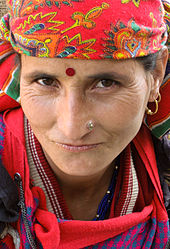
Having lived and worked in Leicester for a number of years now, I have met a few different people of different cultures. Some folk are Hindu and I have noticed the mark on the forehead of many females, so I wondered about its significance. I have learned that the mark is known as a bindi and it is a Hindu tradition that dates to the third and fourth centuries. The bindi was traditionally worn by women for religious purposes or to indicate that they are married. But today the bindi has also become popular among women of all ages, as a beauty mark. Further research has told me that a bindi is a brightly coloured dot, or in modern times a sticker, which was originally worn on the centre of the forehead by Hindus, Sikhs, Buddhists and Jains from the Indian subcontinent.

A Hindu woman in Kullu, Himachal Pradesh wearing a bindi.

The bindi is applied in the centre of the forehead close to the eyebrows and worn in the Indian subcontinent, in particular amongst Hindus in India and Pakistan as well as other areas in and around South-east Asia. A similar marking is also worn by babies and children in China and, as in the Indian subcontinent and Southeast Asia, represents the opening of the ‘third eye’ chakra. It is also the point or dot around which the ‘mandala’ is created, representing the universe. Traditionally, the area between the eyebrows (where the bindi is placed) is said to be the sixth chakra, the seat of ‘concealed wisdom’. The bindi is said to retain energy and strengthen concentration, as it represents the third eye. The syllable for this chakra is ‘OM’. In metaphysics, ‘bindu’ is considered the dot or point at which creation begins and may become unity. It is also described as ‘the sacred symbol of the cosmos in its un-manifested state’. It is said to be linked to the pineal gland, which is a light sensitive gland that produces the hormone melatonin, regulating sleep as well as waking up. Ajna’s key issues involve balancing the higher and lower selves and trusting inner guidance. Its inner aspect also relates to the access of intuition. Mentally, Ajna deals with visual consciousness and emotionally it deals with clarity on an intuitive level.

The Goddess Tara depicted with Ajna, or third eye chakra.

This chakra is the point in the centre of the forehead commonly considered as the centre of consciousness. In Hinduism, Buddhism and Jainism, the bindi is associated with Ajna chakra and divinities in these religions are typically depicted in a meditative pose with their eyes nearly closed, with the gaze focused between eyebrows. The spot between the eyebrows known as Bhrumadhya is where one focuses one’s sight, so that it helps concentration. In South Asia, the bindi is worn by women of all religious dispositions and is not restricted to religion or region.

A relief from stupa, 2nd century BC.

The red bindi has multiple meanings and one simple interpretation is that it is a cosmetic mark used to enhance beauty. Archaeology has yielded clay female figurines from the Indus Valley with red pigment on the forehead and hair parting, but it is unclear whether this held any religious or cultural significance. In Hinduism, the colour red represents honour, love, and prosperity, hence it was worn to symbolise these aspects and in meditation, the point between the eyebrows is where one focuses one’s sight, to help concentration. The encyclopaedic ‘Dictionary of Yoga’ also reports that this ‘Ajna chakra’ is also called the ‘third eye’ and that this chakra is connected with the sacred syllable ‘Om’. On activating this centre, the aspirant overcomes ‘Ahankāra’ (the ego or sense of individuality), the last step on the path of spirituality.

Historically, the ornamental bindi spangle consists of a small piece of lac over which is smeared vermilion, while above it a piece of mica or thin glass is fixed for ornament. Women wore large spangles set in gold with a border of jewels if they could afford it. The bindi was made and sold by lac workers known as Lakhera. In Hinduism, it is part of the ‘Suhāg’ or ‘lucky trousseau’ at marriages and is affixed to the girl’s forehead on her wedding and thereafter always worn. Unmarried girls optionally wore small ornamental spangles on their foreheads. A widow was not allowed to wear a bindi or any ornamentation associated with married women. In modern times, self-adhesive bindi’s are available in various materials, usually made of felt or thin metal and adhesive on the other side. These are simple to apply, disposable substitutes for older lac bindi’s. Sticker bindi’s come in many colours, designs, materials and sizes. There are different regional variations of the bindi. In Maharashtra a large crescent, moon-shaped bindi is worn with a smaller black dot underneath or above, associated with Chandrabindu and Bindu chakra represented by crescent moon, they are commonly known as ‘Chandrakor’ in this region, outside Maharashtra they are popularly known as ‘Marathi bindi’. In the Bengal region a large round red bindi is worn, brides in this region are often decorated with ‘Alpana’ design on forehead and cheeks, along with the bindi. In southern India a smaller red bindi is worn with a white tilak at the bottom, another common type is a red tilak-shaped bindi. In Rajasthan the bindi is often worn round, long tilak-shaped bindi are also common, as well as the crescent moon on some occasions. Decorative bindi’s have become popular among women in South Asia, regardless of religious background. Bindi’s are a staple and symbolic for women in the Indian subcontinent. In addition to the bindi, in India a vermilion mark in the parting of the hair just above the forehead is worn by married women as commitment to long-life and well-being of their husbands. During all Hindu marriage ceremonies, the groom applies sindoor in the part in the bride’s hair. Apart from their cosmetic use, bindi’s have found a modern medical application in India and iodine patch bindi’s have often been used among women in north-west Maharashtra to battle iodine deficiency. But it seems that in South-east Asia, bindi’s are worn by Balinese, Javanese, and Sundanese of Indonesia. Historically, it was worn by many ‘Indianised’ kingdoms in Southeast Asia. Bindi’s are decorated on wedding brides and grooms of Java and other parts of Indonesia, even worn by non-Hindus, but bindi’s in Indonesia are usually white or green, rather than red or black as in India. Bindi’s are popular outside the Indian subcontinent and Southeast Asia as well, but they are sometimes worn purely for decorative purpose or style statement without any religious or cultural affiliation. Decorative and ornamental bindi’s were introduced to other parts of the world by immigrants from the Indian subcontinent. Bindi’s are also part of Bangladeshi culture and women there, irrespective of their religion, adorn themselves with bindi’s as an ethnic practice. In Pakistan, bindi’s are worn by some Muslim girls during Eid, though they are ordinarily worn by Hindu women in the Punjab and Sindh.

However, some international celebrities have been seen wearing bindi’s and the appropriateness of such uses has been disputed. Reacting to a celebrity wearing a bindi whilst singing a particular song, a Hindu leader said that the bindi has religious significance and should not be used as a fashion accessory, but an Indian actress praised the choice as ‘an embrace of Indian culture’. I have an idea that this will continue to be disputed by quite a few people.

This week…
Computers are being used more and more these days and many advances have been made regarding speech recognition. We can ask a computer to tell us what the traffic conditions are, what route to take or what the weather is like. I just hope it doesn’t get to this though.

Imagine yourself at some time in the distant future. You have computers that you talk to directly and they speak back. You have just landed on a planet you’ve never been to before and you ask your computer to check the atmospheric conditions outside. It replies: “Hmmm… it’s ok, but it smells a bit…”

(This courtesy of the late Douglas Adams, author of ‘The Hitchhikers Guide To The Galaxy).

Click: Return to top of page or Index page

Before The Romans

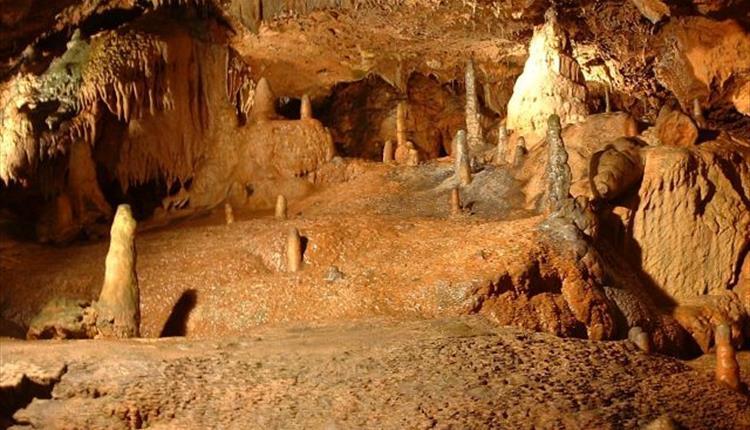
Greetings! I am back to my blog writing. I also tend to work just a little bit ‘in advance’, in case of unexpected delays, as happened recently! So, carrying on from a blog post the other week about prehistoric Britain, I am definitely not going in too deeply as to ‘what happened next’ in this country but giving you now what is perhaps more interesting information as we reach the Neolithic age. This was the period of domestication of plants and animals, as well as the arrival of farming and a more settled, sedentary lifestyle. For example, the development of Neolithic monumental architecture, apparently venerating the dead, may represent more comprehensive social and ideological changes involving new interpretations of time, ancestry, community and identity. In any event, the ‘Neolithic Revolution’ introduced a more settled way of life and ultimately led to societies becoming divided into differing groups of farmers, artisans and leaders. Forest clearances were undertaken to provide room for cereal cultivation and animal herds. Native cattle and pigs were reared whilst sheep and goats were later introduced from the continent, as were the wheats and barleys grown in Britain. However, only a few actual settlement sites are known here, unlike the continent. Cave occupation was common at this time.

A ‘Seamer’ Yorkshire type flint axe used for cutting down trees in the Later Neolithic, found in Bedlam Hill.

The construction of the earliest earthwork sites in Britain began during the early Neolithic (c. 4400BC to 3300BC) in the form of long barrows used for communal burial and the first enclosures linked via causeways, sites which have parallels on the continent. The former may be derived from the long house, although no long house villages have been found in Britain, just individual examples. Evidence of growing mastery over the environment is embodied in the Sweet Track, a wooden trackway built to cross the marshes of the Somerset Levels and dated to around 3800BC. Leaf-shaped arrowheads, round-based pottery types and the beginnings of polished axe production are common indicators of the period, also evidence in the use of cow’s milk comes from analysis of pottery contents found beside the Sweet Track. According to archaeological evidence from North Yorkshire, salt was being produced by evaporation of seawater around this time, enabling more effective preservation of meat. Pollen analysis shows that woodland was decreasing and grassland increasing, with a major decline of elms. There is evidence that winters were typically 3 degrees colder than at present, but summers were some 2.5 degrees warmer. The Middle Neolithic (c. 3300BC – c. 2900BC) saw the development of monuments close to earlier barrows and the growth and abandonment of causewayed enclosures, as well as the building of impressive chamber tombs. The earliest stone circles and individual burials also appeared. Different pottery types appeared during the later Neolithic and new enclosures called henges were built, along with stone rows and the famous sites of Stonehenge, Avebury and Silbury Hill, so building these seems to have reached its peak at this time. Industrial flint mining began, along with evidence of long-distance trade. Wooden tools and bowls were common, and bows were also constructed. Changes in Neolithic culture could also have been due to the mass migrations that occurred in that time, but the science of genetic anthropology is changing very fast and a clear picture across the whole of human occupation of Britain has yet to emerge.

We then move into what is seen as the Bronze Age, as new techniques in the skill of refining metal were brought to Britain. Previously, items had been made from copper but from around 2150BC metal-smiths had discovered how to smelt bronze, which is much harder than copper, by mixing copper with a small amount of tin. With this discovery, the Bronze Age arrived in Britain and over the next thousand years, bronze gradually replaced stone as the main material for tool and weapon making. Britain had large, easily accessible reserves of tin in the modern areas of both Cornwall and Devon and thus tin mining began. By around 1600BC the southwest of Britain was experiencing a trade boom as British tin was exported across Europe, evidence of ports being found in Southern Devon, whilst copper was mined at the Great Orme in North Wales. Some of the people were skilled at making ornaments from gold, silver and copper, as examples of these have been found in graves of the wealthy Wessex culture of central southern Britain. Early Bronze Age Britons buried their dead beneath earth mounds known as barrows. Later in the period, cremation was adopted as a burial practice with cemeteries filled with urns containing cremated individuals appearing in the archaeological record, with a deposition of metal objects such as daggers. People of this period were also largely responsible for building many famous prehistoric sites such as the later phases of Stonehenge along with Seahenge, also known as Holme I, a prehistoric monument located in the village of Holme-next-the-Sea, near Old Hunstanton, Norfolk. A timber circle with an upturned tree root in the centre, Seahenge, along with the nearby timber circle Holme II, is dated to have been built in the spring-summer of 2049BC, during the early Bronze Age in Britain. Contemporary theory is that they were used for ritual purposes, in particular Holme II has been interpreted as a mortuary monument that may originally have formed the boundary of a burial mound. The Bronze Age people lived in round houses and divided up the landscape. Stone rows are to be seen on, for example, Dartmoor. These people ate cattle, sheep, pigs and deer as well as shellfish and birds, they also carried out salt manufacture and the wetlands were a source of wildfowl and reeds. There was ritual deposition of offerings in the wetlands and in holes in the ground. There is evidence of a relatively large scale disruption of cultural patterns which some scholars think may indicate an invasion (or at least a migration) into Southern Great Britain c. the 12th century BC. This disruption was felt far beyond Britain, even beyond Europe, as most of the great Near Eastern empires either collapsed or experienced severe difficulties. Some scholars consider there are six ‘living’ Celtic languages, the four continuously living languages of Breton, Irish, Scottish Gaelic and Welsh, along with the two revived languages Cornish and Manx. A recent study has uncovered a migration into southern Britain during the 500-year period 1300BC – 800BC and these newcomers were genetically most similar to ancient individuals from Gaul, with higher levels of ancestry. During 1000BC to 875BC, their genetic markers swiftly spread through southern Britain, making up around half the ancestry of subsequent Iron Age people in this area, but not in northern Britain. This evidence suggests that, rather than a violent invasion or a single migratory event, the genetic structure of the population changed through sustained contacts between Britain and mainland Europe over several centuries, such as the movement of traders, intermarriage, and small scale movements of family groups. This has been described as a plausible reason for the spread of early Celtic languages into Britain. Whilst there was much less migration into Britain during the Iron Age, it is likely that Celtic reached Britain before then. Interestingly, a study has also found that lactose tolerance rose swiftly in early Iron Age Britain, which was a thousand years before it became widespread in mainland Europe, suggesting that milk became a very important foodstuff in Britain at this time.

A ‘Wandsworth Shield’ from around 750BC – 43AD.

Around 750BC ironworking techniques reached Britain from southern Europe. Iron was stronger and more plentiful than bronze and its introduction naturally marks the beginning of the Iron Age. Iron working revolutionised many aspects of life, most importantly agriculture, as iron tipped ploughs could turn soil more quickly and deeply than the older wooden or bronze ones, and iron axes could clear forest land more efficiently for agriculture. There was now a landscape of arable, pasture and managed woodland. There were many enclosed settlements and land ownership was becoming important. It is generally thought that by 500BC most people inhabiting the British Isles were speaking ‘Common Brythonic’, according to the limited evidence of place-names recorded by Pytheas of Massalia. By the Roman period there is substantial place and personal name evidence which suggests that this was so, Tacitus also states in his Agricola that the British language differed little from that of the Gauls. Among these people were skilled craftsmen who had begun producing intricately patterned gold jewellery, in addition to tools and weapons of both bronze and iron. It is disputed whether Iron Age Britons were ‘Celts’, with some academics actively opposing the idea of ‘Celtic Britain’, since the term was only applied at this time to a tribe in Gaul. However, place names and tribal names from the later part of the period suggest that a Celtic language was spoken.

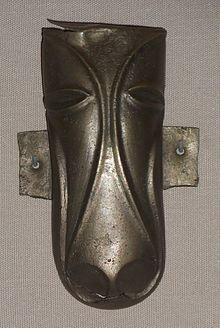
The Stanwick Horse Mask, La Tène style mount, British, 1st century AD.

The traveller Pytheas, whose own works are lost, was quoted by later classical authors as calling the people ‘Pretanoi’, which is cognate (having the same linguistic derivation) with ‘Britanni’ and is apparently Celtic in origin. The actual term ‘Celtic’ continues to be used by linguists to describe the family that includes many of the ancient languages of Western Europe and modern British languages such as Welsh without controversy. Iron Age Britons lived in organised tribal groups, ruled by a chieftain. As people became more numerous, wars broke out between opposing tribes. This was traditionally interpreted as the reason for the building of ‘hill forts’, although the siting of some earthworks on the sides of hills undermined their defensive value, hence the term may represent increasing communal areas or even elite areas. Except some hillside constructions may simply have been cow enclosures. Although the first had been built about 1500BC, hillfort building peaked during the later Iron Age and there are over 2,000 Iron Age hillforts known in Britain. By about 350BC many hillforts went out of use and the remaining ones were reinforced. Pytheas is quoted as writing that the Britons were renowned wheat farmers. Large farmsteads produced food in industrial quantities and Roman sources note that Britain exported hunting dogs, animal skins and slaves.

The last centuries before the Roman invasion saw an influx of Celtic-speaking refugees from Gaul, now approximately modern day France and Belgium, known as the Belgae, who were displaced as the Roman Empire expanded around 50BC. They settled along most of the coastline of southern Britain between about 200BC and 43AD, although it is hard to estimate what proportion of the population they formed there. Also a Gaulish tribe known as the Parisi, who had cultural links to the continent, appeared in northeast England. From around 175BC, the areas of Kent, Hertfordshire and Essex developed especially advanced pottery-making skills. The tribes of southeast England became partially Romanised and were responsible for creating the first settlements (known as oppida) large enough to be called towns. The last centuries before the Roman invasion saw increasing sophistication in British life. About 100BC, iron bars began to be used as currency, whilst both internal trade and trade with continental Europe flourished, largely due to Britain’s extensive mineral reserves. Coinage was developed, based on continental types but bearing the names of local chieftains. This was used in southeast England, but not in areas such as Dumnonia in the west. As the Roman Empire expanded northwards, Rome began to take interest in Britain and this may have been caused by an influx of refugees from Roman occupied Europe, or Britain’s large mineral reserves. There is so much more to tell about Great Britain, but that’s all on the subject – for now at least!

This week…the Riot Act.
There is a phrase sometimes used by people, for example angry parents who might threaten to ‘read the riot act’ to their unruly children in order to tell them off. But in 18th-century England, the Riot Act was a very real document and it was often recited aloud to angry mobs. Instituted in 1715, the Riot Act gave the British government the authority to label any group of more than 12 people as a threat to the peace. In such circumstances, a public official would read a small portion of the Riot Act and order the people to “disperse themselves, and peaceably depart to their habitations.” Anyone that remained after one hour was subject to arrest or removal by force. The law was later put to the test in 1819 during the infamous Peterloo Massacre, in which a cavalry unit attacked a large group of protesters after they appeared to ignore a reading of the Riot Act.

Click: Return to top of page or Index page

Queen Elizabeth II. Requiem in Pacem.

As you might expect, my weekly blog is a much shorter one than usual. On September 8, 2022 Buckingham Palace announced that the longest-reigning monarch in British history, Queen Elizabeth II, sadly died. After serving as the head of our royal family for 70 years, Queen Elizabeth II passed away peacefully at Balmoral Castle, her estate in the Scottish Highlands, with her family by her side. Upon her death, her eldest son and heir apparent, Prince Charles, immediately ascended as the King of the United Kingdom and took the name King Charles III.

Queen Elizabeth’s body remained in Scotland for a time, when senior royals were able to pay their own moving tribute, standing guard around the coffin for a while – a tradition known as the Vigil of the Princes. The coffin was then returned to England to lie in state for a few days in Westminster Hall. This has allowed for a period of mourning, during which time the public are able to visit, walking slowly by and paying their respects as the coffin lies on a raised platform known as a catafalque.

The Queen’s state funeral will take place at Westminster Abbey on Monday, 19th September, after which the Queen’s coffin will be taken to Windsor for a committal and she will be buried at St. George’s Chapel, next to her husband, Prince Philip, in an annex to the main chapel where her mother and father were buried, along with the ashes of her sister, Princess Margaret.

St. George’s Chapel was chosen in the 19th century as the burial place for the royal family and various members of the family, including Henry VIII, Charles I, George V, and George VI have since been buried throughout the chapel.

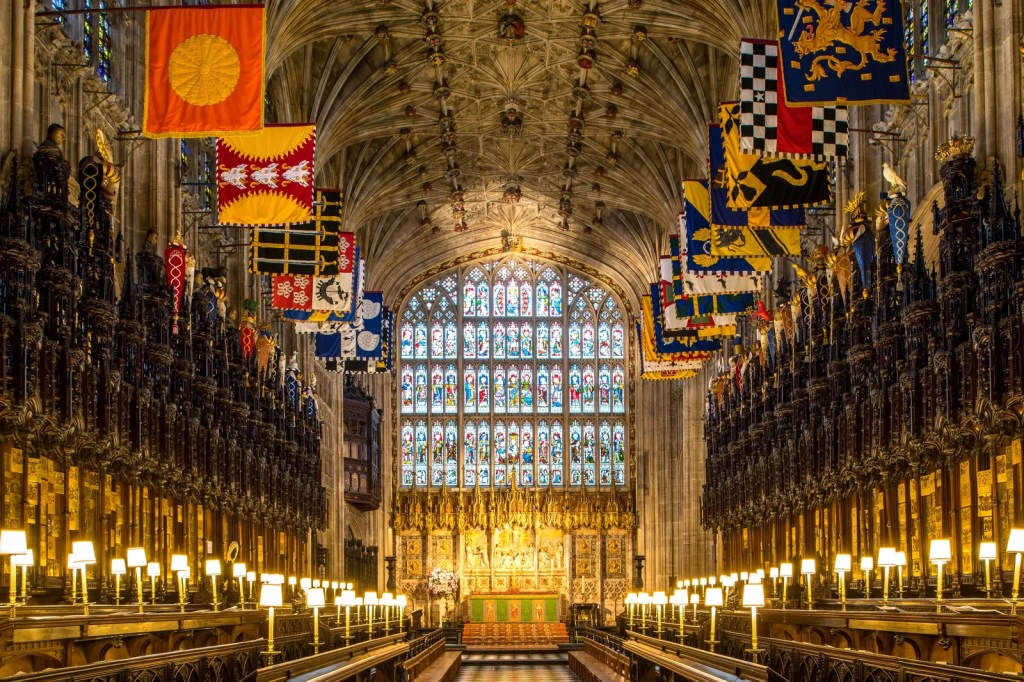
St George’s Chapel.
Photo: WPA Pool/Getty Images.

Built in the Perpendicular Gothic style, St. George’s Chapel is frequently cited as one of the best examples of the 14th-century aesthetic. True to the era, the stunning structure features four-centred pointed arches, fan vaulting, and ornate, intricate detailing. Construction started under Edward IV in 1475 and was completed in 1528 by Henry VIII. It was built in two stages, starting with the choir and its aisles in 1483, with the nave constructed later in 1496. In accordance with the British monarchy, the chapel’s interiors commemorate key figures and moments throughout both royal history and that of the chapel.

Her Royal Majesty is the only British head of state most of us have ever known and she has been a constant in the lives of her people. May she rest in peace and may her family, along with all who knew or knew of her, be comforted by the memories we each of us have over her long life.

Click: Return to top of page or Index page

Prehistoric Britain

This Earth has existed for a very long time. Compared to its life, humans have been here relatively recently. Some may say we have been slow in our development but to me that isn’t so, if we consider that just in what we now call Great Britain, several species of humans have intermittently occupied the area for almost a million years. The earliest evidence of human occupation around 900,000 years ago is at Happisburgh on the Norfolk coast, with stone tools and footprints found. The oldest human fossils, around 500,000 years old, are of the species Homo heidelbergensis at Boxgrove in Sussex. Until that time, Britain had been permanently connected to the Continent by a chalk ridge between South East England and northern France called the Weald-Artois Anticline, but during the Anglian Glaciation around 425,000 years ago a tremendous flood broke through the ridge and Britain became an island when sea levels rose during the following Hoxnian interglacial period. Fossils of very early Neanderthals dating to around 400,000 years ago have been found at Swanscombe in Kent and of classic Neanderthals about 225,000 years old at Pontnewydd in Wales. Britain was unoccupied by humans between 180,000 and 60,000 years ago, then Neanderthals returned. By 40,000 years ago they had become extinct and modern humans had reached Britain. But even their occupations were brief and intermittent due to a climate which swung between low temperatures with a tundra habitat and severe ice ages which made Britain uninhabitable for long periods. The last of these, known as the Younger Dryas, ended around 11,700 years ago, and since then Britain has been continuously occupied. It had been claimed by academics that a post-glacial land bridge existed between Britain and Ireland, however this conjecture began to be refuted by a consensus within the academic community starting in 1983 and since 2006 the idea of such a land bridge has been conclusively disproven, based upon marine geological evidence. It is now concluded that an ice bridge existed between Britain and Ireland up until 16,000 years ago, but this had melted by around 14,000 years ago. Britain was at this time still joined to the Continent by a land bridge known as ‘Doggerland’, but due to rising sea levels this causeway of dry land would have become a series of estuaries, inlets and islands by 7000BC and by 6200BC it would have become completely submerged. So Doggerland was an area of land now submerged beneath the North Sea that connected the British Isles to continental Europe, but it was flooded by rising sea levels around 6500–6200BC and the flooded land is known as the Dogger Littoral. Geological surveys have suggested that it stretched from what is now the east coast of Great Britain to what are now the Netherlands, the western coast of Germany and the Danish peninsula of Jutland. It was probably a rich habitat with human habitation in the Mesolithic period, although rising sea levels gradually reduced it to low-lying islands before its final submergence, possibly following a tsunami caused by the ‘Storegga Slides’. These three Storegga Slides (Norwegian ‘Storeggaraset’) are amongst the largest known submarine landslides and they occurred at the edge of Norway’s continental shelf in the Norwegian Sea approximately 6225–6170BC. The collapse involved an estimated 290km (180 mile) length of coastal shelf, with a total volume of 3,500km3 (840 cubic miles) of debris, which caused a tsunami in the North Atlantic Ocean. Doggerland was named after the Dogger Bank, which in turn was named after 17th-century Dutch fishing boats called ‘doggers’.

A map showing hypothetical extent of Doggerland (c. 10,000BC), which connected Great Britain and continental Europe.

The archaeological potential of the area was first identified in the early 20th century, and interest intensified in 1931 when a fishing trawler operating east of the Wash dragged up a barbed antler point that was subsequently dated to a time when the area was tundra. Vessels have since dragged up remains of mammoths, lions and other animals as well as a few prehistoric tools and weapons. As of 2020, international teams are continuing a two-year investigation into the submerged landscape of Doggerland using new and traditional archaeo-geophysical techniques, computer simulation and molecular biology. Evidence gathered allows study of past environments, ecological change and human transition from hunter-gatherer to farming communities.

Located at the fringes of Europe, Britain received European technological and cultural developments much later than Southern Europe and the Mediterranean region did during prehistory. By around 4000 BC, the island was populated by people with a Neolithic culture. This population had significant ancestry from the earliest farming communities in Anatolia, thus indicating that a major migration accompanied farming. The area is perhaps better known as Asia Minor, it being a large peninsula in Western Asia and the western-most protrusion of the Asian continent which now constitutes the major part of modern-day Turkey. The region is bounded by the Turkish Straits to the northwest, the Black Sea to the north, the Armenian Highlands to the east, the Mediterranean Sea to the south and the Aegean Sea to the west. The Sea of Marmara forms a connection between the Black and Aegean seas through the Bosphorus and Dardanelles straits and separating Anatolia from Thrace on the Balkan peninsula of South-east Europe. But the beginning of the Bronze Age was marked by an even greater population turnover, this time displacing more than 90% of Britain’s Neolithic ancestry in the process. This is documented by recent ancient DNA studies which demonstrate that the immigrants had large amounts of Bronze-Age Eurasian Steppe ancestry associated with the spread of Indo-European languages. No written language of the pre-Roman inhabitants of Britain is known, so therefore the history, culture and way of life of pre-Roman Britain are known mainly through archaeological finds. This evidence demonstrates that ancient Britons were involved in extensive maritime trade and cultural links with the rest of Europe from the Neolithic period onwards, especially by exporting tin that was in abundant supply. Although the main evidence for the period is archaeological, available genetic evidence is increasing, and views of British prehistory are evolving accordingly. Julius Caesar’s first invasion of Britain in 55 BC is regarded as the start of recorded ‘protohistory’, a period between prehistory and history during which a culture or civilisation has not yet developed writing, but other cultures have already noted the existence of those pre-literate groups in their own writings.

Palaeolithic (Old Stone Age) Britain is the period of the earliest known occupation of Britain by humans. This huge period saw many changes in the environment, encompassing several glacial and interglacial episodes greatly affecting human settlement in the region. Providing dating for this distant period is difficult and contentious, as the inhabitants of the region at this time were bands of hunter-gatherers who roamed Northern Europe following herds of animals, or who supported themselves by fishing.

Boxgrove hand-axes at the British Museum.

There is evidence from bones and flint tools found in coastal deposits near Happisburgh in Norfolk and Pakefield in lSuffolk that a species of ‘Homo’ was present in what is now Britain at least 814,000 years ago. At this time, Southern and Eastern Britain were linked to continental Europe by a wide land bridge known as Doggerland, allowing humans to move freely. The species itself lived before the ancestors of Neanderthals split from the ancestors of ‘Homo sapiens’ 600,000 years ago. The current position of the English Channel was a large river flowing westwards and fed by tributaries that later became the Thames in England and the Seine in France. Reconstructing this ancient environment has provided clues to the route first visitors took to arrive at what was then a peninsula of the Eurasian continent. Archaeologists have found a string of early sites located close to the route of a now lost watercourse named the Bytham River which was one of the great Pleistocene rivers of central and eastern England until it was destroyed by the advancing ice sheets of the Anglian Glaciation around 450,000 years ago. It is named after Castle Bytham in Lincolnshire and its catchment area included Worcestershire, Warwickshire, Oxfordshire and Derbyshire. It flowed eastward across East Anglia to the North Sea. This indicates that it was exploited as the earliest route west into Britain. Sites such as Boxgrove in Sussex illustrate the later arrival in the archaeological record of an archaic species called Homo heidelbergensis around 500,000 years ago and these early peoples made flint tools such as hand axes and hunted the large native mammals of the period. One hypothesis is that they would drive the large creatures like elephant, rhinoceros and hippopotamus over the tops of cliffs or into bogs, in order to kill them more easily. However, the extreme cold of the following Anglian Stage which started about 478,000 years ago and ended about 424,000 years ago is likely to have driven humans out of Britain altogether and the region does not appear to have been occupied again until the ice receded during the Hoxnian Stage. This warmer time period lasted from around 424,000 until 374,000 years ago and saw the flint tool industry develop at sites such as Swanscombe in Kent. Britain was populated only intermittently, and even during periods of occupation may have reproduced below replacement level and needed immigration from elsewhere to maintain numbers. According to some historians, around this time Britain and much of Northern Europe seems to have had a long record of abandonment and colonisation as well as a very short record of residency. This period also saw other flint tools introduced, possibly by humans arriving from Africa. However, finds from Swanscombe and Botany Pit in Purfleet support Levallois technology being a European rather than African introduction. The more advanced flint technology permitted more efficient hunting and therefore made Britain a more worthwhile place to remain until the following period of cooling known as the Wolstonian Stage, 352,000–130,000 years ago. From then to around 60,000 years ago there is no evidence of human occupation in Britain, probably due to inhospitable cold in some periods, Britain being cut off as an island in others, and the neighbouring areas of north-west Europe being unoccupied at times when Britain was both accessible and hospitable. There was then only limited Neanderthal occupation of Britain between about 60,000 and 42,000 years ago. Britain had its own unique variety of late Neanderthal hand-axe, so seasonal migration between Britain and the continent is unlikely, but the main occupation may have been in the now submerged area of Doggerland, with summer migrations to Britain in warmer periods. The earliest evidence for modern humans in North West Europe is a jawbone discovered in England at Kents Cavern in 1927, which was re-dated in 2011 to between 41,000 and 44,000 years old. The most famous example from this period is the burial of the ‘Red Lady of Paviland’ (actually now known to be a man) in modern-day coastal South Wales, which was dated in 2009 to be 33,000 years old. The distribution of finds shows that humans in this period preferred the uplands of Wales and northern and western England to the flatter areas of eastern England. Their stone tools are similar to those of the same age found in Belgium and far north-east France, and very different from those in north-west France. At the time when Britain was not an island, hunter gatherers may have followed migrating herds of reindeer from Belgium and north-east France across the giant Channel River, but the climatic deterioration which culminated in the Last Glacial Maximum, between about 26,500 and 19,000 years ago, drove humans out of Britain and there is no evidence of occupation for many years afterwards. Various finds in sites such as Cathole Cave in Swansea county, Creswell Crags on the border between Derbyshire and Nottinghamshire and Gough’s Cave in Somerset provide evidence suggesting that humans returned to Britain towards the end of this ice age during a warm period from 14,700 to 12,900 years ago although further extremes of cold right before the final thaw may have caused them to leave again and then return repeatedly. The environment during this ice age period would have been largely treeless tundra, eventually replaced by a gradually warmer climate, perhaps reaching 17 degrees Celsius (62.6 Fahrenheit in summer, encouraging the expansion of birch trees as well as shrub and grasses. The first distinct culture of the Upper Palaeolithic in Britain is what archaeologists call the Creswellian industry, with leaf-shaped points probably used as arrowheads. It produced more refined flint tools but also made use of bone, antler, shell, amber, animal teeth, and mammoth ivory. These were fashioned into tools but also jewellery and rods of uncertain purpose. Flint seems to have been brought into areas with limited local resources and the stone tools found in the caves of Devon, such as Kent’s Cavern, seem to have been sourced from Salisbury Plain, 100 miles (161km) east. This is interpreted as meaning that the early inhabitants of Britain were highly mobile, roaming over wide distances and carrying ‘toolkits’ of flint blades with them rather than heavy, unworked flint nodules, or otherwise improvising tools extemporaneously. The possibility that groups also travelled to meet and exchange goods or sent out dedicated expeditions to source flint has also been suggested. Between about 12,890 and 11,650 years ago, Britain returned to glacial conditions and may have been unoccupied for periods of time.

Kent’s Cavern, Devon.

The Younger Dryas was followed by the Holocene, which began around 9,700 BC and continues to the present. There was then limited occupation by some hunter gatherers, but this came to an end when there was a final downturn in temperature which lasted from around 9400BC to 9200BC. Mesolithic people occupied Britain by around 9000BC and it has been occupied ever since. By 8000BC temperatures were higher than today, and birch woodlands spread rapidly, but there was a cold spell around 6200BC which lasted about 150 years. The plains of Doggerland were thought to have finally been submerged around 6500BC to 6000BC, but recent evidence suggests that the bridge may have lasted until between 5800BC and 5400BC, and possibly as late as 3800BC. The warmer climate changed the arctic environment to one of pine, birch and alder forest, but this less open landscape was less conducive to the large herds of reindeer and the wild horses that had previously sustained humans. Those animals were replaced in people’s diets by pig and less social animals such as elk, red deer, roe deer, wild boar and aurochs (wild cattle), which would have required different hunting techniques. Tools changed to incorporate barbs which could snag the flesh of an animal, making it harder for it to escape alive. Tiny microliths were developed for hafting onto harpoons and spears. Woodworking tools such as adzes appear in the archaeological record, although some flint blade types remained similar to their Palaeolithic predecessors. The dog was domesticated because of its benefits during hunting, and the wetland environments created by the warmer weather would have been a rich source of fish and game. Wheat of a variety grown in the Middle East was present on the Isle of Wight at the Bouldnor Cliff Mesolithic Village dating from about 6000BC. It is likely that these environmental changes were accompanied by social changes, with humans spreading and reaching the far north of Scotland during this period. Excavations at Howick in Northumberland have uncovered evidence of a large circular building dating to c. 7600BC which is interpreted as a dwelling. A further example has also been identified at Deepcar in Sheffield, and a building dating to c. 8500BC was discovered at a Mesolithic site in North Yorkshire. So the older view of Mesolithic Britons as nomadic is now being replaced with a more complex picture of seasonal occupation or, in some cases, permanent occupation. Travel distances seem to have become shorter, typically with movement between high and low ground. Though the Mesolithic environment was bounteous, the rising population and the ancient Britons’ success in exploiting it eventually led to local exhaustion of many natural resources. The remains of a Mesolithic elk found caught in a bog at Poulton-le-Fylde in Lancashire show that it had been wounded by hunters and escaped on three occasions, indicating hunting during the Mesolithic. A few Neolithic monuments overlie Mesolithic sites but little continuity can be demonstrated. Farming of crops and domestic animals was adopted in Britain around 4500 BC, at least partly because of the need for reliable food sources. The climate had been warming since the later Mesolithic and continued to improve, replacing the earlier pine forests with woodland. We were settling down and planned to stay!

This week…picture the scene.
Some years ago I was in a shop in Peterborough, standing at a counter with my arms at my side. As I looked at a few items, I felt a little hand creep into mine. I’ve never had any children of my own, so I slowly looked down. I saw a young child look up at me and realise they’d got hold of the wrong person! The child’s mum and dad were standing nearby, chuckling and the dad called to the child who let go of me and ran over to their dad, who was wearing the same style and colour coat that I was. They’ll tell that tale in years to come, I’m sure!

But I end on a sad note, the passing away yesterday of Queen Elizabeth II. She gave us her whole life, may she now rest in peace with her beloved Philip. R.i.P.

Click: Return to top of page or Index page

The Need For Change

I have said in a previous blog post that although I was born in London, we as a family moved to a town where Dad had managed to get a job as a teacher. Over the years we lived in the town he was also involved with various things there, he was scoutmaster for the local troop and was actively involved at our local church, which was St. Mary’s.

St. Mary’s church, Whittlesey.

For a while we lived near to the church and apparently I was a little scared of the sound of the church bells, but I was very young at the time. Then I learned that Dad was a bellringer and as soon as I knew my Dad was helping to make the noise of the bells, I was happy. Dad sang in the choir and later he was choirmaster. He was also deputy organist and one of two churchwardens, one being the People’s warden and the other the Church warden, each with their own responsibilities. In addition, for a few years he was treasurer on the local Parochial Church Council (PCC) but as with so many of these volunteer organisations it seems that only a limited number of people ever want to get involved. So it was that after a number of years Dad decided enough was enough and someone else should take on the role of treasurer. I do think the old adage of ‘One volunteer is worth ten pressed men’ held true in this case! But in time, perhaps Dad felt he was being taken advantage of, also he wasn’t getting any younger in terms of job promotion. Apart from that, Mum and I were now working, not in the town but in the city a few miles away. So it was that one year Dad told everyone at the PCC’s Annual General Meeting (AGM) that he would be standing down the following year as treasurer and they now had twelve months to get a replacement who he would be more than happy to train as much as might be required, ready for handing over the books. Sadly however, despite him regularly reminding them and urging them to recruit a replacement in time for the next AGM, nobody did a single thing about it. So, true to his word, at that next AGM Dad brought all the books etc along and left them on the table. Despite protestations from other council members, even a plea from the vicar, my Dad stood firm. He had made it abundantly clear several times during that year what would happen and they were therefore left to resolve the problem of a new treasurer on their own. But it was no small effort for Dad to stand up to the rest of those PCC members. I have an idea that Dad had also set his eyes on getting more experience in a teaching job elsewhere, which later he did. We moved a few miles to the edge of the city and a bit later Dad got a job as deputy head at a school fairly near to where we were now living. He stayed there until he retired and he was due to finish in the December, but was able to stay on an extra term until the end of the school year, so the children didn’t get a different teacher for that one term. In my view it was the proper way of managing the changes the children would have in the following school year.

‘Park Inn by Radisson’ hotel, Peterborough.
Formerly Telephone House.

The above image is of the present Park Inn by Radisson hotel, with its entrance in Wentworth Street, Peterborough but it was originally built as Telephone House, with the the main entrance in Trinity Street. The original building was four and a half storeys high when I started work there in 1969, but it had one and a half floors added to it a few years later. The council then built Bourges Boulevard and part of that new road went straight across Trinity Street, cutting that old road in two. Quite why an underpass couldn’t have been built there I have no idea. At the time I started work, the site was also used by the Post Office as part of their sorting and delivery work but when separation came and Post Office Telephones became British Telecom, the postal side left. But then a little while later a major extension to the telephone exchange was built on the site and the exchange was joined to Telephone House. It must have caused the architects some work, as the two buildings had different levels and it meant quite a few different sets of stairs! But building Bourges Boulevard, putting an extension onto Telephone House and constructing a full extension to the existing telephone exchange were not the only major changes to Peterborough. It had been designated a ‘new town’ in 1967 and the Peterborough Development Corporation decided to construct a new, purpose-built shopping centre in the heart of the city. Planning permission was received in the late summer of 1976 and in November the retailer John Lewis Partnership announced that it had agreed to be the anchor shop in the new development. The opening of the store in Peterborough marked the company’s return to the city after an absence of over twenty-five years. Sadly however, John Lewis announced the permanent closure of the store in April 2021, leaving the centre without its main anchor tenant. Today there are still two other anchor tenants such as M&S and the Boots company which are still open, soon there will be a new anchor for the centre and that will be the much anticipated Empire Cinemas which will open as part of the £60million extension to the mall, this will also include a new food court and several new stores, whose names, so far as I know, are yet to be announced.

North Square of Queensgate Shopping centre in July 2017.

In 2011, a £20 million revamp to Queensgate was undertaken, which included the clothing retailer Primark taking over several units and an extension to replace the units taken over. Changes to the large multi-storey car park removed references to local historical figures, these being Edith Cavell, Frank Perkins, Henry Royce and John Clare in favour of a colour-coded system, but I have an idea there were some serious complaints at this because the names were subsequently reinstated and paired with the new colour system. Paten Bridge, which crosses Bourges Boulevard (the A15), links Queensgate to the station quarter, which includes a new full sized Waitrose supermarket with a coffee shop and restaurant, built in 2014 on the site of the former Royal Mail sorting office. In 2018 some areas were re-paved and a number of shop fronts were updated. There has been discussion on covering the entire street with a glass roof, but so far as I know, the plans have not been finalised. In 2015, a detailed planning application for a £30 million enhancement of the centre was submitted to Peterborough City Council as the plan was to create a 77,000 square feet (7,153 square metre) extension in partnership with John Lewis, but which has since permanently closed. The development was to include a restaurant hub and a multi-screen digital cinema. Planning permission was granted and work was scheduled to start in 2019, also tenders for the cinema and the food hall were allocated. In early 2020 McLaren Construction Group landed the contract to build the 77,000 square foot extension, work quickly began on the site compounds which resulted in half of the bus station being closed temporarily and relocated to the Coach Park just behind The Brewery Tap. Before work could fully get underway, due to the Coronavirus pandemic work ground to a halt whilst everyone in the building trade found out where they stood, but after guidelines and measures were put in place work quickly resumed on site with cranes and scaffolding being erected to provide material and personnel access to the roof. In preparation of the extension John Lewis carried out a £21 million refurbishment project on their anchor store in the centre, part of their project involved giving up around 60,000 square feet of retail space to make way for the construction for four new retail units, three of which would have two floors. Next expressed an interest in moving into one of the store which was rumoured to be a 32,000 square foot retail unit directly opposite H&M, however Next closed its Queensgate store in April 2021, and is unlikely to consider a return to the centre. TK Maxx have announced they will be giving up their current store in Bridge Street to move into a vacant unit, on the upper ground floor of the Central Square. It is a forever changing world!

Back in 1969, when I first joined what was originally Post Office Telephones, later British Telecom (BT), I had been asked if I intended to make BT my career, which I did. I learned that experience in the company was useful for promotion as well as, shall we say a ‘degree of flexibility’. That was certainly true at times, especially as I had started at sixteen, straight from school. I learned much about people and whilst most were kind or at the very least friendly, others were not, in fact one or two were not good people at all in my opinion. It meant having to adapt, also sadly if ‘your face didn’t fit’ as the old saying is, things could be quite difficult. Also the changing attitudes by managers was not easy to accept at times. So when a promotion opportunity came that involved me moving to Leicester, my Dad actually urged me to go, not in an unkind way but because he knew it would be good for me. So I went and it was – good for me, that is. Over the years further changes within the company meant I was working in such places as Nottingham, Birmingham, Sheffield and Manchester. But in time, work finally led me back to Leicester. Back when I was sixteen, I was learning about the offices, telephone exchanges and other buildings that BT used. There was the maintenance and cleaning of them, the household stores required, we also had the local telephone exchange with all the amazing equipment needed, but which still had a very old-style lift with a heavy manual doors. Not like the modern automatic ones of today! There was a large canteen on the third floor. So I got to see all that, also the large room where the ‘100’ and ‘999’ telephone operators worked. Pretty girls, most of them but they were all kept under strict supervision. It was all very different from school! A few years later I was moved into the accounts department, where I saw how the telephone bills were collated and produced, then a few years later I went on to the telephone directory compilation team, manually filling in the cards used by a computer which then collated all of the entries ready for printing the directories. It has all changed now of course. But this was where I got my first introduction to computers, in particular I realised how accurate one has to be when inputting data to them. I had said how I’d wanted BT to be my career and after a year or so I was advised that I’d be moving to the Sales department. I must say at this point that in the other offices I’d worked in, it was, generally, fairly quiet. But in this Sales office, it seemed like everyone was working at three times the speed of any other, folk were multitasking, everything was a blur to begin with. But I soon got used to it. I enjoyed the work, also with each move to a different group or department I was getting more and more experience in the company as a whole. In addition, I became more interested in the deeper world of computers and much of the associated programming which I was doing as a hobby at home! So it was that I got the opportunity to actually do some limited amounts of programming, I was also doing checks on new software prior to it being distributed generally, looking to ensure there were no errors. I did find occasional ones, not many though. This helped when it came to training others in the use of the new software which I and a few others did. What amused me was that a further reorganisation in the company had brought me back to Leicester, where I began training and working with some of the people I had worked with many years before. I was also able to make my mother laugh when I told her of that move as I was teaching people about using computers and she recalled the time when I was just sixteen, still at school and looking for a job, because I had applied for one with an engineering company in Peterborough as a computer operator. I’d been turned down because they said that I had no aptitude for working with computers! Yet here I was, years later teaching computer skills. But things change and BT were cutting back, so when they made me an offer I could not refuse I went. I had been with them thirty-eight years! After some additional teacher training I started my own small business, teaching basic computer skills and photography, as the latter was a hobby I was keen on. I had been used to using ‘film’ cameras, yet here I was now able to take photographs, view them instantly and then use computer software to enhance and crop them before using the Internet to share them with others.

We all go through different changes in our lives, I know that I have had to adapt to the changes around me, though I don’t think my personal outlook on life has altered too much overall. But I have definitely learned a great deal. I have learned that there is a need in adjusting to changes that are around us, but I have been told that I seem to see a silver lining in every cloud. Most of the time I do, but be assured that there have been just a few occasions when I haven’t been happy with how my life has been. It is then that I have found a change to be more than just a good idea, but absolutely necessary. It has meant not seeing some people very often, if at all in some cases and it has meant accepting some changes too, but change is often not simply a good idea, but absolutely necessary.

This week…
“Said Harriet to Ophelia,
I shall draw a sketch of thee!
What kind of pencil shall I use,
2B or not 2B!!!”
~ Spike Milligan

Times Past, Present And Future

It is true that as this Earth turns, every day is new. But certain things occur regularly, often with the seasons. So whilst we have a pretty good idea when some events will happen, a great many others are simply beyond us to forecast them. We do know that rain will fall, but not always when or where we want! We have all the modern forecasting, we also have quite sophisticated equipment that help us to predict earthquakes and the tsunamis which can be created as a result, but that is pretty much all we can do with those, which is to be prepared. Our clocks show us the passage of time, we are born, we live and hopefully we learn, then we pass away. My dear Dad passed away in 1989, shortly before his seventieth birthday. Mum did very well, despite being badly injured during World War II. She passed away in 2016, aged ninety-five! But Dad was a heavy smoker for many years and cancer got him. Dad was a schoolteacher in Whittlesey, he was deputy organist and choirmaster at our local church for many years. So for me, music has always been part of my life and it has been a real inspiration to me for as long as I can remember. I am told that even before I was born, whilst my mother was carrying me she was always singing as she was so happy. I’ve said before about church organ music and there were times, especially when things weren’t going too well for me, I would go into Peterborough cathedral and often find an organist playing, perhaps practicing for a service or concert. I would attend organ concerts, not all were to my taste in music but I enjoyed them. I also sang in a few different choirs, one was the Gildenburgh choir in Peterborough and for a time the choirmaster was Andrew Newberry, who was also the deputy organist at the same cathedral. One particular person I first heard at a concert there was an American named Carlo Curley. He was an organist, not resident at any particular church but would travel around the world, giving concert performances in cathedrals, churches, concert halls, wherever and he had a very ‘outgoing’ personality.

Carlo Curley.

Carlo James Curley (August 24, 1952 – August 11, 2012) was an American classical concert organist who was born into a musical family in Monroe, North Carolina, USA and attended the North Carolina School of the Arts. By the age of 15 he was organist at a large Baptist church in Atlanta, Georgia, subsequently studying with some brilliant organists. His long-time friend and confidant Robert Noehren was another noted influence. At 18, Carlo was Director of Music at Girard College in Philadelphia and he developed his performance style in the manner of Virgil Fox, wanting to make classical organ music popular to a wider audience. He did this by including his arrangements and transcriptions of pieces from other classical genres. He was the resident organist at the Alexandra Palace, London in the 1970s and was the first classical organist to perform a solo organ recital at the White House, Washington for the U.S. President Jimmy Carter. He played before several European heads of state and toured extensively throughout the world, earning the marketing nickname ‘the Pavarotti of the Organ’, he was also one of only a few concert organists worldwide who supported themselves exclusively by giving recitals, concerts and master classes without any supplement from teaching or church position. Carlo toured extensively throughout the world, and had a large and loyal following. The Carlo Curley Concert Circle, based in the UK, was formed and numerous trips were organised with him throughout England and abroad. I was privileged to have been part of that following and went on several special trips for members of this Concert Circle. These were usually weekends away, we would stay in hotels and have private concerts and guided tours around different cathedrals or churches like Peterborough, Southwell Minster, York, Birmingham, Lincoln and Westminster Abbey to name but a few. Carlo also did a concert at the church in Attleborough in Norfolk, which was right next to where my late mother lived. This meant she was actually able to meet him personally and that delighted her, as I had spoken with her about him a few times. Carlo Curley also used a substantial Allen touring organ, especially where the venue lacked an instrument of sufficient scope to support his repertoire. He recorded commercially for various record labels, he participated in several concerts with other organists and his final such concert was in June 2012 at Liverpool Anglican Cathedral with his friend Ian Tracey using a Copeman Hart instrument. He served as patron for numerous music societies as well as for the newly formed British Academy of Music, he was involved in organ design as well as their construction and he served as advisor to numerous clients, including Melbourne City Council in Australia and The Cube, Shiroishi in Japan. His autobiography ‘In The Pipeline’ was published by HarperCollins in 1998. One of his Allen organs is now used in the Cathedral of St Michael and St George in Aldershot in the UK. A life-long bachelor, Carlo Curley died on 11 August 2012 aged 59 in Melton Mowbray, where he lived for a number of years. His ashes are interred in the grounds of Pershore Abbey in Worcestershire. Carlo was actually born in North America, he travelled the world but chose to live in the relative peace and quiet of Melton Mowbray, Leicestershire, England. I myself have many memories of that town and I still have friends there. It is a lovely town, good people and a beautiful church with a delightful organ and I have been to quite a few concerts there too. In addition, not far away is a place where they refurbish and rebuild church organs with great skill. It was fascinating to watch, but then I have always been amazed at the skill some people have, whether it be building or repairing items.

Here in the UK we have recently had the Commonwealth Games and as with almost all sports there is the need, the urge to win, whether as part of a team or as individuals. I think these Games showed this up very well. Whether it is in sports or in life generally, some simply want to be the best and if done in a positive way that is no bad thing as it can motivate others to try harder. But sadly, some do so in a very negative way, selfishly putting others down, perhaps to prove something to themselves. In some cases they can also mar or even destroy the lives of others in their attempt to do this. I have noticed how many spend their lives following the same routines, doing the same thing day-in day-out, even going to the same places for refreshment or relaxation, never wanting to ever try something new. Such people also often find it difficult to cope with a change that is outside their control, but in this ever-changing world it is better if we can adapt to change. Some years ago I learned that the man who had been the headmaster at my old school had passed away. He had been quite active in the town all his life, but when he reached sixty-five he had to retire and sadly less than two years later his life ended. So it is perhaps a gentle reminder that, at the end of the day, we all go the same way. Also, as life passes by we cannot remain as we once were, but happily many then find other outlets for their skills, perhaps by teaching others so that their skills are passed on. I was told a delightful saying recently which was “Shrouds have no Pockets”, meaning that worldly wealth cannot be kept and used after death. It comes, according to the Oxford Dictionary of Phrase and Fable, from the mid-19th century.

I have said before about parents and grandparents saying how “It wasn’t like that in our day” and nor is it. What amuses me is that as I reach that same age, I begin to echo those same words! But that is perhaps how it ought to be, as we strive to better ourselves. I have written about different technologies, like cameras, computers, all things that the younger generation nowadays take for granted but when I was younger I was just the same. Many good things can and do come from these changes in technology, in our knowledge, in fact through so many things, but we can all too easily forget the basics. Sometimes the simplest of things are in fact the best! I am reminded of the time some years ago when I was walking past a colleague’s desk at work and they said, in an exasperated tone of voice, “Stupid computer, I can’t find anything I need!” So I stopped and politely enquired what the problem was. I learned that they were looking for a particular telephone number, so I said “That’s no problem”, at which point they said in the same exasperated tone, “If you’re so clever, you find it!”. So I ignored the computer and reached out for an old-style, printed telephone directory on my colleague’s desk. I quickly found the telephone number required and was grudgingly thanked, but to me it was no problem. I had been taught a similar lesson some years before, in that sometimes the ‘old’ ways are the simplest, as they can be the best. Once upon a time we humans all lived in caves, men hunted for food whilst their women bore children, they fed and cared for all the family. The idea of husband and wife, children, all living and working together became an integral part of human life for so many. I know that there have been wedding ceremonies for years, although it seems they are not universal to marriage and not necessary in most legal jurisdictions. They are not even universal within the Christian marriage, as Eastern Christians do not have marriage vows in their traditional wedding ceremonies. I am most used to hearing the marriage vows which are promises each partner in a couple make in turn to the other during a wedding ceremony which is based upon Western Christian traditions. That is because I have sung in a few different church choirs and so have heard the following words a great many times. But over time, these words have been altered a little. When I was a lad, the words that the bride and groom said either to other were:

“I, (forenames), take thee, (forenames), to be my lawfully wedded wife/husband, to have and to hold from this day forward, for better for worse, for richer for poorer, in sickness and in health, to love, cherish and to obey, till death us do part, according to God’s holy ordinance, and thereto I plight/give thee my troth”.

Here the groom makes a promise (plight thee my troth) to his bride and in reply the bride accepts the promise and returns it (give thee my troth). But in time it was amended, a few words modernised and in later versions the word ‘obey’ was dropped, whilst ‘holy ordinance’ was replaced by ‘holy law’. As I have said on a few occasions now, things change and will continue to do so. A long time ago we used to kill with rocks, then swords, then guns and other weapons were invented. We saw birds flying and wanted to do the same, so now we have aircraft and much more. At one time it was more usual for human males to go hunting for food whilst the females cared for the children. But not all species live that way and as we know, things change. Men and women have worked to design, build and maintain a great many things together, although this has not always been recognised immediately. But even now, there are still those people who continue to ask “Why should I be the one to change?”. They want to carry on in their own ways, they expect those around them to adapt to them, but that isn’t always the best way to survive. There have been a few people I’ve known who refused to change, to adapt, perhaps because of how they were treated. Sadly a number of them are no longer alive now. But I am reminded of some good, thoughtful words spoken by Srinivas Arka, an Indian Guru I know, which are, “Our future depends mainly on the way we think at present. To change our lives, we must change the way we think”. I have seen this to be true, I have learned of this adaptation in other creatures on Earth too, for example polar bears who, finding their world was being taken over by us humans, adapted. They found food from wherever they could and they continue to survive. We too must adapt and adjust so that we may survive. The ones who cannot or perhaps will not change? Some refer to them as dinosaurs, but that isn’t fair on those creatures who lived so long ago, as evidence suggests an asteroid impact was the main culprit of their downfall. Volcanic eruptions that caused large-scale climate change may also have been involved, together with more gradual changes to Earth’s climate that happened over millions of years. Some folk are just stubborn and will not change their ways!

It is around this particular time of year that I especially recall memories of people not now with us, also places I have been to and know well. I do not dwell on these memories, but remember them, mainly with happiness. We all have our own, special, individual thoughts and memories. I wrote last week about the lovely, unexpected trip to the seaside and I can still recall the sea air, the soft sand, fresh fish & chips and that lovely ice cream! Yes, my legs ached afterwards but it was worth it. People come and go, places may not be as easily reached but memories, for most, linger on. I look to the future and wonder – where to next?

This week…
A word of warning. Never get stuck behind Satan in the queue at a Post Office. For the devil takes many forms…

Click: Return to top of page or Index page