Flat Earth

‘Flat Earth’ is an archaic and scientifically disproven conception of the Earth’s shape as a plane or disc. Many ancient cultures subscribed to a flat-Earth cosmography.

A Flat Earth map drawn by Orlando Ferguson in 1893.

The above map has several references to biblical passages as well as various jabs at the “Globe Theory”. However, the idea of a spherical Earth appeared in ancient Greek philosophy with Pythagoras as far back as the sixth century BC. Except many folk of the sixth and fifth century BC retained the flat-Earth model. In the early fourth century BC, Plato wrote about a spherical Earth and by about 330BC, his former student Aristotle had provided strong empirical evidence for a spherical Earth. Knowledge of the Earth’s global shape gradually began to spread beyond the Hellenistic world and by the early period of the Christian Church, the spherical view was widely held, with some notable exceptions. It is a historical myth that medieval Europeans generally thought the Earth was flat and it is said that this myth was created in the seventeenth century by Protestants to argue against Catholic teachings. Despite the scientific fact and obvious effects of Earth’s ‘sphericity’, pseudoscientific flat-Earth conspiracy theories are espoused by modern flat Earth societies and, increasingly, by unaffiliated individuals using social media.

‘Imago Mundi’, a Babylonian map, sixth century BC.

The Babylonian Map of the World (or ‘Imago Mundi’) is a Babylonian clay tablet written in the Akkadian language. Dated to no earlier than the ninth century BC (with a late eighth or seventh date being more likely), it includes a brief and partially lost textual description. The tablet describes the oldest known depiction of the known world. Ever since its discovery there have been a variety of divergent views on what it represents in general and about specific features in particular. The map is centred on the Euphrates river, flowing from the north (top) to the south (bottom). The city of Babylon is shown on the Euphrates, in the northern half of the map. The mouth of the Euphrates is labelled “swamp” and “outflow”. Susa, the capital of Elam, is shown to the south, Urartu to the northeast, and Habban, the capital of the Kassites is shown (incorrectly) to the northwest. Mesopotamia is surrounded by a circular ‘bitter river’ or Ocean, and seven or eight regions, depicted as triangular sections, are shown as lying beyond the Ocean. It has been suggested that the depiction of these regions as triangles might indicate that they were imagined as mountains. In early Egyptian and Mesopotamian thought, the world was portrayed as a disk floating in the ocean. A similar model is found in the Homeric account from the eighth century BC in which it was thought that “Okeanos, the personified body of water surrounding the circular surface of the Earth, is the begetter of all life and possibly of all gods”. The Pyramid Texts and Coffin Texts of ancient Egypt show a similar cosmography, where ‘Nun’ (the Ocean) encircled ‘Nbwt’ (“dry lands” or “Islands”). The Israelites also imagined the Earth to be a disc floating on water with an arched firmament above it that separated the Earth from the heavens. The sky was a solid dome with the Sun, Moon, planets, and stars embedded in it. Both Homer and Hesiod, another Greek poet generally thought to have been active between 750 and 650BC described a disc cosmography on the Shield of Achilles.

Possible rendering of Anaximander’s world map.

Several pre-Socratic philosophers believed that the world was flat. One thought that the Earth floated in water like a log, but it has been argued that he actually believed in a round Earth. There were others, with perhaps fanciful ideas. Belief in a flat Earth continued into the fifth century BC and another even believed that the flat Earth was depressed in the middle like a saucer, to allow for the fact that the Sun does not rise and set at the same time for everyone. The ancient Norse and Germanic peoples believed in a flat-Earth cosmography with the Earth surrounded by an ocean, with the ‘axis mundi’, a world tree or pillar in the centre and in the world-encircling ocean sat a snake. There is a a Norwegian didactic text in Old Norse from around 1250 that deals with politics and morality. It was originally intended for the education of King Magnus Lagabøte, the son of King Håkon Håkonsson, and it has the form of a dialogue between father and son. The son asks, and is advised by his father about practical and moral matters, concerning trade, chivalric behaviour, strategy and tactics. Parts of this work deal with the relationship between church and state and explains the Earth’s shape as a sphere in this way: “If you take a lighted candle and set it in a room, you may expect it to light up the entire interior, unless something should hinder, though the room be quite large. But if you take an apple and hang it close to the flame, so near that it is heated, the apple will darken nearly half the room or even more. However, if you hang the apple near the wall, it will not get hot; the candle will light up the whole house; and the shadow on the wall where the apple hangs will be scarcely half as large as the apple itself. From this you may infer that the Earth-circle is round like a ball and not equally near the sun at every point. But where the curved surface lies nearest the sun’s path, there will the greatest heat be; and some of the lands that lie continuously under the unbroken rays cannot be inhabited”. Meanwhile in ancient China, the prevailing belief was that the Earth was flat and square, whilst the heavens were round, an assumption virtually unquestioned until the introduction of European astronomy in the seventeenth century. An English sinologist (a person who studies China) emphasised the point that there was no concept of a round Earth in ancient Chinese astronomy and it seems that Chinese thoughts on the form of the Earth remained almost unchanged from early times until the first contacts with modern science through the medium of Jesuit missionaries in the seventeenth century. Whilst the heavens were variously described as being like an umbrella covering the Earth (the Kai Tian theory), or like a sphere surrounding it (the Hun Tian theory), or as being without substance while the heavenly bodies float freely (the Hsüan Yeh theory), the Earth was at all times flat, although perhaps bulging up slightly.

An illustration based on that of a twelfth-century Asian cosmographer.

The model of an egg was often used by Chinese astronomers to describe the heavens as spherical, such that ”The heavens are like a hen’s egg and as round as a crossbow bullet, the Earth is like the yolk of the egg and lies in the centre”. The analogy with a curved egg led some modern historians to conjecture that Chinese astronomers were, after all, aware of the Earth’s sphericity. The egg reference, however, was rather meant to clarify the relative position of the flat Earth to the heavens, as in a passage of Zhang Heng’s cosmogony he himself says: “Heaven takes its body from the Yang, so it is round and in motion. Earth takes its body from the Yin, so it is flat and quiescent”. The point of the egg analogy is simply to stress that the Earth is completely enclosed by Heaven, rather than merely covered from above as the Kai Tian describes. Chinese astronomers, many of them brilliant men by any standards, continued to think in flat-Earth terms until the seventeenth century; this surprising fact might be the starting-point for a re-examination of the apparent facility with which the idea of a spherical Earth found acceptance in fifth-century BC Greece. When Chinese geographers of the seventeenth century, influenced by European cartography and astronomy, showed the Earth as a sphere that could be circumnavigated by sailing around the globe, they did so with formulaic terminology previously used by Zhang Heng to describe the spherical shape of the Sun and Moon, i.e. that they were as round as a crossbow bullet.

Semi-circular shadow of Earth on the Moon during a partial lunar eclipse.

Pythagoras in the sixth century BC and Parmenides in the fifth century BC stated that the Earth is spherical and this view spread rapidly in the Greek world. Around 330BC, Aristotle maintained on the basis of physical theory and observational evidence that the Earth was spherical, and reported an estimate of its circumference. This circumference was first determined around 240BC by Eratosthenes and by the second century AD, Ptolemy had derived his maps from a globe and developed the system of latitude, longitude and climes. His Almagest, a second-century work only written in the Greek language was a mathematical and astronomical treatise on the apparent motions of the stars and planetary paths, and only translated into Latin in the eleventh century from Arabic translations. In the first century BC, Lucretius opposed the concept of a spherical Earth because he considered that an infinite universe had no centre towards which heavy bodies would tend. Thus, he thought the idea of animals walking around topsy-turvy under the Earth was absurd. By the first century AD, Pliny the Elder was in a position to say that everyone agreed on the spherical shape of Earth, though disputes continued regarding the nature of the antipodes and how it is possible to keep the ocean in a curved shape.

The Thorntonbank Wind Farm near the Belgian coast with the lower parts of the more distant towers increasingly hidden by the horizon, demonstrating the curvature of the Earth.

The Vedic texts depict the cosmos in many ways, and one of the earliest Indian cosmological texts picture the Earth as one of a stack of flat disks. In these texts, ‘Dyaus’ (heaven) and ‘Prithvi’ (Earth) are compared to wheels on an axle, yielding a flat model. They are also described as bowls or leather bags, yielding a concave model. By about the fifth century AD, the astronomy texts of South Asia, particularly of Aryabhata, assume a spherical Earth as they develop mathematical methods for quantitative astronomy for calendar and time keeping. The medieval Indian texts called the Puranas describe the Earth as a flat-bottomed, circular disk with concentric oceans and continents. This general scheme is present not only in the Hindu cosmologies, but also in Buddhist and Jain cosmologies of South Asia. However, some Puranas include other models. The fifth canto of the Bhagavata Purana, for example, includes sections that describe the Earth both as flat and spherical. During the early period of the Christian Church, the spherical view continued to be widely held, with some notable exceptions. Athenagoras, an eastern Christian writing of around the year 175AD, said that the Earth was spherical. The influential theologian and philosopher Saint Augustine, one of the four Great Church Fathers of the Western Church, similarly objected to the ‘fable’ of antipodes, saying that “But as to the fable that there are Antipodes, that is to say, men on the opposite side of the Earth, where the sun rises when it sets to us, men who walk with their feet opposite ours that is on no ground credible. And, indeed, it is not affirmed that this has been learned by historical knowledge, but by scientific conjecture, on the ground that the Earth is suspended within the concavity of the sky, and that it has as much room on the one side of it as on the other; hence they say that the part that is beneath must also be inhabited. But they do not remark that, although it be supposed or scientifically demonstrated that the world is of a round and spherical form, yet it does not follow that the other side of the Earth is bare of water; nor even, though it be bare, does it immediately follow that it is peopled. For Scripture, which proves the truth of its historical statements by the accomplishment of its prophecies, gives no false information; and it is too absurd to say, that some men might have taken ship and traversed the whole wide ocean, and crossed from this side of the world to the other, and that thus even the inhabitants of that distant region are descended from that one first man”. Some historians do not view Augustine’s scriptural commentaries as endorsing any particular cosmological model, endorsing instead the view that Augustine shared the common view of his contemporaries that the Earth is spherical, in line with his endorsement of science in ‘De Genesi ad litteram’.

Ninth-century Macrobian cosmic diagram showing the ‘sphere of the Earth’ at the centre (‘globus terrae’).

Medieval Christian writers in the early Middle Ages felt little urge to assume flatness of the Earth, though they had fuzzy impressions of the writings of Ptolemy and Aristotle, relying more on Pliny. But with the end of the Western Roman Empire, Western Europe entered the Middle Ages with the great difficulties that affected the continent’s intellectual production. Most scientific treatises of Greek classical antiquity were unavailable, leaving only simplified summaries and compilations. In contrast, the Eastern Roman Empire did not fall, and it preserved the learning. Still, many textbooks of the Early Middle Ages supported the sphericity of the Earth in the western part of Europe, though a few of the scholars at that time still thought of the Earth as in the shape of a wheel.
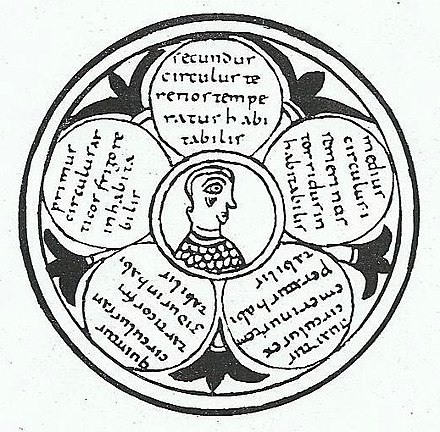
Isidore’s portrayal of the five zones of the Earth.

A possible non-literary but graphic indication that people in the Middle Ages believed that the Earth (or perhaps the world) was a sphere is the use of the ‘orb’ in the regalia of many kingdoms and of the Holy Roman Empire. It is attested from the time of the Christian late-Roman emperor Theodosius II (423) throughout the Middle Ages. However, the word ‘orbis’ means circle and there is no record of a globe as a representation of the Earth since ancient times in the west until 1492, when Martin Behaim, a German textile merchant and cartographer who served King John II of Portugal, was an adviser in matters of navigation and participated in a voyage to West Africa. A recent study of medieval concepts of the sphericity of the Earth noted that “since the eighth century, no cosmographer worthy of note has called into question the sphericity of the Earth”. However, the work of these intellectuals may not have had significant influence on public opinion, and it is difficult to tell what the wider population may have thought of the shape of the Earth, if they considered the question at all.
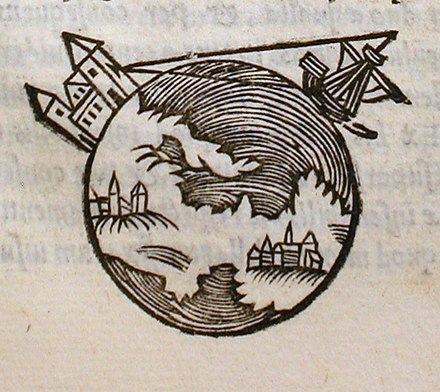
Picture from a 1550 edition of On The Sphere Of The World, the most influential astronomy textbook of thirteenth century Europe.

Portuguese navigation down and around the coast of Africa in the latter half of the 1400s gave wide-scale observational evidence for Earth’s sphericity. In these explorations, the Sun position moved more northward the further south the explorers travelled. Its position directly overhead at noon gave evidence for crossing the equator. These apparent solar motions in detail were more consistent with north–south curvature and a distant Sun, than with any flat-Earth explanation. The ultimate demonstration came when Ferdinand Magellan’s expedition completed the first global circumnavigation in 1521 and one of the survivors of the voyage recorded the loss of a day in the course of the voyage, giving evidence for east–west curvature. In the seventeenth century, the idea of a spherical Earth spread in China due to the influence of the Jesuits, who held high positions as astronomers at the imperial court. The astronomical and geographical treatise ‘Gezhicao’ written in 1648 by Xiong Mingyu explained that the Earth was spherical, not flat or square, and could be circumnavigated.

Logo of the Flat Earth Society.

In the ninteenth century, a historical myth arose which held that the predominant cosmological doctrine during the Middle Ages was that the Earth was flat. However, subsequent studies of medieval science have shown that most scholars in the Middle Ages, including those read by Christopher Columbus, maintained that the Earth was spherical. In 1956, Samuel Shenton set up the International Flat Earth Research Society, better known as the “Flat Earth Society” from Dover, England, as a direct descendant of the Universal Zetetic Society. The availability of communications technology and social media like YouTube, Facebook and Twitter have made it easy for individuals, famous or not, to spread disinformation and attract others to erroneous ideas, including that of the flat Earth. So, to maintain a belief in the face of such overwhelming contrary, publicly available empirical evidence accumulated in the Space Age, modern believers must generally embrace some form of conspiracy theory out of the necessity of explaining why major institutions such as governments, media outlets, schools, scientists, and airlines all assert that the world is a sphere. They tend to not trust observations they have not made for themselves, and often distrust or disagree with each other. For young children who have not yet received information from their social environment, this can mean that their own perception of their surroundings may often lead to a false concept about the shape of the Earth. They can think that the Earth ends at the horizon and that one can fall off the edge. The proper education they receive then helps them to gradually change their false concepts into one of a truly spherical Earth as well as space and other planets.

This week… A quote I like.
“The road to success is always under construction”
~ Unknown.

Click: Return to top of page or Index page

A History Of Tobacco

Tobacco and tobacco-related products have a long history that stretches back to 6,000 BC. The plant today known as tobacco, or Nicotiana tabacum, is a member of the nicotiana genus, a close relative to the poisonous nightshade and could previously only be found in the Americas. It may surprise many to learn just how long tobacco has been known of here on Earth. Research shows that Native Americans first start cultivating the tobacco plant as far back as 6,000 BC. By around 1 BC, indigenous American tribes started smoking tobacco in religious ceremonies and for medicinal purposes. After that, little was known or at least recorded about tobacco, but archeological finds now indicate that humans in the Americas began using tobacco as far back as 12,300 years ago, thousands of years earlier than had previously been documented. It has been found that tobacco was first discovered by the native people of Mesoamerica and South America and later introduced to Europe and the rest of the world.

Christopher Columbus with native Americans. Artist unknown.

So in 1492, Columbus was warmly greeted by the Native American tribes he encountered when he first set foot on the new continent. They brought gifts of fruit, food, spears, and more and among those gifts were dried up leaves of the tobacco plant. As they were not edible and had a distinct smell to them, those leaves, which the Native Americans have been smoking for over two millennia for medicinal and religious purposes, were thrown overboard. However, Columbus soon realised that dried tobacco leaves were a prized possession among the natives, as they bartered with them and often bestowed them as a gift. That same year, the tobacco plant and smoking was introduced to Europeans but it was not until 1531 that Europeans started the cultivation of the tobacco plant in Central America. Then in 1558 the first attempt at tobacco cultivation in Europe began but failed. Rodrigo de Jerez and Luis de Torres are the first Europeans to observe smoking. This was on Cuba and Jerez becomes a staunch smoker, bringing the habit back with him to Spain. However, Jerez’s neighbours were so petrified of the smoke coming out of his mouth and nose that he was soon arrested by the Holy Inquisition and held in captivity for nearly 7 years. However, thanks to a lot of seafarers at the time, smoking became an entrenched habit in both Spain and Portugal before long. Soon Portuguese sailors were planting tobacco around nearly all of their trading outposts, enough for personal use and gifts. They started growing tobacco commercially in Brazil, where it was soon a sought-after commodity and traded across the ports in Europe and the Americas. By the end of the sixteenth century, tobacco plant and use of tobacco were both introduced to virtually every single country in Europe. Tobacco was snuffed or smoked, depending on the preference and doctors claimed that it had medicinal properties. Some, such as Nicolas Monardes in 1571, went as far as to write a book to outline 36 specific ailments that tobacco could supposedly cure, from toothache to lockjaw and cancer. So tobacco had already long been used in the Americas by the time European settlers arrived and took the practice to Europe, where it became popular. Eastern North American tribes have historically carried tobacco in pouches as a readily accepted trade item, as well as smoking it in pipe ceremonies, whether for sacred ceremonies or those to seal a treaty or agreement. In addition to its use in spiritual and religious ceremonies, tobacco has been used for medical treatment of physical conditions. As a pain killer it has been used for earache and toothache and occasionally as a poultice. Some indigenous peoples in California have used tobacco as one ingredient in smoking mixtures for treating colds, where it is usually mixed with the leaves of the small desert sage, or the root of Indian balsam, or cough root (the addition of which was thought to be particularly good for asthma and tuberculosis). In addition to its traditional medicinal uses, tobacco was also used as a form of currency between Native Americans and Colonists from the 1620s as it was considered a monetary standard that lasted twice as long as the gold standard. Tobacco also has ceremonial use and religious use of tobacco is still common among many indigenous peoples in America. For example amongst the Cree and Ojibwe of Canada and the north-central United States, it is offered to the Creator with prayers, and is used in pipe ceremonies as well as being presented as a gift. This is especially traditional when asking an Ojibwe elder a question of a spiritual nature.

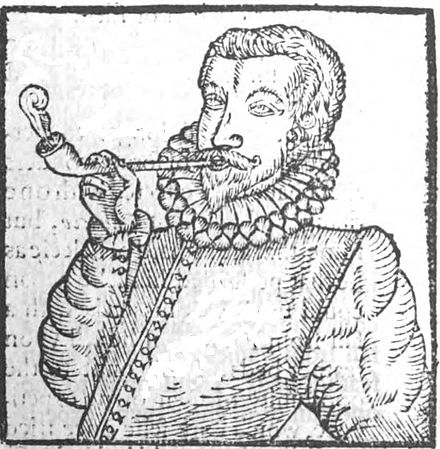
The earliest image of a man smoking a pipe, from ‘Tabaco’ by Anthony Chute (1595).

Greek and Roman accounts exist of smoking hemp seeds, and a Spanish poem c.1276 mentions the energetic effects of lavender smoke, but tobacco was completely unfamiliar to Europeans before the discovery of the New World. Bartolomé de las Casas described how the first scouts sent by Christopher Columbus into the interior of Cuba found “men with half-burned wood in their hands and certain herbs to take their smokes, which are some dry herbs put in a certain leaf, also dry, like those the boys make on the day of the Passover of the Holy Ghost; and having lighted one part of it, by the other they suck, absorb, or receive that smoke inside with the breath, by which they become benumbed and almost drunk, and so it is said they do not feel fatigue. These, muskets as we will call them, they call ‘tabacos’. I knew Spaniards on this island of Española who were accustomed to take it, and being reprimanded for it, by telling them it was a vice, they replied they were unable to cease using it. I do not know what relish or benefit they found in it.” Following the arrival of Europeans, tobacco became one of the primary products fuelling colonisation, and also became a driving factor in the introduction of African slave labour. The Spanish introduced tobacco to Europeans in about 1528, and by 1533, Diego Columbus mentioned a tobacco merchant of Lisbon in his will, showing how quickly the traffic had sprung up. The French, Spanish, and Portuguese initially referred to the plant as the “sacred herb” because of its valuable medicinal properties. Meanwhile the Japanese were introduced to tobacco by Portuguese sailors from 1542, and tobacco first arrived in the Ottoman Empire a few years later, where it attracted the attention of doctors and became a commonly prescribed medicine for many ailments. Although tobacco was initially prescribed as medicine, further study led to claims that smoking caused dizziness, fatigue, dulling of the senses and a foul taste/odour in the mouth. Then a French ambassador in Lisbon named Jean Nicot sent samples to Paris in 1559. Nicot sent leaves and seeds to Francis II and the King’s mother, Catherine of Medici, with instructions to use tobacco as snuff. The king’s recurring headaches (perhaps sinus trouble) were reportedly “marvellously cured” by snuff. However, Francis II nevertheless died at seventeen years of age on 5 December 1560, after a reign of less than two years. French cultivation of ‘herbe de la Reine’ (the queen’s herb) began in 1560. By 1570 botanists referred to tobacco as Nicotiana. In 1563, the Swiss doctor Conrad Gesner reported that chewing or smoking a tobacco leaf “has a wonderful power of producing a kind of peaceful drunkenness”. In 1571, Spanish doctor Nicolas Monardes wrote a book about the history of medicinal plants of the new world. In this he claimed that tobacco could cure thirty-six health problems and reported that the plant was first brought to Spain for its flowers, but “Now we use it to a greater extent for the sake of its virtues than for its beauty”.

“Raleigh’s First Pipe in England”, included in Frederick William Fairholt’s ‘Tobacco, its History and Associations’.

Sir Walter Raleigh introduced Virginia tobacco into England, and a naval commander by the name of John Hawkins was the first to bring tobacco seeds to England. William Harrison ’s ‘English Chronology’ mentions tobacco smoking in the country as of 1573, before Sir Walter Raleigh brought the first “Virginia” tobacco to Europe from the Roanoke Colony, referring to it as ‘tobah’ as early as 1578. In 1595 Anthony Chute published ‘Tabaco’, which repeated earlier arguments about the benefits of the plant and emphasised the health-giving properties of pipe-smoking. A popular song of the early 1600s by Tobias Hume proclaimed that “Tobacco is Like Love”. But the importation of tobacco into England was not without resistance and controversy. King James I wrote a famous polemic entitled ‘A Counterblaste to Tobacco’ in 1604, in which the king denounced tobacco use as “a custome lothsome to the eye, hatefull to the Nose, harmefull to the braine, dangerous to the Lungs, and in the blacke stinking fume thereof, neerest resembling the horrible smoke of theStigian pit that is bottomelesse.” That year, an English statute was enacted that placed a heavy protective tariff on tobacco imports. The duty rose from 2p per pound to 6s 10p, a 40-fold increase, but English demand remained strong despite the high price and Barnabee Rych reported that 7,000 stores in London sold tobacco and calculated that at least 319,375 pounds sterling were spent on tobacco annually. Because the Virginia and Bermuda colonies’ economies were affected by the high duty, in 1624 King James I instead created a royal monopoly. No tobacco could be imported except from Virginia, and a royal license that cost 15 pounds per year was required to sell it. To help the colonies, King Charles II banned tobacco cultivation in England, but allowed herb gardens for medicinal purposes. Meanwhile, it seems that tobacco was introduced elsewhere in continental Europe more easily. Iberia exported “ropes” of dry leaves in baskets to the Netherlands and southern Germany; for a while tobacco was in Spanish called ‘canaster’ after the word for basket (‘canastro), and influenced the German ‘Knaster. In Italy, Prospero Santacroce in 1561 and Nicolo Torbabuoni in 1570 introduced it to gardens after seeing the plant whilst on diplomatic missions. Cardinal Crescenzio introduced smoking to the country in about 1610, after learning about it in England. The Roman Catholic Church did not condemn tobacco as James I did, but Pope Urban VIII threatened excommunication for smoking in a church. In Russia, tobacco use was banned in 1634 except for foreigners in Moscow. Peter the Great, who in England had learned of smoking and the royal monopoly, became the monarch in 1689 and revoking all bans, he licensed the Muscovy Company to import 1.5 million pounds of tobacco per year, with the Russian Crown receiving 28,000 pounds sterling annually. It was in 1633 when Sultan Murad IV banned smoking in the Ottoman Empire. When the ban was lifted by his successor, Ibrahim the Mad, it was instead taxed. In 1682, Damascene jurist Abd al-Ghani al-Nabulsi declared: “Tobacco has now become extremely famous in all the countries of Islam … People of all kinds have used it and devoted themselves to it … I have even seen young children of about five years applying themselves to it.” There are many events too numerous to detail here on tobacco, so here are just a notable few, with occasional explanations. 1624 saw the Popes ban use of tobacco in holy places, considering sneezing (snuff) too close to sexual pleasures. In 1633, Turkey introduced a death penalty for smoking but it didn’t stay in effect for long and was lifted in 1647. In 1650, tobacco arrived in Africa as the European settlers grew it and used it as a currency. Then in 1700 the African slaves were first forced to work on tobacco plantations, years before they became a workforce in the cotton fields. 1730 saw the first American tobacco companies open their doors in Virginia and in 1750, a Damascene townsmen observed “a number of women greater than the men, sitting along the bank of the Barada River. They were eating and drinking, and drinking coffee and smoking tobacco just as the men were doing”. In 1753 a Tobacco genus was named by a Swedish botanist Carolus Linnaeus, ‘nicotiana rustica’ and ‘nicotiana tabacum’ named for the first time. Then in 1791, British doctors found that snuff leads to an increased risk of nose cancer. There was the first American tobacco tax in 1794 and in 1826 the alkaloid Nicotine was isolated for the first time. A few years later, in 1847, Philip Morris opened their first shop in Great Britain, selling hand-rolled Turkish cigarettes. Around 1861 the first American cigarette factory produced 20 million cigarettes and in 1880 the first cigarette-rolling machine was developed. Then in 1890, the American Tobacco Company opened its doors. In 1912 there is the first reported connection between smoking and lung cancer, but by 1918 an entire generation of young men returned from war, addicted to cigarettes. This meant that in 1924 over 70 billion cigarettes were sold in the United States. But by 1950 it seems that 50% of a cigarettes included a filter tip. Things were changing, as in 1967 there was a definitive link between smoking to lung cancer and evidence was presented that it was causing heart problems. In 1970 the tobacco manufacturers became legally obliged to print a warning on the labels that smoking is a health hazard and between 1970 and 1990 the same companies were faced with a series of lawsuits. Courts then limited their advertising and marketing, which had an effect on certain sports, like motor racing where advertising was no longer allowed. Then in 1992 the Nicotine patch was introduced and in the following years more cessation products were starting to be developed. In 1996, researchers found conclusive evidence that tobacco damages a cancer-suppressor gene. Then in 1997, tobacco companies were hit with major lawsuits, ordering them to spend large amounts of money on anti-smoking campaigns over the next 25 years which was predominantly focused on educating the young on dangers of smoking. Also from 1990, bans on public smoking came into effect in most states in America, as well as in other countries in the world.

A tobacco plantation in Queensland, Australia in 1933.

Meanwhile, cigarettes were gaining in popularity. In fact, they came to the height of their popularity during the First and Second World Wars. Tobacco companies sent millions of packs of cigarettes to soldiers on the front lines, creating hundreds of thousands of faithful and addicted consumers in the process. Cigarettes were even included into soldiers’ C-rations – which contained mostly food and supplements, along with cigarettes. The 1920s were also the period when tobacco companies started marketing heavily to women, creating brands such as ‘Mild as May’ to try to feminize the habit and make it more appealing to women. The number of female smokers in the United States tripled by 1935. Then in the mid-twentieth century, medical research demonstrated the severe negative health effects of tobacco smoking, including lung and throat cancer, which has led to a sharp decline in tobacco use. In addition, tobacco and tobacco products are more regulated today. Companies have lost countless lawsuits and are now forced to clearly label their products as having a detrimental effect on the health of a person. Also, tobacco advertising is severely limited and regulated. Still, tobacco companies make a great deal of money every year, destroying the health of others and it is estimated that there are around one billion tobacco users in the world today. The damage caused by this addiction amounts to massive health expenses and environmental damages and more effort has still to be made to educate people, especially teenagers and young adults, about the dangers of smoking. There is help and alternatives to smoking, for example various Nicotine replacement therapies such as skin patches. When I was in my twenties I tried smoking a pipe just once but was ill, so never did that again. I was also a keen singer as well as playing a trumpet in a local brass band, so wouldn’t smoke just to be the same as a couple of my friends! Still, I developed asthma which may not have been helped as my father smoked. In fact we are sure it was that which brought about his death just a few months before his seventieth birthday. My mother, who did smoke on rare occasions when she was younger, survived until she was ninety-five. I think that says it all.

This week…
There was an engineer who regularly made house calls to help fix computer problems for people. Afterwards, he had to write a report on what the problem had been and sometimes he would simply put ‘PICNIC’. One day he was asked what was meant by this, and he explained: “Problem In Chair, Not In Computer”…

Click: Return to top of page or Index page
Good Friday

Good Friday is the Friday before Easter, which is calculated differently in Eastern Christianity and Western Christianity. Easter falls on the first Sunday following the Paschal Full Moon, the full moon on or after 21 March, taken to be the date of the vernal equinox. The Western calculation uses the Gregorian calendar, whilst the Eastern calculation uses the Julian calendar, whose 21 March now corresponds to the Gregorian calendar’s 3 April. The calculations for identifying the date of the full moon also differ. In Eastern Christianity, Easter can fall between 22 March and 25 April on Julian Calendar (thus between 4 April and 8 May in terms of the Gregorian calendar, during the period 1900 and 2099), so Good Friday can fall between 20 March and 23 April, inclusive, or between 2 April and 6 May in terms of the Gregorian calendar. Good Friday itself is a Christian holiday commemorating the crucifixion of Jesus and his death at Calvary and it is observed during Holy Week as part of the Paschal Triduum. Members of many Christian denominations observe Good Friday with both fasting and church services. In many Catholic, Lutheran, Anglican and Methodist churches the ‘Service of the Great Three Hours’ Agony’ is held from noon until 3:00pm, the time duration that the Bible records as darkness covering the land to Jesus’ sacrificial death on the cross, whilst the Communicants of the Moravian Church have a Good Friday tradition of cleaning gravestones in Moravian cemeteries. The date of Good Friday varies from one year to the next in both the Gregorian and Julian calendars. However, Eastern and Western Christianity disagree over the computation of the date of Easter and therefore of Good Friday, which is regarded as a widely instituted legal holiday around the world, including in most Western countries and twelve U.S. states. Some predominantly Christian countries, such as Germany, have laws prohibiting certain acts such as dancing and horse racing, in remembrance of the sombre nature of Good Friday. The name ‘Good Friday’ comes from the sense ‘pious, holy’ of the word “good”. Less common examples of expressions based on this obsolete sense of “good” include “the good book” for the Bible, “good tide” for “Christmas”. A common folk etymology incorrectly analyses “Good Friday” as a corruption of “God Friday” similar to the linguistically correct description of “goodbye“ as a contraction of “God be with you”. In Old English, the day was called “Long Friday”, and equivalents of this term are still used in Scandinavian languages and Finnish. I have learned that in Latin, the name used by the Catholic Church until 1955 was “Friday of Preparation [for the Sabbath]”), then in the 1955 reform of Holy Week, it was renamed “Friday of the Passion and Death of the Lord”, then in the new rite introduced in 1970, shortened to “Friday of the Passion of the Lord”. In Dutch, Good Friday is known as ‘Goede Vrijdag’, in Frisian as ‘Goedfreed’. In German-speaking countries, it is generally referred to as ‘Karfreitag’’, or “Mourning Friday”, with ‘Kar’ from Old High German ‘kara’‚ “bewail”, “grieve”‚ “mourn”, which is related to the English word “care” in the sense of cares and woes), but it is sometimes also called ‘Stiller Freitag’ (“Silent Friday”) and ‘Hoher Freitag’ (“High Friday, Holy Friday”). In the Scandinavian languages and Finnish it is called the equivalent of “Long Friday” as it was in Old English (“Langa frigedæg”). In Irish it is known as ‘Aoine an Chéasta’, “Friday of Crucifixion”, from ‘céas’, “suffer;” similarly, it is ‘DihAoine na Ceusta’ in Scottish Gaelic. In Welsh it is called ‘Dydd Gwener y Groglith’, “Friday of the Cross-Reading”, referring to ‘Y Groglith’, a medieval Welsh text on the Crucifixion of Jesus that was traditionally read on Good Friday. In Greek, Polish, Hungarian, Romanian, Breton and Armenian it is generally referred to as the equivalent of “Great Friday” whilst In Serbian, it is referred either as “Great Friday” or, more commonly, “Loved Friday”. In Bulgarian, it is also called “Great Friday”, or, more commonly, “Crucified Friday”. In French, Italian, Spanish and Portuguese it is referred to as “Holy Friday”, and in Arabic, it is also known as “Great Friday”.

‘The Judas Kiss’ by Gustave Doré, 1866.

According to the accounts in the Gospels, the royal soldiers, guided by Jesus’ disciple Judas Iscariot, arrested Jesus in the Garden of Gethsemane. Judas received 30 pieces of silver for betraying Jesus and told the guards that whomever he kisses is the one they are to arrest. Following his arrest, Jesus was taken to the house of Annas, the father-in-law of the high priest, Caiaphas. There he was interrogated with little result, bound and sent to Caiaphas where the Sanhedrin, an assembly of elders known as rabbi’s who were appointed to sit as a tribunal in every city in the ancient [Land of Israel, had assembled. Conflicting testimony against Jesus was brought forth by many witnesses, to which Jesus answered nothing. Finally the high priest adjured Jesus to respond under solemn oath, saying “I adjure you, by the Living God, to tell us, are you the Anointed One, the Son of God?” Jesus testified ambiguously, “You have said it, and in time you will see the Son of Man seated at the right hand of the Almighty, coming on the clouds of Heaven.” The high priest condemned Jesus for blasphemy and the Sanhedrin concurred with a sentence of death. One of the disciples of Jesus, Peter, who was waiting in the courtyard, also denied Jesus three times to bystanders while the interrogations were proceeding just as Jesus had foretold. In the morning, the whole assembly brought Jesus to the Roman governor Pontius Pilate under charges of subverting the nation, opposing taxes to Caesar, and making himself a king. Pilate authorised the Jewish leaders to judge Jesus according to their own law and execute sentencing, but the Jewish leaders replied that they were not allowed by the Romans to carry out a sentence of death. Pilate questioned Jesus and told the assembly that there was no basis for sentencing. Upon learning that Jesus was from Galilee, Pilate referred the case to the ruler of Galilee, King Herod, who was in Jerusalem for the Passover Feast. Herod questioned Jesus but received no answer so sent Jesus back to Pilate, who told the assembly that neither he nor Herod found Jesus to be guilty. Pilate resolved to have Jesus whipped and released, but under the guidance of the chief priests, the crowd asked for Barabbas, who had been imprisoned for committing murder during an insurrection. Pilate asked what they would have him do with Jesus, and they demanded, “Crucify him”. Pilate’s wife had seen Jesus in a dream earlier that day, and she forewarned Pilate to “have nothing to do with this righteous man”. Pilate had Jesus flogged and then brought him out to the crowd to release him. The chief priests informed Pilate of a new charge, demanding Jesus be sentenced to death “because he claimed to be God’s son.” This possibility filled Pilate with fear, and he brought Jesus back inside the palace and demanded to know from where he came.

Antonio Ciseri’s nineteenth century depiction of Jesus with Pontius Pilate.

Coming before the crowd one last time, Pilate declared Jesus innocent and washed his own hands in water to show he had no part in this condemnation. Nevertheless, Pilate handed Jesus over to be crucified in order to forestall a riot. The sentence written was “Jesus of Nazareth, King of the Jews.” Jesus carried his cross to the site of execution (assisted by Simon of Cyrene), called the “place of the Skull”, or “Golgotha“ in Hebrew and in Latin “Calvary”. There he was crucified along with two criminals. Jesus agonised on the cross for six hours and, during his last three hours on the cross, from noon to 3pm, darkness fell over the whole land. Jesus spoke from the cross, quoting the messianic Psalm 22: “My God, my God, why have you forsaken me?” Then, with a loud cry, Jesus gave up his spirit. There was an earthquake, tombs broke open, and the curtain in the Temple was torn from top to bottom. The centurion on guard at the site of crucifixion declared, “Truly this was God’s Son!”. Then Joseph of Arimathea, a member of the Sanhedrin and a secret follower of Jesus, who had not consented to His condemnation, went to Pilate to request the body of Jesus. Another secret follower of Jesus and member of the Sanhedrin named Nicodemus brought about a hundred-pound weight mixture of spices and helped wrap the body of Jesus. Pilate asked confirmation from the centurion of whether Jesus was dead. A soldier pierced the side of Jesus with a lance causing blood and water to flow out and the centurion informed Pilate that Jesus was dead. Joseph of Arimathea took Jesus’ body, wrapped it in a clean linen shroud, and placed it in his own new tomb that had been carved in the rock in a garden near the site of the crucifixion. Nicodemus also brought 75 pounds of myrrh and aloes, and placed them in the linen with the body, in keeping with Jewish burial customs. They rolled a large rock over the entrance of the tomb, then they returned home and rested, because Shabbat had begun at sunset. Matt. 28:1 “After the Shabbat, at dawn on the first day of the week, Mary Magdalene and the other Mary went to look at the tomb”. i.e. “After the Sabbath, at dawn on the first day of the week,…”. “He is not here; he has risen, just as he said….”. (Matt. 28:6)

A Crucifix, prepared for veneration.

The Catholic Church regards Good Friday and Holy Saturday as the Paschal fast. In the Latin Church, a ‘fast day’ is understood as having only one full meal and two ‘collations’ (a smaller repast, the two of which together do not equal the one full meal) – although this may be observed less stringently on Holy Saturday than on Good Friday. Interestingly the Roman Rite has no celebration of Mass between the Lord’s Supper on Holy Thursday evening and the Easter Vigil, unless a special exemption is granted for rare solemn or grave occasions by the Vatican or the local bishop. The only sacraments celebrated during this time are Baptism, for those in danger of death, Penance and Anointing of the Sick. Whilst there is no celebration of the Eucharist, it is distributed to the faithful only in the Celebration of the Lord’s Passion, but can also be taken at any hour to the sick who are unable to attend this celebration. The Celebration of the Passion of the Lord takes place in the afternoon, ideally at three o’clock, however for pastoral reasons (especially in countries where Good Friday is not a public holiday) it is permissible to celebrate the liturgy earlier, even shortly after midday, or at a later hour. The celebration consists of three parts, these being the liturgy of the word, the adoration of the cross, and the Holy communion. The altar is laid bare, without cross, candlesticks and altar cloths. It is also customary to empty the holy water fonts, in preparation of the blessing of the water at the Easter Vigil. Traditionally, no bells are rung on Good Friday or Holy Saturday until the Easter Vigil. The liturgical colour of the vestments used is red. Before 1970 vestments were black, except for the Communion part of the rite when violet was used and if a bishop or abbot celebrates, he wears a plain mitre. Before the reforms of the Holy Week liturgies in 1955, black was used throughout. The Vespers of Good Friday are only prayed by those who could not attend the Celebration of the Passion of the Lord. Also the Three Hours’ Devotion that is based on the Seven Last Words from the Cross begins at noon and ends at 3pm, the time that the Christian tradition teaches that Jesus died on the cross.

The Great Intercessions, sung at Heiligenkreuz Abbey, Austria.

There is also the Liturgy, which is a customary public ritual of worship that is performed by a religious group. The Good Friday liturgy consists of three parts, these being the Liturgy of the Word, the Veneration of the Cross, and the Holy Communion. The Liturgy of the Word consists of the clergy and assisting ministers entering in complete silence, without any singing. They then silently make a full prostration which signifies the abasement or fall of humans on Earth. It also symbolises the grief and sorrow of the Church. Then follows the Collect prayer, and the reading or chanting of Isaiah 52:13–53:12, Hebrews 4:14–16, Hebrews 5:7–9, and the Passion account from the Gospel of John, traditionally divided between three deacons, yet usually read by the celebrant and two other readers. In the older form of the Mass known as the Tridentine Mass, the readings for Good Friday are taken from Exodus 12:1-11 and the Gospel according to St. John (John 18:1-40); (John 19:1-42). The Great Intercessions, also known as ‘orationes sollemnes’, immediately follow the Liturgy of the Word and consists of a series of prayers for the Church, the Pope, the clergy and laity of the Church, those preparing for baptism, the unity of Christians, the Jews, those who do not believe in Christ, those who do not believe in God, those in public office, and those in special need. After each prayer intention, the deacon calls the faithful to kneel for a short period of private prayer, the celebrant then sums up the prayer intention with a Collect-style prayer. As part of the pre-1955 Holy Week Liturgy, the kneeling was omitted only for the prayer for the Jews. The Adoration of the Cross has a crucifix, not necessarily the one that is normally on or near the altar at other times of the year, solemnly unveiled and displayed to the congregation, and then venerated by them, individually if possible and usually by kissing the wood of the cross, whilst the ‘Improperia’ or Reproaches with the appropriate hymns are chanted. Holy Communion is bestowed according to a rite based on that of the final part of Mass, beginning with the Lord’s Prayer, but omitting the ceremony of “Breaking of the Bread“ and its related acclamation, the Agnus Dei. The Eucharist, consecrated at the Evening Mass of the Lord’s Supper on Holy Thursday, is distributed at this service. Before the Holy Week reforms of Pope Pius XII in 1955, only the priest received Communion in the framework of what was called the ‘Mass of the Presanctified’, which included the usual Offertory prayers, with the placing of wine in the chalice, but which omitted the Canon of the Mass. The priest and people then departed in silence, and the altar cloth removed, leaving the altar bare except for the crucifix and two or four candlesticks.

In the Protestant church, the 1662 Book of Common Prayer did not specify a particular rite to be observed on Good Friday but local custom came to mandate an assortment of services, including the Seven Last Words from the Cross and a three-hour service consisting of Matins, Ante-communion (using the Reserved Sacrament in high church parishes) and Evensong. In more recent times, revised editions of the Prayer Book and Common Worship have re-introduced pre-Reformation forms of observance of Good Friday corresponding to those in today’s Roman Catholic Church.

The chancel of a Lutheran church.

The chancel of this Lutheran church is adorned with black paraments, or hangings on and around the altar, such as altar cloths, as well as the cloths hanging from the pulpit and lectern, this being the liturgical colour associated with Good Friday in the Lutheran Churches. Also, in Lutheran tradition from the sixteenth to the twentieth century, Good Friday was the most important religious holiday, and abstention from all worldly works was expected. During that time, Lutheranism had no restrictions on the celebration of the Eucharist on Good Friday. On the contrary, it was a prime day on which to receive the Eucharist, and services were often accentuated by special music such as the St Matthew Passion by Johann Sebastian Bach.
More recently, Lutheran liturgical practice has recaptured Good Friday as part of the larger sweep of the great Three Days: Maundy Thursday, Good Friday, and the Vigil of Easter. Along with observing a general Lenten fast, many Lutherans emphasise the importance of Good Friday as a day of fasting within the calendar. ‘A Handbook for the Discipline of Lent’ recommends the Lutheran guideline to “Fast on Ash Wednesday and Good Friday with only one simple meal during the day, usually without meat”.

The altar of a Methodist church on Maundy Thursday.

On Maundy Thursday, the altar of this Methodist church was stripped and the crucifix veiled in black for Good Friday, as black is the liturgical colour for Good Friday in the United Methodist Church. A wooden cross sits in front of the bare chancel for the veneration of the cross ceremony, which occurs during the United Methodist Good Friday liturgy. Many Methodist denominations commemorate Good Friday with fasting, as well as a [service of worship based on the Seven Last Words from the Cross. This liturgy is known as the Three Hours Devotion as it starts at noon and concludes at 3pm, the latter being the time that Jesus died on the cross. Other churches have practices only performed at this particular time, for example in the Moravian Church, communicants practice the Good Friday tradition of cleaning gravestones in Moravian cemeteries. It is also not uncommon for some communities to hold interdenominational services on Good Friday. As well as the United Kingdom, Good Friday is observed as a public or federal holiday in many other countries and territories with a strong Christian tradition such as Australia, Bermuda, Brazil, Canada, the countries of the Caribbean, Chile, Colombia, Costa Rica, Czech Republic, Ecuador, Finland, Germany, Hungary, Malta, Mexico, New Zealand, Peru, the Philippines, Portugal, the Scandinavian countries, Singapore, Spain, Switzerland and Venezuela. In the United States, just twelve states observe Good Friday as state holiday, these being Connecticut, Texas, Delaware, Hawaii, Indiana, Tennessee, Florida, Kentucky, Louisiana, New Jersey, North Carolina and North Dakota.

A Good Friday service in Ireland.

In the Republic of Ireland, Good Friday is not an official public holiday, but most non-retail businesses close for the day. Up until 2018 it was illegal to sell alcoholic beverages on Good Friday, with some exceptions, so pubs and off-licences generally closed. Critics of the ban included the catering and tourism sector, but surveys showed that the general public were divided on the issue. In Northern Ireland, a similar ban operates until 5pm on Good Friday. Other countries also make Good Friday a public holiday or at least have ‘restricted trading’. In the United States, Good Friday is not a government holiday at the federal level but individual states, counties and municipalities may observe the holiday. Some Baptist congregations and some non-denominational churches oppose the observance of Good Friday, regarding it as a so-called “papist“ tradition, and instead observe the Crucifixion of Jesus on Wednesday to coincide with the Jewish sacrifice of the Passover Lamb, to which a number of Christians believe is an Old Testament pointer to Jesus Christ). A Wednesday Crucifixion of Jesus allows for Him to be in the tomb for three days and three nights as he told the Pharisees he would be (Matthew 12:40), rather than two nights and a day by inclusive counting, as was the norm at that time if he had died on a Friday. Further support for a Wednesday crucifixion based on Matthew 12:40 includes the Jewish belief that death was not considered official until the beginning of the fourth day, which is disallowed with the traditional Friday afternoon to Sunday morning period of time.

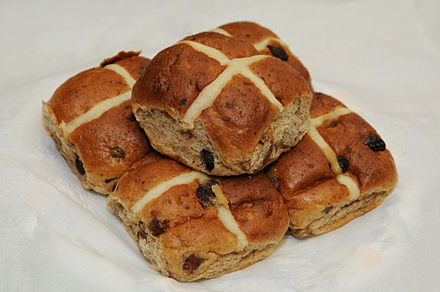
Hot cross buns are traditionally toasted and eaten on Good Friday in Britain, Canada, Australia and New Zealand.

Here in the United Kingdom, Good Friday was historically a common law holiday and is recognised as an official public holiday, also known as a Bank Holiday. All state schools are closed and most businesses treat it as a holiday for staff, although many retail stores now remain open. Government services in Northern Ireland operate as normal on Good Friday, substituting Easter Tuesday for the holiday. Traditionally there has been no horse racing on Good Friday in the UK, but in 2008, betting shops and stores opened for the first time on this day and in 2014 Lingfield Park and Musselburgh staged the UK’s first Good Friday race meetings. The BBC has for many years introduced its 7am News broadcast on Radio 4 on Good Friday with a verse from Isaac Watts‘ hymn “When I Survey the Wondrous Cross“. That is something I only found out as part of my research for this blog, but it really is a lovely hymn with very well-suited words.

This week…Walls Have Ears
Or, be careful what you say as people may be eavesdropping. It is said that the Louvre Palace in France was believed to have a network of listening tubes so that it would be possible to hear everything that was said in different rooms. People say that this is how the Queen Catherine de Medici discovered political secrets and plots.

Click: Return to top of page or Index page

Squirrels

Squirrels are members of the biological family ‘Sciuridae’, which includes small or medium-size rodents. The squirrel family includes tree squirrels, ground squirrels, chipmunks, prairie dogs (which are rodents, but named for their habitat and warning call, which sounds similar to a dog’s bark) and flying squirrels. Squirrels are indigenous to the Americas, Eurasia, and Africa, and were introduced by us humans to Australia. The earliest known fossilised squirrels date from the Eocene epoch, a geological period that lasted from about 56 to 33.9 million years ago, and amongst other living rodent families the squirrels are most closely related to the mountain beaver and the dormouse. The word ‘squirrel’, first attested in 1327, comes from the Anglo-Norman ‘esquirel’ which is from the Old French ‘escurel’, the reflex of a Latin word ‘sciurus’, which was taken from the Ancient Greek word ‘skiouros’, from ‘shadow-tailed’, referring to the long bushy tail which many of its members have. A group of squirrels is called a ‘dray’ or a ‘scurry’.

Reaching out for food on a garden bird feeder, this squirrel can rotate its hind feet, allowing it to descend a tree head-first.

Squirrels are generally small animals, ranging in size from the African pygmy squirrel and least pygmy squirrel at 10 to 14 cm (3.9 to 5.5 in) in total length and just 12 to 26 g (0.42 to 0.92 oz) in weight, to the Bhutan giant flying squirrel at up to 1.27 m (4 ft 2 in) in total length, and several marmot species, which can weigh 8 kg (18 lb) or more. Squirrels typically have slender bodies with very long bushy tails and large eyes. In general, their fur is soft and silky, though much thicker in some species than others. The coat colour of squirrels is highly variable between, often even within, species. In most of the species the hind limbs are longer than the fore limbs, whilst all species have either four or five toes on each foot. The feet, which include an often poorly developed thumb, have soft pads on the undersides and versatile, sturdy claws for grasping and climbing. Tree squirrels, unlike most mammals, can descend a tree head-first. They do so by rotating their ankles 180 degrees, enabling the hind feet to point backward and thus grip the tree bark from the opposite direction. Squirrels live in almost every habitat, from tropical rainforest to semi-arid desert, avoiding only the high polar regions and the driest of deserts. They are predominantly herbivorous, subsisting on seeds and nuts, but many will eat insects and even small vertebrates. As their large eyes indicate, squirrels have an excellent sense of vision, which is especially important for the tree-dwelling species. Many also have a good sense of touch, with ‘vibrissae’
(whiskers, to you and me) on their limbs as well as their heads. These hairs are finely specialised for this purpose, whereas other types of hair are coarser as tactile sensors. Their teeth follow the typical rodent pattern, with large incisors (for gnawing) that grow throughout life, and cheek teeth (for grinding) that are set back behind a wide gap. Many juvenile squirrels die in the first year of life. Adult squirrels can have a lifespan of 5 to 10 years in the wild. Some can survive 10 to 20 years in captivity. Premature death may occur when a nest falls from the tree, in which case the mother may abandon her young if their body temperature is not correct. Many such baby squirrels are rescued and fostered by a professional wildlife carer until they can be safely returned to the wild, although the density of squirrel populations in many places and the constant care required by premature squirrels means that few people are willing to spend their time doing this, so sadly such animals are routinely euthanised instead. A squirrel has a multifunctional use of its tail, including to keep rain, wind, or cold off itself, to cool off when hot, by pumping more blood through its tail, as a counterbalance when jumping about in trees, as a parachute when jumping and to signal with. When a squirrel sits upright, its tail folded up its back may stop predators looking from behind from seeing the characteristic shape of a small mammal.

A squirrel in sunlight.

Squirrels mate either once or twice a year and, following a gestation period of three to six weeks, give birth to a number of offspring that varies by species. The young are ‘altricial’, being born naked, toothless, and blind. In most species of squirrel, the female alone looks after the young, which are weaned at six to ten weeks and become sexually mature by the end of their first year. In general, the ground-dwelling squirrel species are social, often living in well-developed colonies, while the tree-dwelling species are more solitary. In zoology, a crepuscular animal is one that is active primarily during the twilight period. This is distinguished from diurnal and nocturnal behaviour, where an animal is active during the hours of daylight and of darkness respectively. Some crepuscular animals may also be active by moonlight or during an overcast day. Matutinal animals are active only before sunrise and vespertine only after sunset. Hence our ‘mattins’ and ‘vespers’ in the Christian church. Ground squirrels and tree squirrels are usually either diurnal or crepuscular, whilst the flying squirrels tend to be nocturnal—except for lactating flying squirrels and their young, which have a period of diurnality during the summer.

A squirrel eating a fruit in Manyara National Park, Tanzania.

Because squirrels cannot digest cellulose, they must rely on foods rich in protein, carbohydrates and fats. In temperate regions, early spring is the hardest time of year for squirrels because the nuts they buried are beginning to sprout (and thus are no longer available to eat), whilst many of the usual food sources are not yet available. During these times, squirrels rely heavily on tree buds. Squirrels, being primarily herbivores, eat a wide variety of plants, as well as nuts, seeds, conifer cones, fruits, fungi and green vegetation. Some squirrels though do consume meat, especially when faced with hunger. They have been known to eat small birds, young snakes and smaller rodents, as well as birds eggs and insects. Some tropical squirrel species have even shifted almost entirely to a diet of insects. Squirrels, like pigeons and other fauna, are synanthropes in that they benefit and thrive from their interaction in human environments. This gradual process of successful interaction is called ‘synurbanisation’, where squirrels lose their inherent fear of humans in an urban environment. When squirrels were almost completely eradicated during the Industrial Revolution in New York, they were later re-introduced to ‘entertain and remind’ us humans of nature. The squirrel blended into the urban environment so efficiently that when synanthropic behaviour stopped (i.e. people did not leave their rubbish outside during particularly cold winters), the squirrels could become aggressive in their search for food. Aggression and predatory behaviour has been observed in various species of ground squirrels, in particular the thirteen-lined ground squirrel.

A three-coloured Prevost’s Squirrel in Zagreb Zoo, Croatia.

Living squirrels are divided into five subfamilies, with about fifty-eight genera and some two hundred and eighty-five species. The oldest squirrel fossil, ‘Hesperopetes’, dates back to the ‘Chadronian’ (late Eocene) about forty to thirty-five million years ago and is similar to the modern flying squirrel. A variety of fossil squirrels, from the latest Eocene to the Miocene, have not been assigned with certainty to any living lineage. Though at least some of these were probably variants of the oldest basal ‘protosquirrels’, in the sense that they lacked the full range of traits of present living squirrels. The distribution and diversity of such ancient and ancestral forms suggest the squirrels as a group may have originated in North America. Apart from these sometimes little-known fossil forms, the evolutionary biology of the living squirrels is fairly straightforward. The three main lineages are the Ratufinae (Oriental giant squirrels), Sciurillinae and all other subfamilies. The Ratufinae contain a mere handful of living species in tropical Asia. The neotropical pygmy squirrel of tropical South America is the sole living member of the Sciurillinae. The third lineage, by far the largest, has a near-cosmopolitan distribution and this further supports the hypothesis that the common ancestor of all squirrels, living and fossil, lived in North America, as these three most ancient lineages seem to have radiated from there. If squirrels had originated in Eurasia for example, one would expect quite ancient lineages in Africa, but African squirrels seem to be of more recent origin. So the main group of squirrels can be split into five subfamilies. The Callosciurinae, sixty species mostly found in South East Asia, the Ratufinae, four cat-sized species found in South and South-East Asia, the Sciurinae, containing the flying squirrels and the tree squirrels, Sciurillinae, a single South American species and Xerinae, including three tribes of mostly terrestrial squirrels, including marmots, chipmunks and [prairie dogs. There are also other Holarctic ground squirrels, African and some Eurasian ground squirrels, and African tree squirrels. It is thought that squirrels are a cause for concern because they often cause electrical disruptions and it has been hypothesised by some that the threat to the internet infrastructure and services posed by squirrels may exceed that posed by cyber-attacks. It makes me wonder who thinks of these ideas. Squirrels have been reported to be ‘successfully trained’ in Chongqing, China to sniff out illicit drugs and in 2023 a team of six Eurasian red squirrels became part of a sub-unit within the Chongqing city police dog brigade. According to Chongqing police department, their small size and agility are beneficial as they are able to help the police detect drugs through tiny spaces in warehouses and storage units that dogs are unable to reach. Yin Jin, a police dog handler, who had been assigned to train these squirrels told ‘The Paper’ that “these squirrels have an acute sense of smell. But in the past, our training problems for small rodents was not developed enough to attempt a program like this” and that her team of squirrels have so far done an “excellent job” in drug detection exercises, but are not yet ready to be deployed. One day, perhaps?

This week…
One of the many things my father said to me and I have tried to always remember, is to never promise anything that you are not prepared to carry out. Otherwise folk can and will take advantage. It is a lesson well-learned.

Click: Return to top of page or Index page

The Steam Engine

So let’s get the “technical” bits out of the way first! In thermodynamics and engineering, an ‘engine’ is defined as “a system that converts heat to usable energy, particularly mechanical energy, which can then be used to do mechanical work”. The steam engine performs this mechanical work using steam as its working fluid and it uses the force produced by steam pressure to push a piston back and forth inside a cylinder. This pushing force can be transformed, by a connecting rod and crank, into a rotational force for work. Steam engines are external combustion engines where the working fluid is separated from the combustion products. Easy, isn’t it!

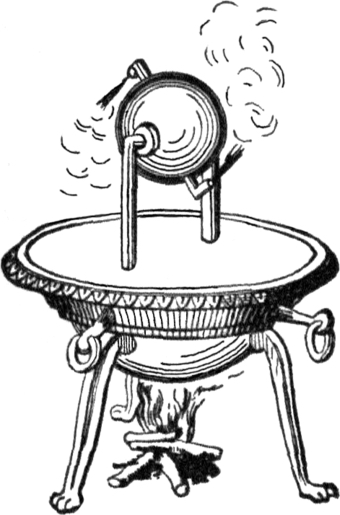
An ‘aeolipile’ rotates due to the steam escaping from the arms. No practical use was made of this effect.

Although steam-driven devices were known as early as the above ‘aeolipile’ in the first century AD, with a few other uses recorded in the sixteenth century, in 1606 Jerónimo de Ayanz y Beaumont patented his invention of the first steam-powered water pump for draining mines. Thomas Savery is considered the inventor of the first commercially used steam powered device, a steam pump that used steam pressure operating directly on the water. The first commercially successful engine that could transmit continuous power to a machine was developed in 1712 by Thomas Newcomen, then James Watt made a critical improvement in 1764 by removing spent steam to a separate vessel for condensation, thus greatly improving the amount of work obtained per unit of fuel consumed.

Jacob Leupold’s steam engine.

The first commercial steam-powered device was a water pump, developed in 1698 by Thomas Savery. Small engines were effective, though larger models were problematic and were prone to boiler explosions. Savery’s engine was used in mines, pumping stations and supplying water to water wheels which powered textile machinery. Then in 1720 Jacob Leupold described a two-cylinder high-pressure steam engine and the invention was published in his major work “Theatri Machinarum Hydraulicarum”. The engine used two heavy pistons to provide motion to a water pump, where each piston was raised by the steam pressure and returned to its original position by gravity.

Early Watt steam pumping engine.

The next major step occurred when James Watt developed an improved version, developing his engine further and modifying it to provide a rotary motion suitable for driving machinery. This enabled factories to be sited away from rivers, and accelerated the pace of the Industrial Revolution. But Watt’s designs were low pressure condensing engines and his patent prevented others from making high pressure and compound engines. Shortly after Watt’s patent expired in 1800, in 1801 Richard Trevithick and also (but separately) Oliver Evans, introduced engines using high-pressure steam. Trevithick obtained his high-pressure engine patent in 1802 and Evans had made several working models before then. These were much more powerful for a given cylinder size than previous engines and could be made small enough for transport applications. Thereafter, technological developments and improvements in manufacturing techniques (partly brought about by the adoption of the steam engine as a power source) resulted in the design of more efficient engines that could be smaller, faster, or more powerful, depending on the intended application. The Cornish engine was developed by Trevithick and others in the 1810s and it used high-pressure steam expansively, then condensed the low-pressure steam, making it relatively efficient. The Cornish engine design rather limited it to pumping, so they were used in mines and for water supply until the late nineteenth century. Early builders of stationary steam engines considered that horizontal cylinders would be subject to excessive wear, and as a result their engines were arranged with the pistons in a vertical position, but in time the horizontal arrangement became more popular, allowing compact, but powerful engines to be fitted in smaller spaces. The star of the horizontal engine was the Corliss steam engine, patented in 1849, which was a four-valve design with separate steam admission and exhaust valves and automatic variable steam cutoff. Corliss was given the Rumford Medal, an award bestowed by Britain’s Royal Society every alternating year for “an outstandingly important recent discovery in the field of thermal or optical properties of matter made by a scientist working in Europe”, and the committee said that “no one invention since Watt’s time has so enhanced the efficiency of the steam engine”. In addition to using 30% less steam, it provided more uniform speed due to variable steam cut off, making it well suited to manufacturing, especially cotton spinning.

A steam powered road-locomotive.

As the development of steam engines progressed through the eighteenth century, various attempts were made to apply them to road and railway use. In 1784, William Murdoch, a Scottish inventor, built a model steam road locomotive. The first full-scale working railway steam locomotive was built by Richard Trevithick here in the United Kingdom and on 21 February 1804 the world’s first railway journey took place as Trevithick’s unnamed steam locomotive hauled a train along the tramway from the Pen-y-darren ironworks near Merthyr Tydfil to Abercynon in South Wales. The design incorporated a number of important innovations that included using high-pressure steam, which reduced the weight of the engine and increased its efficiency. Trevithick visited the Newcastle area later in 1804 and the colliery railways in north-east England became the leading centre for experimentation and development of steam locomotives. Trevithick continued his own experiments using a trio of locomotives, concluding with the ‘Catch Me Who Can’ in 1808 and in 1825 George Stephenson built the ‘Locomotion’ for the Stockton and Darlington Railway. This was the first public steam railway in the world and then in 1829, he built ‘The Rocket’ which was entered in and won the Rainhill Trials. The Liverpool and Manchester Railway opened in 1830, making exclusive use of steam power for both passenger and freight trains and the first experimental road-going steam-powered vehicles were built in the late eighteenth century, but it was not until after Richard Trevithick had developed the use of high-pressure steam that mobile steam engines became a practical proposition. The first half of the nineteenth century saw great progress in steam vehicle design, and by the 1850s it was becoming viable to produce them on a commercial basis, but this progress was dampened by legislation which limited or prohibited the use of steam-powered vehicles on roads. Improvements in vehicle technology continued from the 1860s to the 1920s and steam road vehicles were used for many applications.

An early British horse-drawn fire engine with steam-powered water pump.

By the nineteenth century, stationary steam engines powered the factories of the Industrial Revolution. They also replaced sails on ships, giving us paddle steamers, whilst steam locomotives operated on the railways, with the latter continuing to be manufactured until the late twentieth century in places such as China and the former East Germany. Steam engines remained the dominant source of power until the early twentieth century, when advances in the design of the steam turbine, electric motors and internal combustion engines gradually resulted in the replacement of steam engines, with merchant shipping relying increasingly upon diesel engines, and warships on the steam turbine. The final major evolution of the steam engine design was in the use of steam turbines, starting in the late part of the nineteenth century. Steam turbines are generally more efficient than reciprocating piston type steam engines for outputs above several hundred horsepower, they have fewer moving parts and provide rotary power directly instead of through a connecting rod system or similar means. These steam turbines virtually replaced reciprocating engines in electricity generating stations early in the twentieth century, where their efficiency, higher speed appropriate to generator service and smooth rotation were advantages. Today most electric power is provided by steam turbines and were extensively applied for propulsion of large ships throughout most of the twentieth century. Although the old reciprocating steam engine is no longer in widespread commercial use, various companies are exploring or exploiting the potential of the engine as an alternative to internal combustion engines.

An industrial boiler used for a stationary steam engine.

For safety reasons, just about all steam engines are equipped with mechanisms to monitor the boiler, such as a pressure gauge and a sight glass, which is usually a a transparent tube through which the operator of a tank or boiler can observe the level of liquid contained inside, to monitor the water level. Many engines, both stationary and mobile, are also fitted with a governor to regulate the speed of the engine without the need for any human interference. The most useful instrument for analysing the performance of steam engines is the steam engine indicator. There is much more than can be said on the intricacies of how steam engines work, but I have no intention of detailing them here. Suffice to say that land-based steam engines could exhaust their steam to atmosphere, as feed water was usually readily available. Prior to and during World War I a design of engine dominated marine applications where high vessel speed was not essential, but it was superseded by the British invention of a steam turbine where speed was required, for instance in warships such as the ‘Dreadnought’ battleships and ocean liners. HMS Dreadnought, constructed in 1905, was the first major warship to replace the proven technology of the standard steam engine with the then-novel steam turbine.

A rotor of a modern steam turbine used in a power plant.

A steam turbine consists of one or more rotors (rotating discs) mounted on a drive shaft, alternating with a series of stators (static discs) fixed to the turbine casing. The rotors have a propeller-like arrangement of blades at the outer edge. Steam acts upon these blades, producing rotary motion. Turbines are only efficient if they rotate at relatively high speed, therefore they are usually connected to reduction gearing to drive lower speed applications, such as a ship’s propeller. But in the vast majority of large electric generating stations, turbines are directly connected to generators with no reduction gearing and typical speeds are from 3,000 to 3,600 revolutions per minute, but in nuclear power applications the turbines typically run at half these speeds. Steam turbines provide direct rotational force and therefore do not require a linkage mechanism to convert reciprocating to rotary motion so they produce smoother rotational forces on the output shaft. This contributes to a lower maintenance requirement and less wear on the machinery they power than a comparable reciprocating engine. The main use for steam turbines is in electricity generation and in the 1990s about 90% of the world’s electric production was by use of steam turbines. However, the recent widespread application of large gas turbine units and typical combined cycle power plants has resulted in reduction of this percentage to the 80% regime for steam turbines. In electricity production, the high speed of turbine rotation matches well with the speed of modern electric generators, which are typically direct connected to their driving turbines.

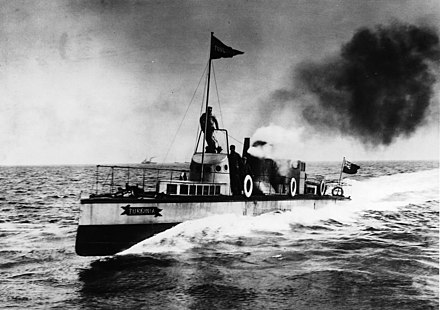
‘Turbinia’ at speed – the first steam turbine-powered ship.

In marine service, pioneered on the ‘Turbinia’, steam turbines with reduction gearing (although the Turbinia has direct turbines to propellers with no reduction gearbox) dominated large ship propulsion throughout the late twentieth century, being more efficient (and requiring far less maintenance) than reciprocating steam engines. In recent decades, reciprocating diesel engines and gas turbines have almost entirely supplanted steam propulsion for marine applications. Virtually all nuclear power plants generate electricity by heating water to provide steam that drives a turbine connected to an electrical generator. Nuclear-powered ships and submarines either use a steam turbine directly for main propulsion, with generators providing auxiliary power, or else employ turbo-electric transmission, where the steam drives a turbo generator set with propulsion provided by electric motors. A limited number of steam turbine railway locomotives were manufactured and some non-condensing direct-drive locomotives did meet with some success for long haul freight operations in Sweden and for express passenger work here in Britain, but were not repeated. Elsewhere, notably in the United States, more advanced designs with electric transmission were built experimentally, but not reproduced. It was found that steam turbines were not ideally suited to their railroad environment and these locomotives failed to oust the classic reciprocating steam unit in the way that modern diesel and electric traction has done.

With all of the above there is the need for safety. Steam engines possess boilers and other components that are pressure vessels which contain a great deal of potential energy. As a result, steam escapes and boiler explosions can and have in the past caused great loss of life. Whilst variations in standards may exist in different countries, stringent legal, testing, training, care with manufacture, operation and certification is applied to ensure safety. The steam engine contributed much to the development of thermodynamic theory, however, the only applications of scientific theory that influenced the steam engine were the original concepts of harnessing the power of steam and atmospheric pressure and knowledge of properties of heat and steam. The experimental measurements made by Watt on a model steam engine led to the development of the separate condenser. Watt independently discovered latent heat, which was confirmed by the original discoverer Joseph Black, who also advised Watt on experimental procedures. Watt was also aware of the change in the boiling point of water with pressure. Otherwise, the improvements to the engine itself were more mechanical in nature. Though thermodynamic concepts did give engineers the understanding needed to calculate efficiency, which aided the development of modern high-pressure and temperature boilers as well as the steam turbine. A modern, large electrical power station, producing several hundred megawatts of electrical output with steam reheat, economiser etc. will achieve efficiency in the mid 40% range, with the most efficient units approaching 50% thermal efficiency. It is also possible to capture the waste heat using cogeneration in which the waste heat is used for heating a lower boiling point working fluid or as a heat source for district heating via saturated low-pressure steam. In the twentieth century the rapid development of internal combustion engine technology led to the demise of the steam engine as a source of propulsion of vehicles on a commercial basis, with relatively few remaining in use beyond the Second World War. Happily many of these vehicles were acquired by enthusiasts for preservation and numerous examples are still in existence. In the 1960s, the air pollution problems in California gave rise to a brief period of interest in developing and studying steam-powered vehicles as a possible means of reducing the pollution, but apart from interest by many steam enthusiasts around the world, the occasional replica vehicle as well as experimental technology, no steam vehicles are in regular production at present.

This week… Empathy.
We can rarely experience things in the same way as another but we can empathise, even in silence, with them. Knowing that you are there, that they are not alone, can be enough. A few have said that to understand another person, you must swim in the same water that drowned them. But I believe that if you cannot swim, you can at least be a lifeline which others can hold on to and trust.

Click: Return to top of page or Index page

St. Patrick’s Day

Yes, it is St. Patrick’s Day but today is also a special one for me as I celebrate my seventieth birthday. I am told that when I was born, my parents settled on naming me Andrew David, but other folk thought they ought to include Patrick. Except then I’d need George as well, which would have been far too many! So, Saint Patrick’s Day, or the Feast of Saint Patrick (in Irish, ‘Lá Fhéile Pádraig’, literally the Day of the Festival of Patrick), is a cultural and religious celebration held on 17 March each year, the traditional death date of Saint Patrick (c. 385 – c. 461), the foremost patron saint of Ireland. Saint Patrick’s Day was made an official Christian feast day in the early seventeenth century and is observed by the Catholic Church, the Anglican Communion (especially the Church of Ireland), the Eastern Orthodox Church and the Lutheran Church. The day commemorates Saint Patrick and the arrival of Christianity in Ireland. These celebrations generally involve public parades and festivals, dancing and the wearing of green attire or shamrocks. Christians who belong to liturgical denominations also attend church services and historically, the Lenten restrictions on eating as well as the drinking of alcohol were lifted for the day, which has encouraged and propagated the holiday’s tradition of alcohol consumption. Saint Patrick’s Day is a public holiday in the Republic of Ireland, Northern Ireland, the Canadian province of Newfoundland and Labrador (for provincial government employees), and the British Overseas Territory of Montserrat. It is also widely celebrated in the United Kingdom, Canada, the U.S.A., United States, Argentina Australia and New Zealand, especially amongst Irish diaspora. It seems that Saint Patrick’s Day may be celebrated in more countries than any other national festival! Modern celebrations have been greatly influenced by those of Irish descent, most particularly those in North America. Sadly however, there has been criticism of Saint Patrick’s Day celebrations for having become too commercialised and for fostering negative stereotypes of the Irish people.

Saint Patrick was a fifth-century Romano-British Christian missionary and Bishop in Ireland. Much of what is known about him comes from a ‘Declaration’ allegedly written by Patrick himself. It is believed that he was born in Roman Britain in the fourth century into a wealthy Romano-British family. His father was a deacon and his grandfather was a priest in the Christian church. According to his ‘Declaration’, at the age of sixteen he was kidnapped by Irish raiders and taken as a slave to Gaelic Ireland. It says that he spent six years there working as a shepherd and that during this time he found God. In the Declaration he states that God told him to flee to the coast, where a ship would be waiting to take him home and after making his way home, Patrick went on to become a priest. According to tradition, Patrick then returned to Ireland to convert the pagan Irish to Christianity, which he successfully did. However, Patrick’s efforts were then turned into an allegory in which he drove snakes out of Ireland, despite the fact that it was already known that snakes did not inhabit the country. Tradition holds that he died on 17 March and was buried at Downpatrick and over the following centuries, many legends grew up around Patrick and he became Ireland’s foremost saint.

A three-leaved shamrock.

According to legend, Saint Patrick used the three-leaved shamrock to explain the Holy Trinity to Irish pagans. Incidentally, as part of my research I have learned that there is a difference between Shamrocks and Clovers. To start with, shamrocks always have three leaves, whilst clovers can have a fourth leaf. Shamrocks are usually green, but you can find purple, green or white clover. Finally, shamrocks grow in clumps, while four-leaf clovers are rare and grow one at a time. But back to the story. Celebrations generally involve public parades and festivals, Irish traditional music sessions and the wearing of green attire or shamrocks. There are also formal gatherings such as banquets and dances, although these were more common in the past. The participants generally include marching bands, the military, fire brigades, cultural organisations, charitable organisations, voluntary associations, youth groups and so on. More effort is made to use the Irish language, especially in Ireland, where 1 March to St Patrick’s Day on 17 March is ‘Seachtain na Gaeilge’ or Irish Language Week. Since 2010, famous landmarks have been lit up in green on Saint Patrick’s Day as part of Tourism Ireland’s ‘Global Greening Initiative’ or ‘Going Green for St Patrick’s Day’. The Sydney Opera House and the Sky Tower in Auckland were the first landmarks to participate in this and since then over 300 landmarks in fifty countries across the globe have gone green for Saint Patrick’s Day. Christians may also attend church services and the Lenten restrictions on eating as well as the drinking of alcohol are lifted for the day. Perhaps because of this, the drinking of alcohol, particularly Irish whiskey, beer, or cider, has become an integral part of the celebrations, so as you might imagine the tradition of ‘drowning’ or ‘wetting’ the shamrock was historically popular. At the end of the celebrations, especially in Ireland, a shamrock is put into the bottom of a cup, which is then filled with whiskey, beer, or cider. It is then drunk as a toast to Saint Patrick, Ireland, or those present. The shamrock would either be swallowed with the drink or taken out and tossed over the shoulder for good luck. Irish Government Ministers travel abroad on official visits to various countries around the globe to celebrate Saint Patrick’s Day and promote Ireland and the most prominent of these is the visit of the Irish Taoiseach (Irish Prime Minister) with the U.S. President, which happens on or around Saint Patrick’s Day. Traditionally the Taoiseach presents the U.S. President a Waterford Crystal bowl filled with shamrocks, as this tradition began when, in 1952, Irish Ambassador to the U.S. John Hearne sent a box of shamrocks to President Harry S. Truman. From then on it became an annual tradition of the Irish ambassador to the U.S. to present the Saint Patrick’s Day shamrock to an official in the U.S. President’s administration, although on some occasions the shamrock presentation was made by the Irish Taoiseach or Irish President to the U.S. President personally in Washington. But it was only after the meeting between Taoiseach Albert Reynolds and President Bill Clinton in 1994 that the presenting of the shamrock ceremony became a recognised annual event for the leaders of both countries for Saint Patrick’s Day. The presenting of the Shamrock ceremony was cancelled in 2020 due to the severity of the COVID-19 pandemic.

A St Patrick’s Day greeting card from 1907.

On Saint Patrick’s Day, it is customary to wear shamrocks, green clothing or green accessories. Saint Patrick is said to have used the shamrock, a three-leaved plant, to explain the Holy Trinity to the pagan Irish and this story first appears in writing in 1726, though it may be older. In pagan Ireland, three was a significant number and the Irish had many triple deities, which may have aided St Patrick in his evangelisation efforts. The first association of the colour green with Ireland is from a legend in the eleventh century ‘Lebor Gabála Érenn’, The Book of the Taking of Ireland. It tells of Goídel Glas (Goídel the green), the eponymous ancestor of the Gaels and creator of the Goidelic languages (Irish, Scottish Gaelic and [Manx). It is said that Goídel is bitten by a venomous snake, but saved from death by Moses placing his staff on the snakebite, leaving him with a green mark and his descendants then settled in Ireland, a land free of snakes. The colour green was further associated with Ireland from the 1640s, when the green harp flag was used by the Irish Catholic Confederation. Green ribbons and shamrocks have been worn on St Patrick’s Day since at least the 1680s and since then, the colour green and its association with St Patrick’s Day have grown. The Friendly Brothers of St Patrick, an Irish fraternity founded in about 1750, adopted green as its colour. However the Order of St Patrick, an Anglo-Irish chivalric order founded in 1783, instead adopted blue as its colour, which led to blue also being associated with St Patrick. Then in the 1790s, the colour green was adopted by the United Irishmen. This was a republican organisation, led mostly by Protestants but with many Catholic members, who launched a rebellion in 1798 against British rule. Ireland was first called ‘the Emerald Isle’ in “When Erin First Rose” (1795), a poem by a co-founder of the United Irishmen, William Drennan, which stresses the historical importance of green to the Irish and the phrase ‘wearing of the green’ comes from a song of the same name about United Irishmen being persecuted for wearing green. The flags of the 1916 Easter Rising featured green, such as the ‘Starry Plough’ banner and the Proclamation Flag of the Irish Republic. When the Irish Free State was founded in 1922, the government ordered all post boxes be painted green, under the slogan ‘green paint for a green people’ and in 1924 the government introduced a green Irish passport. The wearing of the ‘St Patrick’s Day Cross’ was also a popular custom in Ireland until the early twentieth century. These were a Celtic Christian cross made of paper that was covered with silk or ribbon of different colours, and a bunch or rosette of green silk in the centre.

A St Patrick’s Day parade in Dublin.

It seems that as a kind of national day, Saint Patrick’s Day was already being celebrated by the Irish in Europe in the ninth and tenth centuries and only in later times did he become more and more widely seen as the patron of Ireland. Saint Patrick’s feast day was finally placed on the universal liturgical calendar in the Catholic Church due to the influence of Waterford-born Franciscan scholar Luke Wadding in the early 1600s. Saint Patrick’s Day thus became a holy day of obligation for Roman Catholics in Ireland. It is also a feast day in the Church of Ireland, which is part of the worldwide Anglican Communion. The church calendar avoids the observance of saints’ feasts during certain solemnities, moving the saint’s day to a time outside those periods and St Patrick’s Day is occasionally affected by this requirement, when 17 March falls during Holy Week. This happened in 1940, when Saint Patrick’s Day was observed on 3 April to avoid it coinciding with Palm Sunday, and again in 2008 where it was officially observed on 15 March. St Patrick’s Day will not fall within Holy Week again until 2160. In 1903, St Patrick’s Day became an official public holiday in Ireland and this was thanks to the Bank Holiday (Ireland) Act 1903, an act of the United Kingdom Parliament introduced by Irish Member of Parliament James O’Mara. The week of St Patrick’s Day in 1903 was declared Irish Language Week by the Gaelic League and in Waterford they opted to have a procession on Sunday 15 March. The procession comprised the Mayor and members of Waterford Corporation, the Trades Hall, the various trade unions and bands. The parade began at the premises of the Gaelic League in George’s St and finished in the Peoples Park, where the public were addressed by the Mayor and other dignitaries. On Tuesday 17 March, most Waterford businesses, including public houses, were closed and marching bands paraded as they had two days previously. The Waterford Trades Hall had been emphatic that the National Holiday be observed. On St Patrick’s Day 1916, the Irish Volunteers, an Irish nationalist paramilitary organisation, held parades throughout Ireland. The authorities recorded thirty-eight St Patrick’s Day parades, involving 6,000 marchers, almost half of whom were said to be armed and the following month, the Irish Volunteers launched the Easter Rising against British rule. This marked the beginning of the Irish revolutionary period and led to the Irish War of Independence and Civil War. During this time, St Patrick’s Day celebrations in Ireland were muted, although the day was sometimes chosen to hold large political rallies. The celebrations remained low-key after the creation of the Irish Free State, the only state-organised observance was a military procession, trooping of the colours and an Irish-language mass attended by government ministers. In 1927, the Irish Free State government banned the selling of alcohol on St Patrick’s Day, although it remained legal in Northern Ireland. The ban was not repealed until 1961. The first official, state-sponsored St Patrick’s Day parade in Dublin took place in 1931. On three occasions, parades across the Republic of Ireland have been cancelled from taking place on St Patrick’s Day, with all years involving health and safety reasons. In 2001, as a precaution to the foot-and-mouth outbreak, St Patrick’s Day celebrations were postponed to May and in 2020 and 2021, as a consequence to the severity of the COVID-19 pandemic the St Patrick’s Day Parade was cancelled outright. Organisers of the St Patrick’s Day Festival 2021 instead hosted virtual events around Ireland on their SPF TV online channel.

A St Patrick’s Day Christian procession in Downpatrick, where Saint Patrick is said to be buried.

In Northern Ireland, the celebration of St Patrick’s Day was affected by sectarian divisions. A majority of the population were Protestant Ulster unionists who saw themselves as British, whilst a substantial minority were Catholic Irish nationalists who saw themselves as Irish. Although it was a public holiday, Northern Ireland’s unionist government did not officially observe St Patrick’s Day. During the conflict known as ‘The Troubles’ (late 1960s to late 1990s), public St Patrick’s Day celebrations were rare and tended to be associated with the Catholic community. In 1976, loyalists detonated a car bomb outside a pub crowded with Catholics celebrating St Patrick’s Day in Dungannon where four civilians were killed and many were injured. However, some Protestant unionists attempted to ‘re-claim’ the festival, and in 1985 the Orange Order held its own St Patrick’s Day parade. Since the end of the conflict in 1998 there have been cross-community St Patrick’s Day parades in towns throughout Northern Ireland, which have attracted thousands of spectators and in the mid-1990s the government of the Republic of Ireland began a campaign to use St Patrick’s Day to showcase Ireland and its culture. The government set up a group called St Patrick’s Festival, which aimed to offer a national festival that ranks amongst all of the greatest celebrations in the world, to create energy and excitement throughout Ireland via innovation, creativity, grassroots involvement, and marketing activity, to provide the opportunity and motivation for people of Irish descent (and those who sometimes wish they were Irish) to attend and join in the imaginative and expressive celebrations and to project, internationally, an accurate image of Ireland as a creative, professional and sophisticated country with wide appeal. The first St Patrick’s Festival was held on 17 March 1996. In 1997, it became a three-day event, and by 2000 it was a four-day event. By 2006, the festival was five days long; more than 675,000 people attended the 2009 parade. Overall 2009’s five-day festival saw almost 1 million visitors, who took part in festivities that included concerts, outdoor theatre performances, and fireworks. The Skyfest, which ran from 2006 to 2012, formed the centrepiece of the St Patrick’s festival. The topic of a 2004 St Patrick’s Symposium was “Talking Irish”, during which the nature of Irish identity, economic success, and the future were discussed. Since 1996, there has been a greater emphasis on celebrating and projecting a fluid and inclusive notion of ‘Irishness’ rather than an identity based around traditional religious or ethnic allegiance. The week around St Patrick’s Day usually involves Irish language speakers using more Irish during “Seachtain na Gaeilge” (Irish Language Week). Christian leaders in Ireland have expressed concern about the secularisation of St Patrick’s Day and in ‘The Word’ magazine’s March 2007 issue, Fr Vincent Twomey wrote, “It is time to reclaim St Patrick’s Day as a church festival”. He questioned the need for “mindless alcohol-fuelled revelry” and concluded that “it is time to bring the piety and the fun together”. The biggest celebrations outside the cities are in Downpatrick, County Down, where Saint Patrick is said to be buried. The shortest St. Patrick’s Day parade in the world formerly took place in Dripsey, County Cork. The parade lasted just 23.4 metres (25.6 yards) and travelled between the village’s two pubs. The annual event began in 1999, but ceased after five years when one of the two pubs closed.

Saint Patrick’s Day celebration in Trafalgar Square in 2006.

Research shows that celebrations abound elsewhere around the world though. In England, the British Royals traditionally present bowls of shamrock to members of the Irish Guards, a regiment in the British Army, following Queen Alexandra introducing the tradition in 1901 and since 2012 the Duchess of Cambridge has made the presentation. The Scottish town of Coatbridge, where the majority of the town’s population are of Irish descent, also has a Saint Patrick’s Day Festival which includes celebrations and parades in the town centre and Glasgow has a considerably large Irish population; due, for the most part, to the Irish immigration during the nineteenth century. This immigration was the main cause in raising the population of Glasgow by over 100,000 people.

Montreal hosts one of the longest-running and largest Saint Patrick’s Day parades in North America.

One of the longest-running and largest Saint Patrick’s Day parades in North America occurs each year in Montreal, whose city flag includes a shamrock in its lower-right quadrant. The yearly celebration has been organised by the United Irish Societies of Montreal since 1929 and the parade has been held yearly without interruption since 1824. St Patrick’s Day itself, however, has been celebrated in Montreal since as far back as 1759 by Irish soldiers in the Montreal Garrison following the British conquest of New France. There has been a parade held in Toronto since at least 1863, and many other places in Canada hold celebrations each year. In the U.S.A., whilst not a legal holiday there, the event is widely recognised and observed throughout the country as a celebration of Irish and Irish-American culture. Celebrations include prominent displays of the colour green, religious observances, numerous parades, and copious consumption of alcohol. The holiday has been celebrated in what is now the U.S.A. since 1601. In 2020, for the first time in over 250 years, the parade in New York City was postponed due to concerns about the COVID-19 pandemic. Meanwhile the first Saint Patrick’s Day parade in Russia took place in 1992. Since 1999, there has been a yearly ‘Saint Patrick’s Day’ festival in Moscow and other Russian cities. The official part of the Moscow parade is a military-style parade and is held in collaboration with the Moscow government and the Irish embassy in Moscow. The unofficial parade is held by volunteers and resembles a carnival. The island of Montserrat is known as the “Emerald Island of the Caribbean“ because of its founding by Irish refugees from Saint Kitts and Nevis. Montserrat is one of three places where Saint Patrick’s Day is a public holiday, along with the Canadian province of Newfoundland and Labrador. The holiday also commemorates a failed slave uprising that occurred on 17 March 1768. In Australia, the first mention of St Patrick’s Day being celebrated there was in 1795, when Irish convicts and administrators in the penal colony, both Catholic and Protestant, all came together to celebrate the day as a national holiday and this was despite a ban against assemblies being in place at the time. But this unified day of Irish nationalist observance dissipated over time, with celebrations on St Patrick’s Day becoming divisive between religions and social classes, representative more of Australian ways than of Irish and therefore held intermittently throughout the years. As a result, St Patrick’s Day is not a national holiday – although it is celebrated each year across the country’s states and territories. Festivals and parades are often held on weekends around 17 March in cities such as Sydney, Brisbane, Adelaide and Melbourne, but on occasions festivals and parades are cancelled. For instance, Melbourne’s 2006 and 2007 St Patrick’s Day festivals and parades were cancelled due to sporting events, these being the Commonwealth Games and Australian Grand Prix which were booked on and around the planned St Patrick’s Day festivals and parades in the city. In New Zealand, from 1878 to 1955 St Patrick’s Day was recognised as a public holiday together with St George’s Day and St Andrew’s Day. Auckland attracted many Irish migrants in the 1850s and 1860s, and it was here where some of the earliest St Patrick’s Day celebrations took place, which often entailed the hosting of community picnics. However, this rapidly evolved from the late 1860s onwards to include holding parades with pipe bands and marching children wearing green, sporting events, concerts, balls and other social events, where people displayed their Irish history with pride.

St Patrick’s Day is also celebrated in other countries, some perhaps surprisingly. For example whilst Saint Patrick’s Day in Switzerland is commonly celebrated on 17 March with festivities similar to those in neighbouring central European countries, it is not unusual for Swiss students to organise celebrations in their own living spaces on Saint Patrick’s Eve. Traditionally, guests contribute with beverages and dress in green. In Lithuania, although it is not a national holiday there the Vilnia river is dyed green every year on the Saint Patrick’s Day in the capital, Vilnius. In addition, Saint Patrick’s parades are now held in many locations across Japan. The first parade, in Tokyo, was organised by The Irish Network Japan in 1992 and The Irish Association of Korea has celebrated Saint Patrick’s Day since 1976 in Seoul, the capital city of South Korea.

Astronaut Chris Hadfield wearing green in the International Space Station on Saint Patrick’s Day, 2013.

I finish with the International Space Station, where astronauts there have celebrated the festival in different ways. Irish-American Catherine Coleman played a hundred-year-old flute belonging to Matt Molloy and a tin whistle belonging to Paddy Moloney, both members of the Irish music group ‘The Chieftains’ whilst she floated weightless in the space station on Saint Patrick’s Day in 2011. Her performance was later included in a track called ‘The Chieftains in Orbit’ on the group’s 2012 album, Voice of Ages. Chris Hadfield took photographs of Ireland from Earth orbit, and a picture of himself wearing green clothing in the space station, and posted them online on Saint Patrick’s Day in 2013. He also posted online a recording of himself singing ‘Danny Boy’ in space. Where to next, I wonder?

This week…a reminder.
“We change. We have to. Otherwise we spend our lives fighting the same battles” ~ James T Kirk, ‘Star Trek – Beyond’

Click: Return to top of page or Index page
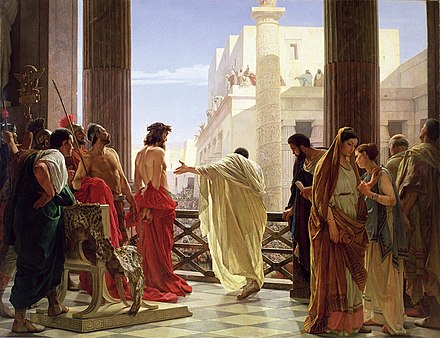
Coffee

Last week I researched tea, so it seems only right that this week I look at coffee, which is a drink prepared from roasted coffee beans. Darkly coloured, bitter, and slightly acidic, coffee has a stimulating effect on us humans, primarily due to its caffeine content and it has the highest sales in the world market for hot drinks. Though coffee is now a global commodity, it has a long history, dating back through centuries of oral tradition. Coffee plants grew wild in Yemen and were widely used by nomadic tribes for thousands of years and Sufi monasteries there employed coffee as an aid to concentration during prayers, but roasting the seeds was not a way to serve coffee until the 1400s. In fact, during the cultivation brewed coffee was reserved exclusively for the priesthood and the medical profession and doctors would use the brew for patients who were experiencing a need for better digestion, also priests used it to stay alert during their long nights of studying for the church. Evidence of knowledge of the coffee tree and coffee drinking first appeared in the late 15th century, where a Sufi Imam is known to have imported goods from Ethiopia to Yemen. Coffee was also exported out of Ethiopia to Yemen by Somali merchants. Apparently Sufis in Yemen used the beverage as an aid to concentration and as a kind of spiritual intoxication when they chanted the name of God, also using it to keep themselves alert during their night-time devotions. By 1414, the plant was known in Mecca and in the early 1500s was spreading to Egypt and North Africa from the Yemeni port of Mocha. Associated with Sufism, many coffee houses grew up in Cairo and these also opened in Syria, especially in the cosmopolitan city of Aleppo (then in Istanbul), the capital of the Ottoman Empire. But in 1511, it was forbidden for its stimulating effect by conservative, orthodox Imams at a theological court in Mecca. However, these bans were to be overturned in 1524 by an order of the Ottoman Turkish Sultan Suleiman I, with the Grand Mufti issuing a fatwa (a legal ruling on a point of Islamic law) allowing the consumption of coffee. In Cairo a similar ban was instituted in 1532, and the coffee houses and warehouses containing coffee beans were sacked. It then reached the rest of the Middle East and from there coffee drinking spread to Italy, and to the rest of Europe, with coffee plants transported by the Dutch to the East Indies and to the Americas. Coffee was banned by the Ethiopian Orthodox Church some time before the eighteenth century, but in the second half of the nineteenth century attitudes softened towards its drinking and consumption spread rapidly. This was largely due to the Emperor, who himself drank it, and to priests and religious seniors who did much to dispel the belief of the clergy that it was a Muslim drink. Meanwhile in Islam, early practitioners of Islamic medicine and science fought against the notion that the effect of coffee was like that of hashish or alcohol, and instead argued the benefits of the drink, which would stimulate the mind whilst protecting against the allure of alcohol and hashish. Coffee houses in Mecca, Yemen, and Cairo began to explode in popularity, and they become centres of public life within the sprawling cities of the Islamic Empire. The coffee houses sometimes acted like regular meeting places which were centres of Islamic life, arts, and thinking, so it was one of the keys to the economy around the Red Sea. Those of Islam were the primary consumers, ingraining it into the culture of the people within the Muslim faith and from Islam, the rest of the world would go on to experience something that holds influence over the world today.

The Coffee Bearer by John Frederick Lewis (1857).

Coffee was first introduced to Europe when the Turks invaded Hungary in 1526. Later in the sixteenth century, coffee was introduced on the island of Malta through slavery. Turkish Muslim slaves had been imprisoned by the Knights of St John in 1565, the year of the Great Siege of Malta, and they used them to make their traditional beverage. A professor of theology and oriental languages in Rome mentioned in one of his works about “Turks, most skilful makers of this concoction”. Also a German traveller wrote in 1663 “the ability and industriousness with which the Turkish prisoners earn some money, especially by preparing coffee, a powder resembling snuff tobacco, with water and sugar.” Coffee was a popular beverage in Maltese high society and many coffee shops opened. The vibrant trade between the Republic of Venice and the people of North Africa, Egypt, and the East brought a large variety of African goods, including coffee, to this leading European port. Venetian merchants introduced coffee-drinking to the wealthy in Venice, charging them heavily for the beverage and in this way, coffee was introduced to the mainland Europe. The first route of travel for coffee was through the massive, sprawling Ottoman Empire that enabled the transportation of goods such as coffee to make their way into Europe and the second route of travel was from the port of Mocha in Yemen, where the East India Trading Co. bought coffee in masses and transported it back to mainland Europe. Coffee became a crucial part of the culture in most of Europe, with kings, queens and the general public all becoming extensively enthralled with the product.

Pope Clement VIII, who popularised coffee in Europe among Christians.

Soon coffee shops started opening and became the drink of the intellectuals, of social gatherings, even of lovers as plates of chocolate and coffee were considered a romantic gift. By 1763 Venice alone accounted for more than two hundred shops, and the health benefits of this miraculous drink were celebrated by many. Some representatives of the Catholic Church opposed coffee at its first introduction in Italy, believing it to be the ‘Devil’s drink’, but Pope Clement VIII, after trying the aromatic drink himself, gave it his blessing, thus boosting further its commercial success and diffusion. Upon tasting coffee, the Pope declared: “Why, this Satan’s drink is so delicious that it would be a pity to let the infidels have exclusive use of it. We shall cheat Satan by baptising it.” Some say that he later on baptised coffee beans because it appeared better for the people than alcoholic beverages. The race among Europeans to obtain live coffee trees or beans was eventually won by the Dutch in 1616 when a Dutch merchant obtained some of the closely guarded coffee bushes from Mocha, Yemen. He took them back to Amsterdam and found a home for them in the Botanical Gardens, where they began to thrive. This apparently minor event received little publicity, but was to have a major impact on the history of coffee. The beans adjusted well to conditions in the greenhouses there and produced numerous healthy bushes. In 1658 the Dutch first used them to begin coffee cultivation in Ceylon (now Sri Lanka) and later in southern India. They abandoned this cultivation to focus on their Javanese plantations in order to avoid lowering the price by oversupply. Within a few years the Dutch colonies, Java in Asia and Suriname in the Americas, had become the main suppliers of coffee to Europe.

A 1652 handbill advertising coffee for sale in St. Michael’s Alley, London.

The first coffee house in England was opened in St. Michael’s Alley in Cornhill, London. The proprietor was Pasqua Rosée, the servant of Daniel Edwards, a trader in Turkish goods. Edwards imported the coffee and assisted Rosée in setting up the establishment. Coffee was also brought in through the British East India Company and the Dutch East India Company in the seventeenth century. Oxford’s Queen’s Lane Coffee House, established in 1654, is still in existence today. By 1675, there were more than three thousand coffee houses throughout England and during this enlightenment, these early English coffee houses became gathering places used for deep religious and political discussions among the populace, since it was a rare opportunity for sober discussion. This practice became so common, and potentially subversive, so much so that in the 1670s King Charles II made an attempt to crush coffee houses. The banning of women from coffee houses was not universal, for example women frequented them in Germany, but it appears to have been commonplace elsewhere in Europe, including in England. A 1661 item entitled “A character of coffee and coffee-houses”, written by one ‘M.P.’ lists some of these perceived benefits as follows:“’Tis extolled for drying up the Crudities of the Stomack, and for expelling Fumes out of the Head. Excellent Berry! which can cleanse the English-man’s Stomak of Flegm, and expel Giddinesse out of his Head’. Except this new commodity proved controversial among some subjects. For instance, the anonymous 1674 “Women’s Petition Against Coffee” declared “the Excessive Use of that Newfangled, Abominable, Heathenish Liquor called COFFEE has Eunucht our Husbands, and Crippled our more kind Gallants, that they are become as Impotent as Age”. Meanwhile in France, one writer praised the Muslim association with various drinks, saying “We are indebted to these great Arab physicians for introducing coffee to the modern world through their writings, as well as sugar, tea, and chocolate.” In 1669 an ambassador from Sultan Mehmed IV arrived in Paris with his entourage bringing with him a large quantity of coffee beans. Not only did they provide their French and European guests with coffee to drink, but they also donated some beans to the royal court.

Monsooned Malabar arabica, compared with green Yirgachefe beans from Ethiopia.

Coffee came to India well before the East India company, through an Indian Sufi saint named ‘Baba Budan’. The first record of coffee growing in India is following the introduction of coffee beans from Yemen by Baba Budan to the hills of Chikmagalur, Karnataka, in 1670. Since then coffee plantations have become established in the region, extending south to Kodagu. Coffee production in India is dominated in the hill tracts of South Indian states, with the state of Karnataka accounting for 53%, followed by Kerala at 28% and Tamil Nadu at 11% of production of 8,200 Tonnes. Indian coffee is said to be the finest coffee grown in the shade rather than direct sunlight anywhere in the world. There are approximately 250,000 coffee growers in India, 98% of them are small growers. As of 2009, the production of coffee in India was only 4.5% of the total production in the world and almost 80% of the country’s coffee production is exported. Of that which is exported, 70% is bound for Germany, the Russian federation, Spain, Belgium, Slovenia, United States, Japan, Greece, Netherlands and France, whilst Italy accounts for 29% of the exports, with most of the export shipped through the Suez Canal. So coffee is grown in three regions of India with Karnataka, Kerala and Tamil Nadu forming the traditional coffee growing region of South India, followed by the new areas developed in the non-traditional areas of Andhra Pradesh and Orissa in the eastern coast of the country and with a third region comprising the states of Assam, Manipur, Meghalaya, Mizoram, Tripura, Nagaland and Arunachal Pradesh of Northeastern India, popularly known as ‘Seven Sister States of India’. Because of this, Indian coffee which is grown mostly in southern India under monsoon rainfall conditions, is naturally termed as ‘Indian monsooned coffee’. Its flavour is seen by some as the best Indian coffee, reaching the flavour characteristics of Pacific coffees, but at its worst it is simply bland and uninspiring. The two well-known species of coffee grown are the Arabica and Robusta. The first variety that was introduced in the Baba Budan Giri hill ranges of Karnataka in the seventeenth century was marketed over the years under the brand names of Kent and S.795. Coffee is served in a distinctive “drip-style filter coffee“ across Southern India.

Café Zimmermann, Leipzig (engraving by Johann Georg Schreiber, 1732).

In Germany, coffee houses were first established in North Sea ports from about 1673. Initially, this new beverage was written in the English form ‘coffee’, but during the 1700s the Germans gradually adopted the French word café, then slowly changed the spelling to Kaffee, which is the present word. In the eighteenth century the popularity of coffee gradually spread around the German lands and was taken up by the ruling classes. Coffee was served at the court of the Great Elector Frederick William of Brandenburg as early as 1675, but Berlin’s first public coffee house did not open until 1721. The composer Johann Sebastian Bach, who was cantor of St. Thomas Church in Leipzig from 1723 to 1750, conducted a musical ensemble at the local Café Zimmermann, and sometime between 1732 and 1735 he composed the secular Coffee Cantata ‘Schweigt stille, plaudert nicht’ in which a young woman, Lieschen, pleads with her disapproving father to accept her devotion to drinking coffee, then a newfangled fashion. The libretto includes such lines as:

Ei! wie schmeckt der Coffee süße,
Lieblicher als tausend Küsse,
Milder als Muskatenwein.
Coffee, Coffee muss ich haben,
Und wenn jemand mich will laben,
Ach, so schenkt mir Coffee ein!

Which translates to:
Oh! How sweet coffee does taste,
Better than a thousand kisses,
Milder than muscat wine.
Coffee, coffee, I’ve got to have it,
And if someone wants to perk me up,
Oh, just give me a cup of coffee!

A coffee house of culture between Vienna and Trieste.

Meanwhile, the first coffee house in Austria opened in Vienna in 1683 after the Battle of Vienna by using supplies from the spoils obtained after defeating the Turks. A Polish military officer of Ukrainian descent who received the coffee beans opened a coffee house and helped popularise the custom of adding sugar and milk to the coffee. ‘Melange’ is the typical Viennese coffee, which comes mixed with hot foamed milk, and is usually served with a glass of water. A very special Viennese coffee house culture developed in Vienna in the 19th century and then spread throughout Central Europe. Scientists, artists, intellectuals, diplomats and financiers met in this special microcosm of the Viennese coffee houses. World-famous personalities such as Gustav Klimt, Sigmund Freud, James Joyce and Egon Schiele were inspired in the Viennese coffee house. This special multicultural atmosphere and culture was largely destroyed by the later National Socialism and Communism and only survived in individual places such as Vienna or Trieste. In this diverse coffee house culture, different types of coffee preparation also developed. This is how the world-famous cappuccino from the Viennese Kapuziner coffee developed over the Italian-speaking parts of the northern Italian empire.

Over in the Americas, a French Naval officer brought coffee seedlings to Martinique in the Caribbean in 1720. Those sprouts flourished and 50 years later there were 18,680 coffee trees there, enabling the spread of coffee cultivation to Saint-Domingue (now part of Haiti) and other islands of the Caribbean. This French territory saw coffee cultivated starting in 1734, and by 1788 supplied half the world’s coffee. Also, after the Boston Tea Party of 1773, large numbers of Americans switched to drinking coffee during the American Revolution because drinking tea had become unpatriotic. Coffee had a major influence on the geography of Latin America. The French colonial plantations relied heavily on African slave labourers, however the dreadful conditions that the slaves worked in on coffee plantations were a factor in the soon-to-follow Haitian Revolution and the coffee industry never fully recovered there. Coffee also found its way to the Isle of Bourbon, now known as Réunion, in the Indian Ocean. The plant produced smaller beans and was deemed a different variety of arabica. The Santos coffee of Brazil and the Oaxaca coffee of Mexico are the progeny of that Bourbon tree. Then in 1727, a Lieutenant-Colonel in the Brazilian army was commissioned by the Portuguese government (who ruled Brazil at the time) to steal coffee from the French, who had several colonised countries nearby growing coffee but had refused to share. So the King of Portugal sent this Lieutenant-Colonel to French Guiana to obtain coffee seeds to become a part of the coffee market. He initially had difficulty obtaining these seeds, but he captivated the French Governor’s wife, and she sent him enough seeds and shoots to commence the coffee industry of Brazil. Except cultivation did not gather momentum until independence in 1822, leading to the clearing of massive tracts of the Atlantic Forest, first from the vicinity of Rio and later São Paulo for coffee plantations. In 1893, the coffee from Brazil was introduced into Kenya and Tanzania (Tanganyika), not far from its place of origin in Ethiopia, 600 years prior, ending its transcontinental journey. In the twentieth century Latin American countries faced a possible economic collapse. Before World War II, Europe was consuming large amounts of coffee. Once the war started, Latin America lost 40% of its market and was on the verge of economic collapse. Coffee was and is a Latin American commodity and the United States saw this, so talked with the Latin American countries and as a result the producers agreed on an equitable division of the U.S. market. The U.S. government monitored this agreement. For the period that this plan was followed the value of coffee doubled, which greatly benefited coffee producers and the Latin American countries. Brazil became the largest producer of coffee in the world by 1852 and it has held that status ever since. It dominated world production, exporting more coffee than the rest of the world combined, from 1850 to 1950. The period since 1950 saw the widening of the playing field due to the emergence of several other major producers, notably Colombia, Ivory Coast, Ethiopia and, most recently, Vietnam, which overtook Colombia and became the second-largest producer in 1999 and reached 15% market share by 2011. A recent change to the coffee market are lattes, frappuccinos and other sugary coffee drinks. This has caused coffee houses to be able to use cheaper coffee beans in their coffee but the cheaper coffee beans, called Robusta, contain more caffeine than expensive beans. This makes them more popular as well. The producers, however, receive less money for the production of cheaper beans than they do for the production of higher quality beans. Since the producers get paid less, they are receiving a smaller income, which in turn hurts the economy of Latin America.

There are several legendary accounts of the origin of the consumption of coffee. According to one, ancestors of today’s people in the Kingdom of Kaffa, an area located in what is now Ethiopia, were the first to recognise the energising effect of the coffee plant. But it is also said that in the ninth century, an Ethiopian goat-herder who, noticing the energising effects when his flock nibbled on the bright red berries of a certain bush, chewed on the fruit himself and his exhilaration prompted him to bring the berries to a monk in a nearby monastery. But the monk disapproved of their use and threw them into the fire, from which an enticing aroma billowed, causing other monks to come and investigate. The roasted beans were quickly raked from the embers, ground up, and dissolved in hot water, yielding the world’s first cup of coffee! Since this story is not known to have appeared in writing before 1671, some 800 years after it was supposed to have taken place, it is highly likely to be apocryphal. There seem to be a few accounts of when coffee was discovered as a drink, one involving a thirteenth century Moroccan Sufi mystic who was travelling in Ethiopia. The legend goes that he observed birds of unusual vitality feeding on berries and, upon trying the berries, experienced the same vitality. Yet another attributes the discovery of coffee to a Sheikh’s disciple and according to the ancient chronicle, he was known for his ability to cure the sick through prayer so was once banished from Mecca to a desert cave. Starving, he chewed berries from nearby shrubbery, but found them to be too bitter. He tried roasting the beans to improve the flavour, but they became too hard. He then tried boiling them to soften the bean, which resulted in a fragrant brown liquid. After drinking the liquid, he was revived and survived for days. As stories of this ‘miracle drug’ reached Mecca, the man was asked to return and was eventually made a saint. Another origin of coffee was described in Homer’s Odyssey and at one point in his Epic, Helena, daughter of Zeus, mixes a drink in a bowl “which had the power of robbing grief and anger of their sting and banishing all painful memories”. It is also said that the Greek gods used coffee for medicinal and spiritual purposes while they lounged at Mount Olympus. Coffee also became associated with Muhammad’s birthday and various legends have ascribed coffee’s origins to Muhammad, who, it is said, brought it to man through the archangel Gabriel to replace the wine which Islam forbade! It fascinates me as to who comes up with these ideas…

This week…
Some films, especially comedies, have great lines. Here is a favourite of mine.
“My mind is aglow with whirling transient nodes of thought, careening through a cosmic vapour of invention” ~ Hedley Lamarr, ‘Blazing Saddles’.

Click: Return to top of page or Index page
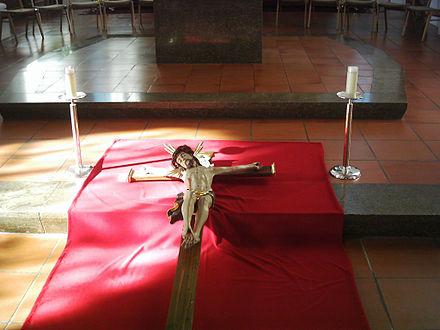
The History Of Tea

The history of tea spreads across multiple cultures over the span of thousands of years, with the tea plant Camellia Sinensis native to the southern Himalayan region of north-east India & Burma, flourished in China, and was introduced into Indian subcontinent by the British who acquired this habit from the Dutch. The earliest tea drinking is thought to date back to China’s Shang dynasty, in which tea was consumed as a medicinal drink. An early credible record of tea drinking dates to the third century AD in a medical text written by Chinese physician Hua Tuo, but it first became known to the Western world through Portuguese priests and merchants in China during the early sixteenth century. Drinking tea became popular in Britain during the seventeenth century and the British introduced commercial tea production to India, in order to compete with the Chinese monopoly on tea.

Tea from Yunnan.

Camellia sinensis is a species of evergreen shrub or small tree in the flowering plant family ‘Theaceae’ and its leaves and leaf buds are used to produce the popular beverage of tea. Common names include tea plant, tea shrub and tea tree. White tea, yellow tea, green tea, oolong, dark tea and black tea are all harvested from one of two major varieties grown today, however Camellia sinensis and Camellia assamica are processed differently to attain varying levels of oxidation, with black tea being the most oxidised and green being the least. Kukicha (twig) tea is also harvested from Camellia sinensis, but uses twigs and stems rather than leaves. It seems that Camellia sinensis originated around the intersection of latitude 29°N and longitude 98°E, the point of confluence of the lands of South-west China, Tibet, North Burma, and North-east India. The plant was introduced to more than 52 countries from this centre of origin. There are some myths associated with tea, as in one popular Chinese legend the Emperor Shennong was drinking a bowl of just boiled water because of a decree that his subjects must boil water before drinking it. Some time around 2737 BC, a few leaves were blown from a nearby tree into his water, changing the colour and taste. The emperor took a sip of the brew and was pleasantly surprised by its flavour and restorative properties. A variant of the legend tells that the emperor tested the medical properties of various herbs on himself, some of them poisonous, and found tea to work as an antidote. A similar Chinese legend states that Shennong would chew the leaves, stems, and roots of various plants to discover medicinal herbs. If he consumed a poisonous plant, he would chew tea leaves to counteract the poison. The earliest physical evidence known of tea comes from the mausoleum of Emperor Jing of Han, indicating that tea was drunk by Emperors of the Han dynasty as early as the second century BC. China is therefore considered to have the earliest records of tea consumption, with possible records dating back to the tenth century BC. It should be noted however that the current word for tea in Chinese only came into use in the eighth century AD, there are uncertainties as to whether the older words used are the same as tea. The first record of cultivation of tea also dates it to the Han dynasty when tea was cultivated on Meng Mountain, near Chengdu. From the Tang to the Qing dynasties, the first 360 leaves of tea grown here were picked each spring and presented to the emperor. Even today its green and yellow teas are still sought after. Teas produced in this period were mainly tea bricks which were often used as currency, especially further from the centre of the empire where coins lost their value. In this period, tea leaves were steamed, then pounded and shaped into cake or brick forms. Then the production and preparation of all tea changed during the Song dynasty. The tea included many loose-leaf styles, to preserve the delicate character which was favoured by court society and it is the origin of today’s loose teas and the practice of brewed tea. A powdered form of tea also emerged. Steaming tea leaves was the primary process used for centuries in the preparation of tea.

An illustration of the legend of monkeys harvesting tea.

The Chinese learned to process tea in a different way in the mid-thirteenth century. Tea leaves were roasted and then crumbled rather than steamed. By the Yuan and Ming dynasties, unfermented tea leaves were first pan-fried, then rolled and dried. This stopped the oxidation process which turned the leaves dark and allowed tea to remain green. In the fifteenth century oolong tea, where the tea leaves were allowed to partially ferment before pan-frying, was developed. But Western taste preferred the fully oxidised black tea and the leaves were allowed to ferment further. Yellow tea was an accidental discovery in the production of green tea during the Ming dynasty, when apparently sloppy practices allowed the leaves to turn yellow, which yielded a different flavour as a result. Tea production in China was a laborious process, conducted in distant and often poorly accessible regions and this led to the rise of many stories and legends surrounding the harvesting process. For example, one story that has been told for many years is that of a village where monkeys would pick tea. According to this legend, the villagers stand below the monkeys and taunt them. The monkeys, in turn, become angry, and grab handfuls of tea leaves and throw them at the villagers. There are products sold today that claim to be harvested in this manner, however no reliable commentators have observed this first-hand, and most doubt that it happened at all. For many hundreds of years the commercially used tea tree has been, in shape, more of a bush than a tree. ‘Monkey picked tea’ is more likely a name of certain varieties than a description of how it was obtained. In 1391, the Hongwu emperor issued a decree that only loose tea would be accepted as a ‘tribute’, and as a result, tea production shifted from cake tea to loose-leaf tea and processing techniques advanced, giving rise to the more energy efficient methods of pan-firing and sun-drying. The last group to adopt loose-leaf tea were the scholar officials, also known as literati who were government officials and prestigious scholars in Chinese society, forming a distinct social class and who were reluctant to abandon their refined culture of whisking tea until the invention of oolong tea. But by the end of the 16th century, loose-leaf tea had entirely replaced the earlier tradition of cake and powdered tea.

Japanese tea ceremony.

In China, during the Sui dynasty (581 AD to 618 AD), tea was introduced to Japan by Buddhist monks and the use of it then spread. Tea later became a drink of the religious classes in Japan and it became a drink of the royal classes when the Emperor Saga encouraged the growth of tea plants. Seeds were imported from China, and cultivation in Japan began. Then in 1191 a Zen priest named Eisai introduced tea seeds to Kyoto and some of the tea seeds were given to the priest Myoe Shonin, which became the basis for Uji tea. Green tea became a staple drink amongst cultured people in Japan, a brew for both gentry and the Buddhist priesthood alike. Production grew and tea became more and more accessible, though still a privilege enjoyed mostly by the upper classes. The tea ceremony of Japan was introduced from China in the 15th century by Buddhists as a semi-religious social custom and the modern tea ceremony developed over several centuries by Zen Buddhist monks. Both the beverage and the ceremony surrounding it played a prominent role in feudal diplomacy. In 1738, Soen Nagatani developed Japanese sencha, literally ‘simmered tea’ which is an unfermented form of green tea. By the twentieth century, machine manufacturing of green tea was introduced and began replacing handmade tea. Later, tea was introduced by Buddhist monks to Korea, where the ‘Day Tea Rite’ was a common daytime ceremony, whereas the ‘Special Tea Rite’ was reserved for specific occasions.

A conical urn-shaped silver-plated samovar used for boiling water for tea in Russia and some Middle-Eastern countries.

The earliest record of tea in Western world is said to be found in the statement of an Arabian traveller, that after 879 the main sources of revenue in Canton were the duties on salt and tea. Marco Polo records the deposition of a Chinese minister of finance in 1285 for his arbitrary augmentation of the tea taxes. In 1557, Portugal established a trading port in Macau and word of the Chinese drink “chá” spread quickly, but there is no mention of them bringing any samples home. In the early seventeenth century, a ship of the Dutch East India Company brought the first green tea leaves to Amsterdam from China. Tea was known in France by 1636 and it enjoyed a brief period of popularity in Paris around 1648. The history of tea in Russia can also be traced back to the same century. Tea was first offered by China as a gift to Czar Michael I in 1618. The Russian ambassador tried the drink but he did not care for it and rejected the offer, delaying tea’s Russian introduction by fifty years. By 1689, tea was regularly imported from China to Russia via a caravan of hundreds of camels travelling the year-long journey, making it a precious commodity at the time. Tea was appearing in German apothecaries by 1657 but never gained much esteem except in some coastal areas. Tea first appeared publicly in England during the 1650s, where it was introduced through coffee houses and from there it was introduced to British colonies in both America and elsewhere. Tea was first introduced to Europe by an Italian traveller, who in 1555 published ‘Voyages and Travels’, containing the first European reference to tea, which he calls “Chai Catai”. Meanwhile Portuguese priests and merchants in the sixteenth century made their first contact with tea in China, at which time it was termed “chá”. The first Portuguese ships reached China in 1516, and in 1560 Portuguese missionary Gaspar da Cruz published the first Portuguese account of Chinese tea, then in 1565 Portuguese missionary Louis Almeida published the first European account of tea in Japan.

A Tea Garden in Assam, India.

Commercial production of tea was first introduced into India by the British, in an attempt to break the Chinese monopoly on tea and the British, using Chinese seeds, plus Chinese planting and cultivating techniques, launched a tea industry by offering land in Assam to any European who agreed to cultivate tea for export. Tea was originally only consumed by Anglicised Indians, it was not until the 1950s that tea grew widely popular in India through a successful advertising campaign by the India Tea Board. Prior to the British, the plant may have been used for medicinal purposes as some cite the Sanjeevani plant as the first recorded reference of tea use in India. However, scientific studies have shown that this plant is in fact a different plant and is not related to tea. Commercial production of tea in India did not begin until the arrival of the British East India Company, at which point large tracts of land were converted for mass tea production. The Chinese variety is used for Sikkim, Darjeeling and Kangra tea, whilst the Assam variety, clonal to the native to Assam, was used everywhere else. The British started commercial tea plantations in India and in Ceylon, only black tea was produced until recent decades mostly in India, except in Kangra (present-day Himachal Pradesh) which produced green tea for exporting to central Asia, Afghanistan and neighbouring countries.

Kangra, a tea-growing region in India, known for its green tea production.

In fact, India was the top producer of tea for nearly a century but was then displaced by China as the top tea producer in the 21st century. It also seems that Indian tea companies have acquired a number of iconic foreign tea enterprises including British brands Lipton, Tetley, Twinings and Typhoo. Most of the Indian tea garden owners have focused on exports to markets like Europe and Russia, whilst very few have focused on building their own brands such as Makaibari, Dharmsala Tea Company, and a few others. Even so, India is the largest consumer of tea worldwide but the consumption of tea in India remains a modest 750 grams per person annually. Recently consumption of green tea has seen a great upsurge across the cities, and regions such as Kangra, which were known for their green tea production historically, have seen a resurgence of their green teas in the domestic market. Other countries also produce tea, such as Iran, Malaysia, Sri Lanka, Australia and Africa. Taiwan is famous for the making of oolong tea and green tea, as well as many western-styled teas. Bubble tea or ‘Zhen Zhu Nai Cha’ is black tea mixed with sweetened condensed milk and tapioca. Since the island was known to Westerners for many centuries as Formosa, short for the Portuguese Ilha Formosa, or ‘beautiful island’, tea grown in Taiwan is often identified by that name. The drinking of tea in the United States was largely influenced by the passage of the Tea Act and its subsequent protest during the American Revolution. Tea consumption sharply decreased in America during and after the Revolution, when many Americans switched from drinking tea to drinking coffee, considering tea drinking to be unpatriotic. It seems Canadians were big tea drinkers from the days of British colonisation until the Second World War, when they began drinking more coffee like their American neighbours to the south. During the 1990s, Canadians begun to purchase more speciality teas instead of coffee. In South America, the tea production in Brazil has strong roots because of the country’s origins in Portugal, the strong presence of Japanese immigrants, and because of the influences of Argentina’s culture. Brazil had a big tea production until the 1980s, but it has weakened in the past decades. The first record of tea in English came from a letter written in 1615 by Richard Wickham, who ran an East India Company office in Japan, writing to a merchant in Macao requesting ‘the best sort of chaw’. But a traveller and merchant who came across tea in Fuji in 1637, wrote, “chaa – only water with a kind of herb boiled in it’. In 1657, Thomas Garway, a tobacconist and coffee-man was the first to sell tea in London at his house in Exchange Alley, charging between 16 and 50 shillings per pound. The same year, tea was listed as an item in the price list in a London coffee house and the first advertisement for tea appeared in 1658. In 1660, Samuel Pepys recorded in his diary: “I did send for a cup of tee (a China drink) of which I never had drank before.” It is probable that early imports were smuggled via Amsterdam or through sailors arriving on eastern boats. The marriage of King Charles II in 1662 to Portuguese princess Catherine of Braganza brought the tea drinking habit to court. Official trade of tea began in 1664 with an import of only two pound two ounces for presentation to the king, which grew to 24 million pounds per year by 1801. Tea was traded in significant amounts by the 18th century, when tea was being sold by grocers and tea shops in London. By the 1720s black tea overtook green tea in popularity as the price dropped, and early on British drinkers began adding sugar and milk to tea, a practice that was not done in China. By the 1720s European maritime trade with China was dominated by exchange of silver for tea. As prices continued to drop, tea became increasingly popular and by 1750 had become the British national drink. A fungus reduced coffee production in Ceylon by 95% in the nineteenth century, thus cementing tea’s popularity. The escalation of tea importation and sales over the period 1690 to 1750 is mirrored closely by the increase in importation and sales of cane sugar, as the British were not drinking just tea but ‘sweet’ tea. As a result, two of Britain’s trading triangles converged, the sugar sourced from Britain’s trading triangle encompassing Britain, Africa and the West Indies and the tea from the triangle encompassing Britain, India and China. In China, the Qing dynasty Qianlong Emperor wrote to King George III in response to the MaCartney Mission’s request for trade in 1793, saying “Our Celestial Empire possesses all things in prolific abundance and lacks no product within its borders. There is therefore no need to import the manufactures of outside barbarians in exchange for our own produce.” Tea had to be paid in silver bullion, and critics of the tea trade at this time would point to the damage caused to Britain’s wealth by this loss of bullion. As a way to generate the silver needed as payment for tea, Britain began exporting opium from the traditional growing regions of British India (in present-day Pakistan and Afghanistan) into China. Although opium use in China had a long history, the British importation of opium increased fivefold between 1821 and 1837, and usage of the drug became more widespread across Chinese society. The Qing government attitude towards opium, which was often ambivalent, hardened because of the social problems created by drug use and took serious measures to curtail importation of opium during 1838 and 1839. Tea had therefore become an important source of tax revenue for the British Empire, and the banning of the opium trade and thus the creation of funding issues for tea importers was one of the main causes of the ‘First Opium War’ a series of military engagements fought between Britain and the Qing dynasty of China between 1839 and 1842. The immediate issue was the Chinese enforcement of their ban on the opium trade by seizing private opium stocks from merchants at Canton and threatening to impose the death penalty for future offenders. Despite the opium ban, the British government supported the merchants’ demand for compensation for seized goods, and insisted on the principles of free trade and equal diplomatic recognition with China. Opium was Britain’s single most profitable commodity trade of the 19th century. After months of tensions between the two nations, the British navy launched an expedition in June 1840 and by August 1842 had defeated the Chinese using modern and technologically superior ships and weapons. The British then imposed the Treaty of Nanking, which forced China to increase foreign trade, give compensation, and cede Hong Kong to the British. Consequently the opium trade continued in China. Twentieth century nationalists consider 1839 the start of a century of humiliation and many historians consider it the beginning of modern Chinese history. But, whilst waging war on China was one of Britain’s tactics, it also began to use India for growing tea. After tea plants were smuggled out of China, plantations were established in areas such as Darjeeling, Assam, and Ceylon. As an attempt to circumvent its dependence on Chinese tea, the East India Company sent a Scottish botanist to China to purchase and bring out of China tea plants, which were then taken to India, although it was the discovery of native varieties of tea plant in India which proved more important for the development of production there. Tea remained a very important item in Britain’s global trade, contributing in part to Britain’s global dominance by the end of the 18th century. To this day, tea is seen worldwide as a symbol of ‘Britishness’, but also, to some, as a symbol of good old British colonialism.

This week…
If you ever think mythology is boring…
Just remember that Cerberus, the hellhound and guard dog of the Underworld, comes from the root Indo-European word Ḱerberos, which evolved into the Greek word Kerberos, which got changed to Cerberus when it went from Greek to Latin. Ḱerberos means ‘spotted’.
So Hades, Lord of the dead, literally named his pet dog ‘Spot’.

Click: Return to top of page or Index page
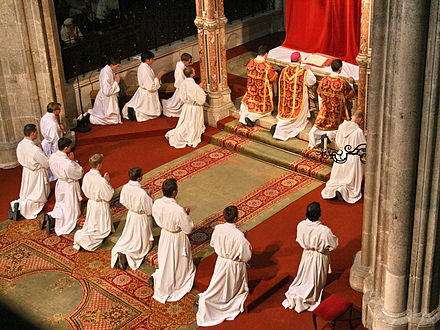
Chakras

The word ‘Chakra’, in Indian thought, refers to each of seven centres of spiritual power in the human body and which are various focal points used in a variety of ancient meditation practices, collectively denominated as Tantra, or the esoteric or inner traditions of Hinduism and the concept of the chakra arose in Hinduism’s early traditions. Beliefs differ between the Indian religions, with many Buddhist texts consistently mentioning five chakras, whilst Hindu sources reference six or seven. Early Sanskrit texts speak of them both as meditative visualisations combining flowers and mantras and as physical entities in the body and within Kundalini yoga, the techniques of breathing exercises, visualisations, mudras, meaning a seal, mark or gesture, as well as mantras which are focused on manipulating the flow of subtle energy through chakras. The modern Western chakra system arose from multiple sources, starting in the 1880s and which introduced the seven rainbow colours for the chakras. Psychological and other attributes, and a wide range of supposed correspondences with other systems such as alchemy, astrology, gemstones, homeopathy, Kabbalah and Tarot were added later. The word ‘chakra’ links to an ancestral Indo-European as well as Ancient Greek, Buddhist and Vedic texts meaning ‘wheel’ or ‘cycle’. The term ‘chakra’ appears to first emerge within the Hindu Vedas, though not precisely in the sense of psychic energy centres, rather as ‘chakravartin’ or the king who “turns the wheel of his empire” in all directions from a centre, representing his influence and power.

An illustration of a Saiva Nath chakra system from the Nath Charit, 1823. Mehrangarh Museum Trust.

The Chakras are part of esoteric ideas and concepts about physiology and psychic centres that emerged across Indian traditions. The belief held that human life simultaneously exists in two parallel dimensions, one physical body and other in a psychological, emotional mind, non-physical which is called the subtle body. This subtle body is energy, whilst the physical body is mass. The psyche or mind plane corresponds to and interacts with the body plane, and the belief holds that the body and the mind mutually affect each other and the subtle body consists of energy channels that are connected by nodes of psychic energy called chakra. The belief grew into extensive elaboration, with some suggesting 88,000 chakras throughout the subtle body. The number of major chakras varied between various traditions, but they typically ranged between four and seven. The important chakras are stated in Hindu and Buddhist texts to be arranged in a column along the spinal cord, from its base to the top of the head, connected by vertical channels. The tantric traditions sought to master them, awaken and energise them through various breathing exercises or with assistance of a teacher. These chakras were also symbolically mapped to specific human physiological capacity, with sounds, subtle elements, in some cases deities, colours and other motifs. Belief in the chakra system of Hinduism and Buddhism differs from the historic Chinese system of meridians in acupuncture, as unlike the latter, the chakra relates to subtle body, wherein it has a position but no definite nervous node or precise physical connection. Chakra and related beliefs have been important to the esoteric traditions, but they are not directly related to mainstream yoga. According to various scholars, the goals of classical yoga such as spiritual liberation, freedom and self-knowledge are attained entirely differently. Chakras have classical traditions in meditation and are often visualised in different ways, such as a lotus flower or a disc containing a particular deity. The classical eastern traditions, particularly those that developed in India during the first millennium AD primarily describe them in a ‘subtle body’ context as to them, they are in same dimension as of the psyche-mind reality that is invisible yet real. In them flow the ‘Prana’, meaning breath or life energy. The concept of this life energy varies between the texts, ranging from simple inhalation-exhalation to far more complex association with breath, mind, emotion and sexual energy. This essence is what vanishes when a person dies, leaving a simple body. Some of this concept states this subtle body is what withdraws within, when one sleeps. All of it is believed to be reachable and able to be awakened, to be important for the health of an individual’s body and mind, also how one relates to other people in one’s life. This subtle body network of chakras is, according to some later Indian theories and many modern speculations, closely associated with emotions. Certain traditions in Hinduism mention numerous numbers and arrangements of chakras, of which a classical system of six-plus-one, the last being the Sahasrara, is most prevalent. This seven-part system, central to the core texts of hatha yoga, is one among many systems found in Hindu tantric literature. Chakra methodology is extensively developed in the goddess tradition of Hinduism called Shaktism is an important concept along with yantras, mandalas and kundalini yoga in its practice. Chakra in Shakta tantrism means circle, an ‘energy centre’ within, as well as being a term for group rituals such as in ‘chakra-puja’ (worship within a circle) which may or may not involve tantra practice. This system is a part of the meditative exercises that came to be known as yoga.

The seven chakra system.

A widely popular schematic of seven chakras which are, from top to bottom, Sahasrara, Ajna, Vishuddhi, Anahata, Manipuri, Svadhisthana and Muladhara. The colours in the image are modern. The more common and most studied chakra system incorporates six major chakras along with a seventh centre generally not regarded as a chakra. These points are arranged vertically along the axial channel (sushumna nadi in Hindu texts, Avadhuti in some Buddhist texts). According to one British scholar of comparative religion specialising in Shaivism and phenomenology but with research interests that span South Asian traditions, this system of six chakras plus the ‘sahasrara’ or centre at the crown first appears in the Kubjikāmata-tantra, an eleventh-century Hindu work. It was this chakra system that was then translated in the early twentieth century by Sir John Woodroffe. The Chakras are traditionally considered meditation aids. The yogi progresses from lower chakras to the highest chakra blossoming in the crown of the head, internalising the journey of spiritual ascent. In both the Hindu kundalini and Buddhist candali traditions, the chakras are pierced by a dormant energy residing near or in the lowest chakra. In Hindu texts she is known as Kundalini, whilst in Buddhist texts she is called Candali or Tummo, Tibetan for ‘gtum mo’ or ‘fierce one’. The following are the common, modern descriptions of these six chakras and the seventh point known as sahasrara but his version incorporates the modern colours of the rainbow not found in any ancient Indian system. The ‘Sahasrara’ is the highest spiritual centre, pure consciousness, containing neither object nor subject. It is said that when the feminine Kundalini Shakti rises to this point, it unites with the masculine Shiva, giving self-realisation and ‘samadhi’. In esoteric Buddhism, it is called Mahasukha, the petal lotus of ‘Great Bliss’ corresponding to the fourth state of Four Noble Truths. Next is ‘Ajna’, a point located between the eyebrows. This is the Guru chakra, or in modern usage the third-eye chakra, the subtle centre of energy, where the tantra guru touches the seeker during the initiation ritual. He or she commands the awakened kundalini to pass through this centre. The next is ‘Vishuddha’, located at the throat and in esoteric Buddhism is called Sambhoga and is generally considered to be the petal lotus of ‘Enjoyment’ corresponding to the third state of Four Noble Truths. Then there is Anahata at the heart, and within it is a yantra of two intersecting triangles, forming a hexagram, symbolising a union of the male and female, and the element of air (vayu). In esoteric Buddhism, this Chakra is called Dharma and is generally considered to be the petal lotus of ‘Essential nature’ and corresponding to the second state of Four Noble Truths. After that is Manipura, located at the navel and for the Nath yogi meditation system, this is described as the ‘Madhyama-Shakti’ or the intermediate stage of self-discovery. This chakra is represented as a downward pointing triangle representing fire in the middle of a lotus with ten petals. After that is Svadhishthana, said to be the root of sexual organs and is represented with a lotus within which is a crescent moon symbolising the water element. In esoteric Buddhism, it is called Nirmana, the petal lotus of ‘Creation’ and corresponding to the first state of Four Noble Truths. Muladhara follows, located at the base of the spine. Dormant Kundalini is often said to be resting here, wrapped three and a half, or seven or twelve times. Sometimes she is wrapped around the black Svayambhu linga, the lowest of three obstructions to her full rising (also known as knots or granthis). It is symbolised as a four-petalled lotus with a yellow square at its center representing the element of earth. The seed syllable is ‘Lam’ for the earth element. All sounds, words and mantras in their dormant form rest in the muladhara chakra, where Ganesha resides.

In her book “Anatomy of the Spirit” (1996), Caroline Myss described the function of chakras as follows: “Every thought and experience you’ve ever had in your life gets filtered through these chakra databases. Each event is recorded into your cells”. The chakras are described as being aligned in an ascending column from the base of the spine to the top of the head. Modern practices often associate each chakra with a certain colour. In various traditions, chakras are associated with multiple physiological functions, an aspect of consciousness, a classical element and other distinguishing characteristics. These do not correspond to those used in ancient Indian systems. The chakras are visualised as lotuses or flowers with a different number of petals in every chakra. The chakras are thought to vitalise the physical body and to be associated with interactions of a physical, emotional and mental nature. They are considered loci of life energy or prana (which modern belief equates with shakti, qi in Chinese, ki in Japanese, koach-ha-guf in Hebrew, bios in Greek and aether in both Greek and English), which is thought to flow among them along pathways called nadi. The function of the chakras is to spin and draw in this energy to keep the spiritual, mental, emotional and physical health of the body in balance. It is seen therefore that chakras are vortices of energy which serve as the main points of our life force, and their condition is paramount to how we feel. They affect the nerves and major organs, as well as our emotional and spiritual state. The word ‘chakra’ in Sanskrit translates to ‘wheel’ or ‘disc’. In yoga, meditation, and Ayurveda, this term refers to the wheels of energy throughout the mind-body system. Ideally, all our chakra frequencies would be in balance all the time, but this is rarely the case. Life can knock us off-balance, but there are ways to align our chakras again. I am learning that everything has a certain frequency at which it vibrates, and this is known as an object’s resonant frequency. Some objects have two or more resonant frequencies, just as we have not one, but several chakras that resonate differently. When sound or light waves, which have their own resonant frequency, hit an object it will lead to harmonic resonance if that frequency corresponds to the resonant frequency of the object. That makes sense to me. But at times, in order for harmonic resonance to occur, the amplitude of the vibration of an object must increase due to the corresponding vibrations of the other object and when that happens, they are tuned to one another. Therefore, both of them will synchronise together. Imagine that you are a clock and the universe is also a clock. If you are in tune and your frequencies match, you will start ticking together through harmonic resonance. Each chakra has its frequency of vibration, sound, colour and symbol to which it is tuned. When it is balanced, cleansed and energised, then the chakra is in harmony and plays its most beautiful melody, emitting inherent vibrations. Many aspects of life can affect these chakra frequencies and ruin the harmony, such as chaotic sounds, stress, and unhealthy thoughts and emotions. On the other hand, things like certain people’s voices, beautiful music, positive mantras, and the vibrational energy of colours and precious stones can help to bring our chakra frequencies back into harmonic resonance. Each chakra resonates at a specific frequency. My research shows that these chakra frequencies are, from bottom to top:
Root Chakra – Root – Muladhara – Red – 432 Hz
Sacral Chakra – Sacrum – Swadhisthana – Orange – 480 Hz
Solar Plexus Chakra – Navel – Manipura – Yellow – 528 Hz
Heart Chakra – Heart – Anahata – Green – 594 Hz
Throat Chakra – Throat – Vishuddha – Light Blue – 672 Hz
Third Eye Chakra – Brow – Ajna – Indigo – 720 Hz
Crown Chakra – Top of Head – Sahasrara – Purple – 768 Hz

Chakra Frequencies Chart.

There are a number of different chakra frequency healing methods that may be used to optimise and maintain these chakra frequencies and for hundreds of years scientists have been aware of the effects of sounds on the human body. Research shows that even high-frequency sounds that are imperceptible to hearing affect a person’s brain activity. Also, holistic healers know that different frequencies of sound are capable of manipulating human consciousness and even causing changes in consciousness, demonstrated by trance states resulting from the singing or beating of drums. Music evokes an emotional response in the human body, which can lead to everything from skin itching to a torrent of purifying tears. Vibration instruments such as singing bowls and gongs are used to create light waves of vibrations that are aimed at readjusting the mind. Numerous musical instruments are often used in sound frequency therapy, ranging from striking a cymbal with hammers, singing bowls, gongs, wind chimes, pan-flutes, kalimba, didgeridoo and plain drums. Such frequencies are found in musical cultures all over the world. The form most associated with Western European music is known as solfège (or solfeggio, if you’re feeling especially Italian). The name solfège is self-referential, as sol and fa are two of the syllables found in that pattern: doh-re-me-fa-soh-la-ti. These Solfeggio frequencies have been associated since ancient times with the creation of sacred music, which is believed to promote healing and it is said that when you play sounds at the following frequencies, you can bring your chakras back into resonance with their natural state. In this, several of the main Solfeggio frequencies correspond to the chakra frequencies. It is said that 174 Hz could work as a natural anaesthetic or painkiller. It can help to relieve pain, physically and energetically, it can give the organs a sense of security and love, thus encouraging them to work optimally. Then 285 Hz can help us with healing damaged tissues and organs due to its amazing ability to help us remember our inner spirit. It is said to affect our energy fields in such a way that it ‘sends a message’ about the restructuring of damaged organs and tissues and this makes it extremely useful in the process of healing wounds, cuts, burns, or any other form of damaged tissue you may have. Next is 396 Hz, the ‘Root’ chakra, corresponding to ‘Doh’ and which is said to free us from guilt and fear and is designed to dissolve negative thinking, negative emotions, and destructive behaviour. It looks for hidden blockages, subconscious negative beliefs, and ideas that distort our energy system and lead to adverse effects as well as releasing the energies of courage, strength, resourcefulness, will, and the ability to survive. Next is the 417 Hz frequency, linked to the Sacral chakra and which eliminates blocks, conventions, habits, and opens the mind to accept change. This frequency clears past traumatic experiences and destroys the devastating effects of negative events. This also corresponds to the ‘Re’ tone and can be used to help us dissolve the energies that accumulate in the energy system. These accumulated energies of unfulfilled desires, frustration, and dissatisfaction can become so dense and create such blocks that we lose our sense of interest and ‘freshness’ of life. Then everything becomes boring and meaningless. Solfeggio frequency 528 Hz correlates with the solar plexus and the note ‘Mi’, which comes from the phrase ‘Mi-ra gestorum’, meaning ‘miracle’ in Latin. This tone is seen by many as the frequency of all botanical life on earth. Next is 639 Hz, linked to the heart chakra and which is associated with the sound ‘Fa’ along with its links with communication. It is perhaps possible to use it to ease problems in relationships in the family, between partners, and with friends as this frequency strengthens relationships, tolerance, and love. It can also be used to communicate with the spiritual realms. Perhaps this is where we get the phrase ’speaking from the heart’, meaning speaking truthfully. Next is Solfeggio frequency 741 Hz, which corresponds to the note “Soh” and the throat chakra. It awakens intuition, frees us from all of the superficial, extraterrestrial influences, subordination, and dependence on outside ideas and world views. It can help with our journey to a healthy, simple life. It can assist us with dietary changes. For example, you might begin to subconsciously choose foods that are not poisoned by toxins. This frequency also helps clear the cells of various types of electromagnetic radiation. Another important application of Solfeggio 741 Hz is the possibility to help with purification of infections, whether they be viral, bacterial or fungal. It promotes a pure, stable, and spiritual life, filled with the joy of creativity and true self-expression. Solfeggio frequency 852 Hz is associated with the note ‘La’ and the third eye chakra. This frequency reveals the ability to see through the illusions of your life, restores the original ability to see and communicate with beings from the subtle world, and awakens clairvoyance. The very term ‘Ajna’, which is used to denote the sixth chakra, means ‘Perception’. We become able to perceive the world in a unity of material and spiritual. This frequency opens the ability to perceive and communicate with higher consciousness, helps us connect with our inner light, and returns us to the definition of ourselves as spiritual beings. Finally there is 963 Hz, the Crown Chakra, enabling connection with higher consciousness. The crown chakra is the highest of the seven chakras. It is located above the crown and has the name “Sahasrara” (thousandfold). It is no longer connected to any sense but opens the divine purpose and connection in our body and mind. Transcendence can be awakened.

I have written a bit more than I planned to this time, but finding the links to musical sounds gave me more than I had expected! I hope you have found it interesting.

This week…
Our faith in God is like insurance. We cannot see it, but we know it is there. We benefit from it and sometimes only remember it when we need it.

Click: Return to top of page or Index page

Johann Sebastian Bach

Johann Sebastian Bach (21 March 1685 – 28 July 1750) was a German composer and musician of the late Baroque period. He is known for his orchestral music, instrumental compositions, keyboard works, organ works and vocal music. The Bach family already counted several composers when Johann Sebastian was born as the last child of a city musician in Eisenach. After being orphaned at the age of ten, he lived for five years with his eldest brother Johann Christoph, after which he continued his musical education in Lüneburg. From 1703 he was back in Thuringia, working as a musician for Protestant churches in Arnstadt and Mühlhausen and, for longer stretches of time, at courts in Weimar, where he expanded his organ repertory, and Köthen, where he was mostly engaged with chamber music. From 1723 he was employed as cantor at St Thomas’s in Leipzig. There he composed music for the principal Lutheran churches of the city, and for its university’s student ensemble, Collegium Musicum. From 1726 he published some of his keyboard and organ music. In Leipzig, as had happened during some of his earlier positions, he had difficult relations with his employer, a situation that was little remedied when he was granted the title of court composer by his sovereign, Augustus III of Poland in 1736. In the last decades of his life he reworked and extended many of his earlier compositions. He died of complications after eye surgery in 1750 at the age of 65. Bach enriched established German styles through his mastery of counterpoint, harmonic and motivic organisation, and his adaptation of rhythms, forms, and textures from abroad, particularly from Italy and France. Bach’s compositions include literally hundreds of cantatas, both sacred and secular. He composed Latin church music, passions, oratorios and motets. He often adopted Lutheran hymns, not only in his larger vocal works, but for instance also in his four-part chorales and his sacred songs. He wrote extensively for organ and for other keyboard instruments, also composing works for instruments such as the violin and the harpsichord, along with suites and chamber music for orchestra. Many of his works employ the genres of both canon and fugue. Throughout the 18th century, Bach was primarily valued as an organist, whilst his keyboard music, such as “The Well-Tempered Clavier”, was appreciated for its didactic qualities. The 19th century saw the publication of some major Bach biographies and by the end of that century all of his known music had been printed. Dissemination of scholarship on the composer continued through periodicals (and later also websites) exclusively devoted to him, and other publications such as the Bach-Werke-Verzeichnis (BWV, a numbered catalogue of his works) and new critical editions of his compositions. His music was further popularised through a multitude of arrangements as well as of recordings, such as three different box sets with complete performances of the composer’s body of work marking the 250th anniversary of his death.

Johann Ambrosius Bach, 1685, Bach’s father. Painting attributed to Johann David Herlicius.

Johann Sebastian Bach was born in Eisenach, the capital of the duchy of Saxe-Eisenach, in present-day Germany, on 21 March 1685 and was the eighth and youngest child of Johann Ambrosius Bach, the director of the town musicians, and Maria Elisabeth Lämmerhirt. His father likely taught him violin and basic music theory. His uncles were all professional musicians, whose posts included church organists, court chamber musicians, and composers. One uncle, Johann Christoph Bach, introduced him to the organ and an older second cousin, Johann Ludwig Bach, was a well-known composer and violinist. Bach’s mother died in 1694, and his father died eight months later. The 10-year-old Bach moved in with his eldest brother Johann Christoph Bach, the organist at St.Michael’s Church in Ohrdruf, Saxe-Gotha-Altenburg. There he studied, performed, and copied music, including his own brother’s, despite being forbidden to do so because scores were so valuable and private, and blank ledger paper of that type was costly. He received valuable teaching from his brother, who instructed him on the clavichord. Johann Christoph exposed him to the works of great composers of the day, including South Germans such as Johann Caspar Kerll, Johann Jakob Froberger and Johann Pachelbel, under whom Johann Christoph had studied). Bach also learned of Frenchmen such as Jean-Baptiste Lully, Louis Marchand and Marin Marais, even the Italian Girolamo Frescobaldi. During this time, he was also taught theology, Latin and Greek at the local gymnasium. By 3 April 1700, Bach and his schoolfriend Georg Erdmann, who was two years Bach’s elder, were enrolled in the prestigious St. Michael’s School in Lüneburg, some two weeks’ travel north of Ohrdruf. Their journey was probably undertaken mostly on foot. His two years there were critical in exposing Bach to a wider range of European culture. In addition to singing in the choir, he played the school’s three-manual organ and harpsichords. He also came into contact with sons of aristocrats from northern Germany who had been sent to the nearby ‘Ritter-Academie’ to prepare for careers in other disciplines.

The Wender organ Bach played in Arnstadt.

In January 1703, shortly after graduating from St. Michael’s and being turned down for the post of organist at Sangerhausen, Bach was appointed court musician in the chapel of Duke Johann Ernst III in Weimar. His role there is unclear, but it probably included menial, non-musical duties. During his seven-month tenure at Weimar, his reputation as a keyboardist spread so much that he was invited to inspect the new organ and give the inaugural recital at the New Church (now Bach Church) in Arnstadt, located about 19 miles (30 kilometres) southwest of Weimar. On 14 August 1703, he became the organist at the New Church, with light duties, a relatively generous salary, and a new organ tuned in a temperament that allowed music written in a wider range of keys to be played. Despite strong family connections and a musically enthusiastic employer, tension built up between Bach and the authorities after several years in the post. Bach was dissatisfied with the standard of singers in the choir. He called one of them a “Zippel Fagottist” (weenie) bassoon player. Late one evening this student, named Geyersbach, went after Bach with a stick. Bach filed a complaint against Geyersbach with the authorities. They acquitted Geyersbach with a minor reprimand and ordered Bach to be more moderate regarding the musical qualities he expected from his students. Some months later Bach upset his employer by a prolonged absence from Arnstadt as after obtaining leave for four weeks, he was absent for around four months in 1705–1706 to visit the organist and composer Dieterich Buxtehude in the northern city of Lübeck. The visit to Buxtehude involved a 280-mile (450-kilometre) journey each way, reportedly on foot. In 1706, Bach applied for a post as organist at the Blasius Church in Mühlhausen and as part of his application he had an Easter cantata performed at 24 April 1707. A month later Bach’s application was accepted and he took up the post in July. The position included significantly higher remuneration, improved conditions, and a better choir. Four months after arriving at Mühlhausen, Bach married Maria Barbara Bach, his second cousin. Bach was able to convince the church and town government at Mühlhausen to fund an expensive renovation of the organ at the Blasius Church and in 1708 Bach wrote a festive cantata for the inauguration of the new council which was published at the council’s expense.

Organ of the St. Paul’s Church in Leipzig, tested by Bach in 1717.

Bach left Mühlhausen in 1708, returning to Weimar this time as organist and from 1714 ‘Konzertmeister’ (director of music) at the ducal court, where he had an opportunity to work with a large, well-funded contingent of professional musicians. Bach and his wife moved into a house close to the ducal palace. Later the same year, their first child, Catharina Dorothea, was born, and Maria Barbara’s elder, unmarried sister joined them. She remained to help run the household until her death in 1729. Three sons were also born in Weimar. Johann Sebastian and Maria Barbara had three more children, who however did not live to their first birthday, including twins born in 1713. Bach’s time in Weimar was the start of a sustained period of composing keyboard and orchestral works. He attained the proficiency and confidence to extend the prevailing structures and include influences from abroad. He learned to write dramatic openings and employ the dynamic rhythms and harmonic schemes found in the music of Italians such as Vivaldi, Corelli and Torelli. Bach absorbed these stylistic aspects in part by transcribing Vivaldi’s string and wind concertos for harpsichord and organ, happily many of these transcribed works are still regularly performed. Bach was particularly attracted to the Italian style, in which one or more solo instruments alternate section-by-section with the full orchestra throughout a movement. In Weimar, Bach continued to play and compose for the organ and perform concert music with the duke’s ensemble. He also began to write the preludes and fugues which were later assembled into his monumental work The Well-Tempered Clavier, “clavier” meaning clavichord or harpsichord) consisting of two books, each containing 24 preludes and fugues in every major and minor key. Bach also started work on the Little Organ Book in Weimar, containing traditional Lutheran chorale tunes set in complex textures. In 1713, Bach was offered a post in Halle when he advised the authorities during a renovation of the main organ in the west gallery of the Market Church of Our Dear Lady. In the spring of 1714, Bach was promoted to ‘Konzertmeister’, an honour that entailed performing a church cantata monthly in the castle church. Bach’s first Christmas cantata was premiered in either 1714 or 1715, then in 1717 Bach eventually fell out of favour in Weimar and, according to a translation of the court secretary’s report, was jailed for almost a month before being unfavourably dismissed. The official notice was “On November 6, 1717, the quondam (former) concertmaster and organist Bach was confined to the County Judge’s place of detention for too stubbornly forcing the issue of his dismissal and finally on December 2 was freed from arrest with notice of his unfavourable discharge.”

Bach’s autograph of the first movement of the first sonata for solo violin, BWV 1001.

Leopold, Prince of Anhalt-Köthen, hired Bach to serve as his Kapellmeister (director of music) in 1717. Prince Leopold, himself a musician, appreciated Bach’s talents, paid him well and gave him considerable latitude in composing and performing. The prince was a Calvinist and did not use elaborate music in his worship, so most of Bach’s work from this period was secular, including the orchestral suites, cello suites, sonatas and partitas for solo violin and his Brandenburg Concertos. Bach also composed secular cantatas for the court. Despite being born in the same year and only about 80 miles (130 kilometres) apart, Bach and Handel never met. In 1719, Bach made the 22 mile (35 kilometre) journey from Köthen to Halle with the intention of meeting Handel, however, Handel had left the town. In 1730, Bach’s oldest son, Wilhelm Friedemann, travelled to Halle to invite Handel to visit the Bach family in Leipzig, but the visit did not take place. On 7 July 1720, whilst Bach was away in Carlsbad with Prince Leopold, Bach’s wife suddenly died. The following year, he met Anna Magdalena Wilcke, a young, highly gifted soprano 16 years his junior, who performed at the court in Köthen and they married on 3 December 1721. Together they had 13 children, six of whom survived into adulthood, these being Gottfried Heinrich, Elisabeth Juliane Friederica, Johann Christoph Friedrich and Johann Christian who both, especially Johann Christian, became significant musicians, also Johanna Carolina and Regina Susanna. In 1723, Bach was appointed Thomaskantor (Cantor) of the St. Thomas School at the St. Thomas Church in Leipzig, which provided music for four churches in the city, the St. Thomas Church and St. Nicholas Church and to a lesser extent the New Church and St. Peter’s Church. This meant he was “the leading cantorate in Protestant Germany”, located in the mercantile city in the Electorate of Saxony, a post which he held for 27 years until his death. During that time he gained further prestige through honorary appointments at the courts of Köthen and Weissenfels, as well as that of the Elector Frederick Augustus (who was also King of Poland) in Dresden. Bach frequently disagreed with his employer, Leipzig’s city council, which he regarded as “penny-pinching”.

Statue of Bach in front of the Thomaskirche in Leipzig.

Johann Kuhnau had been Thomaskantor in Leipzig from 1701 until his death on 5 June 1722. Bach had visited Leipzig during Kuhnau’s tenure and in 1714 he attended the service at the St. Thomas Church on the first Sunday of Advent. In 1717 he had tested the organ of the St. Paul’s Church. In 1716 Bach and Kuhnau had met on the occasion of the testing and inauguration of an organ in Halle. After being offered the position, Bach was invited to Leipzig only after Georg Philipp Telemann indicated that he would not be interested in relocating to Leipzig. Telemann went to Hamburg, where apparently he had his own struggles with the city’s senate.
Bach was required to instruct the students of the ‘Thomasschule’ in singing and provide church music for the main churches in Leipzig. He was also assigned to teach Latin but was allowed to employ four ‘prefects’ (deputies) to do this instead. The prefects also aided with musical instruction. It seems too that a cantata was required for the church services on Sundays and additional church holidays during the liturgical year. Bach usually led performances of his cantatas, most of which were composed within three years of his relocation to Leipzig. Bach collected his cantatas in annual cycles. Five are mentioned in obituaries, three are extant. Sadly, of the more than 300 cantatas which Bach composed in Leipzig, over 100 have been lost to posterity. Most of these works expound on the Gospel readings prescribed for every Sunday and feast day in the Lutheran year. Bach started a second annual cycle the first Sunday after Trinity of 1724 and composed only chorale cantatas, each based on a single church hymn. Bach drew the soprano and alto choristers from the school and the tenors and basses both from the school and elsewhere in Leipzig. Performing at weddings and funerals provided extra income for these groups and it was probably for this purpose, and for in-school training, that he wrote at least six motets. As part of his regular church work, he performed other composers’ motets, which served as formal models for his own. Bach’s predecessor as cantor, Johann Kuhnau, had also been music director for the St. Paul’s Church, the church of Leipzig University but when Bach was installed as cantor in 1723, he was put in charge only of music for festal (church holiday) services at the St. Paul’s Church. His petition to also provide music for regular Sunday services there (for a corresponding salary increase) went all the way to the Elector but was denied. After this, in 1725, Bach ‘lost interest’ in working even for festal services at the St. Paul’s Church and appeared there only on special occasions. The St. Paul’s Church had a much better and newer organ than did the St. Thomas Church or the St. Nicholas Church. Bach was not required to play any organ in his official duties, but it is believed he liked to play on the St. Paul’s Church organ “for his own pleasure”. Bach broadened his composing and performing beyond the liturgy by taking over, in March 1729, the directorship of the Collegium Musicum, a secular performance ensemble started by Telemann. This was one of the dozens of private societies in the major German-speaking cities that were established by musically active university students; these societies had become increasingly important in public musical life and were typically led by the most prominent professionals in a city. In the words of Christoph Wolff, assuming the directorship was a shrewd move that consolidated Bach’s firm grip on Leipzig’s principal musical institutions. Every week the Collegium Musicum would give two-hour performances in winter at the Café Zimmermann, a coffee house on Catherine Street off the main market square and during the summer months in the proprietor’s outdoor coffee garden just outside the town walls, near the East Gate. The concerts, all free of charge, ended with Gottfried Zimmermann’s death in 1741. Apart from showcasing his earlier orchestral repertoire such as the Brandenburg Concertos and Orchestral Suites, many of Bach’s newly composed or reworked pieces were performed for these venues, including parts of his Clavier-Übung (Keyboard Practice), his violin and keyboard concertos and of course the eponymous Coffee Cantata.

Bach’s seal (centre), used throughout his Leipzig years. It contains the superimposed letters J S B in mirror image topped with a crown. The flanking letters illustrate the arrangement on the seal.

In 1733, Bach composed a Kyrie–Gloria Mass in B minor which he later incorporated in his Mass in B minor and he presented the manuscript to the Elector in an eventually successful bid to persuade the prince to give him the title of Court Composer. He later extended this work into a full mass by adding a Credo, Sanctus, and Agnus Dei, the music for which was partly based on his own cantatas and partly original. Bach’s appointment as Court Composer was an element of his long-term struggle to achieve greater bargaining power with the Leipzig council. Then in 1735 Bach started to prepare his first publication of organ music, which was printed as the third Clavier-Übung in 1739. From around that year he started to compile and compose the set of preludes and fugues for harpsichord that would become his second book of ‘The Well-Tempered Clavier’. He received the title of ‘Royal Court Composer’ from Augustus III in 1736. It was during his final years from 1740 to 1748 Bach copied, transcribed, expanded or programmed music in an older polyphonic style, showing an increased integration of polyphonic structures and canons and other elements. His fourth and last ‘Clavier-Übung’ volume, the Goldberg Variations for two-manual harpsichord, contained nine canons and was published in 1741. Throughout this period, Bach also continued to adopt music of contemporaries such as Handel and Stölzel, giving many of his own earlier compositions such as the St Matthew and St John Passions and the Great Eighteen Chorale Preludes their final revisions. He also programmed and adapted music by composers of a younger generation, including Pergolesi and his own students such as Goldberg. Two large-scale compositions occupied a central place in Bach’s last years. From around 1742 he wrote and revised the various canons and fugues of The Art of Fugue, which he continued to prepare for publication until shortly before his death. After extracting a cantata from his 1733 Kyrie-Gloria Mass for the Dresden court in the mid-1740s, Bach expanded that setting into his Mass in B minor in the last years of his life. Although the complete mass was never performed during the composer’s lifetime, it is considered to be among the greatest choral works in history. Becoming blind, Bach underwent eye surgery in March 1750 and again in April by the British eye surgeon John Taylor, a man widely understood today as a charlatan and believed to have blinded hundreds of people. Bach died on 28 July 1750 from complications due to the unsuccessful treatment. The composer’s son Carl Philipp Emanuel saw to it that ‘The Art of Fugue’, although still unfinished, was published in 1751. Together with one of the composer’s former students, Johann Friedrich Agricola, the son also wrote an obituary which was published in Mizler’s Musikalische Bibliothek, a periodical journal produced by the Society of Musical Sciences, in 1754. There is so much more that can be written about Bach, like his musical style, along with detail of his many and varied works, but that may be for another time.

This week… Alternative responses.

Statement: “I’m looking for a lift.”
Response 1: “Walk around that corner and there’s a taxi ahead of you.”
Response 2: “Where is it you want to get to?”
Response 3: “You’re a beautiful person with a wonderful personality!”

Click: Return to top of page or Index page