The Importance Of Reading And Writing

In a few previous blog posts I have commented on differences between the British and American languages, as whilst many words and phrases are the same, many others are very different. Spelling also varies. I have found that the terminologies for individual hobbies are quite specialised just as they are in different businesses, in a similar way to abbreviations and I have detailed some of my findings in earlier blog posts. The biggest problem seems to be in our failure to remember that not everyone follows the same learning paths as ourselves, even when we have the same teachers and we hear the same words. Our upbringing can mean that we remember different things in different ways. In our English language we have many words that are rarely used, whilst some have taken on quite different meanings over time and more are relatively new, due to the advances in modern technology. At one time the phrase being ‘bright and gay’ meant someone was happy in their demeanour, but ‘gay’ has now taken on a very different meaning. I am unable to comment on quite how this might have occurred in other languages though. Knowledge of words can also depend on how much we read, our reading material as well as where we live and the language, colourful or otherwise, that we are exposed to by those around us, as adults or children. There are some folk who use colourful language quite naturally, often within the work that they do where it seems to be acceptable. However in other environments it is most definitely frowned upon. A couple of offices I have worked in kept a ‘swear box’ and anyone uttering what was considered as foul language then had to make a donation, with all monies going towards a night out or perhaps a Christmas meal for the team. It used to amuse me when I heard some folk, especially ladies who spoke in ‘posh’ tones, using utterly foul and abusive language. I wondered why they did it, perhaps to shock, or maybe to elicit a response. I ignored their efforts, refusing to rise to the bait. As for me, I grew up with two elder brothers, one nine years older than myself and the other eleven years older. The eldest one worked in engineering where swearing was commonplace, whilst the other had regular dealings with the public so it was not considered proper to use a bit of bad language. But neither of them brought that behaviour home with them. I always worked in an office environment, I had direct contact with the public so my behaviour was kept an eye on, as were those around me. Our parents very rarely swore, my father had a tremendously good command of English and was a teacher in a local infant & primary school. He could almost make you wish for a good hiding rather than the verbal tongue-lashing he gave if you did something wrong, yet bad language was never used! I was born in London, as were my parents and grandparents, so I heard many of the sayings and phrases from that area. That included a wide range of accents, as despite what many people seem to think, not all Londoners talk with what some consider to be the ‘Cockney’ accent. During my formative years in both Whittlesey and Peterborough I heard a quite a variety of local accents because as well as that which I consider to be a ‘Fen’ accent, there were also both Italian and a few Polish communities there. My work then moved me around the North as well as the Midlands, so I heard quite a few different accents, also some of the expressions uttered there were unusual but naturally were very well-known to folk in those areas. It was around that time that I was caught out whilst on a date with a young lady, as I found that I was not listening to what words she was saying, but how she was saying them! That really was not the best idea I ever had as she was not in the least impressed and we soon went our separate ways… For a while I was able to differentiate between the accents used in and around Birmingham, as what may be heard in the City is really quite different to perhaps a Halesowen or Wolverhampton one. I got really stumped though when conversing with a person who spoke with a quite unusual tone of voice. I discovered that they were from Scotland but had moved around with their work, first in Newcastle but in latter years they had settled in Dudley, which has a really strong local accent. As a result, their accent was just impossible for me to place! We had a good laugh about it. In my young days I was read to, I was shown various picture books, I was taught the alphabet and as I have said before, guided into making good use of a dictionary. Back then there were only physical books, there was nothing like the electronic books of today like Kindle, there was no Internet then either. All this came into good use whilst at British Telecom when I joined a team where we had to manually complete computer cards in order to add or amend entries in the local telephone directory. It was fascinating, as the completed cards were then scanned by a computer but which had difficulty in determining between certain characters and numbers. As a result, when completing these cards we had to place a horizontal line above certain letters so that the computer would know which were to be letters rather than numbers. I can still recall them to this day, they were ‘O’ (not zero), ’S’ (not five), ‘Y’ (not seven) and ‘Z’ (not two). As a team we were then required to check the entries, proof-reading the changes before the new directory was compiled and finally published. We were kept busy as the updates were printed weekly for use by the local Directory Enquiry staff. It has meant that both spelling and grammatical errors on the items I read nowadays simply ’stand out’, almost as if a bright highlighter pen had been used on them. Sadly we can so often miss simple mistakes and it is not always the fault of the reader as our brains can correct errors. It can take real concentration to recognise the errors, as we see what we expect to see. It can be similar with hearing too, as a friend of mine has lost some of their high frequency hearing because of working in a few different noisy environments. As a result, if he is in a rather crowded place like a public house and a female with a high-pitched voice tries to talk with him, he has to almost lip-read to fill in the blanks over what he is hearing. I spent a great many years in a noisy Sales office with a telephone pressed against my left ear and I am beginning to notice a slight drop in performance of that ear now.
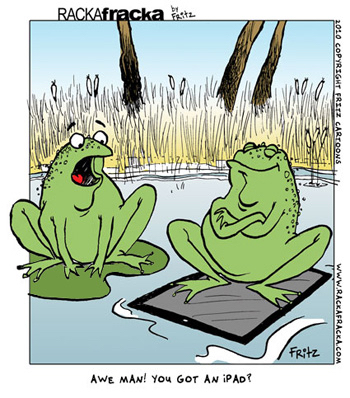
Frog on an iPad

Despite our modern communication techniques, our telephones as well as their associated technology with computers and electronic storage, it is interesting to see how much work still involves paper. I am very well aware as to how important it is to keep records of what has been achieved, what changes have either been made or need to be done as well as the ability to share all that has been both done and learned in the past. Some years ago it was thought that a single language would be a good idea and in 1887 a Polish ophthalmologist by the name of L.L. Zamenhof created Esperanto. It was intended to be a second language of the whole world, the only one for people to learn other than their own and would be ideal for international communication. According to research it is very easy to learn, as all words and sentences are built from 16 basic rules that can fit within a sheet or two of paper. But I guess that it might not be ideal to translate precisely into, as not all languages have a similar structure. I believe that many languages are an amalgam of others that have built up over the years, like English. As for learning languages, I think it often depends on how much trouble a reader is prepared to go to in order to increase their word power as well as quite how much use will be made of this newly acquired skill. It is up to the individual, as it depends on a great many things, like their particular circumstances. I have mentioned hearing, but as we grow older we can also find our sight diminishes. Perhaps the hardest thing to accept is what is happening to our vision and other faculties. Even with this pandemic there is no shortage of reading material, in fact it is most likely the opposite as folk like me are writing more and more. However, I am aware that there is also an unwillingness to take the time, to make the extra effort, especially when we cannot pursue our interests in ways that we used to. Our health can play a huge part in all that we do, but as has been said before these problems should not be seen as obstacles to overcome but as stepping stones to reach our goals. The tendency nowadays is towards the use of modern technology but that may not always be either possible or even preferred. I am well aware of the reticence or inability with some folk to use computers, it was one of the reasons why I ran my small business the way I did, to help others of my age and ability to use such things. But many if not all computers now have a facility to read text and speak words, there are numerous audio books now too. It does not take much, as even just a small monthly publication from somewhere like Readers Digest can prove to be invaluable and a magnifying glass is not too difficult. There is even a section in each edition of that publication called ‘It Pays To Increase Your Word Power’, with a glossary included. In fact each edition comprises a few different stories, jokes as well as a few anecdotes for which the author gets paid! The options are out there. I have also said about how as a young child I was read to and I have had a thought that the same might be done for the elderly, although this may not initially be appreciated by them. When we visit, we may not have much to talk about, so maybe one idea might be to read a book out loud to them. It’s just an idea. In this busy world, I have found it useful to try and set aside time for reading and writing, it was something I did when I was much younger and it is proving useful to me now, to have a routine. I have said to a few of the Carers here how quickly my time passes each day! But as well as writing a daily diary, I also use a reminder app on my iPhone called ToDoist, which reminds me each day of things I must do, like sending greetings to folk, doing some homework, watching certain items via my iPhone that are on tv each weekday. That is a really good thing, as it helps me keep track of the days and when it is the weekend. I have medication which I must take regularly, although here the Care Home staff manage that side of things! Because I use a MacBook which synchronises automatically between the iPhone and the computer, any of the additions, updates or changes on one are copied immediately to the other. All clever and useful. It also means I can begin writing items such as this blog on the MacBook and continue writing from where I left off on the iPhone. Even for those more acquainted with using a Microsoft Windows computer and their Word, Excel and PowerPoint these are now available on the Apple Mac and MacBook, which I use. Some people have commented on how quickly I can often retrieve information that I have in the past been given and apart from organising my computer files, I use a computer program (the correct term is an ‘app’, I believe!) which is called Bear. I use it for note-taking and storing a whole range of information, including images. All this helps me to continue reading and writing!

This week, some fun. We have all experienced this, I am sure.

In the Beginning, there was the Plan,
And thereby came the Assumptions,
But the Assumptions were without Form,
And the Plan was without Substance,
So Darkness was upon the face of the Workers.

And the Workers spake amongst themselves, saying
“It is a crock of sh1t and it stinks”.
And the Workers came unto their Supervisors and saith
“It is a pile of dung, and we cannot live with the smell”.

And the Supervisors went unto their Managers, saying
“It is a container of excrement, and it is very strong,
Such that none may abide by it”.
And the Managers went unto their Directors saying,
“It is a vessel of fertiliser, and none may abide by its strength”.

And the Directors spake amongst themselves, saying one to another
“It contains that which aids growth, and it is very strong”.
And the Directors went unto the Vice Presidents, saying unto them
“It promotes growth, and is very powerful”.

And the Vice Presidents went unto the President, saying unto him,
“This Plan will actively promote the growth and vigour of the Company
With very powerful effects”.
And the President looked upon the Plan
And saw that it was Good.

And the Plan became Policy.

Click: Return to top of page or Index page

First Down!

I was having a gentle toddle along one of the corridors in this lovely Care Home when an inmate who was in their room began calling out. It was so loud that it reminded me of a tale by Agatha Christie, because the sound was so anguished and it made me wonder if a person was in fear of their life! I hasten to assure you that this was not the case at all, they were in fact being treated to a gentle manicure by a couple of Carers. Apparently the inmate has dementia and I am told that it can be difficult to get such sufferers to understand what is truly going on around them. But it made me think of the sounds, the words, the phrases, the terminology we use in our English (British) language. I have made a point of adding the country here, because I am a member as well as a sometimes contributor of a Facebook group called G.A.S.P. (Grammar And Spelling Police) which was set up by some people in America. I have mentioned them in the past because their wording, spelling and even phraseology can be entertaining, in some cases very different from that which we use. But I know that some folk there have expressed amusement at the things we say here. For the most part it is all taken very much in good humour, but there have been odd occasions when things have become ever so slightly ‘heated’! There is one famous quote by the playwright George Bernard Shaw, which is that Britain and the USA are “Two nations separated by a common language” and that is how it is in G.A.S.P., as we share amusing misquotes, signs, spelling errors, all that sort of thing. It is not to make fun of the author, whoever they are, but more to see how our language can create amusement, sometimes by a simple error in translation from one language to another. In this Facebook group, one person asked how they might be able to improve their English and without exception, all of us that replied said they should read more, they should have a dictionary nearby and look up ’new’ words, they should also write these new words down and use them whenever they could. It was how I was taught and it is refreshing to learn that others were taught just the same way. I am quite a fan of Agatha Christie’s work, she wrote many good books that have been turned into films. So as I was writing this, I recalled one work where our heroine, Miss Marple, is in a lawyers office and the lawyer spoke a legal word I did not know. I thought it was ’tonteen’, as that is how I heard it, but when I came to write it here this clever computer soon corrected me. It is actually ’tontine’. But I still checked on the word, finding it to mean “an annuity shared by subscribers to a loan or common fund, the shares increasing as subscribers die until the last survivor enjoys the whole income”. There are so many words, some rarely used, which are particular to a profession or sport. I have mentioned in previous writings about my very keen interest in photography and how I combined it with my teaching to start up my own business, helping folk how to take clearer, better photographs and then to use a computer to share their photos with others. A few years before that I joined a civilian pistol and rifle club as I was introduced by a good friend of mine who was stationed at RAF Wittering. There were times when he would represent his RAF station at the shooting events at Bisley and I believe this was quite an honour for him. So I learned to shoot using various handguns, it also meant that I was taught the proper stance for holding and firing them, something I found tremendously useful when taking photographs, as the stance when shooting with a camera is very similar, providing as it does a firm and stable platform. What was equally fascinating was the terminology used, it highlighted that many words and phrases which are used in the English language do in so many cases cross over from one hobby or profession to another. A while later I was invited over to RAF Wittering, where my friend introduced me to others there. So I suppose it was natural for me to be asked which RAF station I was from, but on learning that I was a civilian the group turned away and virtually ignored me. Except my friend included me in their conversation as I was able to talk reasonably knowledgeably about shooting with handguns as well as my experience with them and how aspects of taking photos and generally handling a camera came in useful when handling a handgun. It fascinated me to see how the group then opened up and began including me in their talk. I have written before about how technical phrases in one environment can often mean something entirely different in another, whilst other terms may be well known to some but completely unknown to others. We can so easily forget this and assume that others know what we know, however I am reminded that when using the word ‘assume’ that we do not inadvertently make an ‘ass’ of ‘u’ and ‘me’! With the coming of the Internet, the use of online dictionaries and more people using computers, I think it is going to happen that we learn more things, more words and phrases that at one time would have been totally unknown to us! This is very true in the world of sport.

American Football vs Rugby

Some years ago one terrestrial tv channel in the UK began to broadcast the pre-season games of American Football. I watched it, became interested in the game and learned more about it. I found that it has many similarities to our rugby and, as with many other games, once you are aware of the basics the rest can come in time. Certainly the shape as well as the size of the ball are almost identical to rugby. I soon learned that an American football field is 300 feet long (not counting the end zones), 160 feet wide and is marked out in lines 10 yards apart across the width of the field. The two end zones are the width of the field and 10 yards deep, along with the rugby-style goal posts at the far back. In addition, centred on the length of the field on either side are the coaching boxes and team areas. But there are major differences in terms of players between our soccer, our rugby and American Football. In soccer, a match is played by two teams with eleven players in each, one being a goalkeeper. A match may not start or continue if either team has fewer than seven players. Likewise a game of rugby is played between two teams with 15 players per team; eight players in the tight scrum and seven players called backs who are scattered all over the field. Wearing jerseys, the numbers on the player’s backs will then determine where they are located on the field. American Football is played between two teams, each one comprising an Offensive Unit, a Defensive Unit and a Special Teams Unit. Within each Unit are a defined number of players and every player has a named, designated number on their back as well as a position on the field of play and task for which they are specifically trained. In addition, they train for other positions in case of any injuries. There are only eleven players allowed from each side on the field at any one time, so one side will play from their Defensive Unit whilst the other side play from their Offensive Unit. Once it has been determined, by the toss of a coin, which side will start and play first then the other team use the Kicker from their Special Teams Unit to kick the ball from their 25-yard line as far down the field as possible. The Offensive Unit of eleven players then come onto the field and attempt to advance the ball from where it has finished, or from the 25-yard line if the ball ended up in the end zone, whilst the players in the Defensive Unit try to prevent this. There are two main ways for the Offense to advance the ball, either by running or passing. The Offense have a series of four plays, known as ‘downs’, starting with the ‘first and ten’ as it is the first down and ten yards to achieve. If the Offense advances ten or more yards within the four downs, they are then awarded a new set of four downs. However, if they can perhaps only achieve, say, five yards on that first attempt then they play again and with just five yards to go on their second attempt this is called ‘second and five’. They might then achieve a further three yards, meaning the next play is ‘third and two’, it being the third ‘down’ with just two yards to go to achieve the full ten yards. If the quarterback throws the ball downfield and it is caught by a Receiver from the Offensive Unit, the ball is then played from however far down the field the ball is caught and the Offensive player stopped by a Defensive player. It might be ten, twenty, fifty or sixty yards downfield! If the player manages to run with the ball into the end zone this is a touchdown. In a similar manner to rugby, the ultimate aim is to get the ball over the goal line into the end zone to score a touchdown, thus scoring six points. If they achieve this, the Kicker from their Special Teams Unit then attempts a Conversion, aiming to kick the ball from a fixed point 25 yards from the goal line to between the goal posts, which is similar to rugby. If this is successful, the team get an extra point. If they fail to advance ten yards within the four ‘downs’, then possession of the football is turned over to the other team from wherever the ball has finished. In most situations, if the Offense reaches their fourth down without moving the ball the required ten yards, they will ‘punt’ or kick the ball as far down the field as possible, which forces the other team to begin their drive from where the ball ends up. If however the Offense are in Field Goal range, usually 35 yards or less from the goal, then they might attempt to score a Field Goal instead of a touchdown. The Field Goal is similar to the Conversion but is attempted from the middle of the field from however far down the field the ball happens to be. If successful, a Field Goal scores three points. At all times during the game a group of officials known as the chain crew keep track of both the downs and the distance measurements. On television, a yellow line is electronically superimposed on the field to show the first down line to the viewing audience. In a typical play, the Center passes the ball backwards between their legs to the Quarterback in a process known as the Snap. Then the quarterback either hands the ball off to another player, throws the ball, or runs with it. The play ends when the player with the ball is tackled or goes out-of-bounds or a pass hits the ground without a player having caught it. A forward pass can be legally attempted only if the passer is behind the line of scrimmage (the line where each play starts) and only one forward pass can be attempted per down. As in rugby, players can also pass the ball backwards at any point during a play. A ‘down’ also ends immediately if the runner’s helmet comes off. The game is divided into four quarters of fifteen minutes each, but the difference with this game is that it is very much a series of stop and go events, with different players coming on and off the field on both sides between ‘downs’. Which actual players are on the field is determined by the Offense and Defense team coaches or the Head Coach of each side. They try to guess what game strategy, that ‘plays’ the other side will use. Another big difference with this game compared to rugby or soccer are the number of officials on the field at any one time. A big difference with this game compared to rugby or football are the number of officials on the field at any one time. So apart from the Referee, there is an Umpire, a Down Judge, a Line Judge, a Field Judge, a Side Judge and a Back Judge! These officials are all dedicated to looking out for infractions to particular rules and each official carries a weighted, bright yellow flag which they throw to the ground to signal that a foul has been called. The officials then consult with the referee who determines what penalty is to be applied. It may mean moving the ball back to where the last ‘play’ started, but a more serious penalty can be applied if appropriate, for example one player grabbing the face mask of another. In addition, a limited number of ’time-outs’ may be called by either side, like if a quarterback feels the need to discuss a change of strategy for a particular ‘play’. In the United States, most games are televised so there can also be a delay in the game whilst tv adverts are on. All this can extend a simple game of four quarter hour sessions to a good deal longer! There is much more to this game in terms of strategy, planning, watching how other teams play over the season which lasts just sixteen weeks, with thirty-two teams taking part across the U.S.A. I have found it a fascinating game and as with most things, the more I learn, the more I find there is to learn. But what is really entertaining is the enthusiasm that the commentators have on this game. I have heard and watched a few games, on television as well as attending Wembley and the spectators are kept very well informed as to how the game is progressing, there are huge screens showing the gameplay and for example, when an Offensive player moves the ball successfully on or beyond the ten yards, it is the signal for the referee to call that the play has been a success. At that point, the commentator shouts this over the loudspeakers, resulting in a “FIRST DOWN!”. Interestingly, most fans on both sides appreciate a good strategy and will applaud when one is made. I have had the privilege of going to Wembley Stadium and watching American Football games that were played between different teams, but despite the fans themselves being supporters of one team or another, more often than not they are really supporters of the game, as the games they are attending may not always be between the teams they particularly support. Most wish to see a good, healthy honest game, and almost all of the time we get exactly that. Any bad behaviour by fans mean that they are immediately expelled, whilst bad or illegal behaviour by players or even coaches on the sidelines will mean the person(s) being fined, at times expelled, but most especially the team itself being fined, often for bringing the game into disrepute. Whatever our interests, especially sports, over the years we learn all of the rules, regulations, peculiarities and terminology as well as the individuals, teams and habits associated with our chosen interests. It keeps us active and happy. As we grow older, sometimes we have to adjust, but with all of the technology available nowadays, we still have options, like watching on television!

This week, some poetry from Pam Ayres.

I have a little Sat-Nav, it sits there in my car.
A Sat-Nav is a driver’s friend, it tells you where you are.
I have a little Sat-Nav, I’ve had it all my life.
It’s better than the normal ones, my Sat-Nav is my wife.

It gives me full instructions, especially how to drive,
”It’s sixty miles an hour”, it says, “You’re doing sixty five”.
It tells me when to stop and start, and when to use the brake
And tells me that it’s never ever, safe to overtake.

It tells me when a light is red, and when it goes to green
It seems to know instinctively, just when to intervene.
It lists the vehicles just in front, and all those to the rear.
And taking this into account, it specifies my gear.

I’m sure no other driver has so helpful a device,
For when we leave and lock the car it still gives its advice.
It fills me up with counselling, each journey’s pretty fraught.
So why don’t I exchange it, and get a quieter sort?

Ah well, you see, it cleans the house, makes sure I’m properly fed.
It washes all my shirts and things, and keeps me warm in bed!
Despite all these advantages and my tendency to scoff,
I only wish that now and then, I could turn the b€££&r off!
~ Pam Ayres

Click: Return to top of page or Index page

Times Change

As I began writing this, I wondered. Yes, times do change, but just how well do we change with them? Nature never ceases to amaze me and the more I learn of it, the more I marvel at it. We can take nature for granted so easily, yet we abuse it so much. Happily it either survives or adapts to the changes. I said in a blog post a little while ago that I was watching a lovely film about Arctic wildlife and how it showed a polar bear go into a village to look for food. I have also since learned about Arctic foxes, who are opportunistic feeders, eating practically any animal it can, alive or dead. They rely entirely on populations of rodents, especially lemmings, voles, and other small mammals. They will also eat birds, insects, eggs, berries, reptiles, and amphibians. These animals have adapted to the changes around them for sources of food. With a global pandemic presently upon us, we are still having to adjust, to adapt to changing circumstances and we are finding ways to cope, although some are perhaps managing to do so better than others. I am very much aware of the changes I have had in my life during the past eighteen months and overall they have benefited me, which I am grateful for. Statistics are being bandied about relating to our health and lifestyles, some people might be attempting to scare us, whilst others help us see sense. Many years ago I was told an entertaining statistic which was that in one area in a particular year over half a million people died in their beds, whilst in that same year just two people died near the North Pole. So it was suggested that statistically, we would be safer sleeping near to the North Pole than it would be in your bed. This was a ridiculous statement, obviously, but it proves that statistics can so easily be manipulated. Even over the last hundred years or so our technologies have advanced, there have been amazing changes that have benefited our lives and yet some have proven to be detrimental to life itself. I have mentioned asbestos which turned out to be a killer, also more and more vehicles are on our roads these days and for a time diesel-powered cars were deemed to be the best fuel. But now we are starting or at least beginning to look towards electrically powered vehicles. There was a time when owning a car was a luxury, now a family may have two or three at home and they must be kept somewhere. As a result, areas at the front of our properties which were at one time used as gardens are being covered over with tarmac for these vehicles to park on. Except climate change is creating heavier rainfall now, so that the heavy rains do come but instead of all that rainwater soaking steadily into the earth and helping to feed the plants and other living things in our gardens, this water runs quickly over the tarmac and down onto the road, thus flooding roads and properties. This also means that excessive amounts of water flood quickly into our drains and into our rivers, but they cannot cope with that amount of outflow in such a short space of time and areas of our towns and cities flood. This causes disruption to traffic and travel, prevents folk getting to and from work, causes delays to deliveries of goods and services as well as exacerbating the degradation of road surfaces. We might look back and see how we could have changed things, but we didn’t. I am reminded that change is around us all the time, and to quote the former American President John F Kennedy, “Change is the law of life. And those who look only to the past or the present are certain to miss the future”. Good words, but how much have we learned, I wonder. There is no doubt that as humans we have most certainly changed, we have learned a great many new things, we have invented, developed and used new skills, including the ability to store knowledge and share so much with future generations. Though different groups view change differently. Whilst some embrace it, others reject it out of hand. Many folk look to utilise advances in technology and skills for the benefit of both themselves and others, whilst some take on a more selfish attitude, usually to enhance their wealth. Some such folk even consider that they are above others, even above the laws of where they live. Yet they too will pass away, leaving all their worldly goods behind. It does not make any difference as to whether they are buried in a marble mausoleum or in a wooden casket, surely what should be more important is how they have lived, what they brought to the world and all that they did during their lifetime to improve the world they leave behind. For example one man planted a tree in an area that was nearly a desert, but despite that he continued planting trees and in time those trees became a forest with plants, animals and insects there. So it can be with us as humans, planting not just trees and other such things, but seeds of goodness and positive living, thus showing care for all things. We are not perfect by any means, we all make mistakes, often making incorrect decisions but surely the important thing is to learn, to change and to grow. We can look back on our mistakes, but it is not so easy to change our ways, our behaviours, especially as all too often we can put a financial cost on such changes, not considering the cost to our environment. Others have written extensively on the various ways in which humans adapt to change and it has been said that the human body can and does readily respond to all of the changing environmental stresses in a variety of biological and cultural ways. For example we can acclimatise ourselves to a wide range of both humidity and temperature and and this ability to rapidly adapt to varying environmental conditions has made it possible for us to survive in most regions of the world. We have created clothing and machines which enable us to leave this Earth, to survive in space, to travel to the Moon and back, but we still have famine, drought and poverty. Some humans still wish to control the thoughts and ways of others, not for the benefit of all but purely for their own ends. Ranging from Eskimos to Africans, Asians to Australians, all races, no matter where we live, our skin colour, what language we speak, it makes no difference – or at least it shouldn’t. Whatever our clothing, personality or behaviour, we are all human and should surely be treated as equals. We have a body, a mind and a spirit that are equally unique. Different cultures lead us to different religions, some folk have very differing political views and there are times when we seem to forget that this is a transitory life. We are surrounded by such a wide range of plants, animals and other things, some of which have life and others that do not, like the rocks, stones and mountains, even the air we breathe but which all go together to make this planet, the amazing and beautiful world on which we live.

Earth, viewed from the Moon

According to radiometric dating estimation and other evidence, this Earth formed over 4.5 billion years ago. Within the first billion years of Earth’s history, life appeared in the oceans and began to affect Earth’s atmosphere and surface, leading to the proliferation of various different organisms. In fact, some geological evidence indicates that life may have arisen as early as 4.1 billion years ago. Since then, the combination of Earth’s distance from the Sun, physical properties, and geological history have allowed life to evolve and thrive. In the history of life on Earth, biodiversity has gone through long periods of expansion, occasionally punctuated by mass extinctions. Over 99% of all species that ever lived on Earth are extinct. The Ice Ages on Earth began 2.4 million years ago and lasted until 11,500 years ago. During this time, the earth’s climate repeatedly changed between very cold periods, during which glaciers covered large parts of the world and very warm periods during which many of the glaciers melted. In the time of dramatic climate change some 300,000 years ago, the humans we know as Homo sapiens evolved in Africa. Like other early humans that were living at this time, they gathered and hunted food, and evolved behaviours that helped them respond to the sometimes dramatic challenges of survival in unstable environments. Over long periods of time, streams and rivers wore away the rocks, many living things died out but equally many adapted and survived in the changing environment on Earth. Change has been with us and around us all this time, we can look back at the Egyptian pyramids dating back to over four thousand years ago and we can marvel at their technology. They found ways to achieve their goals. Closer to home but of a similar age, the Avebury complex is one of the principal ceremonial sites of Neolithic Britain that we can visit today. It was built and altered over many centuries from about 2850 BC until about 2200 BC and is one of the largest, and undoubtedly the most complex, of Britain’s surviving Neolithic henge monuments. How they mined the stones and transported them is amazing, but they achieved their aims. In a similar way, over the years our changes in weaponry were developed, diseases were fought and in time overcome. Now almost 8 billion humans live on Earth and we all depend on its biosphere and natural resources for our survival. Humans increasingly impact Earth’s surface, hydrology, atmospheric processes and other life. I personally feel it has much to do with our innate ways of wanting, wishing and willingness to survive. In my short lifetime to date I know of successes and failures, some in my family and some not. My maternal grandfather was in a ship that was torpedoed at the Battle of Jutland where only a few survived and he was one of them. However, having spent so much of his life at sea he could not easily adapt to living on land. My paternal grandfather fought at the Somme during World War I, he was captured and during his imprisonment lost one and a half fingers from one hand. But he survived, he adapted to his injuries. My father sustained a bad shoulder injury during a training exercise during World War II, so was not sent abroad with the rest of the unit he was in. He survived and met my mother, who was herself severely injured in London during the war and she was at first told she would never walk again. But she did, she bore three children and passed away at the grand age of 95. Yet a good friend of mine who was a brilliant musician did not heed the warnings of his doctor and sadly passed away aged 59. Over a few years I managed to get my parents and grandparents to tell me a few stories about the conflicts they were in, but they would never talk about the conflicts themselves, what they faced or how they coped, all I got were fun anecdotes. I guess it would have been too much and it is also how we cope with pain and suffering. I was born prematurely and have epilepsy, from birth I have had a weak right side similar to a stroke and I also have asthma. So I have learned to adapt, to survive. Right now I am in a Care Home, still recovering from heart problems along with Covid-19. I have had to adjust, to adapt to changing circumstances, but my faith and the excellent care I am receiving will get me through for a good while yet, that is what I hope and pray. As we all grow older, we encounter new challenges and we survive them, though we may find it tough going at times. But the good Earth turns, times change, and we must change or at least adapt with them. I wonder what the future may hold for us all!

This week…
It seems someone has had a valuable item stolen.
The owner has a message for the thief, which is:
To whoever has stolen my Microsoft Office.
I will find you.
It is something I Excel at.
Your Outlook is bleak.
You have my Word…

Click: Return to top of page or Index page

Whittlesey And The Fens

In a blog post earlier this year I wrote about Whittlesey. Whilst this is not my ‘home’ town as such because I was born in London, we moved there when I was just eight months old because of my mother’s health and as my father had acquired a teaching job in the town, along with the use of the adjacent school house. This town was definitely where I began my education in this life, a journey which continues as there is always something new to learn, no matter what age we are! I got to know the area fairly well, although this was nothing like the families who had lived there all their lives. They knew their history, how things had changed so much as well as how it had grown and developed over so very many years. My research showed the town’s name appearing in the Domesday Book of 1086 as “Witesie”, meaning “Wit(t)el’s island”, deriving from either Witil, “the name of a moneyer”, or a diminutive of Witta, a personal name plus “eg”, meaning “’island’, also used as a piece of firm land in a fen. At some point the spelling of the town’s name was Whittlesea, but sadly my research has so far failed to determine exactly when. The name was then modernised at some point to Whittlesey, however, the old name spelling of Whittlesea is still used at the local railway station and on all British Rail timetables. In the centre of Whittlesey is the Market Square that has on it a structure known as the Buttercross and this dates back to 1680. It was originally a place for people to sell goods, but the structure was considered useless in the 1800s and only saved from demolition when a local businessman donated some slate tiles for the roof. Latterly it served as a bus shelter, until the local bus services were relocated from the Market Place to a purpose-built terminal in nearby Grosvenor Road. Adjacent to the Market Square is the church of St Mary’s, which does contain 15th-century work but most of the building is later. It is well-known for having one of the tallest buttressed spires in Cambridgeshire for the smallest tower base. The spire is 171 feet (52 metres) high. The church also contains a chapel that was restored in 1862 as a memorial to Sir Harry Wakelyn Smith, who I wrote about in a blog post earlier this year. The other church in the town is St Andrew’s, which blends the Perpendicular and Decorated styles of Gothic and its records date from 1635. A market is held on the Market Square every Friday and the right to hold a weekly market was first granted in 1715, although there have been several periods since in which the market did not function, for example from the late 1700s until about 1850. At one time the town had a large number of public houses, fifty-two in all and in 1797 a local farmer noted in his diary, “They like drinking better than fighting in Whittlesea.” In 1784, during the reign of King George III a brick tax was introduced, a property tax to help pay for the wars in the American Colonies. As a result, the local clay soil was used to make boundary walls made of cob, a natural building material made from subsoil, water, fibrous organic material, typically straw, and sometimes lime. The contents of subsoil naturally vary, and if it does not contain the right mixture it can be modified with sand or clay. Cob is fireproof, resistant to seismic activity and uses low-cost materials, although it is very labour intensive. Some examples of these cob walls still stand today and are claimed to be unique in Fenland. At one time there were several pits near to the town which were quarried for their clay, but only one is still in existence with the rest now flooded. Clay walls predate the introduction of the brick tax in other parts of the country and some were thatched. As a result, Whittlesey was significant for its brickyards, around which the former hamlet of King’s Dyke was based for much of the 20th century, although only one now remains following the closure of the Saxon brickworks in 2011. The detailed excavations of an area known as Flag Fen indicate thriving local settlements as far back as 1000 BCE, also at the nearby Must Farm quarry a Bronze Age settlement is described as “Britain’s Pompeii”, due to its relatively good condition and in 2016 this was being excavated by the University of Cambridge’s Archaeological Unit. At Must Farm at least five homes of 3,000 years in age have been found, along with Britain’s most complete prehistoric wooden wheel, dating back to the late Bronze Age. Whittlesey was linked to Peterborough in the west and March in the east by the Roman Fen Causeway, probably built in the 1st century CE. Roman artefacts have been recovered at nearby Eldernell, and a Roman skeleton was discovered in the nearby village of Eastrea during construction of its village hall in 2010. The town is still accessible by water, being connected to the River Nene by King’s Dyke, which forms part of the Nene/Ouse Navigation. Moorings can be found at Ashline Lock, alongside the Manor Leisure Centre’s cricket and football pitches.

Whittlesey Market Place in the 1940’s

The town is regarded as being on the edge of an area known as The Fens, also known as the Fenlands, and is a coastal plain of eastern England. This naturally marshy region supports a rich ecology and numerous species, and helps absorb storms. Most of the fens were drained centuries ago, resulting in a flat, dry, low-lying agricultural region supported by a system of drainage channels and man-made rivers, dykes and drains along with automated pumping stations. There have been unintended consequences to this reclamation, as the land level has continued to sink and the dykes have been built higher to protect it from flooding. The word ‘fen’ is a local term for an individual area of marshland or former marshland. In addition, it also designates the type of marsh typical of the area, which has neutral or alkaline water chemistry and relatively large quantities of various dissolved minerals, but few other nutrients. This fen land lies around the coast of the Wash, an area of nearly 1,500 square miles (3,900 square kilometres) in the counties of Lincolnshire, Cambridgeshire and Norfolk. Most of this Fenland lies within a few metres of sea level and as with similar areas in the Netherlands, much of the area originally consisted of fresh or salt-water wetlands. These have been artificially drained and continue to be protected from floods by drainage banks and pumps and with the support of this drainage system, the Fens have become a major arable agricultural region in Britain for grains and vegetables. The Fens are particularly fertile, as they contain around half of the grade one agricultural land in England. The Fens have also been referred to as the “Holy Land of the English” because of the former monasteries, which are now churches and cathedrals, of Crowland, Ely, Peterborough, Ramsey and Thorney. Other significant settlements in the area include Boston, Cambridge, Spalding and Wisbech. The Fens are very low-lying compared with the chalk and limestone uplands that surround them, in most places no more than 33 feet (10 metres) above sea level. As a result of drainage and the subsequent shrinkage of the peat soil, many parts of the Fens now lie below mean sea level. This is despite one writer in the 17th century describing the Fenland as entirely above sea level (in contrast to the Netherlands) and the area now includes the lowest land in the United Kingdom. Holme Fen, in Cambridgeshire, is around 9 feet (2.75 metres) below sea level. Within the Fens are a few hills which have historically been called “islands” as they remained dry when the low-lying fens around them were flooded. The largest of the fen-islands was the 23-square-mile (60 square kilometre) Kimmeridge Clay island, on which the cathedral city of Ely was built, its highest point is 128 feet (39 metres) above mean sea level. Without artificial drainage and flood protection, the Fens would be liable to periodic flooding, particularly in winter due to the heavy load of water flowing down from the uplands and overflowing the rivers. Some areas of the Fens were once permanently flooded, creating lakes or Meres, whilst others were flooded only during periods of high water. In the pre-modern period arable farming was limited to the higher areas of the surrounding uplands, the fen islands, and the so-called “Townlands”, an arch of silt ground around the Wash, where the towns had their arable fields. Though these lands were lower than the peat fens before the peat shrinkage began, the more stable silt soils were reclaimed by medieval farmers and embanked against any floods coming down from the peat areas or from the sea. The rest of the Fenland was dedicated to pastoral farming, fishing, fowling and the harvesting of reeds or sedge for thatch. In this way, the medieval and early modern Fens stood in contrast to the rest of southern England, which was primarily an arable agricultural region.

Not far from Whittlesey is an area referred to as Whittlesey Mere. It is reputed to have formed from about 500 BC when silt was deposited by the rivers Nene and Welland and water backed up which in turn was unable to flow away towards the Wash and the North Sea. As a result, a series of large ponds formed and water plants as well as reeds, sedges and mosses grew. Wet and dry periods ensued and over time the plants decomposed and turned into peat. The Mere formed as a shallow lake with a peat bog on the south side and a river-bank on the north side. This Mere occupied land southeast of Yaxley Fen, south of Farcet Fen, and north of Holme Fen, with the town of Whittlesey lying to the northeast. Whittlesea Mere stretched 6 miles wide, being both the largest as well as the shallowest lake in lowland England and was always at or below sea level, which made it very difficult to drain. Great gales were mainly a feature of autumn and spring, summer weather was often muggy and close, drying the peat out. In 1626, King Charles I of England engaged the services of an experienced embankment engineer named Sir Cornelius Vermuyden, a Dutch-born British engineer to introduce Dutch land-reclamation methods into England. His first task was to drain Hatfield Chase on the Isle of Axholme in Yorkshire. Jointly financed by Dutch and English capitalists, this project was quite a controversial undertaking, not only for the engineering techniques used but also because it employed Dutch instead of English workmen. The fen-men, local inhabitants who hunted and fished in the fens, attacked the Dutch workers and in order to complete the project, the engineer had to employ English workers and compensate the fen-men for their loss of hunting and fishing rights. Vermuyden was then contracted to drain the Great Fens, or Bedford Level, Cambridgeshire. This project was completed in 1637, although it drew objections from other engineers who claimed his drainage system was inadequate. However in 1642, during the English Civil Wars, Parliament ordered that the dykes be broken and the land flooded to stop a Royalist army advance. In 1649 Vermuyden was then commissioned to reclaim the Bedford Level and by 1652 some 40,000 acres were drained. According to the traveller Celia Fiennes, who saw Whittlesey Mere in 1697, it was “3-mile broad and six-mile long. In the midst is a little island where a great store of Wildfowle breed…. The ground is all wett and marshy but there are severall little Channells runs into it which by boats people go up to this place; when you enter the mouth of the Mer it looks formidable and its often very dangerous by reason of sudden winds that will rise like Hurricanes….” But despite the initial success of his land-reclamation efforts, Vermuyden’s techniques were undermined by the unique peatland ecology of the Fens. Draining the marshes caused the peat to shrink dramatically, lowering the land surface by as much as 12 feet (3.7 metres) below the height of the drainage canals and making the area extremely susceptible to flooding. Much of the reclaimed land was regularly flooded by the end of the 17th century, and the issue remained largely unsolved until steam-powered pumps were employed in the early 19th century. In the very hot summer of 1826 the Mere completely dried out. The bed of the Mere contained only 100 acres of water where over 1,000 was the norm and this laid bare large areas of mud. Then high wind blew what little water remained into deep fissures, leaving tons of eel, carp, pike and perch all flapping on the surface. Although the Mere filled up again in the winter of 1827, no fish were caught in it for another 5 years. In December 1851 it was drained artificially when a 25hp Appold centrifugal pump, capable of lifting 16,000 gallons of water per minute, was used. The Mere’s owner, a Mr Wells of Holme Fen, also instructed labourers to cut a bank in the Mere allowing the water to escape into one of the outflowing rivers. Thousands came to watch this feat of engineering; some brought big baskets or horses and carts to carry the fish away. Some people strapped boards on to their feet so they would not sink into the soft mud and thereby waded carefully towards the fish which were left dying on the surface. Various treasures were found, including a valuable chandelier, various swords and a pure gold censer (incense burner). In November 1852 heavy rains swelled the outer rivers and the new banks could not stand the extra weight of water, so Whittlesea Mere returned to its former glory but was then emptied again by artificial means, leaving an area of some 3,000 acres of peat-covered swamp to be turned into agricultural land. Since the advent of modern drainage in the 19th and 20th centuries, the Fens have been radically transformed. Today arable farming has almost entirely replaced pastoral. The economy of the Fens is heavily invested in the production of crops such as grains, vegetables, and some cash crops such as rapeseed and canola. As such, the Fens are very flat and offer clear views right across Cambridgeshire and Norfolk, a beautiful area of the countryside.

Whittlesey Mere, 1851

For this week, a couple of fun ones…
I’ve just finished writing an essay on the life of Julius Caesar, starting with where he was baptised. The font was Times New Roman.

During a routine inspection by his Colour Sergeant, a dead fly was found inside a soldier’s locker. The soldier was given two punishment details; one for keeping a pet, and the other for not feeding it.

Click: Return to top of page or Index page

The Telephone Network

It fascinates me how someone can have a brilliant idea and others just cannot imagine it ever being of any use. I think this is a fine example. In 1875, a certain Mr A.G. Bell formed the American Bell Telephone Company. A year later, he patented the first improvement in telegraphy, thus creating the first wired voice transmission where a pair of physical wires were connected between two devices. In 1876, Bell had a meeting with Western Union and according to the minutes of that meeting, Bell offered all rights to the telephone for sale to them for a mere $100,000. Bell’s profession was actually that of a voice teacher, yet he claimed to have discovered an instrument of great practical value in communication which had been overlooked by thousands of workers who had spent years in the field. He believed that a telephone would one day be installed in every residence and place of business, but at that meeting the committee thought Bell’s proposals were too fantastic. They felt that the central exchange alone would represent a huge outlay in land and buildings, to say nothing of the relevant equipment. In conclusion, the committee felt that it had no option but to advise against any investments in Bell’s scheme. They did not doubt that it would find uses in special circumstances, but any development of the kind and of the scale which Bell so fondly imagined was utterly and completely out of the question!

Alexander Graham Bell (March 3, 1847– August 2, 1922) was a Scottish-born inventor, scientist, and engineer who is credited with inventing and patenting the first practical telephone. His father, grandfather, and brother had all been associated with work on elocution and speech, also both his mother and wife were deaf, so profoundly influencing Bell’s life’s work. His research on hearing and speech further led him to experiment with hearing devices which in time culminated in Bell being awarded the first U.S. patent for the telephone on March 7, 1876. Bell considered his invention an intrusion on his real work as a scientist and refused to have a telephone in his study. But in 1878, some two years after he had invented the telephone, Bell is quoted as saying ”It is conceivable that cables of telephone wires could be laid underground, or suspended overhead, communicating by branch wires with private dwellings, country houses, shops, manufactories etc., etc., uniting them through the main cable with a central office where wires could be connected as desired, establishing direct communication between any two places in the city. Such a plan as this, though impracticable at the present moment will, I firmly believe, be the outcome of the introduction of the telephone to the public. Not only so, but I believe, in the future, wires will unite the head offices of the Telephone Company in different cities, and a man in one part of the country may communicate by word of mouth with another in a distant place. I am aware that such ideas may appear to you Utopian. Believing however as I do that such a scheme will be the ultimate result of the telephone to the public, I will impress upon you all the advisability of keeping this end in view, that all present arrangements of the telephone may be eventually realised in this grand system.” Many other inventions marked Bell’s later life, including some groundbreaking work in optical telecommunications, hydrofoils as well as aeronautics. Although Bell was not one of the 33 founders of the National Geographic Society, he had a strong influence on the magazine whilst he served as its second president from January 7, 1898, until 1903.

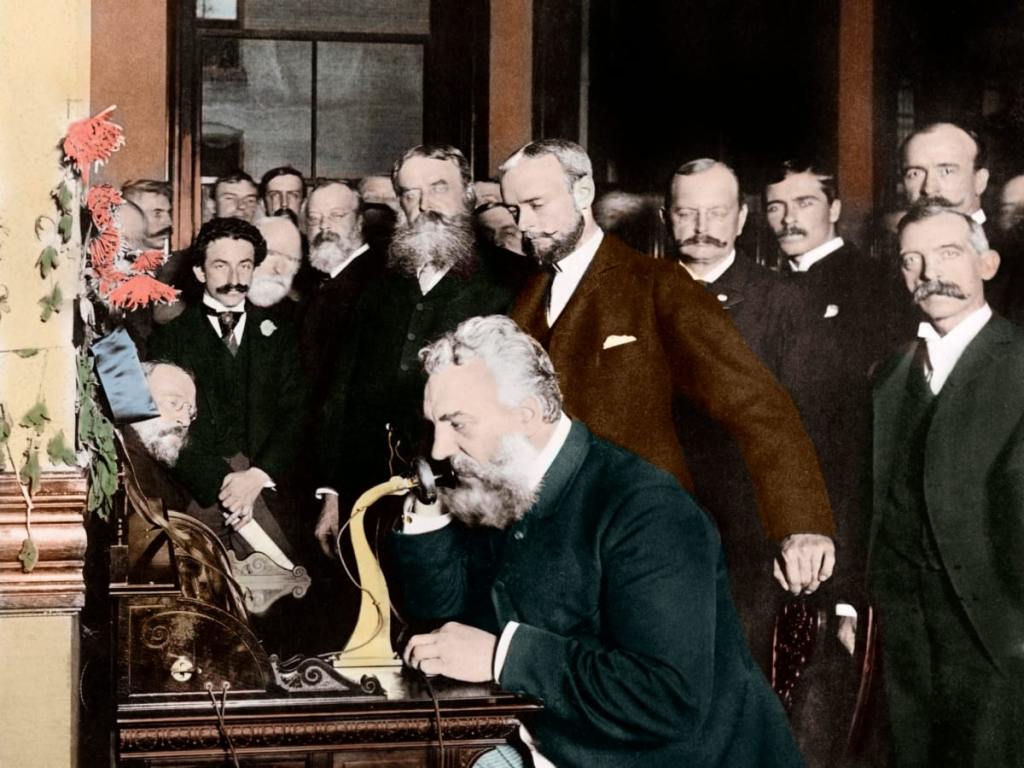
Alexander Graham Bell, making a call.

The commercialisation of the telephone began in 1876, with instruments operated in pairs for private use between two locations. It became more and more commonplace for users to want a fixed telephone in their home, but to begin with those users who wanted to communicate with persons at multiple locations had as many telephones as necessary for the purpose. To alert another user to the establishing of a telephone call was done by first whistling loudly into the transmitter until the other party heard the alert. Bells were soon added to stations for signalling so that an attendant no longer needed to wait for the whistle. Later on, telephones took advantage of the exchange principle which was already employed in telegraph networks. Each telephone was connected by wire to a telephone exchange established for a town or area. Communications outside this exchange area used a system called trunking and this was installed between exchanges. The Public Switched Telephone Network, or PSTN as it is often referred to, began. Alexander Bell demonstrated the telephone to Queen Victoria on 14 January 1878 at Osborne House on the Isle of Wight with calls to London, Cowes and Southampton and these were the first long-distance calls in the UK. The Telephone Company Ltd (Bell’s Patents) was registered on 14 June 1878 to market Bell’s patent telephones in Great Britain and it concentrated its efforts on the sale of telephone instruments and the fitting of private lines. The National Telephone Company (NTC) was then formed on 10 March 1881 and this brought many smaller local companies together. Meanwhile in the U.S.A. Bell co-founded the American Telephone and Telegraph Company (AT&T) in 1885, but here in the U.K. the NTC had already formed the basis of our early telephone network which existed until the Telephone Transfer Act 1911. Then, because the National Telephone Company had become a monopoly, the Liberal government decided to take it into public hands so it was taken over by the General Post Office (GPO) in 1912 and up until 1982 the main civil telecommunications system in the UK was a monopoly, even when the Post Office Act 1969 changed the General Post Office from a department of state to a public corporation, known as the Post Office, with the telephony side becoming Post Office Telecommunications. There was still one area in the UK which had its own telecommunications provider and this was Hull, served by KCom, though it was known then as Kingston Communications. Meanwhile broadcasting of radio and television was a duopoly of the British Broadcasting Corporation (BBC) and the Independent Broadcasting Authority (IBA) where these two organisations controlled all broadcast services. They also directly owned and operated the broadcast transmitter sites. Mobile phone and Internet services did not exist at all at that time. The civil telecommunications monopoly ended when Mercury Communications arrived in 1983 and the Post Office system then evolved into British Telecom which was privatised in 1984. All the broadcast transmitters which belonged to the BBC and IBA were privatised during the 1990s and then belonged to Babcock International and Arqiva. British Rail Telecommunications was created by British Rail (BR) in 1992 and operated its own national trunked radio network providing dedicated train-to-shore mobile communications, and in the early 1980s BR helped establish the Mercury Communications, now Cable & Wireless Co (C&WC), core infrastructure by laying a resilient ‘figure-of-eight’ fibre optic network alongside Britain’s railway lines, spanning London, Bristol, Birmingham, Leeds and Manchester.

For many years users of telephone lines were commonly referred to as subscribers because they rented access to their local provider’s network via a fixed telephone line, a pair of wires connecting a handset both provided and maintained by the network provider into the public switched telephone network (PSTN) which had a dedicated port in the telephone exchange equipment, thus supplying the subscribers unique telephone number and a meter for the charging of calls. When there was a shortage of cabling in a particular area two subscribers would share a single pair of wires with simple switching system enabling one subscriber or the other to use the network at any one time. These were naturally referred to as shared service lines. In the early days of the service automation was introduced between the telephone and the exchange so that each subscriber could directly dial another subscriber connected to the same exchange, however calls to a subscriber in a different exchange area required manual switching by operators who were housed in switch rooms of large exchanges around the country. Later, more sophisticated address signalling enabled the direct dialling of calls by subscribers of the service and the use of operators was reduced to handling calls to the emergency services, these being to the fire, police, ambulance and coastguard. Networks were gradually designed and extended in a hierarchical manner until they spanned cities, countries, continents and oceans. Also, the shared service system had to be phased out in the UK some years later when other telephone companies were allowed to connect their services to the BT network, thus requiring a common standard of connection for all to use.

The PSTN network now provides infrastructure and services for public telecommunication and is the aggregate of the world’s circuit-switched telephone networks that are operated by national, regional, or local telephony operators. These consist of wires, fibre-optic cables, microwave transmission links, cellular networks, communications satellites and undersea telephone cables, all of which are interconnected by switching centres which allow for most telephones to communicate with each other. Originally a network of fixed-line analogue telephone systems, the PSTN is now almost entirely digital in its core network. It includes mobile and other networks, as well as fixed telephones. In the 1970s, the telecommunications industry began to implement a different service for transmitting data over much of the end-to-end equipment that was already in use in the PSTN. In the 1980s, the industry began planning for digital services assuming they would follow much the same pattern as voice services, and conceived end-to-end circuit-switched services, known as the Broadband Integrated Services Digital Network (B-ISDN) but this was overtaken by the Internet. At the turn of the 21st century, the oldest parts of the telephone network may still use analogue technology for the last mile or less to the end user, but digital technologies such as Digital subscriber line (DSL), Integrated Services Digital Network (ISDN) and optical fibre connectivity have become more common in this portion of the network. There are also many private networks, usually used by large companies and which are linked to the PSTN through limited ‘gateways’ such as a private branch exchange (PBX). This is like a small telephone exchange or switching system that serves a private organisation and permits sharing of central office trunks between internally installed telephones, and provides intercommunication between those internal telephones within the organisation without the use of their external lines. The central office lines provide connections to the PSTN network and the concentration aspect of a PBX permits the shared use of these lines between all stations in the organisation. The PBX enables two or more extensions to directly connect whilst not using the PSTN network. This method reduces the number of lines needed from the organisation to the public switched telephone network and saves on call charges. Besides telephones, other devices such as a fax machines or computer modems can be connected to the PBX and each may have its own, dedicated extension number that is usually mapped to the numbering scheme of the central office and the telephone number block allocated to the PBX. Also a large organisation may connect directly to its other offices by means of private circuits which are permanently connected, which if used enough allow the transmission of voice and data for a lower cost than normal calls. At one time these were done over analogue lines, then digital ones, but these are largely being overtaken by other services now including mobile phone and Internet services.

Wireless technology…

So far as the regulation of the communication industry is concerned, the Consultative Committee for International Telephony and Telegraphy (CCITT) was created in 1956 but was renamed in 1993 as the International Telecommunication Union – Telecommunication (ITU-T). It is one of the three sectors of the International Telecommunication Union (ITU), the other two sectors being Radio (ITU-R) and Development (ITU-D). The technical operation of the PSTN adheres to the standards created by the ITU-T which coordinates standards for telecommunications and information communication technology for such things as cybersecurity, machine learning, and video compression between its member states, private sector members, and academia members. These standards allow different networks in different countries to interconnect seamlessly. Technically it is the E.163 and E.164 standards which provide a single global address space for telephone numbers. The combination of the interconnected networks and the single numbering plan thus allow telephones around the world to dial each other. Here in the UK the regulation of communications has changed many times during the same period and most of the bodies have been merged into Ofcom, this being the independent regulator and competition authority for the UK industry. So to my mind, it shows that Alexander Bell’s idea of communications was an excellent starting point, but it has surely now developed way beyond his visions or expectations.

I am reminded…
I used to work for British Telecom and for a few years I worked as part of their Midland Region Mobile Exhibition Team. This involved the staffing of various exhibitions, mainly around the Midlands and on one occasion I was at a public agricultural show where the stand was in an open aircraft hangar. It was a bitterly cold day, but we were in our official uniforms of light grey trousers, thin white shirt, blue jacket with brass buttons and we were all freezing cold. So I found a nearby stall holder selling very thick navy blue jumpers that perfectly matched our uniforms and we bought those for ourselves. Our BT Exhibition Manager turned up and was not too happy, but he knew we needed them so the extra clothing was approved!

Click: Return to top of page or Index page
Social Media

I was eleven years old when my parents bought me a lovely camera as a Christmas present. They knew that with the muscular weakness in my right hand I would find loading and operating a standard film camera a little bit difficult to do on my own, so they purchased a Kodak Instamatic 100. This type I could manage, as instead of the the standard type of film that had to be deftly threaded into the camera in order to make it work, this one used a drop-in cartridge. I could also hold the camera and work the shutter button with the index finger of my left hand rather than my right and still keep the camera steady. Then a few years later I bought a better camera, this was still a Kodak Instamatic but the 333 model which had a light meter built in and that automatically adjusted the shutter speed. I used this for a fair while but then I bought a Single Lens Reflex (SLR) camera, an Asahi Pentax SP1000, which did use a standard film but by now I could manage. This one allowed me to change lenses, it used a prism and mirror system to view the image that I was wanting to take directly through the lens itself, I was also able to manually adjust the shutter speed, aperture and focussing. As soon as the film was used up, I would then take it in to a chemists shop in Peterborough where it would be processed. The helpful assistant knew a great deal about photography and would often look at my photos with me. I was able to discuss the results with him and he taught me the basics of lighting, focussing and other camera techniques. After a while I began using a different film which meant I was now obtaining colour slides rather than prints by sending the film off to Kodak in a pre-paid envelope, I then received the slides in the post about a week later from their processing department in Hemel Hempstead. Now this photography was something that I could do and enjoy. I continued with my hobby all through my thirty-eight years working for British Telecom, but perhaps not always as much as I might have liked. So when my time with BT ended I didn’t give it much thought to begin with, but I slowly picked it up again. I was still using a standard film camera, thirty-six exposures at a time and sending the exposed film away for processing. Then I decided to move over to digital, but to begin with I bought a small Olympus camera and experimented with that. It served me very well, especially when I decided to have a holiday in the U.S.A. Once I was happy with that and could afford to, I looked around for a digital SLR. I had previously used an Asahi Pentax but couldn’t find a digital version that I liked, so I bought a Canon digital SLR camera and over the next few years added a couple of lenses with different focal lengths as these enabled me to ‘zoom in’ on what I was photographing. I was able to get some good results with those. I had also been doing some voluntary work with a charity and one day was chatting to a man in a nearby office. I saw that on his desk he had a really lovely old camera which I admired and commented on, the next thing I knew I was involved in photography work with a new venture he was setting up called a Social Media Cafe. This met once a week and it got me out and about. I took photos of local events, but there were a just few occasions when we had to be careful like the times a few of us were photographing EDL marches. But most times were fun, like Sky Ride. I did this for a few years and I will admit to being rather pleased with a few of the photos that I managed to take in that time, I was fortunate enough to get some in a local newspaper and one item was later enlarged and put on the wall of the local library for a little while after the place had re-opened following a major makeover. There was also a rather large advertising project I was involved in with the city council where I took the photographs which were then added to posters and displayed around the city. That was quite something.

Asahi Pentax SP1000

But I was now looking for a much-needed job, I also think the folk in the JobCentre were trying to get me off their books and with my experience as a tutor/trainer with British Telecom it was felt that I could put that to good use. At first so did I, but it seemed that my experience with BT counted for nought out in the big wide world! So I went to Leicester college and got myself a proper teaching qualification. Then was I able to start up my own business, so I did just that by combining my knowledge of computers, my love of photography and my teaching skills into Adwaen Photography and Computer Training. I chose the name ‘Adwaen’ because of my ancestry, as the word means ‘I know’ or ‘I understand’ in Welsh which I felt was quite appropriate because I really wanted others to hopefully learn from me and perhaps then help others as a result. I provided training on basic photography as well as using computers, I linked and combined these into various media platforms such as Facebook, Twitter and Flipboard as well as running training sessions on Social Media. I can look back now and smile, as this business had actually started out from a quite casual conversation as I admired the camera on that man’s desk. So thank you John, we never know where things can lead. In fact what this initial contact did was to also lead me into not just showing and teaching others about social media, but actively doing more of it myself. I did not want to lose this skill, this knowledge, so when I found myself in a Care Home recovering from heart problems and Covid-19 I decided to write this weekly blog. It has been going a year now and folk seem happy with it, so that pleases me and encourages me. A blog is defined as a regularly updated website or web page, typically one run by an individual or small group, that is written in an informal or conversational style. Each entry is ‘posted’ onto the website and are typically displayed in reverse chronological order so that the most recent post appears first, at the top of the web page. Blogs evolved from online diaries and journals in the mid-1990s and at that time many internet users were already running personal web pages where they published regular updates about their own lives and thoughts, as well as social commentary. The term web log was first used during the late 1990s, which later became ‘weblog’, then ‘we blog’, and finally just ‘blog’. Due to the growing number of such web pages, several programs and websites started to appear which made it easier for users to create online journals and personal blogs. It made the technology accessible to many non-technical users and helped popularise blogging. The only real difference between a blog and other types of website is that typical websites are static in nature where content is organised in pages and they are not updated so frequently, whereas a blog is dynamic, and it is usually updated more frequently. In fact some bloggers (those who write blogs) publish multiple new articles on a daily basis. These blogs can be on a theme, on personal views, events, anything that the writer chooses to write about. I post an updated blog each week on a Friday morning.

Prior to the rise of computers, especially home computers and the Internet, folk would communicate by writing letters and then use the postal system to send them. I believe though that some fathers were unhappy when the postal service was first established all those years ago, as it meant their daughters could send messages without their parents knowing! Urgent items of information used telegrams, there was also telegraphic signalling with morse code, and after that came the telephone system. In latter years mobile phones have come along, but in general these all have a common theme which is either one-to-one or one-to-many communication. Then came the Internet. Websites and blogging brought along social media, which as I have said consists of websites and various applications which enable users to create and share content or to participate in social networking. This enabled many-to-many communication, which is generally a great idea and extremely useful when used appropriately. We have a few different ways of doing this form of communication and as a result there have had to be rules and regulations brought in. I have already said about a blog, which is short for web log and is a personal website where individuals may write about opinions, activities and experiences. We also have Twitter, which is a ’micro-blogging’ system that allows you to send and receive short posts called tweets. These tweets can be up to a hundred and forty characters long, they may also include links to relevant websites and resources. Twitter users ‘follow’ other users. If you follow someone you can see their tweets in your Twitter ‘timeline’. You can choose to follow people as well as organisations with similar academic and personal interests to you. Also you can create your own tweets or you can re-tweet information that has been tweeted by others. Retweeting means that information can be shared both quickly and efficiently between a large number of people. Twitter itself only allows for basic text and no pictures, but other programs do work well with Twitter to allow images to be included. There are a few others around, some which use a neat magazine format and one I like is Flipboard, which is an online magazine where the user can easily ‘flip’ or copy items and articles from existing websites into an online magazine. This is especially good for specific subjects like hobbies, but it can also be used for general information. I have included a photo from my collection, I took this one very cold winter’s morning at Southend whilst I was attending a few days training with BT.

Winter Sunrise at Southend

I think one website that most will have heard of and are possibly using now to view this blog post of mine is Facebook. Where this differs so much is that you can share words, pictures, videos of events, hobbies, fun, things you like, in fact almost anything within reason. There are strict guidelines and support for the system, where users can report anything they feel is inappropriate and then if necessary a user will have the item they have posted removed by a moderator. The user may even be barred from Facebook and we have seen that happening quite recently in the U.S.A. when a user was deliberately posting false as well as misleading information. There are also groups that may be set up that refer to specific subjects or areas and users will only be allowed in to that ‘closed’ user group if they answer certain questions correctly. For example I am in such a group relating to the town where I grew up and was educated. A user may have many Facebook friends and some folk choose to be ‘Facebook friends’ with people they do not directly know but who do share a common interest. A user may also prevent another user from having any contact with themselves if they wish. I must say that I find Facebook useful, however there are some folk who put what I do regard as inappropriate or excessive information on Facebook at times. For example, an article in the Leicester Mercury newspaper appeared a little while ago saying about a new Mum who was posting onto Facebook every little thing (including photos) that her new baby was doing, like wearing a new outfit, crawling off the mat, six months old, etc. Naturally her Facebook friends were delighted for her to begin with, but in the end they asked her to stop as too much was too much. That Mum might have been better off keeping a personal diary. I use a program called Day One, where I can keep a daily diary and I have found it most useful to refer back to at times, for important information! The Facebook system allows users to check and change various settings, in particular the Security settings, so you know who can see what you’re posting! I will admit to occasionally getting ‘friend’ requests from people I do not know and so I check on their profile. I hardly ever agree to such requests, as once agreed to friends can see all the comments other people post, even if they are not their own friends! As to whether anyone is right or wrong to join Facebook, it must be down to the individual. So I have a fun example for you to explain the system. Imagine you have taken a photograph of your dog. You then post it just once on Facebook for people to see and comment on. They can then comment on that and share your post with others like their friends, some of whom you may not know, for them to see and share with their Facebook friends if they wish. This is rather like walking down the street and stopping everyone you see to look at the photo and comment on it. You even give them a copy of the photo and they can then do the same to everyone they meet. Alternatively, you can limit it to just your Facebook friends and in that case you would be then going round and visiting each and every one of the friends you have in the whole wide world, showing them the photo and allowing each one of them to comment on it. So it does have its good points, it is easy to share information, keep in contact with people and be up to date with events all around the world as well as locally. Items can be deleted and edited, which is very useful sometimes. For me, the only real down-side to the system are the adverts, as these are almost always unwanted but are done so users aren’t paying for access to the Facebook service. I try to be careful when I am sharing information, but in general I am in favour of Facebook, so long as we are careful and just think before clicking on that ‘send’ or ‘post’ button. I have seen a few heated arguments appear online at times and a moderator has had comments as well as posts reported to them and the relevant items removed. Having folk from all around the world see what you are saying can be great, but it really has highlighted to me a few differences in the meaning of words and that’s just in the English language. I still wonder at how our biscuits are called cookies in American English, whilst their biscuits are what we call scones. I also wonder what technology will bring to us in the future world of Social Media!

This week, we have…
Friends of mine recently found a bird’s nest that was being re-used. It was noted that there were no eggs there on Sunday, but one egg on Monday and two eggs by Tuesday. I told them I knew why – because Sunday is meant to be a day of rest…

Click: Return to top of page or Index page

Holidays

I have been thinking a little more about holidays. I have said in previous posts about my holiday memories, I detailed my lovely round the world cruise but I haven’t said too much about when I was quite young. As a lad I went with my parents on holidays to North Devon and we got quite used to travelling the route from Peterborough. We had a few regular stopping places, although in those days there were no such things as fast-food places like McDonalds or anything. But there was a park in Northampton where we used the public toilets, we would have a few sandwiches and tea from a flask, then carry on to our next regular ‘service areas’. Except for one time at Northampton when Dad and I were quietly drinking tea as we watched a few squirrels leaping up trees, when Mum returned, looking a bit flustered. It seemed that the Ladies toilet was locked – so Dad and I ’stood guard’ in order for Mum to use the Gents. It was quite early in the morning, but we felt it prudent to be prepared! The only real travel problems occurred when the bypasses and motorways were being constructed and on one occasion we had to stop and ask a policeman, as we found we were on the wrong road. He asked us, in his broad local accent, if we really wanted to go to Chippenham! We had missed an earlier turning at a roundabout which had recently been constructed, so we turned around and were soon on our way again. Holidays to North Devon became an annual event, at first our stays were in a caravan on a farmer’s field and it was there that one time I had to be kept isolated in the caravan as I had gone down with mumps! In later years we stayed in a chalet on a caravan site that was in Westward Ho!. We were never a family for sitting on the beach all day, we liked to explore, so we did day trips to various places in the area. At first our wanderings were done locally, to Bucks Cross where there was the post office and shop. Back then we had to walk along the side of the main road or on the grass verge, as there were no pavements leading from the farm. Then we went on a bit further, like to Clovelly, Hartland and Bude as well as an odd shopping trip to Bideford. We had a couple of relatives in Plymouth, so we did day trips to see them too. To me our holidays seemed to involve very little forward planning, although knowing my dad they most probably were, but to me they were lovely that way. Mum and Dad must have arranged visits with the folks in Plymouth so they knew we were calling, but otherwise things were, or they seemed to me at least, spur of the moment. So our days varied, we might have one day in Bude, another with a morning in Clovelly, back to the chalet for lunch and the afternoon I could have to myself, walking along the beach or the Kipling Tors, where I would sit quietly watching the world pass by. On the Westward Ho! sea front there was a fish & chip shop which served fish freshly caught in the bay. Then the year after my grandmother had passed away, my grandfather, or ‘Pop’ as I knew him, came along and he stayed with us in a static caravan on the same site as the chalet we had used before. On the site was an amusement arcade for youngsters to play on slot machines, a penny arcade you might call it, but it was also licensed so Pop and my dad went down there some nights for a drink or two. The caravan was a six-berth, with one double bed, two single beds in the small bedroom and a fold-down double bed-settee which was in the main room. So to begin with I shared the room with Pop, except one night he came back from the bar and fell fast asleep really quickly. Sadly his snoring was so loud I simply couldn’t sleep (sorry Pop!) so I rolled my bedclothes and pillows up and made up the bed in the main room. I was so embarrassed the following morning, but it was all I could do. Sadly Pop decided not to accompany us on holidays again, instead he went off when he wished from his bungalow in Whittlesey, visiting our relatives in London. We continued to take our holidays to the West Country, it was really relaxing and included a few fun times too. One day we had spent most of the day in Westward Ho! but as it was a fine evening we decided to journey the fifteen or so miles to Hartland Quay, to see the sunset. We drove there and parked the car on the cliff-top, but we were accosted by a very fine-looking gentleman who spoke to us in quite a haughty tone, berating us for parking quite where we had. It turned out that this was in fact a gentleman quite well-known in the area, it being Lieutenant-Colonel Pine-Coffin, the owner at that time of the nearby Portledge Manor. Situated in the parish of Alwington, south-west of Bideford, Devon, it and the surrounding area belonged to the Coffins, a noble family of Norman origin, for almost a thousand years. The Coffin family is said to have acquired the manor of Alwington soon after the Conquest, but the written record begins with a grant of free warren to Richard Coffin in 1254. What I have found interesting is that a free warren, often simply a warren, was a type of franchise or privilege conveyed by a sovereign in medieval England to an English subject, promising to hold them harmless for killing game of certain species within a stipulated area, usually a wood or small forest. The family boasted a number of famous soldiers, including this Lieutenant-Colonel John Trenchard Pine-Coffin who was the last member of the family to own its seat at Portledge. Sadly the sale of the estate was forced by taxation in 1998. The place had a distinguished ancestry and this included Sir William Coffin (d. 1538) who was Master of the Horse to Queen Jane, Sir Edward Pine-Coffin (1784-1862), a Commissary General in the Army, along with John Edward and Tristram James Pine-Coffin (both d. 1919) who fought with distinction in the Second Boer War and the Great War respectively. The family also served as sheriffs, justices, clergymen, and aldermen in Devon, though no member became seriously involved in any national politics. They are therefore an unusual example of a substantial family, armigerous (bearing or entitled to use a coat of arms) but not titled, which farmed in the same area and served their county for 900 years, thus leaving extensive records. Their library at Portledge, collected in the 17th century and sold in 1800, was famous throughout North Devon, and records of it tell us much about the reading habits of the Devon gentry.

Mandatory Credit: Photo by ANL/Shutterstock (5694091a) Wedding Of Miss Susan Bennett, daughter Of Colonel A. D. Bennett Of Plymouth to Mr John Trenchard Pine-Coffin Of Bideford at Buckfast Abbey.

I will admit to smiling when, as a young lad, I first heard his name but it is unusual so I recently decided to find out about this man and share what I have learned. Lieutenant-Colonel John Trenchard Pine-Coffin was born on June 12, 1921 in Kashmir and educated at Wellington. He had both a distinguished as well as an adventurous career in The King’s African Rifles and the Parachute Regiment. After Sandhurst, he was then commissioned into the Devonshire Regiment and served with the King’s African Rifles in East Africa, except his African-born sergeant was not best pleased when Pine-Coffin advised him not to wear medals that had been awarded to him by the Germans, but the sergeant quickly won the respect of his men without them. Pine-Coffin accompanied the King’s African Rifles to Burma. Stealth was often the key to his survival during this campaign and one night, whilst laying low in an attempt to conceal their presence from the Japanese, Pine-Coffin impressed on his African troops the real need for complete silence. They had, however, acquired a taste for tea and one of them, perhaps in his search for a superior brew, had placed their billy-can on a fire piled high with full ammunition boxes! On another occasion, when a strong Japanese patrol was preparing to attack his unit, his soldiers threw down their arms and disappeared into the darkness. Pine-Coffin and his brother officers had therefore resigned themselves to their fate when the men reappeared from the jungle with rather sheepish faces and said: “We like you too much to see you killed.” They collected their weapons, regrouped and helped to beat off the enemy assault. After the Japanese surrender, Pine-Coffin went to Pakistan to look for his father, who had been a prisoner of the Japanese since the fall of Singapore. He scoured the hospitals that were treating soldiers from PoW camps but was unsuccessful, however his father was repatriated to England. Pine-Coffin then joined the Parachute Regiment and was posted to the Middle East where he saw action during the Suez crisis. Following a move to Cyprus, he was involved in counter-insurgency operations in the Troodos mountains and when he came across a number of heavily bearded men hiding in a monastery, Pine-Coffin suspected that they were Eoka terrorists in disguise so asked his sergeant to give their beards a sharp tug. These all stayed firmly in place and he had to make a swift tactical withdrawal. During his twenty-eight years with the Parachute Regiment, Pine-Coffin served with all three battalions and in 1961 took command of 1st Parachute Battalion but his parachuting career was brought to a premature end when he landed in the dark on a tractor, broke several bones in his feet and as a result a series of staff appointments followed. In 1963 he was in Nassau when ordered to investigate a party of Cuban exiles that had infiltrated Andros Island, part of the Bahamas. His seaplane landed in thick mud and Pine-Coffin decided that his only chance of reaching dry land was to strip off. Upon coming ashore, plastered in mud and wearing only a red beret and a pair of flippers, he was confronted by a party of armed Cubans, so mustering as much authority as he could in the circumstances he informed the group that they were trespassing on British sovereign territory and were surrounded. The following morning, when the Royal Marines arrived to rescue him they were astonished to find him and his radio operator in a clearing standing guard over the Cubans and a pile of surrendered weapons. Pine-Coffin attended the Joint Services Staff College and the Imperial Defence College before retiring from the Army in 1969, building up a large farming enterprise in Devon and establishing a 3-star country hotel, the Portledge Hotel. He was involved in many local charitable enterprises, including the British Red Cross and the RNLI. In 1974 he was appointed High Sheriff of Devon. In 1952 he married Susan Therese Bennett, the daughter of Colonel A. D. Bennett of Plymouth and they had a son and two daughters. Lieutenant-Colonel John Trenchard Pine-Coffin, O.B.E. passed away on August 22 2006, aged 85. I think that for me, his name will always be synonymous with my lovely holidays in Devon and Cornwall.

This reminded me…
A friend was doing an online DJ set for a Devon & Cornwall radio station, playing hits from the 60’s and 70’s but they couldn’t decide whether to put The Jam or Cream on first…

Anniversaries, Birthdays And Holy Days

I have mentioned that during the first few years of our lives we believe that we are the centre of the Universe and everything revolves around us. As we get older, most of us realise that there are in fact others around and we ought to interact with at least some of them! As I got older I soon learned about a few delightful occasions such as birthdays, Christmas and a few other regular events like getting Easter eggs and Pancake Day. So of course I enjoyed receiving gifts and I began to look forward to those occasions. As part of me growing up and learning, I was taught how to find out things for myself. My parents knew they wouldn’t always be around, so I was taught to learn. It might seem strange, but I don’t think we all naturally just learn. I have said before how someone I knew was in an adult learning class and they simply needed a little bit of extra coaching and thankfully I was able to assist them. I didn’t tell them, I just guided their thoughts. Just as mine have been in the past and still are today. It really is true to say that we don’t know what we don’t know! My dad had a lovely book called the Pears Cyclopaedia and I would often sit, read and learn from it. Sadly it is no longer in print but there are still old copies available through the Internet. But the Internet is where we often go now, to find out, in fact the phrase ‘let’s Google that’ is now recognised terminology. Though I still like books! For me that encyclopaedia had almost too much information in it and I did not want to fill my mind with information that I might not need, so I tried to know the basic information and more especially where to get the detail if I needed to. Sadly there is also some disinformation available, but this should not be a surprise to us as that has been the way of people for many centuries. It ought not to be, but there are some who will alter the facts to suit their own ends. So it was that I learned much about calendars, annual events and anniversaries as so much has occurred that has shaped all our lives. Nowadays I like to watch the different quiz shows on television, but it does seem that some contestants have filled their minds with a great deal of historical information and I marvel at their instant recall. It takes all sorts! We should not forget our past though. There have been so many things which have occurred during recorded history and I am sure there are countless memorable ones which have sadly been lost in the mists of time. That is why I am glad we do keep a good record of events, so that we have the chance or at the very least the opportunity to learn from what has gone before. Though sadly there are those who never seem to ever learn, or even try to.

So we have regular events like festivals, both religious and non-religious, local and national ones involving various sports which some like more than others. There are birthdays, wedding anniversaries, I also believe that it is good to include obituaries as it is sometimes easy to forget folk when they have sadly passed away. We should surely remember them for the good times, though I know there are some folk who we may recall with perhaps a little less fondness than others! It will depend on the background of each of us, our family’s history and upbringing, ancestry as well as perhaps our religion that may determine what events we remember most from the past. I try to at least appreciate why my paternal grandfather had nothing good to say about Germans, with him having been in a concentration camp in World War I. Likewise those folk with other ancestry may have a few mixed feelings and it is perhaps difficult to separate their personal feelings towards a country whose leaders behaved so abominably all those years ago. But we should perhaps remember that some people from this country did not always treat people in other countries too well. Throughout history, whether it was Hannibal and his elephants, Gunpowder Plot, French Revolution, Spanish Inquisition, India’s independence, transport of slaves, sending prisoners to a new life in Australia to name but a few, the list is endless. That is why I liked that encyclopaedia, because it laid out events in a neat, chronological order. It also gave details of famous people. Sport plays a big part in every country and right now there are quite a few regular sporting events on the calendar here. I will admit that whilst I’m not a big fan of tennis or football, I do follow Formula One motor racing. Also that overlaps quite well with the American Football season, which means I should be happy. So far as anniversaries are concerned there are always some to recall, as American Independence was declared on July 4th 1776, whilst on the same date in 1954 fourteen years of food rationing in Britain ended and in 2020 I was moved to this Care Home. Also in July 1969 I left school to start work at Post Office Telephones in Peterborough, having failed a computer aptitude test with a firm in the same city. What I find ironic is that many years later I was running my own business, teaching folk how to use computers! Things do have a habit of working out if we have faith. As well as the many religious festivals which are commemorated by different countries on various dates throughout the year, there are also other ‘holidays’ for us to observe. The first meaning of the word holiday in the Oxford English Dictionary is “A consecrated day, a religious festival, (usually written holy day)”. The definition takes its origin from the observance of religious festivals and saint’s days. The second meaning is “A day on which ordinary occupations (of an individual or a community) are suspended; a day of exemption or cessation from work; a day of festivity, recreation, or amusement”. The page from the British Almanac of 1833 shows the large number of holidays kept at the Bank of England and the Exchequer, and other public offices. These holidays were to celebrate various Royal events, Christian festivals and Saint’s days, it even included a commemoration of when the Great Fire of London began on September 2nd 1666 in a baker’s shop on Pudding Lane.

The tradition of local holidays became even stronger after the industrial revolution when factories in a town would close down, and the whole workforce was then able to go on holiday. For the owners this made economic sense as they saved on the running costs for the time of the closure, and there was no loss of productivity during the rest of the year as the whole workforce was absent at the same time. In northern England and Scotland, and particularly in the mill towns and villages of Lancashire, these holidays were called Wakes weeks and were originally religious celebrations or feasts, held on the saint’s day of the local church, when the rushes that acted as a carpet in the church were renewed. This evolved into a local holiday and celebration when families were reunited, and travelling fairs came to visit. In Scotland each city had its trades fortnight when the tradespeople took their holidays. In Glasgow this coincided with the Glasgow Fair, an annual event, held since the late 12th century when the Bishop of Glasgow was granted the right to hold an annual fair by King William I. This long established event became Fair Fortnight after the Second World War and is still going strong in the 21st century. An article from the Glasgow Herald of 12 July 1844 says the following: ‘The annual period “when toil remitting lends its turn to play” has again come around, and Glasgow Fair, according to the want of bygone centuries, has been officially proclaimed by the Magistrates, and is now in full course.’ With the decline in manufacturing, the standardisation of school holidays and the increase in paid holidays for employees these local holidays have died out. However, some organisations such as universities close down between Christmas and New Year and magazine publishers often publish double or triple issues so that staff may have a break over the festive period.

A New Year Resolution

Here in the UK we owe our statutory bank holidays to Sir John Lubbock, first Baron of Avebury, a scientific writer, banker and politician who studied ants. He also tried to teach his poodle to read. In 1871, he drafted the Bank Holiday Bill. So statutory bank holidays were introduced by the 1871 Bank Holiday Act and were days when the Bank of England and banks could close. The Act made provision for no financial dealing to occur on that day and bills or promissory notes that were due on that day were not payable until the following day and did not incur any penalties. Before this time banks were unable to close on weekdays as to do so would have put them at the risk of bankruptcy. But once the act was on the statute books, bank staff were able to have fixed holidays. Other employees had more informal arrangements with their employers and took their holidays to fit around the business and trade. The first bank holidays were Easter Monday, Whit Monday, the first Monday in August and Boxing Day, in England, Wales and Ireland. In Scotland they were New Year’s Day, Good Friday, the first Monday in May, the first Monday in August, and Christmas Day. Confusingly there were also public holidays, which are common law holidays that came about through habit and custom, these were Christmas Day and Good Friday in England, Wales and Northern Ireland. Today, the terms public and bank holiday have become interchangeable.

In addition to these, there are also the Movable Feasts. These are holidays which fall according to astronomical events rather than being at a fixed point in the year. Easter is the first weekend after the full moon which occurs on or after the 21 March (often this is the Vernal equinox). Whit Monday was created as a bank holiday in the 1871 Act and follows Whitsun Sunday, the seventh Sunday after Easter. Whitsuntide was always a popular holiday as it marked the beginning of the summer. Philip Larkin’s poem the Whitsun Weddings celebrates this as he describes a train journey to London and the weddings and holiday activities he saw. Then Whit Monday was replaced by the Spring Bank Holiday in the 1971 Act and is now always the last Monday in May. Initially, the Bank Holiday Act of 1871 allowed for the closure of banks and other financial institutions, but as time has gone on businesses, local & central government, schools, colleges and universities have also chosen to close. Shops too, but not as much nowadays except for Christmas Day. There is no statutory obligation for them to do so, just as there is no statutory right to have time off on a bank holiday; it is all dependent on what is in an employee’s contract of employment. In 1971, a hundred years after Lubbock’s Bank Holiday Act was passed, the original Act was repealed and incorporated into the Banking and Financial Dealings Act of 1971 which also created some new bank holidays. Under the 1971 Act and subject to a Royal Proclamation, special days can be appointed as bank holidays (either additional to or in place of bank holidays which fall on a Saturday or Sunday). Additional bank holidays have included the Millennium bank holiday on 31 December 1999. There have also been previous Jubilee celebrations, but the only Diamond Jubilee celebration for any of Elizabeth’s predecessors was in 1897, for the 60th anniversary of the 1837 accession of Queen Victoria. Monday 3 June 2002 marked the Golden Jubilee bank holiday, then 2012 marked the Diamond Jubilee of Elizabeth II and the next one is the Platinum Jubilee which is expected to be marked in 2022 in both the United Kingdom and the Commonwealth, it being the 70th anniversary of the accession of Queen Elizabeth II on 6 February 1952.

This week… NE1 for tennis?
With it being Wimbledon Fortnight and there being so much tennis coverage, a friend has jokingly suggested on Facebook that the postal code for Wimbledon ought to be NE1, rather than SW19. In fact NE was first created as part of the London postal district in 1858 and covered North East London, but the Post Office closed the NE district in 1867 and the E district absorbed its residents. However, fearing a backlash, the Post Office didn’t actually tell the residents that their new postcode was E and people still addressed letters to NE. The only change was that NE letters were sorted along with E letters on arriving at the Post Office. Then in 1869, NE-ers were finally told about the change, and they weren’t happy, in fact many simply rejected it. In 1897 a doctor led a group of Hackney businessmen in petitioning to bring back the NE district, simply because they objected to being identified as ‘eastern’. They claimed that being associated with East London was harming their businesses. So it’s not just today that certain postcodes have social, cultural, even financial implications. The street signs in the area displaying NE were kept up and the NE initials were used for addressing letters and for street signs until 1917. Then between 1967 and 1970 there was a major rollout of new postal codes by the Post Office to major centres, with Newcastle upon Tyne taking NE, other areas being Aberdeen, Belfast, Brighton, Bristol, Bromley, Cardiff, Coventry, Manchester, Newport, Reading, Sheffield, Southampton and the Western district of London.

A Sense Of Contentment

Contentment in this world isn’t easy. When we are young, we have little or no sense of time, things just happen as if by magic, although I hasten to add that is not the case for everyone, as appearances can be deceptive and what seems to be a happy, contented person may be concealing hidden truths. Many feel they ought to to ‘fit in’ with others; not always, but often. As they get older some may hide their true selves, for fear of being bullied or perhaps taken advantage of. As I have said previously, we can be drawn in to unfortunate circumstances, wrong behaviours, doing things that are not just wrong but illegal. The old phrase ‘be sure your sins will find you out’ is so very true, as I learned at quite an early age with something I did that was wrong. It was relatively minor but it taught me a lesson, as it was meant to do. I was punished appropriately. I also saw it with others, notably when a work colleague who had not been with the firm for very long was summarily escorted out of the building as they had seriously contravened a company law. I don’t know, but they may also have been prosecuted. In any event, they lost their job. It brought home to me the absolute importance of always telling the truth and of obeying the rules. If the rules are wrong then do your best to challenge them, but still abiding within the rules. Violence is rarely the solution, diplomacy is better and usually leads to a far longer lasting end to a conflict or disagreement. But not telling the truth, trying to distort the facts, is wrong. Plain and simple. As I feel sure my military friends will tell you, that was drummed into them from day one. I am told that during his time in the army, one of my brothers developed a bad skin problem, dermatitis, which affected his scalp. It meant that for a while he had to carry a note with him at all times to prove that for medical reasons he was excused wearing a hat or cap. Without it he would have been on a charge for being improperly dressed. My early years at work were a bit stressful, for me it was nothing at all like school! In my case I did not lie, but on one occasion I did not tell my manager when I was completely overwhelmed with work but I hid the paperwork, in the hope that I would find the time to catch up. The work was discovered, but the worst part for me was when my manager told me quietly how disappointed they were with me. That struck deep into me, so I learned and never made that mistake ever again. I was encouraged by some good people and I gained in self-confidence, as I mentioned in a blog post a few weeks back I even stood up for myself when someone at work began bullying me. I was also moved around a fair bit and that was really good for me, as I had hoped to make BT my career if I could, which I did. I do still wonder quite what some of my work colleagues thought about that though, as I moved every two or three years or so to a different job, office or department, at times even to a different city, learning about the business as a whole. But each time, at some point afterwards there would be a change made, in some cases with the office closing! As a result, a few folk became rather apprehensive whenever I arrived! For my Nottingham colleagues I was there for five years and for Birmingham we moved to a brand new office, though in one Sheffield office I was there just six months and in the other just three years until their work was relocated and they took on new work. I assure you, none of it was of my doing! Wherever I went, it was usually to try and better myself, although one move was most definitely to improve my health. Even that expanded my knowledge and I was content in my faith and belief that difficulties could and would be overcome in time. But finding contentment is not always easy. Whilst it can take almost no time at all for some people to know what they want in life, for others it can seem to almost take forever. One of my school colleagues knew at the age of fifteen who it was that she wanted to marry and indeed she did. I believe they are still together. But some dither, one guy I worked with kept asking us “Do you think she’ll have me?”. Eventually we all persuaded him to ask and happily she said yes! I too was married for a while and she then decided I wasn’t what she wanted and we went our separate ways. After that it took a while for me to trust again, that wasn’t too easy but life goes on and I expect that a few of you reading this may have heard of the same or similar situations. It is sad, but there are some extremely selfish people out there who will sacrifice almost anything, even their own families, in order to save themselves or get what they want. As we grow up, we may treasure certain things, they may perhaps be clothes, presents, items that may hold little monetary value but which remind us of a person, a memory or an event which is why we get so upset when we lose something, or worse still if it is stolen from us. Some folk never seem to be content with what they have, they are forever wanting more, the latest gadgets or the latest telephone. As I write I am reminded of one fun experience! A number of years ago whilst working for British Telecom I was at a Sales stand, demonstrating their latest range of telephones. They were modern ones, nothing like the old ones we were used to seeing and they weren’t cheap items, either. One was a Mickey Mouse telephone and on the first day of the event a lady approached me, she saw this telephone and promptly ordered one. The following day another lady approached me, asked about the same phone and ordered one. The next day yet another lady walked up to me and said that her neighbours had each ordered a Mickey Mouse telephone so she had to have one as well! The order was placed. Some folk want the newest, the latest, they treasure possessions whilst others consider money itself to be important. There are those who say that money is the root of all evil, but they are misquoting from the Bible, as the correct version is “For the love of money is the root of all of evil: which while some coveted after, they have erred from the faith, and pierced themselves through with many sorrows”. ~ 1 Timothy 6:10. So it is not the love of money, it is what is done with it that matters. We read so often how people seek both peace and contentment and it is often those who lead a simple life without many possessions who are, as they have enough food and clothing for themselves and they do what they can to help others. They give thanks every day for all things in their lives, the good and the not so good. Such folk are content.

Contentment

There are so many sayings and quotes on the subject of contentment, as we are all different. Even in what we see, because others may be looking at the same view, yet what they perceive may be different. I can look out of my room window at a sunset and enjoy all the beautiful colours, but what of a person next to me who is colour blind? I do not know what they see and they cannot describe it to me. Someone who may have been deaf from birth might now, through modern technology, be able to ‘hear’, but they cannot describe the sound. Some years ago now I had grown a moustache, as at the time I played a trumpet in a brass band and my tutor, a former trumpet player with the BBC, had said that not shaving that area helped strengthen the muscles on my upper lip. Then one week I was working at a BT exhibition and demonstrating telephone equipment for people with disabilities when a gentleman walked up to me and we chatted. Then after a few minutes he stopped and said “You have no idea, have you!”. It turned out that he was in fact deaf and was lip-reading me. He asked me to trim my moustache so that my upper lip could be seen and ‘read’, which I did, that evening. The following day the same man returned, took one look at me and exclaimed “That’s better, thank you!” and purchased the item that he had seen the previous day. I hadn’t realised he was deaf and it made me appreciate that first impressions can indeed be deceptive. I have watched items on YouTube where a person is in tears simply because their sense of sight or sound has been enabled. There are no words to describe their feelings. I grew up in Whittlesey where the vicar of the local St. Mary’s church, Revd Quinion, had poor eyesight as he had cataracts. After he’d had a successful eye operation he then saw my father, but did not know who he was until my dad spoke to him as the vicar only knew him previously by his voice. What can be very difficult though is when a sense, a capability is lost or at least reduced. It is then that we are most in need of our memories, when we can remember. But we should surely also maintain a positive outlook on things, knowing that we can say ‘I did that’ or ‘I was there’. In my teens I played a trumpet, first at school, then in a local brass band. I sang in the church choir and later in various choirs both large and small. I was invited to join the Peterborough Chamber Choir and I accepted. I was very glad I did, as I gained much pleasure in being part of that, in fact to me it was an honour. It was hard work as we were a small group, but well worth the effort. I can look back now and realise how very much I enjoyed all the various things I did. In that I am truly thankful, as I hear of many who are or have been unhappy with their lot, but to me the idea has always been to try and make the best of whatever circumstances I am in. The time may come when things change and I am unable to do even the things I can now do, so in that I am truly thankful. Where I am now in this Care Home I am noticing how inmates live, as they are for the most part a little bit older than me. There is a definite daily routine for both Carers and Inmates and given that many have dementia in various stages, that makes good sense. They have a fairly settled routine. Some may at times make demands that cannot be met, usually down to their dementia, but everything is done as much as possible for them. Happily some are getting visitors now and I am certain that is helping them, but there are times when an inmate will get upset and needs calming down. I continue to do as much as I can, it is certainly why I continue with my daily diary, my morning online greetings to a few folk and my weekly blog posts such as this. I keep up to date with basic news, both here and abroad, I scan Facebook, ignoring the adverts though, or most of them anyway. I still recall my time over a year ago now when I woke up in hospital, not knowing quite where I was or what had happened to me. The room had no windows, so I had no concept of day or night and I will admit to wondering for a very short time if I was even still alive! But that soon passed, especially when a television was placed where I could see it. As things are, I am content but I continue to look to the future. I learned years ago to avoid saying “I never will…” as the strangest things can happen to us all. To me, the important thing is to remain as positive as I can in thought, word and deed and to be thankful. To maintain that inner feeling of contentment.

This week:
In France…
They say a Miss is as good as a Mlle.
When making an omelette they only use one egg, as one egg is an oeuf…
I asked a French person whether they played video games, they said Wii…
I was taught to always say thank you, even for little things. You know the old saying, be grateful for small merci’s…

Click: Return to top of page or Index page

Always Learning

From the moment we are born, we are learning. Every breath we take, every move we make, we are learning. Happily some things we are born with, like the sucking reflex enabling us to feed. Most but not all of us are born with our senses of sight, hearing, smell, taste, and touch all working, most but not all have fully functioning limbs too. To begin with our senses are far from precise, so over time these develop through repetition and training, just as our brain and muscles do. Even as we sleep, our minds are quietly assembling the events of our wakeful day and storing them. We may not remember all these dreams, but everyone is believed to dream between three and six times per night. It is thought that each dream lasts between five and twenty minutes, but around ninety-five percent of dreams are then forgotten by the time a person gets out of bed. Our dreaming can help us learn, as well as develop our long-term memories. The learning process is also a two-way street, as our parents or guardians, in fact our whole family, even our pets, are learning at the same time about us, noticing our habits. Some of these habits are perhaps better altered, whilst others may be encouraged. I am told that when I was very young, I developed whooping cough which can be serious. So for a while, my dear mum would rush up to my room at the first sound of me crying and I learned that if I cried then someone would come. But then one time the local district nurse was visiting and helped to calm mum down, during which time I apparently stopped crying and was soon fast asleep! I got out of the habit, so it was quite a learning experience for both of us. My two elder brothers were born during World War II, whilst I arrived a good few years later and as a result my upbringing was rather different to that of my brothers, partly because my parents now had much valuable experience with them to call upon. Food was becoming more varied and post-war rationing had now all but ended, as fourteen years of food rationing in Britain ended at midnight on 4 July 1954 when restrictions on the sale and purchase of meat and bacon were lifted. But I am told that my mother had a fright soon after we moved to Whittlesey as she heard what to her was an air-raid siren. It was, but this siren was now being used to call the local volunteer fire brigade to the fire station, which was not far from where we lived at the time. Our home was also near to a lovely church which has a very tall spire and as a result the church bells were quite loud and the noise upset me. But once I was able to understand exactly what the sound was, how it was made and also that my dad was a bellringer, I was happy. It was the same with storms, thunder and lightning. The logical explanations of what they were and what they did made sense to me! Years later I then wondered how many times per day does lightning strike the Earth. I learned that about 100 lightning bolts strike the Earth’s surface every second That’s about 8 million per day and 3 billion each year! Always the enquiring mind. As I was growing up, thankfully my questions were, in the main, either answered or at least explained. I learned not just the basics of reading, writing, arithmetic, history and the like, I also began to learn about other living things. I think it was there that I began to realise that some folk are just naturally gifted in certain areas whilst others are not, but that we are all unique in our own way and that what suits one in doing a task might not suit another. One beaver might create a dam and build its lodge differently to another, but the final result will be what is important. At school I wanted to learn, I had been told that was what school was for, to learn, except just filling my head with facts didn’t always work for me, I wanted to know the why as well as what. Sometimes a simple explanation was all I needed, but over the years I have seen that some teachers are better than others and as I said the other week, there are teachers and there are educators. I fully accept that there are times when some immediate action is required and explanations can be given later, as at a young age we know nothing about the potential dangers of standing by an open fire or being too close to the edge of a cliff! It was also when being an individual became apparent to me, as I said the other week I was encouraged by my school colleagues to try smoking a cigarette but I wouldn’t do so simply because everyone else was.

Learning…

When I started work for Post Office Telephones, I was a civil servant and I had to pass their entrance exam. I began work in what was then known as the Accommodation department. Within the Peterborough Telephone Area there were over a hundred exchanges as well as quite a number of local engineering centres, all providing and maintaining the telephone service for an area of over two thousand square miles, from Skegness to St. Neots! It was here I began to learn multi-tasking, being able to work on filling in forms but at the same time becoming more aware of what was going on around me. Some of my colleagues had been working there for quite a few years and at the time I could not imagine working for the same company for so long, but in fact I don’t really think I did, despite being with the firm for thirty-eight years. That’s because the company evolved, it too learned. Not everyone was happy with all the changes that took place, even simple things like addressing managers by their first names took a bit of getting used to on both sides, but it happened. A few senior managers who have long since passed away would regularly go drinking at lunchtime and it was expected that some of us would accompany them. I preferred a proper bite to eat and a walk around town though, in fact it was during a lunchtime wander that I saw the first Sinclair ZX81 computer on sale! That really was a major step for me, learning much about computers, their programming and uses. By now Post Office Telephones was British Telecommunications Plc, with its structural and various departmental name changes. Also the levels of management were becoming less and less, computers really were becoming more and more commonplace although I do wonder if they generated more paperwork! Over the years we had a series of studies, some by staff in the company and some brought in from outside but they were usually the same or at least very similar. It was all Time Management in various guises, hoping to improve Efficiency. A few weeks ago now I told the story of the Ant whose management thought it might work better if supervised and so generally improve its efficiency. The management had lots of new ideas, they made changes but the joke was that they ended up sacking the Ant because it ended up showing a lack of motivation and a negative attitude as a result of those changes. There were new ideas, but sometimes change seemed to be made simply for the sake of change, to say that things were better. Not so long ago there was a funny television series by the late Victoria Wood called ‘dinnerladies’ and in that there were some great characters whose parts had been cleverly written. Right at the beginning of the first series we were introduced to the main characters, a group of mostly female and middle-aged canteen workers at a factory set in the Manchester area. The central character was the kind and very dependable Brenda ‘Bren’ Furlong, played by Victoria Wood, whose relationship with sarcastic and exhausted canteen manager Tony Martin developed through the series. Then there was the prim and prudish Dolly Bellfield and her friend Jean, along with the younger pair of characters, Twinkle (who was often came to work dressed in her work clothes) and the relatively slow-witted, mild-mannered Anita who was the complete opposite to her posh-voiced mother, an estate agent. There was Stan Meadowcroft, the opinionated, easily provoked but well-meaning maintenance man who was responsible for cleaning the factory and fixing equipment. Then there was the cheery but rather disorganised Philippa Moorcroft, the Personnel manager who was from the south of England and who at first did not fit in well with the rest of the staff. She moved to Manchester because of her relationship with a senior member of staff, Mr Michael. Julie Walters also appeared in several episodes as Bren’s somewhat disadvantaged, rather delusional and manipulative mother who lived in a caravan behind a petrol station. She had abandoned Bren at an orphanage but often turned up to ask for favours. Each episode had a definite story but also a continuing theme and we saw how changes occurred along with numerous misunderstandings. The series developed very well as each character learned about the others. The series ended when the excellent canteen was closed to make room for more offices. A familiar scenario, sadly. I will admit to smiling when Personnel was renamed Human Resources, with no change of work just a fancy name change, also how Philippa attempted to introduce various things like Scottish Country Dancing to a factory environment. It reminded me of a time when one of my senior managers attempted to get us office-based sales staff to persuade callers to have a more modern telephone by simply offering the staff incentives such as a bottle of wine or similar to the person who ’sold’ the most each month. The orders for more modern telephones went up for a short while, but the manager could not seem to understand why the orders dropped when the incentive scheme was stopped. I have spoken to others working in other industries and found that to a large extent they found the same where they worked. There are exceptions of course, for example like the military, but in that environment there is no nine to five working like in an office, if work needs finishing then every person involved keeps working until it is job done and signed off.

I do think that we can sometimes lose sight of how potentially important our interaction with others can be. We learn to communicate and we may only say a few kind or thoughtful words to someone, but at that moment it may be exactly what that person needs. Equally, harsh words may have an adverse effect. Most of us at some time or another have had moments when we question our own decisions, but a few supportive words can make a world of a difference. A couple I know ended up leaving their partners and marrying each other as they learned to trust their feelings for each other. They now have a child of their own, a life that would not have existed otherwise and who can say what a difference that child or perhaps their offspring might make to the world in the future. Even that person’s interaction with others, which I think is called the ‘ripple’ effect. As the years have passed and I have moved around the Midlands I have met many different people of different races, cultures and creeds. On one occasion I was invited to an event where the guest was Srinivas Arka and I was more involved with one of his charities than I perhaps am now. But this was an event attended predominantly by those of an Asian background, in fact I think I was the only non-Asian attendee. Some folk looked at me, wondering who I was, but I was warmly greeted by several people who knew me. It was a learning experience for me, seeing how different races can be treated and a reminder that we are all human. Sadly there are those who even now still try to have us believe that some humans are, how can I put it, ‘lesser beings’ than others. To my mind, whether you believe in God or not, whether your thoughts on how the Universe began differ from others, whether you find eating certain things upsetting, it is surely down to our individual choice. But we should still all be treated the same. I have said that we are always learning, but I guess that ought to be adjusted in that for most of us we have the capacity to learn. However some do not. Where I am living at the moment I see inmates in this Care Home who have dementia and sadly it is difficult for them to learn. Last year when I was in hospital I could not even turn over in bed without assistance, but I have learned to move again. I had to. There are still some things I cannot do unaided, but thankfully I am learning to walk again and if I can I hope to show others here that we can overcome difficulties, we can learn to adapt to changes as time passes. A friend of mine has need of a hearing aid now, we think it may be as a result of having to spend so much time on the telephone at work! I know it can be hard and we all have proverbial dark days, but I try to have faith that with a positive attitude we will survive for a good while longer and that is fine with me. This beautiful world continues to change, not always in an ideal way but it seems to me that Nature has a habit of restoring a balance, despite those who seem to want to upset it for whatever reason. The Earth does not stop turning, the Sun continues to shine down upon us although at times I read ridiculous questions from folk, like asking whether our moon is hollow, how long it would take us to reach the nearest star and I expect as each new generation appears then similar questions will be asked. Last week I said about how technology was continuing to change and over the years some folk have felt it has not always been for the better! Thankfully we do learn, though sometimes the cost can be quite high. One example is asbestos, it was at first thought to be an excellent material, but it turned out to be a killer if not handled safely. We are coping with the effects of a pandemic, but as I have said there are differences of opinion on how it started and its treatment. But we are doing what we do, we are learning, using different technologies to keep in touch with others, which I believe is important. Quite a number of people now use or are at least aware of Zoom, a video conferencing service we can use to meet virtually with others, whether by video, audio only or both, all whilst conducting live chats. The system also allows these sessions to be recorded for viewing later. I have been looking at quite a few things on YouTube, though much of it I ignore, especially the adverts. Their systems seem to think they’re being helpful! Sometimes they are, for example that is how I learned about Radio Garden, which enables folk to listen to radio stations for free from all around the world. Very clever. I have also found quite a number of ‘live’ web cams, again from around the world and the way the Internet is now there must be much more that I haven’t yet discovered. But it keeps me occupied, reading, writing and above all, learning.

This week, the benefits of a good vocabulary.
I recently called an old engineering friend of mine and asked what he was working on these days. He replied that he was presently working on an aqua-thermal treatment of ceramics, steel and aluminium in a somewhat constrained environment. I was impressed, until I discovered that he was actually in the kitchen doing the washing up under his wife’s supervision…

Click: Return to top of page or Index page