The Isle Of Ely

Back in January of this year I wrote a blog post entitled Transport History in which I mentioned that one of the cars my Dad owned during his life was a Ford Anglia. That car had a on it a stick-on panel displaying the ‘Isle of Ely’ badge, of which we were proud. The Isle of Ely is a historic region which is around that cathedral city in Cambridgeshire and between 1889 and 1965 it formed an administrative county of England. It is so called because it was only accessible by boat until the waterlogged Fens were drained in the 17th century, something which I have detailed in my Whittlesey And The Fens blog. Still susceptible to flooding today, it was these watery surrounds that gave Ely its original name the ‘Isle of Eels’, a translation of the Anglo Saxon word ‘Eilig’ and this is a reference to the creatures that were often caught in the local rivers for food. This etymology was first recorded by the Venerable Bede.
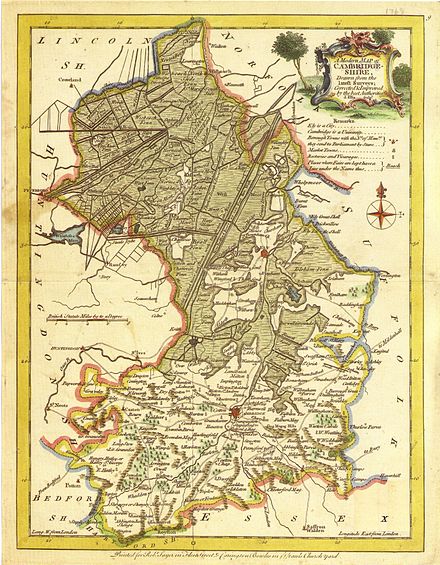
The Isle of Ely 1648 by J Blaeu

Until the 17th century, the area was an island surrounded by a large area of fenland, a type of swamp. It was coveted as an area easy to defend, and was controlled in the very early medieval period by the Gyrwas, an Anglo-Saxon tribe. Upon their marriage in 652, Tondbert, a prince of the Gyrwas, presented Æthelthryth (who became St. Æthelthryth), the daughter of King Anna of the East Angles, with the Isle of Ely. She afterwards founded a monastery at Ely, which was destroyed by Viking raiders in 870, but which was rebuilt and became a famous abbey and shrine. Beginning in 1626 and using a network of canals designed by Dutch experts, the Fens were then drained but many Fenlanders were opposed to the draining as it deprived some of them of their traditional livelihood. Acts of vandalism on dykes, ditches, and sluices were common, but the draining was complete by the end of the century. The area’s natural defences led to it playing a role in the military history of England. Following the Norman Conquest, the Isle became a refuge for Anglo-Saxon forces under Earl Morcar, Bishop Aethelwine of Durham and Hereward the Wake in 1071. The area was taken by William the Conqueror, but only after a prolonged struggle. In 1139 civil war broke out between the forces of King Stephen and the Empress Matilda. Bishop Nigel of Ely, a supporter of Matilda, unsuccessfully tried to hold the Isle and then in 1143 Geoffrey de Mandeville rebelled against Stephen and made his base in the Isle. Geoffrey was mortally wounded at Burwell in 1144. Then in 1216, during the First Barons War, the Isle was unsuccessfully defended against the army of King John. Ely took part in the Peasants Revolt of 1381. During the English Civil War the Isle of Ely was held for the parliamentarians and troops from the garrison at Wisbech Castle were used in the siege of Crowland, also parts of the Fens were flooded to prevent Royalist forces entering Norfolk from Lincolnshire. The Horseshoe sluice on the river at Wisbech and the nearby castle and town defences were upgraded and cannon brought from Ely.

Chatteris Plaque on Leonard Childs Bridge

From 1109 until 1837, the Isle was under the jurisdiction of the Bishop of Ely, who appointed a Chief Justice of Ely and exercised temporal powers within the Liberty of Ely. This temporal jurisdiction originated in a charter granted by King Edgar in 970 and confirmed by Edward the Confessor and Henry I to the abbot of Ely. The latter monarch established Ely as the seat of a bishop in 1109, creating the Isle of Ely a county palatine. In England, Wales and Ireland a county palatine or palatinate was an area ruled by a hereditary nobleman enjoying special authority and autonomy from the rest of a kingdom. The name derives from the Latin adjective palātīnus, “relating to the palace”, from the noun palātium, “palace“. It thus implies the exercise of a quasi-royal prerogative within a county, that is to say a jurisdiction ruled by an earl, the English equivalent of a count. A duchy palatine is similar but is ruled over by a duke, a nobleman of higher precedence than an earl or count. The nobleman swore allegiance to the king yet had the power to rule the county largely independently of the king. It should therefore be distinguished from the feudal barony, held from the king, which possessed no such independent authority. Rulers of counties palatine created their own feudal baronies, to be held directly from them ‘in capite’, such as the Barony of Halton. This was in old English law where a capite (from Latin caput, or head) was a tenure, abolished by the Tenures Abolition Act 1660 by which either person or land was held immediately of the king, or of his crown by knight-service. So a holder of a capite is termed a tenant in chief. County palatine jurisdictions were created in England under the rule of the Norman dynasty but in continental Europe they have an earlier date. In general, when a palatine-type autonomy was granted to a lord by the sovereign, it was in a district on the periphery of the kingdom, at a time when the district was at risk from disloyal armed insurgents who could retreat beyond the borders and re-enter. For the English sovereign in Norman times this applied to northern England, Wales and Ireland. As the authority granted was hereditary, some counties palatine legally survived well past the end of the feudal period. It was an act of parliament in 1535/6 which ended the palatine status of the Isle, with all justices of the peace to be appointed by ‘letters patent’, issued under the great seal and warrants to be issued in the king’s name. However, the bishop retained exclusive jurisdiction in civil and criminal matters. A chief bailiff was appointed for life by the bishop and they performed the functions of high sheriff within the liberty, also heading the government of the city of Ely. Interestingly I learned about letters patent, a type of legal instrument in the form of a published written order issued by a monarch, president or other head of state, generally granting an office, right, monopoly, title, or status to a person or corporation. They can be used for the creation of government offices, or for granting city status or a coat of arms. They are also issued for the appointment of representatives of the Crown, such as governors and governors-general of Commonwealth realms, as well as appointing a Royal Commission. In the United Kingdom they are also issued for the creation of peers of the realm. In addition to all this, a particular form of letters patent has evolved into the modern intellectual property patent (referred to as a utility patent or design patent in United States patent law, granting exclusive rights in an invention (or a design in the case of a design patent). In this case it is essential that the written grant should be in the form of a public document so other inventors can consult it both to avoid infringement and understand how to put it into practical use. In the Holy Roman Empire, Austrian Empire and Austria-Hungary, an imperial patent was also the highest form of generally binding legal regulations, for example a Patent of Toleration. I did a bit of research, finding that the more I learn, then the more there is to learn! For example, I read that the Patent of Toleration (in German ’Toleranzpatent’ was an edict of toleration issued on 13 October 1781 by the Habsburg emperor Joseph II. Part of the Josephinist reforms, the Patent extended religious freedoms to non-Catholic Christians living in the crown lands of the Habsburg monarchy, including Lutherans, Calvinists and the Eastern Orthodox. More specifically, these members of minority faiths were now legally permitted to hold “private religious exercises” in clandestine churches. The Patent guaranteed the practice of religion by the Evangelical Lutheran and the Reformed Church in Austria. Nevertheless, worship was heavily regulated, wedding ceremonies remained reserved for the Catholic Church, and the Unity of the Brethren was still suppressed. Similar to the articular churches admitted 100 years before, Protestants were only allowed to erect ‘houses of prayer’ which should not in any way resemble church buildings. In many Habsburg areas, especially in the hereditary lands of Upper Austria, Styria and Carinthia, Protestant parishes quickly developed, strongly relying on traditions. The Patent also regulated mixed faith marriages, foreshadowing the Marriage Patent that was to be released in 1783 seeking to bring marriages under civil rather than canon law. In allowing marriages between religions, if the father was Catholic all children were required to be raised as Catholics whilst if the mother was Catholic only the daughters had to be raised as such. The Patent was followed by the Edict of Tolerance for Jews in 1782. The edict extended to Jews the freedom to pursue all branches of commerce, but also imposed new requirements. Jews were required to create German-language primary schools or send their children to Christian schools (Jewish schools had previously taught children to read and write Hebrew in addition to mathematics.) The Patent also permitted Jews to attend state secondary schools. A series of laws issued soon after the Edict of Toleration abolished the autonomy of the Jewish communities, which had previously run their own court, charity, internal taxation and school systems. It required Jews to acquire family names, made Jews subject to military conscription and required candidates for the rabbinate to have secular education. The 1781 Patent was originally called the “Divine Send of Equal Liberties” but was further put down by the monarch’s advisor. Constraints on the construction of churches were abolished after the revolutions of 1848. The Protestant Church did not receive an equivalent legal status until Emperor Franz Joseph I of Austria issued the Protestant patent in 1861.

But back to Ely. In July 1643, Oliver Cromwell was made governor of the Isle. The Liberty of Ely Act 1837 ended the bishop’s secular powers in the Isle and the area was declared a division of Cambridgeshire, with the right to appoint justices revested in the crown. Following the 1837 Act the Isle maintained separate Quarter Sessions and formed its own constabulary. Under the Local Government Bill of 1888, which proposed the introduction of elected county councils, the Isle was to form part of Cambridgeshire. Following the intervention of the local member of parliament, Charles Selwyn, the Isle of Ely was constituted a separate administrative county in 1889. In 1894 the county was divided into county districts, with the rural districts being Ely, North Witchford, Thorney, Whittlesey and Wisbech. The urban districts were Ely, March and Whittlesey, with Wisbech being the only municipal borough. Whittlesey Rural district consisted of only one parish and this was added to Whittlesey urban district in 1926. However, the county was small in terms of both area and population and its abolition was proposed by the Local Government Boundary Commission in 1947, but its report was not acted upon and the administrative county survived until 1965. Then, following the recommendations of the Local Government Commission for England, on 1 April 1965 the bulk of the area was merged to form Cambridgeshire and Isle of Ely, with the Thorney Rural District going to Huntingdon and Peterborough. From a parliamentary standpoint the Isle of Ely parliamentary constituency was created as a two-member seat in the First and Second Protectorate Parliaments from 1654 to 1659. The constituency was then re-created with a single seat in 1918 but in the boundary changes of 1983 it was replaced by the new constituency of North East Cambridgeshire. Original historical documents relating to the Isle of Ely are held by Cambridgeshire Archives and Local Studies at the County Record Office in Ely. On 1 May 1931, the Isle of Ely County Council was granted a coat of arms. Previous to this, the council had been using the arms of the Diocese of Ely, this being ‘Gules, three ducal coronets, two and one or’. Then in the new grant, silver and blue waves were added to the episcopal arms to suggest that the county was an “isle”. The crest above the shield was a human hand grasping a trident around which an eel was entwined, referring to the popular derivation of “Ely”. On the wrist of the hand was a ‘Wake knot’, representing Hereward the Wake. This Wake knot or ‘Ormond knot’ is an English heraldic knot used historically as an heraldic badge by the Wake family, the lords of the manor of Bourne, Lincolnshire and also by the Butler family, Earls of Ormond of Irish heritage. There is one fascinating item relating to the Wake name that I have learned and which in fact relates to knots. When I was a lad, I was taught how to tie just a few different knots, one of which was the Reef Knot, which is used to join two lines of the same diameter together. Then there is the Sheet Bend, which is used to tie lines of unequal thickness together. But for a stronger join there is the Carrick Bend, also known as the Sailor’s Breastplate and is a knot for joining two lines of very heavy rope or cable that are too large and stiff to be easily formed into other common bends. It will not jam even after carrying a significant load or being soaked with water. As with many other members of the basket weave family, the aesthetically pleasing interwoven and symmetrical shape of the Carrick Bend has also made it popular for decorative purposes. The Wake knot however may be used to join a rope and a strap.

A Wake knot.

In addition to all this, I have learned the following relating to the Isle of Ely in that it became a marquessate, the territorial lordship or possessions of a marquess. The title Marquess of the Isle of Ely was created in the Peerage of Great Britain for Prince Frederick. The title of Duke of Edinburgh was first created on 26 July 1726 by King George I, who bestowed it on his grandson Prince Frederick, who became Prince of Wales the following year. The subsidiary titles of the dukedom were Baron of Snowdon, in the County of Caernarvon, Viscount of Launceston, in the County of Cornwall, Earl of Eltham, in the County of Kent and Marquess of the Isle of Ely. The marquessate was apparently erroneously gazetted as Marquess of the Isle of Wight, although Marquess of the Isle of Ely was the intended title. In later editions of the London Gazette the Duke is referred to as the Marquess of the Isle of Ely. Upon Frederick’s death, the titles were inherited by his son Prince George. When he became George III in 1760, the titles merged into the Crown and ceased to exist. To me, the Isle of Ely is a lovely part of East Anglia, with a fascinating history.

This week…
I am told that in Croatia there is a Museum Of Broken Relationships, at present located in Zagreb. But I think at least part of it should be in Split…

Click: Return to top of page or Index page
Guy Fawkes

It seems only right that I should write about this today!
Guy Fawkes (13 April 1570 – 31 January 1606), also known as Guido Fawkes whilst he was fighting for the Spanish, was a member of a group of provincial English catholics and who was involved in the failed Gunpowder Plot of 1605. He was born and educated in York and when he was just eight years old his father died, after which his mother married a recusant catholic, the term meaning a person who refuses to submit to an authority or to comply with a regulation but which may also be used to describe the state of those who refused attendance of any Anglican services during the history of England, Wales and Scotland. The term was first used to refer to people who remained loyal to the Pope and the Roman Catholic Church and who did not attend any Church of England services and ‘recusancy’ comes from the Latin recusare, to refuse or make an objection. Fawkes converted to Catholicism and left for mainland Europe, where he fought for Catholic Spain in the Eighty Years War against Protestant Dutch reformers in the Low Countries. He travelled to Spain to seek support for a Catholic rebellion in England without success and later met Thomas Wintour, with whom he returned to England. Wintour then introduced him to Robert Catesby, who planned to assassinate King James I and restore a Catholic monarch to the throne. Beneath the House of Lords in London the plotters leased an undercroft, which is traditionally a cellar or storage room often brick-lined and vaulted and used for storage in buildings since medieval times. In modern usage, an undercroft is generally a ground (street-level) area which is relatively open to the sides, but covered by the building above. Whilst some were used as simple storerooms, others were rented out as shops. For example, the undercroft rooms at Myres Castle in Fife, Scotland around 1,300 were used as the medieval kitchen and a range of stores. Many of these early medieval undercrofts were vaulted, such as the vaulted chamber at Beaverton Castle in Gloucestershire. The term is also sometimes used to describe a crypt beneath a church, used for burial purposes. For example, there is a 14th-century undercroft or crypt extant at Muchalls Castle in Aberdeenshire, Scotland, even though the original chapel above it was destroyed in an act of war in 1746. Undercrofts were commonly built in England and Scotland throughout the thirteenth and early fourteenth centuries. They occur in cities such as London, Chester, Coventry and Southampton. Anyway, back to the plot! Fawkes was placed in charge of the gunpowder they stockpiled in the undercroft, however the the authorities were then prompted by an anonymous letter to search the Westminster Palace during the early hours of 5 November, and they found Fawkes guarding the explosives. He was questioned and tortured over the next few days and confessed to wanting to blow up the House of Lords. Immediately before his execution on 31 January, Fawkes fell from the scaffold where he was to be hanged and broke his neck, thus avoiding the agony of being hung, drawn and quartered. He became synonymous with the Gunpowder Plot, the failure of which has been commemorated here in the UK as Guy Fawkes Night since 5 November 1605, when his effigy is traditionally burned on a bonfire, commonly accompanied by fireworks.

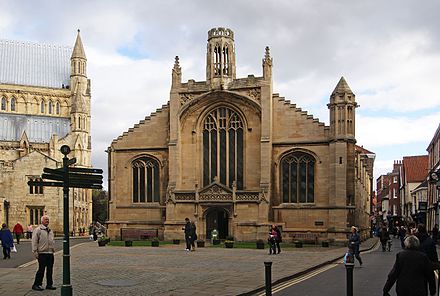
St Michael le Belfrey,York, next to York Minster.

But to me, there had to be more to this basic story so I have delved deeper and found the following. Guy Fawkes was born in 1570 in Stonegate, York and was the second of four children born to Edward Fawkes, a proctor (a variant of procurator, a person who takes charge of, or acts for, another) and which has somewhat different meanings in law, religion and education. In this case Edward was an advocate of the consistory court at York. His wife was Edith. Guy’s parents were regular communicants of the Church of England, as were his paternal grandparents. His grandmother, born Ellen Harrington, was the daughter of a prominent merchant, who served as Lord Mayor of York in 1536. Guy’s mother’s family though were recusant catholics and his cousin, Richard Cowling, became a Jesuit priest. The name ‘Guy’ was an uncommon one in England, but may have been popular in York on account of a local notable, Sir Guy Fairfax of Steeton. The exact date of Fawkes’s birth is unknown, but he was baptised in the church of St Michael le Belfrey, York on 16 April, so as the customary gap between birth and baptism was three days, he was probably born about 13 April. In 1568, Edith had given birth to a daughter named Anne, but the child died aged about seven weeks, in November that year. She bore two more children after Guy, these being Anne in 1572 and Elizabeth in 1575. Both were married, in 1599 and 1594 respectively. In 1579, when Guy was eight years old, his father died and his mother then remarried several years later to the Catholic Dionis Baynbrigge (or Denis Bainbridge) of Scotton, Harrogate. Fawkes may have become a Catholic through the Baynbrigge family’s recusant tendencies, and also the Catholic branches of the Pulleyn and Percy families of Scotton, but also from his time at St Peter’s school in York. A governor of the school had spent about twenty years in prison for recusancy, and its headmaster, John Pulleyn, came from a family of noted Yorkshire recusants, the Pulleyns of Blubberhouses. In her 1915 work ‘The Pulleynes of Yorkshire’, author Catharine Pullein suggested that Fawkes’s Catholic education came from his Harrington relatives, who were known for harbouring priests, one of whom later accompanied Fawkes to Flanders in 1592–1593. Fawkes’s fellow students included John Wright and his brother Christopher, both later involved with Fawkes in the Gunpowder Plot along with Oswald Tesimond, Edward Oldcorne and Robert Middleton, who became priests. The latter was executed in 1601. After leaving school, Fawkes entered the service of Anthony Browne, 1st Viscount Montagu who took a dislike to Fawkes and after a short time dismissed him. Fawkes was subsequently employed by Anthony-Maria Browne, 2nd Viscount Montagu, who succeeded his grandfather at the age of eighteen. At least one source claims that Fawkes married and had a son, but no known contemporary accounts confirm this. In October 1591 Fawkes sold the estate in Clifton in York that he had inherited from his father. He then travelled to the continent to fight in the Eighty Years War for Catholic Spain against the new Dutch Republic and in France from 1595 until 1598 and the Peace of Vervins. Although England was not by then engaged in land operations against Spain, the two countries were still at war and the Spanish Armada of 1588 was still in recent memory. He joined Sir William Stanley, an English Catholic and veteran commander in his mid-fifties who had raised an army in Ireland to fight in Leicester’s expedition to the Netherlands. Stanley had been held in high regard by Elizabeth I, but following his surrender of Deventeer to the Spanish in 1587 he, and most of his troops, had switched sides to serve Spain. Fawkes became an ‘alférez’ or 2nd lieutenant, fought well at the siege of Calais in 1596 and by 1603 had been recommended for a captaincy. That year he travelled to Spain to seek support for a Catholic rebellion in England and he used the occasion to adopt the Italian version of his name, Guido. In his memorandum he described James I, who became king of England that year, as “a heretic”, who intended “to have all of the Papist sect driven out of England.” He denounced Scotland, and the King’s favourites among the Scottish nobles, writing “it will not be possible to reconcile these two nations as they are, for very long”. Although he was received politely, the court of Philip III was unwilling to offer him any support.

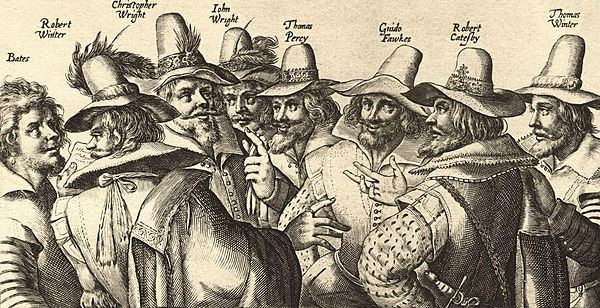
A contemporary engraving of eight of the thirteen conspirators, by Crispin van de Passe.

In 1604 Fawkes became involved with a small group of English Catholics, led by Robert Catesby, who planned to assassinate the Protestant King James I and replace him with his daughter, third in the line of succession who was Princess Elizabeth. Fawkes was described by the Jesuit priest and former school friend Oswald Tesimond as “pleasant of approach and cheerful of manner, opposed to quarrels and strife, loyal to his friends”. Tesimond also claimed Fawkes was “a man highly skilled in matters of war”, and that it was this mixture of piety and professionalism that endeared him to his fellow conspirators. The author Antonia Fraser describes Fawkes as “a tall, powerfully built man, with thick reddish-brown hair, a flowing moustache in the tradition of the time, and a bushy reddish-brown beard”, and that he was “a man of action, capable of intelligent argument as well as physical endurance, somewhat to the surprise of his enemies”. The first meeting of the five central conspirators took place on Sunday 20 May 1604, at an inn called the Duck and Drake, in the fashionable Strand district of London. Catesby had already proposed at an earlier meeting with Thomas Wintour and John Wright to kill the King and his government by blowing up “the Parliament House with gunpowder”. Wintour, who at first objected to the plan, was convinced by Catesby to travel to the continent to seek help. Wintour met with the Constable of Castile, the exiled Welsh spy Hugh Owen and Sir William Stanley, who said that Catesby would receive no support from Spain. Owen did, however, introduce Wintour to Fawkes, who had by then been away from England for many years, and thus was largely unknown in the country. Wintour and Fawkes were contemporaries, each was militant and had first-hand experience of the unwillingness of the Spaniards to help. Wintour told Fawkes of their plan to “doe some whatt in Ingland if the pece with Spaine healped us nott” and thus in April 1604 the two men returned to England. Wintour’s news did not surprise Catesby as despite positive noises from the Spanish authorities, he feared that “the deeds would nott answere”. One of the conspirators, Thomas Percy, was promoted in June 1604, thus gaining access to a house in London that belonged to John Whynniard, Keeper of the King’s Wardrobe. Fawkes was installed as a caretaker and began using the pseudonym John Johnson, servant to Percy. The contemporaneous account of the prosecution, taken from Thomas Wintour’s confession, claimed that the conspirators made an attempt to dig a tunnel from beneath Whynniard’s house to Parliament, although this story may have been a government fabrication. No evidence for the existence of a tunnel was presented by the prosecution and no trace of one has ever been found. Fawkes himself did not admit the existence of such a scheme until his fifth interrogation, but even then he could not locate the tunnel. If the story is true however, by December 1604 the conspirators were busy tunnelling from their rented house to the House of Lords. They ceased their efforts when, during tunnelling, they heard a noise from above. Fawkes was sent out to investigate, and returned with the news that the tenant’s widow was clearing out a nearby undercroft located right beneath the House of Lords. The plotters purchased the lease to the room, which also belonged to John Whynniard. Both unused and filthy, it was considered an ideal hiding place for the gunpowder the plotters planned to store. According to Fawkes, twenty barrels of gunpowder were brought in at first, followed by sixteen more on 20 July. On 28 July however, the ever-present threat of the plague delayed the opening of Parliament until Tuesday, 5 November. In an attempt to gain foreign support, in May 1605 Fawkes travelled overseas and informed Hugh Owen of the plotters’ plan. At some point during this trip his name made its way into the files of Robert Cecil, 1st Earl of Salisbury, who employed a network of spies right across Europe. One of these spies, Captain William Turner, may have actually been responsible. Although the information he provided to Salisbury usually amounted to no more than a vague pattern of invasion reports and included nothing which regarded the Gunpowder Plot, on 21 April he told how Fawkes was to be brought by Tesimond to England. Fawkes was a well-known Flemish mercenary and would be introduced to “Mr Catesby” and “honourable friends of the nobility and others who would have arms and horses in readiness”. Turner’s report did not, however, mention Fawkes’s pseudonym in England, John Johnson, and did not reach Cecil until late in November, well after the plot had been discovered. It is uncertain when Fawkes returned to England, but he was back in London by late August 1605, when he and Wintour discovered that the gunpowder stored in the undercroft had decayed. More gunpowder was brought into the room, along with firewood to conceal it. Fawkes’s final role in the plot was settled during a series of meetings in October as he was to light the fuse and then escape across the Thames. Simultaneously, a revolt in the Midlands would help to ensure the capture of Princess Elizabeth. Acts of regicide, the purposeful killing of a monarch or sovereign were frowned upon, and Fawkes would therefore head to the continent, where he would explain to the Catholic powers his holy duty to kill the King and his retinue.

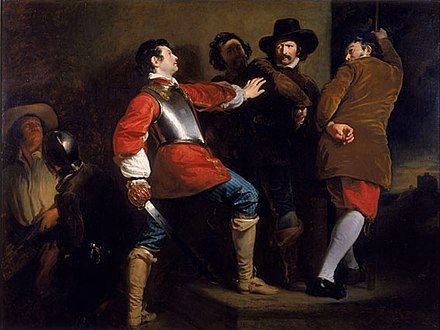
‘Discovery of the Gunpowder Plot’ (c.1823) by Henry Perronet Briggs.

A few of the conspirators were concerned about fellow Catholics who would be present at Parliament during the opening. On the evening of 26 October, Lord Monteagle received an anonymous letter warning him to stay away, and to “retyre youre self into yowre contee whence yow maye expect the event in safti for they shall receyve a terrible blowe this parleament”. Despite quickly becoming aware of the letter, informed by one of Monteagle’s servants, the conspirators resolved to continue with their plans, as it appeared that it “was clearly thought to be a hoax”. Fawkes checked the undercroft on 30 October and reported that nothing had been disturbed. Monteagle’s suspicions had been aroused however, and the letter was shown to King James. The King ordered Sir Thomas Knyvet to conduct a search of the cellars underneath Parliament, which he did in the early hours of 5 November. Fawkes had taken up his station late on the previous night, armed with a slow match and a watch given to him by Percy “becaus he should knowe howe the time went away”. He was found leaving the cellar, shortly after midnight, and arrested. Inside, the barrels of gunpowder were discovered hidden under piles of firewood and coal. Fawkes gave his name as John Johnson and was first interrogated by members of the King’s Privy chamber, where he remained defiant. When asked by one of the lords what he was doing in possession of so much gunpowder, Fawkes answered that his intention was “to blow you Scotch beggars back to your native mountains”. He identified himself as a 36-year-old Catholic from Netherdale in Yorkshire, and gave his father’s name as Thomas and his mother’s as Edith Jackson. Wounds on his body noted by his questioners he explained as the effects of pleurisy. Fawkes admitted his intention to blow up the House of Lords, and expressed regret at his failure to do so and his steadfast manner earned him the initial admiration of King James, who described Fawkes as possessing “a Roman resolution”. James’s admiration did not, however, prevent him from ordering on 6 November that “John Johnson” be tortured, to reveal the names of his co-conspirators. He directed that torture be light at first, referring to the use of manacles, but more severe if necessary, authorising the use of the rack as “the gentler Tortures are to be first used unto him ‘et sic per gradus ad ima tenditur’ (and so by degrees proceeding to the worst)”. Fawkes was transferred to the Tower of London. The King composed a list of questions to be put to “Johnson”, such as “as to what he is, for I can never yet hear of any man that knows him”, “When and where he learned to speak French?”, and “If he was a Papist, who brought him up in it?”. Afterwards the room in which Fawkes was interrogated became known as the Guy Fawkes Room. Sir William Waad, Lieutenant of the Tower, supervised the torture and also obtained Fawkes’s confession. He searched his prisoner, and found a letter addressed to Guy Fawkes. To Waad’s surprise, “Johnson” remained silent, revealing nothing about the plot or its authors. Then on the night of 6 November he spoke with Waad, who reported to Salisbury “He (Johnson) told us that since he undertook this action he did every day pray to God he might perform that which might be for the advancement of the Catholic Faith and saving his own soul”. According to Waad, Fawkes managed to rest through the night, despite his being warned that he would be interrogated until “I had gotton the inwards secret of his thoughts and all his complices”. His composure was broken at some point during the following day and the observer Sir Edward Hoby remarked “Since Johnson’s being in the Tower, he beginneth to speak English”. Fawkes revealed his true identity on 7 November, and told his interrogators that there were five people involved in the plot to kill the King. He began to reveal their names on 8 November, and told how they intended to place Princess Elizabeth on the throne. His third confession, on 9 November, implicated Francis Tresham. Following the Ridolfi plot of 1571, prisoners were made to dictate their confessions, before copying and signing them, if they still could. Although it is uncertain if he was tortured on the rack, Fawkes’s scrawled signature suggests the suffering he endured at the hands of his interrogators.

The trial of eight of the plotters began on Monday 27 January 1606. Fawkes shared the barge from the Tower to Westminster Hall with seven of his co-conspirators. They were kept in the Star Chamber before being taken to Westminster Hall, where they were displayed on a purpose-built scaffold. The King and his close family, watching in secret, were among the spectators as the Lords Commissioners read out the list of charges. Fawkes was identified as Guido Fawkes, “otherwise called Guido Johnson”. He pleaded not guilty, despite his apparent acceptance of guilt from the moment he was captured. The jury found all the defendants guilty, and the Lord Chief Justice, Sir [John Popham, pronounced them guilty of high treason. The Attorney General, Sir Edward Coke, gave the court details of how each of the condemned would be executed, saying that they were to be “put to death halfway between heaven and earth as unworthy of both”. Fawkes’s and Tresham’s testimony regarding the Spanish treason was read aloud, as well as confessions related specifically to the Gunpowder Plot. The last piece of evidence offered was a conversation between Fawkes and Wintour, as they had been kept in adjacent cells. The two men apparently thought they had been speaking in private, but their conversation was intercepted by a government spy. When the prisoners were allowed to speak, Fawkes explained his not guilty plea as ignorance of certain aspects of the indictment. On 31 January 1606, Fawkes and three others, Thomas Wintour, Ambrose Rockwood and Robert Keyes, were dragged from the Tower on wattled hurdles to the Old Palace Yard at Westminster, opposite the building they had attempted to destroy. His fellow plotters were then hanged and quartered. Fawkes was the last to stand on the scaffold, where he asked for forgiveness of the King and state, whilst still keeping up his “crosses and idle ceremonies” (Catholic practices). Weakened by torture and aided by the hangman, Fawkes began to climb the ladder to the noose, but either through jumping to his death or climbing too high so the rope was incorrectly set, he managed to avoid the agony of the latter part of his execution by breaking his neck. His lifeless body was nevertheless quartered and, as was the custom, his body parts were then distributed to “the four corners of the kingdom”, to be displayed as a warning to other would-be traitors.

On 5 November 1605, Londoners were encouraged to celebrate the King’s escape from assassination by lighting bonfires, provided that “this testemonye of joy be carefull done without any danger or disorder”. After that an Act of Parliament designated each 5 November to be held as a day of thanksgiving for “the joyful day of deliverance”, and remained in force until 1859. Fawkes was one of thirteen conspirators, but he is the individual most associated with the plot. Here in Britain, 5 November has variously been called Guy Fawkes Night, Guy Fawkes Day, Plot Night and Bonfire Night and this is of course traced directly back to the original celebration of 5 November 1605. Bonfires were usually accompanied by fireworks from the 1650s onwards, and it became the custom after 1673 to burn an effigy (usually of the pope) after James, Duke of York, converted to Catholicism. Effigies of other notable figures have found their way onto the bonfires, although most modern effigies are of Fawkes. The “guy” is normally created by children from old clothes, newspapers, and a mask. During the 19th century, “guy” came to mean an oddly dressed person, while in many places it has lost any pejorative connotation and instead refers to any male person and the plural form can refer to people of any gender. James Sharpe, professor of history at the University of York, has described how Guy Fawkes came to be toasted as “the last man to enter Parliament with honest intentions”, whilst William Harrison Ainsworth’s 1841 historical romance ‘Guy Fawkes; or, The Gunpowder Treason’ portrays Fawkes in a generally sympathetic light and his novel transformed Fawkes in the public perception into an “acceptable fictional character”. Fawkes subsequently appeared as “essentially an action hero” in children’s books and the ‘penny dreadfuls’ such as The Boyhood Days of Guy Fawkes; or, The Conspirators of Old London, were published around 1905. Now I know why as children we would say ‘a penny for the guy’. The historian Lewis Call considered that “Fawkes is now a major icon in modern political culture” whose face has become a potentially powerful instrument for the articulation of post-modern anarchism” in the late 20th century. His point of view. There seems to be a far more ‘Health and Safety’ culture around nowadays though, with greatly more organised gatherings. I recall as a child liking the firework displays in our back garden in Whittlesey, with dad firmly in charge. We had Catherine wheels, rockets, Roman candles, sparklers, all different sorts, but sadly my grandfather used to annoy us by letting off bangers near our feet! That I’m glad to say was soon stopped. Nowadays the events seem to be a far more commercial event, so I thought that I would add some history to the day, to remind us quite why we do remember this every year. But do remember to keep all pets safe please.

This week, especially if you know of the ‘Harry Potter’ books or films…
(This next bit contains spoilers – you have been warned!)

In the Harry Potter’ series, Fawkes was a highly intelligent male phoenix and Albus Dumbledore’s animal companion and defender. It is unknown quite how long Fawkes had been in Dumbledore’s service. He had been loyal to him for many years prior to the Headmaster’s death though. Fawkes was instrumental in helping Harry Potter defeat Salazar Slytherin’s basilisk as the tears of the phoenix, which possessed healing properties, saved Harry’s life after his arm was punctured by the basilisk’s fang and injected its venom. In a later event, Fawkes came to Dumbledore’s aid in fighting Lord Voldemort during the Battle of the Department of Mysteries. Following Dumbledore’s death, Fawkes sang his Lament over the grounds of Hogwarts School of Witchcraft and Wizardry but it then left and flew away, never to be seen again. Its tail feathers were the cores of the wands which were held by Lord Voldemort and Harry Potter.

Click: Return to top of page or Index page
The Cathedral City Of Peterborough

As a cathedral city in Cambridgeshire with a population of 202,110 in 2017, Peterborough was originally part of Northamptonshire but became part of Cambridgeshire 1974. The city is 76 miles (122 kilometres) north of London, on the River Nene which flows into the North Sea some 30 miles (48 kilometres) to the north-east. I was taught that ‘Nene’ was pronounced ’Neen’, but I have heard some other folk say ’Nenn’ or even ’Nenny’! I prefer ’Neen’. The railway station is an important stop on the East Coast Main Line between London and Edimburgh and with it being right on the edge of the Fens the local area is flat, with some places the land lying below sea level, for example in parts to the east of Peterborough. Human settlement in the area began before the Bronze Age and this can be seen at the Flag Fen archaeological site to the east of the current city centre, also with evidence of Roman occupation. The Anglo-Saxon period saw the establishment of a monastery, Medehamstede, which later became Peterborough Cathedral. The population grew rapidly after the railways arrived in the 19th century, and Peterborough became an industrial centre, particularly known for its brick manufacture. After the Second World War, growth was limited until designation as a New Town in the 1960s. Housing and population are at present still expanding and a £1 billion regeneration of the city centre and immediately surrounding area is under way. Industrial employment has fallen since then, a significant proportion of new jobs being in financial services and distribution. As I have said, the original name of the town was Medehamstede and the town’s name changed to Burgh from the late tenth century, possibly after Abbot Kenulf had built a defensive wall around the abbey, and it eventually developed into the form Peterborough, though the town does not appear to have been a borough until the 12th century. The contrasting form ‘Gildenburgh’ is also found in the 12th century history of the abbey, the Peterborough version of the Anglo-Saxon Chronicle and in a history of the abbey by the monk Hugh Candidus. The name has been used a few times for various things including the Gildenburgh choir which still exists and which I was a member of for a number of years. The present-day Peterborough is the latest in a series of settlements which have at one time or other benefited from its site where the river Nene leaves large areas of permanently drained land for the fens. Remains of Iron Age settlement and what is thought to be religious activity can be seen at the Flag Fen archaeological site to the east of the city centre, the Romans established a fortified garrison town at Durobrivae on Ermine Street some five miles (eight kilometres) to the west in Water Newton, around the middle of the 1st century AD. Durobrivae’s earliest appearance among surviving records is in the Antonine Itinerary of the late 2nd century. There was also a large 1st century roman fort at Longthorpe, designed to house half a legion, or about 3,000 soldiers. It may have been established as early as around AD44 to 48. Peterborough was an important area of ceramic production in the Roman period, providing Nene Valley Ware that was traded as far away as Cornwall and the Antonine Wall, Caledonia. The place is shown by its original name to have possibly been an Anglian settlement before AD 655, when Sexwulf founded a monastery on land granted to him for that purpose by Peada of Mercia, who converted to Christianity and was briefly ruler of the smaller Middle Angles sub-group. His brother Wulfhere though murdered his own sons, similarly converted and then finished the monastery by way of atonement. Hereward the Wake rampaged through the town in 1069 or 1070 and outraged, Abbot Turold erected a fort or castle, which, from his name, was called Mont Turold. This mound, or hill, is on the outside of the deanery garden, now called Tout Hill. The abbey church was rebuilt and greatly enlarged in the 12th century and the Peterborough Chronicle, a version of the Anglo-Saxon one, contains unique information about the history of England after the Norman conquest. It was written here by monks in the 12th century. This is the only known prose history in English between the conquest and the later 14th century. The burgesses received their first charter from “Abbot Robert” – probably Robert of Sutton (1262–1273). The place suffered materially in the war between King John and the confederate barons, many of whom took refuge in the monastery here and in Crowland Abbey, from which sanctuaries they were forced by the king’s soldiers, who plundered the religious houses and carried off great treasures. The abbey church became one of Henry VIII ’s retained, more secular, cathedrals in 1541, having been apparently assessed at the Dissolution in the King’s Books as having revenue of £1,972.7s.0¾d per annum.

Early English Gothic West Front of Peterborough Cathedral.

When civil war broke out, Peterborough was divided between supporters of King Charles I and the Long Parliament. The city lay on the border of the Eastern Association of counties which sided with Parliament, and the war reached Peterborough in 1643 when soldiers arrived in the city to attack Royalist strongholds at Stamford and Crowland. The Royalist forces were defeated within a few weeks and retreated to Burghley House, where they were captured and sent to Cambridge. While the Parliamentary soldiers were in Peterborough however, they ransacked the cathedral, destroying the Lady Chapel, chapter house, cloister, high altar and choir stalls, as well as mediaeval decoration and records. Housing and sanitary improvements were effected under the provisions of an Act of Parliament passed in 1790 and an Act was passed in 1839 to build a gaol to replace the two that previously stood. After the dissolution the dean and chapter, who succeeded the abbot as lords of the manor, appointed a high bailiff. Also constables were elected, though it is unclear as to whether they were elected by the dean and chapter or by the ‘court leet’, as other borough officers were but this ended when the municipal borough was incorporated in 1874 under the government of a mayor, six aldermen and eighteen councillors. Among the privileges claimed by the abbot as early as the 13th century was that of having a prison for felons taken in the Soke of Peterborough. In 1576 Bishop `Edmund Scambler sold the lordship of the hundred of ‘Nassaburgh’, which was coextensive with the Soke, to Queen Elizabeth I, who gave it to Lord Burghley and from that time until the 19th century he and his descendants, the Earls and Marquesses of Exeter, had a separate gaol for prisoners arrested in the Soke. The abbot formerly held four fairs, of which two, St. Peter’s Fair, granted in 1189 and later held on the second Tuesday and Wednesday in July, and the Brigge Fair, granted in 1439 and later held on the first Tuesday, Wednesday and Thursday in October, were purchased by the corporation from the Ecclesiastical Commissioners in 1876. The Bridge Fair, as it is now known, granted to the abbey by King Henry VI, survives. Prayers for the opening of the fair were once said at the morning service in the cathedral, followed by a civic proclamation and a sausage lunch at the town hall which it seems still takes place. The mayor traditionally leads a procession from the town hall to the fair where the proclamation is read, asking all persons to “behave soberly and civilly, and to pay their just dues and demands according to the laws of the realm and the rights of the City of Peterborough”. That I have never seen or heard. Railway lines began operating locally during the 1840s, but it was the 1850 opening of the Great Northern Railway’s line from London to York that transformed Peterborough from a market town to an industrial centre. Lord Exeter had opposed the railway passing through Stamford, so that Peterborough, situated between two main terminals at London and Doncaster, increasingly found itself developed as a regional hub.

Coupled with vast local clay deposits, the railway then enabled large-scale brick-making and distribution to take place and the area was the UK’s leading producer of bricks for much of the twentieth century. Brick-making had been a small seasonal craft since the early nineteenth century, but during the 1890s successful experiments at Fletton using the harder clays from a lower level had resulted in a much more efficient process. The market dominance during this period of the London Brick Company, founded by the prolific Scottish builder and architect John Hill, gave rise to some of the country’s most well-known landmarks, all built using Fletton Brick. Perkins Engines was established in Peterborough in 1932 by Frank Perkins, creator of the Perkins diesel engine. Thirty years later it was employing more than a tenth of the population of Peterborough, mainly at its Eastfield site. In 1903 Baker Perkins had relocated from London to the area known as Westwood, now the site of the HM prison, followed by Peter Brotherhood to Walton in 1906. Both manufacturers of industrial machinery, they too became major employers in the city. British Sugar remains headquartered in Woodston, although the beet sugar factory, which opened there in 1926, was closed in 1991. We could always tell when sugar beet was being processed because of the distinct ‘aroma’! The Norwich and Peterborough Building Society (N&P) was formed by the merger of the two separate building societies in 1986. It was the ninth largest building society at the time of its merger into the Yorkshire Group in 2011. N&P continued to operate under its own brand administered at Lynch Wood until 2018. Much was happening in these years and prior to merger with the Midlands Co-op in 2013, Anglia Regional, the UK’s fifth largest co-operative society, was also based in Peterborough, where it was established in 1876. The combined society began trading as Central England Cooperative in 2014. Designated as a New Town in 1967, the Peterborough Development Corporation was then formed in partnership with the city and county councils to house London’s overspill population in new townships sited around the existing urban area. There were to be four townships, one each at Bretton, (originally to be called Milton, a hamlet in the Middle Ages), Orton, Paston, Werrington and Castor. The last of these was never built, but a fourth, called Hampton, is now taking shape south of the city. It was decided that the city should have a major indoor shopping centre at its heart and so planning permission was received in late summer 1976 and Queensgate, containing over 90 stores and including parking for 2,300 cars, was opened by Queen Beatrix of the Netherlands in 1982. 34 miles (55 kilometres) of urban roads were planned and a network of high-speed landscaped thoroughfares, which are known as parkways, was constructed. Peterborough’s population grew by 45.4% between 1971 and 1991, new service-sector companies like Thomas Cook and Pearl Assurance were attracted to the city, ending the dominance of the manufacturing industry as employers. An urban regeneration named Opportunity Peterborough, under the chairmanship of Lord Mawhinney, was set up by the Office of the Deputy Prime Minister in 2005 to oversee Peterborough’s future development. Between 2006 and 2012 a £1 billion redevelopment of the city centre and surrounding areas was planned. The master plan provided guidelines on the physical shaping of the city centre over the next 15–20 years. Proposals are still progressing for the north of Westgate, the south bank and the station quarter, where Network Rail is preparing a major mixed use development. Whilst recognising that the reconfiguration of the relationship between the city and station was critical, English Heritage found the current plans for Westgate unconvincing and felt more thought should be given to the vitality of the historic core and with the city expanding, in July 2005 the council adopted a new statutory development plan. Its aim is to accommodate an additional 22,000 homes, 18,000 jobs and over 40,000 people living in Peterborough by 2020. The newly developing Hampton township will be completed, there will be a 1,500-home development at Stanground and a further 1,200-home development at Paston. In recent years Peterborough has undergone significant changes with numerous developments underway, most notably are Fletton Quays, a project to construct 350 apartments, various office spaces as well as a new home for Peterborough City Council with other projects within the development to include a Hilton Garden Inn hotel with a sky bar, a new passport office and various leisure, restaurant and retail opportunities. Other projects within the city include the extension to Queensgate Shopping Centre, The Great Northern Hotel and more recently plans to extend the railway station and long stay car park to facilitate more office space in the city centre and further parking. In 2020 planning permission was granted for a new university, ARU Peterborough, which will be based on Bishops Road, a five-minute walk from the City Centre. It will be an employment focused university run by the Anglia Ruskin University with four faculties: Business, Innovation and Entrepreneurship; Creative and Digital Arts and Sciences; Agriculture, Environment and Sustainability; Health and Education. The new university is expected to take its first cohort of approximately 2,000 students by 2022, rising to 12,500 by 2028. The ARU Peterborough is not expected to receive its degree awarding powers before 2030 when a review will take place to determine its future as part of Anglia Ruskin University or whether it should become its own entity. A great deal has changed in the years since I left that fine city and I am sure more will occur, but it will always be special to me.

I am glad to be back writing again. Here we have some fun…

There was a painter who was very interested in making a penny where he could, so he often thinned down his paint to make it go a bit further. He got away with this for some time, but eventually the local church decided to do a big restoration job on the outside of one of their biggest buildings.

The painter put in a bid, and because his price was so low he got the job. So he set about erecting the scaffolding, setting up the planks, and buying the paint. But even though it was a church building, he thinned the paint down with turpentine. A while later he was up on the scaffolding, painting away and the job was nearly completed when suddenly there was a horrendous clap of thunder, the sky opened and the rain poured down washing off all the thinned paint from the church and knocking him off the scaffolding to land on the lawn amongst the gravestones, surrounded by puddles of thinned and useless paint. This guy was no fool, he knew this was a judgment from the Almighty, so he got down on his knees and cried:

“Oh God, Oh God, forgive me; what should I do?”
And from the thunder, a mighty voice spoke.

“Repaint! Repaint! And thin no more!”

Click: Return to top of page or Index page
Picture The Scene

First, a quick update. There was no weekly blog post last Friday because I was unwell, but after a few days in hospital and an increase in the dosage of one of the tablets I take regularly, I am back in the Care Home. I’ve been very well looked after and I express my grateful thanks to everyone who has helped me. My blog post for last week was almost done, so thankfully I had only a little to do to prepare it for this week! So, here we are. Back in time…

The year is 1921. Here on planet Earth in London, England, a child is born who would become my mother. The child who would become my father was by then around eighteen months old and also living in London. My mother’s parents were originally from Truro, Cornwall whilst my father’s family had Welsh connections, not unexpected with a name like Williams! My maternal grandfather George was born in Truro, Cornwall and so fas as I can tell the family worked in the tin mines, though both that and copper as well as a few other metals such as arsenic, silver and zinc were the most common there. During the 18th century, Cornwall was the mining centre of the world, famous for its base metal and tin production and at that time, the Cornish were considered the best hard rock miners in the world. In Truro, tin was an important local industry where the metal was mined and then smelted in local foundries. The city’s newly built elegant Georgian buildings were paid for by the prosperity from the tin and copper industry and as the town was near to a river it provided good transport. One works even had a horse powered wheel. Then, so far as I can determine, a part of the family moved from there to Bury St. Edmunds in Suffolk for a while, I think it was most probably for the chalk mining. After that it was over to South Wales for additional mining work and this was where two of my mothers brothers were born. But after a few years they made their way to London, where my mother and younger brother were born. Already both sides of the family had been through much, with grandfather George, who had survived several hours in the sea when his ship was torpedoed at the Battle of Jutland, had also been in the Merchant navy. Meanwhile my paternal grandfather, Alf, who was born in London, had been in the infantry and had been captured by the Germans in World War I, during which time he lost one and a half fingers of one hand. He then got a job working for the Gas Company. So both families were now living in London. My mother decided there was no way she would want to work in a local factory and she got a job at W.H.Smith’s. Meanwhile my father started work in W.H.Smith’s and there he met my mother. I am told they did not exactly agree on a few things but as so often happens, but love blossomed and despite my mother being badly injured in the blitz in London during the war, they got married. But health issues meant moving to Whittlesey, near Peterborough, when I was but eight months old. Dad had become a teacher and so we grew up there. When I left school I got a job with Post Office Telephones.

‘The Bower’, Whittlesey, near Peterborough.

But back to 1921. Many things happened during the year and there simply isn’t enough room here to catalogue every single world event, so here are just a few of them. More things happened in some months than others, so I have done my best to make it easy to follow the events as they occurred!
January
The first recorded public performance of an illusion “the sawing of a woman in half” was given by an English stage magician by the name of P. T. Selbit at the Finsbury Park Empire Variety Theatre in London.
February
Peter Sallis, the English television actor known for the situation comedy ‘Last of the Summer Wine and for his voicing of Wallace on Wallace and Gromit in Twickenham, was born. He died in 2017. George Formby, the English stage comedian and singer died, aged 45.
March
The Australia national cricket team led by a Warwick Armstrong became the first to complete a whitewash of the touring England team in the Ashes and this was something which would not be repeated for 86 years. On March 31 the British government formally returned the coal mines from wartime control to their private owners, who demanded wage cuts; in response, the Miners Federation of Great Britain called on its partner trade unions in the ‘Triple Alliance of 1914’, this being an alliance of British trade unions, to join it in strike action, leading in turn to the government declaring a state of emergency for the first time under the Emergency Powers Act 1920.
April
On April 1, a lockout of striking coal miners began and on April 3, rationing of coal was introduced. Then on April 15 came “Black Friday” in Britain, where transport union members of that Triple Alliance refused to support national strike action by coal miners. The actor Peter Ustinov was born this month, he died in 2004. In the U.S.A., plans for national airline of airships designed to transport passengers between New York, Chicago and San Francisco before the end of 1922 were announced by U.S. engineer Fred S. Hardesty, who told reporters that fifty million dollars worth of stock would be sold to finance the construction of dirigibles 757 feet (231 metres) long. Hardesty also said that the new dirigibles would be able carry 52 passengers at speeds of up to 100 mph (160 kph), with services between New York and Chicago to start by the spring of 1922.
May
During this month British cotton weavers and spinners had their wages reduced by 30% by their employers. The province of Northern Ireland was created within the United Kingdom and two days after that event, Chanel No. 5 perfume was launched by Coco Chanel. On that same day, only thirteen paying spectators attended the football match between Leicester City and Stockport County F. C., the lowest attendance in the Football League’s history. On May 24 the first Northern Ireland General Election for its new parliament was held. The Ulster Unionists won forty of the fifty-two seats and the dominant party system then lasted for fifty years. The following day the Irish Republican Army (IRA) occupied and burned the Customs House in Dublin, it being the centre of local government in Ireland. Five IRA men were killed and over eighty were captured. The U.S. boxer Sugar Ray Robinson was born , in Ailey, Georgia. He died 1989. The jazz musician & broadcaster Humphrey Lyttelton was born, he died in 2008.
June
Nelson Riddle, the U.S. musician and bandleader, was born in Oradell, New Jersey. He died in 1985. The Northern Ireland Parliament began operations in Belfast, with 40 of the 52 seats filled by the swearing in of Unionists. The remaining 12 seats remained empty as the Sinn Fein and Irish nationalists who had won office refused to take the oath of loyalty to the crown. Babe Ruth of the New York Yankees, the highest-paid major league baseball player in the world, was placed in jail by a New York traffic court magistrate after being convicted of speeding and fined $100 after having driven 26 miles per hour (42kph) on a city highway. Placed in a cell at 11:30 in the morning, “The Home Run King” served five and a half hours and was then released at 4:00 in the afternoon, forty minutes before he was scheduled to bat for the Yankees at the Polo Grounds. Prince Philip, Duke of Edinburgh, consort of Queen Elizabeth II was born on the island of Corfu in Greece. He died in 2021. Marie Curie completed her visit to the U.S.A. and departed for France, having been presented with a $100,000 sample of radium by U.S. President Harding. The United Kingdom Air Navigation and Transport Act, which had been passed into law on December 2, 1920 to provide for the regulation of all air travel within the British Commonwealth, went into effect. It gave the British Empire authority over all air navigation in the British Commonwealth of Nations. The coal strike in the United Kingdom ended as the Miners Federation of Great Britain dropped objections to accepting a cut in wages. The new agreement was designed to expire on September 30, 1922 if either labour or the government gave three months notice of intent to terminate. Formal approval was made by union members on July 1. General Electric (GE), Radio Corporation of America (RCA) and American Telephone & Telegraph (AT&T) entered into an agreement with Westinghouse Electric Company to combine their research in radio broadcasting into a common technology rather than creating rival systems.
July
On July 1, Britain’s striking miners voted to approve a settlement proposed by the British government. The House of Commons then voted a subsidy of ten million pounds to the mining industry to cover the pay increase. John Glenn, the U.S. astronaut and later U.S. Senator for Ohio, was born in Cambridge, Ohio. He was the third American in space, and the first American to orbit the Earth, circling it three times in 1962. He died in 2016. The Church of Scotland Act 1921 received royal assent from King George V, giving the Presbyterian Church of Scotland complete independence in spiritual questions and appointments.
August
Enrico Caruso, the Italian operatic tenor, died aged 48. For the first time, what is now called a “fax“ was sent across the Atlantic Ocean when “a written document was transmitted fac simile by wireless telegraphy” by the Belinograph machine, which had been used in Europe but hadn’t been employed in North America. A handwritten message by New York Times editor C. V. Van Anda was transmitted from Annapolis, Maryland, U.S.A. to Malmaison, France. Esther Williams , the U.S. champion swimmer and actress, was born in Inglewood, California. She died in 2013. The British government relinquished control of the United Kingdom’s railways, seven years after having taken over jurisdiction of them during World War One. Gene Rodenberry, U.S. screenwriter and producer and creator of ‘Star Trek’ was born in El Paso, Texas. He died in 1991. Great Britain announced that its population for 1921 was 42,767,530 of whom almost 17.5% (7,476,168) lived in the London metropolitan area. In addition, because of losses during the Great War, women outnumbered men in Britain by a margin of 22 million to 20 million.
September
The first thing I learn is that on September 1 the “Poplar Rates Rebellion broke out in London after several members of Poplar Borough Council were arrested, including the council leader, for refusing to hand over payments to London County Council. The first Italian Grand Prix was staged on a 10.7 mile (17.2km) series of roads near the village of Montichiari in the province of Brescia. However, the race is more closely associated with the course at Monza, a racing facility just outside the northern city of Milan, which was built in 1922 in time for that year’s race, and this has been the location for most of the races over the years. Harry Secombe, CBE, was born. He was a Welsh comedian, actor, singer and television presenter. He was also a member of the British radio comedy programme ‘The Goon Show’ which ran from 1951 to 1960, playing many characters, but most notably as Neddie Seagoon. An accomplished tenor, he also appeared various in musicals and films, perhaps most notably as Mr Bumble in ‘Oliver!’ (1968). In his later years he was a presenter of television shows incorporating hymns and other devotional songs. He died in 2001. The first ascent of the steep north face of the Eiger, the 13,015 feet (3,967 metre) mountain in the Alps of Switzerland, was made by a team of four climbers, these being Maki Yūkō of Japan with Fritz Steuri, Fritz Amatter and Samuel Brawand of Switzerland. Dock workers in parts of Ireland were forced to accept a reduction of one shilling per day in their wages because of a downturn in the industry. The State Alien Poll Tax law in California was declared as being unconstitutional in an unanimous decision of the Supreme Court of California. The first White Castle hamburger restaurant opened in Wichita, Kansas, marking the foundation of the world’s first ‘fast food’ chain of restaurants. At the city of Madurai, India, the Mahatma Gandhi, leader of the passive resistance movement against British rule, decided to abandon the Western attire that he had worn as a lawyer, in favour of the traditional robe and loin cloth worn by the poorest of the Indian people. He would continue to dress in the style of the common man for the rest of his life. For the first time in more than six years, residents of the United Kingdom were allowed to have alcoholic beverages served to them at pubs, restaurants and hotels in the evening, as restrictions issued in 1915 under the Defence of the Realm Act 1914 (known by the acronym “D.O.R.A.”) were lifted. Alcohol could be served up until midnight, and patrons were allowed until 12:30 in the morning to consume their drinks.
October
New York City’s dockworkers and longshoremen walked out on strike after disagreeing with their union leaders over the extent of a wage cut. On the same day, an earthquake struck near Elsimore, Utah, prompting fears of the end of the world. The quakes also rocked the towns of both Richfield and Monroe. Rioting broke out in London following a peaceful march by 10,000 unemployed people to Hyde Park, escorted by 500 policemen who also controlled side traffic. At Hyde Park, parade leaders announced that the group should march through Trafalgar Square to the London County Council building and an estimated 3,000 people proceeded on this unauthorised march. When speakers attempted to climb on the monument to Admiral Nelson, the police rushed in and charged the crowd and rioting began. The U.S. Army tested a new type of flashless explosive power to make night artillery invisible, and made the first public demonstration of “the world’s greatest gun”, the new 16-inch (410mm) diameter cannon that could fire an artillery shell 20 miles (32km). The Blue Boy, the most famous of the paintings of British artist Thomas Gainsborough, was sold at auction to an American art dealer, Joseph Duveen by the Duke of Westminster. The Daily Telegraph commented that “We have seen too much in these stressful times of that rigorous code of national taxation which has shaken the foundations of private ownership in inherited lands and treasures. Some relief may be derived from the fact that it is the generous wont of American millionaires to leave their spoils of European art treasures to public galleries.” Duveen bid £170,000 (roughly $809,000 at the then exchange rate of $4.76 to a British Pound, and equivalent to $12,030,000 in 2021). He also bought the Joshua Reynolds painting Sarah Siddons as the Tragic Muse for an additional £30,000 after the Duke of Westminster had declined to sell The Blue Boy by itself for £150,000. Shortly after the start of the peace conference between Ireland and the United Kingdom in London, the German police, tipped off by a British liaison officer, discovered a ship laden with weapons in the port of Hamburg, bound for Ireland. In a ceremony in the French city of Châlons-en-Champagne, the unidentified soldier to be interred in the United States Tomb of the Unknown Soldier at Arlington National Cemetery was selected from four possible persons. U.S. Army Sergeant Edward F. Younger, who had been awarded the Distinguished Service Cross for valour during World War One, was tasked with picking from four identical caskets, and he placed flowers on the third one from the left. The U.S. Treasury Secretary Andrew Mellon announced new regulations concerning physician prescription of alcohol. Doctors could prescribe up to 2½ gallons of beer or two quarts of wine for medicinal purposes for as often as necessary, but whisky and other alcohol were limited to one pint, no more often than every ten days. The action came at the same time that the U.S. Senate was considering a bill, passed by the House of Representatives in August, to prohibit beer from being prescribed as a medicine. U.S. president Warren G. Harding spoke at the 50th anniversary of the founding of Birmingham, Alabama to an audience of black and white residents, declaring that there must be equality between the races in “political and economic life” but that the black and white needed to remain segregated. The U.S. Senator Pat Harrison of Mississippi said later, “The President’s speech was unfortunate. Of course, every rational being desires to see the negro protected in his life, liberty and property. I believe in giving him every right under the law to which he is entitled, but to encourage the negro to strive through every political avenue to be placed upon equality with the whites is a blow to the whole white civilisation of this country that will take years to combat.” Harrison added, “If the President’s theory that the black person, either man or woman, should have full economic and political rights with the white man or white woman, then that means that the black man can strive to become President of the United States, it means white women should work under black men in public places, as well as in all trades and professions. Place the negro upon political and economic equality with the white man or woman and the friction between the races will be aggravated.”
November
Charles Bronson, the American film actor who starred in The Great Escape was born in Ehrenfeld, Pennsylvania. He died in 2003. On the 11th, the UK’s first official “Poppy Day” took place on Remembrance Day. Poppies were sold by the Royal British Legion at the instigation of Madame Guérin. Initially, her Poppy Days benefited the widows and orphans of the war devastated regions of France. She was christened ‘The Poppy Lady from France’ after being invited to address the American Legion at its 1920 convention in Cleveland, Ohio about her original ‘Inter-Allied Poppy Day’ idea which was for all World War I Allied countries to use artificial poppies, made by French widows and orphans, as an emblem for remembering those who gave their lives during the World War I and, at the same time, creating a method of raising funds to support the families of the fallen and those who had survived, thereafter. Nowadays the Remembrance Poppy encompasses all conflicts that have occurred ever since. The first radio broadcast in New Zealand was made by Professor Robert Jack, a physicist, from the Physics Department building of the University of Otago.
December
Deanna Durbin (Edna Mae Durban), a Canadian-born actress and singer, was born in Winnipeg. She had an amazing vocal range. She later settled in France and died in 2013. The Anglo-Irish Treaty, establishing the Irish Free State as an independent nation incorporating 26 of Ireland’s 32 counties, was signed in London. Sergei Prokofiev’s Piano Concerto No. 3 was performed for the first time by the Chicago Symphony Orchestra. The Russian composer, pianist and conductor himself performed the piano solo during the premiere concert. Camille Saint-Saens, the French composer of Romantic classical music which included the popular musical suite Carnival of the Animals, died. He had refused to allow performance of this work during his lifetime.

This is by no means the full detail of all that happened a hundred years ago but I hope you have found it interesting, nonetheless. Much has happened, many changes have occurred and will continue to do so.

For this week, as it has been a challenging one.
“It is difficult for humans to fully comprehend how Nature is constantly working in our bodies, how universal forces are constantly inspiring us, providing us with knowledge and experience of how we are deeply connected to them and guided by them. The next step is to understand the seemingly contradictory statement that we cannot hold anything for too long in our hands although in truth, everything, including the whole Universe, belongs to us.” ~ Srinivas Arka, 19 July 2018

Click: Return to top of page or Index page

We Are The Same But Different

The human race as it exists today are, in very broad terms, all the same, as biologically we are ‘Homo sapiens’. Yet we are also very slightly different, each and every single one of us, even twins and other multiple births, especially as we grow and develop. Humans are the most abundant and widespread species of primate on Earth, our basic structure comprising a main body containing various organs for supporting life as well as holding the basic skeletal frame. Attached to it are feet and legs, enabling the body to move around and two arms and hands to reach out and grab anything, from food to tools to hand-holds that may be helpful. On top of the body is a head, containing other organs that enable sight and sound, taste, smell as well as the ingestion of food and drink. It incorporates breathing, allowing bodily fluids like blood to receive life-giving oxygen and expel unwanted gases. Also in the head is the brain, which controls the whole system, even whilst the body is at rest. The brain has also enabled the development of advanced tools, culture and language. We are highly social beings and tend to live in complex social structures composed of many cooperating and competing groups, from family and kinship networks to political states. Social interactions between humans have established a wide variety of values, social states and rituals which generally bolster human society but also give rise to war-like conditions at times and at various levels. Curiosity and the human desire to understand and influence the environment and to explain as well as manipulate phenomena have motivated the human development of science, philosophy, religion, mythology and other fields of knowledge. Research suggests that Homo sapiens emerged around 300,000 years ago on Earth, evolving from ‘Homo heidelbergensis’ and migrating out of Africa, gradually replacing local populations of archaic humans. For most of our history all humans have been nomadic hunter-gatherers, but the Neolithic Revolution which began in South-west Asia around 13,000 years ago saw the emergence of agriculture and permanent human settlement. As populations have become larger and denser, various forms of governance have developed within and between communities and a number of civilisations have risen and fallen. Humans have continued to expand, with a global population of over 7.9 billion in July 2021.

Genes and the environment have influenced human biological variation in visible characteristics, physiology, disease susceptibility, mental abilities, body size and life span. Though humans vary in many ways such as genetic and physical features, humans on average are over 99% similar, with the most genetically diverse populations from Africa. In terms of gender, at birth humans usually occur in or represent one of two distinct forms with certain features. At puberty, they then develop secondary sex characteristics where only the male makes the necessary development in order to fertilise the female, whilst only the female is capable of pregnancy and undergo menopause, then becoming infertile around the age of 50 years. The actual nature of male and female gender roles has varied historically, and many challenges to a predominant gender have recurred in different societies over the years. In terms of sustenance, we are omnivorous, capable of consuming a wide variety of both plant and animal material, we have used fire and other forms of heat to prepare and cook our food for a great many years. We can survive for up to eight weeks without food and three or four days without water. Human lives are generally characterised by activity during the day, with a period of sleep or general inactivity at night. Having said that, over a period of years technology has altered that. On average we sleep around seven to nine hours per day. Childbirth is dangerous, with a high risk of complications and death and often both the mother and the father provide care for their children, who are quite helpless at birth. Within our brain we have a large and highly developed prefrontal cortex, the region of the brain associated with higher functions. We are quite intelligent beings, capable of retaining information for either a short time in our short-term memory, also known as primary or active memory and having it readily available for a short period of time. Then there is our long-term memory which is divided between semantic and episodic memory. Our semantic memory refers to the general world knowledge that we have accumulated throughout our lives and this general knowledge, comprising facts, ideas, meaning and concepts is intertwined in experience and dependent on our culture. It is distinct from episodic memory, which is how we store and recall our experiences and specific events that occur during our lives, from which we can recreate at any given point. For instance, semantic memory might contain information about what a cat is, whereas episodic memory might contain a specific memory of petting a particular cat. The latter is also of usual, everyday events such as times, location geography, associated emotions and other contextual information that can be explicitly stated or conjured. It is the collection of past, personal experiences which occurred at particular times and places, for example the party on your tenth birthday. It amazes me how powerful this capability is, but here in the Care Home I am in at present I can also see the direct effects on individuals when some of it is lost. From my research I have learned that the term “episodic memory” was coined by Endel Tulving in 1972, referring to the distinction between remembering and knowing, with remembering a feeling that is located in the past, whilst knowing is of course actual factual recollection.

Memory Lane

But in addition to comprehension of memory, we have a self-awareness of ourselves and the world around us although to imagine just how vast our world, our universe, actually is I think is for the most part beyond us. However the human mind is capable of introspection, of private thought and imagination. We can form views on existence and sadly over the years some have used this capacity for their own ends, having others believe things that are completely untrue despite them being presented with logical facts. Having said that, our brains have enabled some to make great technological advancements and complex tool development possible through reason and the transmission of knowledge to future generations. Language, art and trade are defining characteristics of humans and long-distance trade routes may have led to cultural explosions and resource distribution that have given humans an advantage over other similar species. The down-side to that though may have also helped to create the health problems we have experienced in the past, such as measles, polio, mumps etc and which we are experiencing today with Covid-19. I have no doubt that more changes will occur in the future. Back in Biblical times they may not have known about DNA, but it is clear that they learned that interbreeding was not the thing to do and often problems such as deformities could occur, though I believe Nature did and does still play a part in managing that. If we look back over even the last few hundred or so years, I believe many families bore many more children than we do now because it was expected that some simply would not survive. As a child in the church choir I would listen to to vicar’s sermon on a Sunday, but if I couldn’t follow it I would read the prayer book and on one occasion I found an item called ‘A Table of Kindred and Affinity wherein whosoever are related are forbidden by the Church of England to marry together.’ There it states that no man or woman may marry people they are directly related to by blood and it gives a list of such relationships. So even before we knew about our blood and such things to the level we do now, it was known that certain things should not be done. Scientists will continue to research, learn and develop new knowledge as well as skills but it should surely continue to be for the greater good of all life, of all things on this planet. We owe it to ourselves and future generations not to be selfish and to remember who and what has gone on before us. We cannot know what will occur in the future but we can at the very least be mindful of how much we owe to the past. As I have said before, this is a transitory life and no-one can live on Earth forever but no matter what our colour, creed, belief or our location, we are all human and an integral part of all that which exists on this planet.

This week my writings are a little shorter than usual, I have not been at my best so a doctor put me on a course of antibiotics and I am much better now. But as a result, I have been sleeping a bit more than usual and that happens with me! So this week I will close with what I think is a useful reminder for us all.

Learning to live.
One day, the donkey spoke to the tiger.
The donkey told the tiger, “The grass is blue.”
The tiger replied, “No, the grass is green.”
The discussion became heated, and the two decided to submit the issue to arbitration, so they approached the lion.
As they approached the lion on his throne, the donkey started screaming:
”Your Highness, isn’t it true that the grass is blue?”
The lion replied: “If you believe it is true, the grass is blue.”
The donkey rushed forward and continued: “The tiger disagrees with me, contradicts me and annoys me. Please punish him.”
The king then declared: “The tiger will be punished with 3 days of silence.”
The donkey jumped with joy and went on his way, content and repeating
“The grass is blue, the grass is blue…”
The tiger asked the lion, “Your Majesty, why have you punished me, after all, the grass is green?”
The lion replied, “You have known and seen that the grass is green.”
The tiger asked, “So why do you punish me?”
The lion replied, “That has nothing to do with the question of whether the grass is blue or green. The punishment is because it is degrading for a brave, intelligent creature like you to waste time arguing with an ass, and on top of that, you came and bothered me with that question just to validate something you already knew was true.”

The biggest waste of time is arguing with the fool and fanatic who doesn’t care about truth or reality, but only the victory of their beliefs and illusions. Never waste time on discussions that make no sense. There are people who, for all the evidence presented to them, do not have the ability to understand. Others who are blinded by ego, hatred and resentment, and the only thing that they want is to be right even if they aren’t.
When ignorance screams, intelligence moves on.

Click: Return to top of page or Index page

Our Earth

We all have differing interests as we grow up and one of mine has been, in fact still is, my interest in outer space, our world and how we live. I am most definitely a Star Trek fan and in that series, humans were referred to rather appropriately as ‘carbon-based life-forms’. That is because life on Earth is based on carbon, perhaps because (so I have learned) that each carbon atom can form bonds with up to four other atoms simultaneously. That is a bit technical for me, but it seems that because of that, carbon is well-suited to form the long chains of molecules which then serve as the basis for life as we know it, such as proteins and DNA. In fact, research by some earth scientists at Rice University suggests that virtually all of Earth’s life-giving carbon could have come from a collision about 4.4 billion years ago between this Earth and an embryonic planet similar to Mercury. Science fiction has long imagined alien worlds inhabited by other life, but based on other elements. One example are the rock-eating Horta, a silicon-based life form as featured in the original Star Trek series. Also in that series, Mr Spock has green blood because the oxygen-carrying agent in Vulcan blood includes copper, rather than iron, as is the case in humans. For us here, carbon is the backbone of each and every known biological molecule. Happily we have air to breathe, but most of the time we cannot see it. We know it is a mixture of different gases and in terms of volume, the dry air in our Earth’s atmosphere is about 78.09 percent nitrogen, 20.95 percent oxygen, and 0.93 percent argon. A brew of trace gases accounts for the other 0.03 percent, including the greenhouse gases carbon dioxide, methane, nitrous oxide and ozone. Whilst air is mostly gas, it also holds lots of tiny particles. Some, like dust and pollen, are picked up naturally when the wind blows but the air can also carry particles that cause air pollution, such as the soot, smoke, and other pollutants from car exhausts and power plants. When there are too many particles in the air, it can be difficult for plants and animals to breathe. My parents were made aware of that during the Great Smog in London in 1952, which affected my mother so badly we had to move from there the following year. It was also a contributory factor to my development. We all know from school that we all need to breathe, just as plants and animals do, but Nature keeps this good and healthy balance. As we breathe, we give off carbon dioxide, then plants use this gas, along with sunlight, to make food through the process of photosynthesis and in this way plants give off oxygen. That’s the basic science lesson!

When I was at school, I soon found that sport wasn’t something I enjoyed too much. But others did, in fact a few went on to county championships and I believe some got into playing professional football. Others went on to working in local factories, I know of one who became a teacher and then headmaster at a Peterborough school. We had one lad who was something of a bully and it must have been for show, as he became an actor, though I do not think they were big acting parts. Some of my school colleagues did stay local, they met and married locally and found jobs fairly close by. Then there were others who I have learned went far and wide, up to Scotland, in addition some went to Australia and the U.S.A. I have said about my time with British Telecom (BT) and I started with them in Peterborough, working in the offices adjacent to the main telephone exchange. I learned much about the workings of the company and about the behaviours of my colleagues. Most folk were good, but some were not so good. I had always had an enquiring mind, so when Sir Clive Sinclair brought out a very simple ‘home’ computer, I was very interested in it and bought one. Over the next few years both better as well as more advanced versions came out and I took an interest in the various different computer languages associated with computers. Then, when the opportunity came for me to move away on promotion to Leicester, I took it. That changed my life in so many different ways! Within a few short years I had learned a great deal, I was married and then further changes occurred within BT and I was moved to Nottingham. After a little while my marriage ended, fairly amicably but it was around this time that much bigger, better home computers emerged like the ones we see today. I continued learning quietly, putting the new knowledge to good use. Work moves to Sheffield and Birmingham meant I put these skills to more and more good use, in fact I believe they were instrumental in getting me moved yet again from Birmingham up to Sheffield, utilising many of the computer skills I now had. During all of these changes I noticed the human behaviours of certain people and the effects on others as well as myself. I saw how some tried to demand or force change on others, sadly seeming not to care what effect their ways might have. I saw how some, at the height of major changes, might try to almost ’sneak’ their ideas in. I also saw what a real difference it made when some, like good managers, behaved as benevolent dictators, as they had their own ideas but were ready to accept ideas from others if they were better. Sadly I also saw in some cases where good ideas were either ignored or the person having the idea did not feel they ought to speak up. I am reminded of something told to me many years ago, which is this. Consider a calm, still pond. If you drop a boulder in, it is likely to be seen as a bad thing and not be appreciated, because of all the disruption it creates. Conversely, drop a pebble, stone or a boulder into a rough sea and their effects will not be noticed. That may be why potentially ‘bad’ news is mentioned by some during a time of crisis, in the hope that the bad news might go unnoticed. Drop a stone into the calm, still pond and there its effects are far more likely to be noticed, even liked for its effect. But drop a pebble in and the slight ripple may not even be noticed, as in that circumstance nothing changes. I learned that when things aren’t right, making a gigantic fuss is not a good idea. But staying calm, speaking firmly and positively without getting at all upset is far more likely to achieve the desired result. If not, so long as we have played our part, done our best, that is all we can wish for. What I did have to be taught though was that we should try and work to live, not live to work. We each do our bit, some more than others, some not at all appreciative of what others may do for them but they ought to. I saw such a lovely quote the other day about time and it is this. Time is free, but it is priceless. You cannot own it, but you can use it. You cannot keep it, but you can spend it and once you have lost it, you can never get it back.

I have said previously about singing in the local church choir and at junior school we were introduced to music. Various musical instruments were all shown and demonstrated, in fact as a schoolteacher my Dad taught all the children in class about the recorder. I learned some years later that whilst Dad knew the basics of playing, being a good teacher he very soon found which children had an aptitude for playing so he got them to demonstrate all the finger positions, etc as that kept them occupied! With me having limited mobility in my right hand I could not manage a recorder, however I did learn the basics of a harmonica. It was also at junior school that we would listen to different types of music, I delighted in such lessons. Upon moving to secondary school I continued with music, learning to play a cornet and then getting my own trumpet. It meant that a few of us joined together into a small band, we would play at our school and others in Whittlesey. On leaving school I had proper tuition from a good man who was a retired professional trumpet player formerly employed by the BBC, I also played trumpet in a local brass band for a few years. But by then I was also singing in a couple of mixed-voice choirs and I could sing better than play the trumpet! So music has always been a part of me, whether it be classical, jazz, organ, in fact all sorts. Though country & western doesn’t really give me much enjoyment! Music for me may be loud or soft, fast or slow, it can invoke moods and pique the imagination. For example, one classical piece called ‘Vltava’, by Smetana, this being part of the symphonic poem ‘Má Vlast’ (My Homeland) can do so. In this piece one can imagine a stream, beginning high in the mountains and working its way down, growing in size and strength. It passes over waterfalls, rocks, the stream becoming a river, widening and passing through towns, ultimately widening out and flowing into the sea. I was barely ten years old when I first heard this at school, but I could close my eyes and imagine all this. It was so peaceful and very, very calming. I have found a lovely performance of this work on YouTube which can be seen and heard via the following link: YouTube

Harbour View

Water has such special qualities. Apart from being essential to life, of being made up of hydrogen and oxygen, it is cycled again and again in Nature, falling as rain onto the earth and the sea. Over land, some drops and soaks into the earth, some falls on trees and plants where it is absorbed and used. Some is evaporated whilst some flows together into streams and rivers and ultimately back into the sea. Over the years we have created reservoirs in order to provide water for our use, we have built pumping stations, drained fenlands to provide additional land for growing crops and created barriers to prevent unwanted flooding. Yet Nature still has the capacity to overcome these man-made structures, as in the floods in early 1953 that caused much death and destruction in the Netherlands and the east coast of England. The uses of water continue to be learned through the generations, I know it has helped me a great deal in the past eighteen months and sadly my poor health is partly my own fault for not drinking enough of it! I have corrected that failure and drink water as we all should do. We know that people with injuries have had positive results in regaining muscle strength, it is also used cleverly to teach astronauts to work where there is no air. For me though, as a child I used to be frightened by rain, both seeing and hearing thunderstorms. I was taught what they were and what they did to this wondrous Earth and so I learned to marvel at Nature’s power. I still delight in seeing rainbows, they are so very special to me. From a scientific point of view I know exactly what they are and how they are formed, but they are still a delight to behold. The most amazing changes were visible in, over and under water when I was on my lovely long cruise holiday in 2013. At one point in that journey we were away from port for nine days, though we did see Pitcairn Island and bought gifts from the locals who came out to us in small boats. So the Earth is a watery place. But just how much water exists on, in, and above our planet? About 71 percent of the Earth’s surface is water-covered and the oceans hold about 96.5 percent of all Earth’s water. Water also exists in the air as water vapour in rivers and lakes, in ice-caps and in glaciers. It is also in the ground as soil moisture and in aquifers. Whatever and wherever, it is vital to us all, not just for the properties I have mentioned already but for all of its calming and refreshing effects. I live in England and the British Isles are surrounded by water, so as a nation we are used to going to the seaside for holidays, not just for a break, a change of scenery but to be by the sea. The people of much larger countries though cannot easily go to the seaside, so they go to other places in their countries like large lakes. It is water, just the same. It brings us relaxation, it has such a calming effect, it is refreshing. I know I must also mention a further role that water plays for many of us and that is in the form of a blessing. I was baptised within hours of being born as I was not initially expected to live, but a nurse assured my mother to not worry as I would survive. That nurse was correct – I am still here, writing for as long as I am able. In some faiths baptism is a simple blessing, with the sign of the cross made by a priest who has dipped a finger in holy water in a font. With other faiths there is a total immersion in water, described in the bible as the baptismal blessing by John the Baptist. Other faiths have their own beliefs, some have none, but nevertheless we still have and need water.

During research the other day I found a word that was new to me. It often happens! So I researched it. The word was ’sinecure’.
I learned that it referred to a position requiring little or no work but giving the holder status or financial benefit. For example “political sinecures for the supporters of ministers”.
So I wondered – when does a sinecure become insecure?

Click: Return to top of page or Index page

Healing Mind, Body And Spirit

Every one of us goes through difficult times. I have mentioned before how some survive whilst others do not, I have also mentioned ones who simply did not try and that to me is a big mistake. As has been famously said, it is not the falling down, because we all do that. It is the getting up again that is important. It may take a bit of doing, it may require time and support from others, but it can be done. I know. I have been writing weekly blog posts for a while and as I am getting closer and closer to finishing one, I usually get a sort of ‘prompt’ for the next one. In fact some of you may have noticed that there can be something of a thread between each one. But recently I sat and posted a blog as usual, which was fine and in addition the next one was started. No, you eager ones, you must always wait for Friday, you just have to! Except this one time I received little or no ‘inspiration’ for this next blog, as it just didn’t occur to me. So I left writing for a day or so, I got on with other things and came back to it. I was then reminded of how I was, both physically and mentally, last year. That was when I found myself in a hospital bed, I couldn’t even roll over without help. But one nurse then said “which is your ‘good’ side?”, as they knew one side is weaker than the other. So I was gently coaxed, I was also politely encouraged. I was helped in a positive way, but not rushed. Once I had proved to myself and to them that I could do that, they said “well done – now try the other side’. I needed a pillow to support me, but in time I did it. Except the next task was to get me sitting up in bed. Then I was shown an exercise or two so I could strengthen my arm and leg muscles and after a time I was sitting on the edge of the bed, with two physiotherapists just grinning at me and saying “We knew you could do it!”. After a while of this I stood up. I could only stand on my own two feet for a few seconds, but I did it. I used a clever device to rotate round and this did enable me to move and manoeuvre myself into a chair. It took some doing, but it was done. I looked at the two of them and then said “You……” They knew. They grinned even more! So regular, daily but easy practice followed and I began to walk a few steps, holding on tightly to a walking frame. I don’t mind admitting that at times it took quite a bit of encouragement. Next was to get to the en-suite toilet. Again it took some work, but I achieved it. But what delighted me was the attitude of these nurses and physiotherapists, as they said nothing at all about what had happened to me or how I had got myself into this state. I did think about it and I knew I had let myself down. To this day I can get myself upset over that, but not as much as time slowly progresses. What I have learned to do is forgive myself. Others have said I should feel proud of what progress I have made, but only a few know how I was and how I’d not looked after myself. Proud? No. Actually I am humbled and so very thankful to be given another chance at life in this lovely world and which I do hope to enjoy for some time yet. As I write this, I am in a Care Home where they really do care. I have read horror stories of other Care Homes but this is a very good one. I admit that sometimes, even as I write this, Carers will get stern, sharp even, with an inmate but that is because they know that particular person can and should do better. In time I know that I will gain strength physically and mentally as well as emotionally. I shall go out yet again into a world which has also had to change in the last eighteen months. I do think back to 2019 and walking down Gallowtree Gate, the main street in Leicester, wondering why a few Chinese students were walking around and each one wearing a mask over their mouth and nose. Many shops have closed, bus routes are different to how I remember them and I will find other changes. But we survive. So for me it is important to reiterate what I said last year. There are many who do not have the same ideas, the same thoughts as I do and that is how things should be. But having a positive outlook on life is such a good thing, in my humble opinion. I saw a really lovely item of inspiration on Facebook the other day, it is this.

Tip of the Day

When it comes to our body, we are taught from a very young age what not to do, like putting a hand in or near a fire, that hot food and drink can burn or at least scald. Medicines are kept out of the way of children, because the danger is they might be seen as sweets. Minor cuts and bruises are dealt with, most often at home, with guidance from local midwives and nurses. As we get older we learn more at school about how things work, but it can depend on the level of education we attain as to how much we learn. Those who go on to higher education may become nurses, doctors and then go into specialist areas. If I had tried to talk to my grandfather about DNA and the things we know about ourselves now, I think he might have said it was all nonsense and not to be believed. For example bloodletting did begin around 3000 years ago with the Egyptians, then continued with the Greeks and Romans, the Arabs and Asians, then spread through Europe during the Middle Ages and the Renaissance. It reached its peak in Europe in the 19th century but subsequently declined and today in Western medicine is used only for a few select conditions. But to appreciate the reasons behind it, we should perhaps first go back some 2300 years ago and consider just how disease was thought of at that time. Back then, Hippocrates (~460–370 BC) believed that existence was represented by the four basic elements, these being earth, air, fire, and water, which in humans were related to the four basic ‘humours’; blood, phlegm, black bile, yellow bile. Each humour was centred in a particular organ, considered to be the brain, lung, spleen, and gall bladder and related to a particular personality type, which were sanguine, phlegmatic, melancholic, and choleric. Being ill meant having an imbalance of the four humours. Therefore the treatment consisted of removing an amount of the excessive humour by various means such as bloodletting, purging, catharsis, diuresis, and so on. By the 1st century bloodletting was already a common treatment, but when Galen of Pergamum (129–200 AD) declared blood as the most dominant humour, the practice of venesection (an effective way to reduce the iron levels, red blood cells or the thickness of your blood to a safe level) gained even greater importance. Galen was able to propagate his ideas through the force of personality and the power of the pen and his total written output exceeds over two million words. He had an extraordinary effect on medical practice and his teaching persisted for many centuries. His ideas and writings were disseminated by several physicians in the Middle Ages when bloodletting became accepted as the standard treatment for many conditions. I have found more on the subject of bloodletting and those of you wanting more are free to do your own research! All I will say is that by the late 1800s, enthusiasm for leech therapy had waned, but leeches are still used today in special situations.

Much has been learned about our physical health and how to maintain it, but from what I have learned, many years ago mental health was ignored. The Madhouse Act of 1774 was the first legislation in the United Kingdom addressing mental health. Privately funded lunatic asylums were widely established during the nineteenth century and the County Asylums Act 1808 permitted (but did not compel) Justices of the Peace to provide establishments for the care of “pauper lunatics” so that they could be removed from workhouses and prisons. The Lunacy Act 1845 established the Board of Commissioners in Lunacy and as a result, Justices were forced to build lunatic asylums financed by local rates. In 1859, there were about 36,000 people classified as lunatics in all forms of care in England and Wales, with about 31,000 classed as paupers and 5,000 as private patients. Over 17,000 of the paupers were in county asylums or on contract in licensed houses, about 7,000 were in workhouses, whilst a similar number were ‘living with friends or elsewhere’. Ten percent of workhouse infirmaries provided separate wards for those considered as insane. The Lunacy Act of 1862 then permitted voluntary admission and any person who had been a patient in any type of mental hospital during the previous five years could enter a licensed house as a voluntary boarder. The Lunacy Commissioners could remove lunatics from workhouses to county asylums and the chronic insane who were considered harmless were moved from the overcrowded asylums to the workhouses. In London, the Metropolitan Asylums Board, established by the Metropolitan Poor Act 1867 built two large asylums for London. These were the Leavesden Mental Hospital and the Caterham Asylum. They were built to similar designs by the same architect and each was intended to accommodate 1560 patients in six three-storey blocks for 860 females and five blocks for 700 males, but within five years each had been extended by around 500 places. In 1870 there were about 46,500 poor law mental health cases: 25,500 in county asylums, 1,500 in registered establishments, 11,500 in workhouses and the remainder boarded out with relatives. In 1876, there were nearly 65,000 people classified as mentally disordered in England and Wales. It is not clear if there was actually an increase in the prevalence of mental illness. From around 1870 there were moves to separate those who were then called ‘idiot’ children from adults. Darenth School for 500 children with learning disabilities was opened by the Metropolitan Asylums Board in 1878 and a separate institution next to the school, with accommodation for 1,000 adults, was opened in 1880. The Lunacy Act 1890 then placed an obligation on local authorities to maintain institutions for the mentally ill and by 1938, 131,000 patients were in local authority mental hospitals in England and Wales, with 13,000 in District Asylums in Scotland where there were also seven Royal Mental Asylums. However, mental hospitals were overcrowded and understaffed and mental health services were not integrated with physical health services when the NHS was established in 1948. Shortages of money, staff and buildings continued. Then in 1956 the Confederation of Health Service Employees organised an overtime ban, the first national industrial action in the NHS. The government increased capital spending from 1954, hoping to increase bed numbers by 2,800 but rising numbers of patients, especially the elderly, caused a shift in policy away from institutions and towards day centres and community care. In 1961 the Minister of Health made a speech where he said “in fifteen years time there may well be needed not more than half as many places in hospitals for mental illness as there are today”. This marked a shift towards Care in the Community and it was given further impetus by a series of scandals over long-stay hospitals from 1968 onwards. On World Mental Health Day in 2018, the Prime Minister finally appointed the UK’s first Suicide Prevention minister. This occurred as the government hosted the first ever global mental health summit. So a great deal has been done over the years, certainly in my lifetime, to recognise and address mental health issues. But I feel that we must continue to learn how our minds work an how we are affected by the world around us, most especially when faced with a global pandemic. More and more people are seeing that even if they do not agree with having recommended treatment, they should surely respect the wishes of others and follow the behavioural guidelines. Here we are not legally required to wear a face covering in every setting, but we should do so in circumstances where the government does recommend. They expect us to continue to wear face coverings such as in crowded and enclosed spaces like public transport. As I said last year, this Covid-19 is creating so much extra work in hospitals, but it is also having a knock-on effect in other places. Lockdown has meant no visits by relatives or friends to Care Homes, so patients and their families have been suffering as a result. We have been limited as to how close we are allowed to get to each other and for many that can be most frustrating. I am of the opinion that healthy living is a combination of a positive mind, a healthy body and a calm, peaceful spirit. Both doctors and nurses help us when we need good maintenance of body and mind, but we can do much to help ourselves.

I think back to the time in 2010 when I was in a hospital bed and a doctor was explaining to me what had happened in terms of the heart attack I’d had. He told me what extra tablets I needed to take in addition to those I was on to control my epilepsy. As I have said to a few folk now, I foolishly asked the doctor how long I would be taking these extra tablets for. I think I was under the impression they would be like an antibiotic, or something to help repair damage, I didn’t know. But of course I was then told “always”. So I soon learned to adapt, I modified my daily routines for the tablet-taking, including when I was going out or away anywhere. I am very much a ‘computer’ person, so I found an ‘app’ for my iPhone, I tried a few in fact but this particular one that is called Medisafe keeps a record of the number of tablets I have for each drug, it prompts me to take the medication at the appropriate time, it also allows me to set a minimum order quantity so I know when to order more of the medication. It works for me. Having said that, senior staff in this Care Home look after all medication and they give me my tablets as required as well as ordering supplies. I still look though when I am given my tablets, as I know exactly what I expect to receive. Keeping calm can be quite difficult at times, but that too is something which we can achieve by not allowing others to affect us negatively. As well as that, our spiritual healing may be done in a few different ways and there are a number of therapies available nowadays. One which has been and continues to be good for me is a particular relaxation therapy called Arka Dhyana. It has been taught to me by Srinivas Arka, a man who is also well-known around the world as an author and philosopher. Some healers use their own hands to heal those they are caring for, but Arka Dhyana uses a combination of ones own touch, sound and breath. The sound is a unique one and the breathing is done in such a way as to make each person more aware of it, as under normal circumstances our bodies have an automated system so that our breathing adjust to our requirements. In the same way that some other healing techniques work, it is known that there are certain energy centres in the body. Using the Arka Dhyana technique, by simply touching these centres and making a particular, unique sound the healing is energised. I will say again at this point that this has nothing to do with any religion, I have not altered in any way my belief or faith in God, nor have I been asked to do so at any time. But what I have found is that this healing technique works for me and for a great many others in many countries all around the world. I have found that I have become a much calmer person, learning to adapt to all of the changes that have occurred in the last few years and most notably those in the last few months! My body is getting healthier, my mind is clearer and I am now much more at peace spiritually.

This week I am reminded of…
The lovely television series ‘Countdown’, which features Susie Dent as the person who confirms which words are acceptable. She also talks about the unusual but interesting words, along with their meanings. So it was that one day she said about a ’mumpsimus’ and this is a person who obstinately adheres to old customs or ideas, in spite of evidence that they are wrong or unreasonable. I am sure we have all met one of those, but we may not have called them a mumpsimus.

Click: Return to top of page or Index page

Sense And Sensibility

So last week I wrote mainly about our hearing and pardon the pun, but I also touched on sight. In fact our dominant sense is sight, whilst hearing is our most sensitive due to the range of loudness over which our hearing operates. I am confident that most if not all of you will have watched a few episodes of the tv series ‘QI’, where the panel are told about facts which are Quite Interesting. The presenters often refer to the band of ‘QI elves’, a team of people who find out these interesting facts and figures and a team of them have been on another tv quiz show which I like, that being ‘Only Connect’. On one of the QI episodes the question was asked “How many senses do humans have?” to which one of the team, Alan Davies, replied quite innocently “five’. At this of course the klaxon sounded! It is the number which we are of course first taught at school, these being sight, hearing, touch, smell and taste. Except there are many more than we perhaps realise, as we do not necessarily attribute them to being true senses. But even these five main senses are technically more than a single sense. Sight itself combines two senses, given the two distinct types of receptors we have, one for colour (cones) and one for brightness (rods). Another sensor, but which is related to a chemical reaction, is our sense of smell and this combines with taste to produce flavours. You could argue that taste should count for five senses by itself due to the differing types of taste receptors, these being sweet, salty, sour, bitter, and umami, the latter being Japanese which means “a pleasant savoury taste.” Its receptors detect the amino acid glutamate, which is a taste generally found in meat and some artificial flavouring. Then there is touch, which has been found to be distinct from pressure, temperature, pain, and even itch sensors which have a distinct system from other touch-related senses. Pressure is obvious, so I’ll say no more on that one. But there are more.

Thermoception is the ability to sense heat and cold. This is also thought of as more than one sense — not just because of the two hot/cold receptors, but also because there is a completely different type of receptor in terms of the mechanism for detection in the brain. The thermo-receptors there are used for monitoring internal body temperature. I have mentioned sound, detecting vibrations along some medium, such as air or water that is in contact with your ear drums but linked to this are senses which work to control both body awareness, which is proprioception, which deals with how your brain understands where your body is in space. It includes the sense of movement and position of our limbs and muscles. For example, proprioception enables a person to touch their finger to the tip of their nose, even with their eyes closed. It enables a person to safely go up and down steps without looking at each one. Folk with poor proprioception may be clumsy and uncoordinated, which can happen when we might have consumed alcohol or taken drugs. So it is one of the things police officers test when they stop a vehicle when they suspect that the person driving may be doing so whilst under the influence of drink or drugs. The “close your eyes and touch your nose” request is testing that sense. It is also used all the time in little ways, such as when you scratch an itch on your foot, but never once look at your foot to see where your hand is in relation to your foot. Additionally there is equilibrioception, which is the sense that allows you to keep your balance and sense your own body movement in terms of acceleration and directional changes. This sense also allows for perceiving gravity, though I do not believe we use that sense much nowadays, if at all. Then we have tension sensors which are found in our muscles and these allow the brain the ability to monitor muscle tension. There are more senses yet! One is nociception, which in one word is pain. At one time this was considered the result of overloading other senses, such as touch. But it is now viewed as its own unique sensory system. There are three distinct types of pain receptors, which are the cutaneous (skin), somatic (bones and joints), and visceral (body organs). We also have stretch receptors which are found in the lungs, bladder, stomach and the gastrointestinal tract. These sense the dilation of blood vessels and so are often involved in headaches. Chemoreceptors trigger an area of the medulla in the brain that is involved in detecting blood borne hormones and drugs. It is also involved in the vomiting reflex. Now, we may not consider these next two as ‘senses’, but they are fairly obvious. One is for hunger, allowing your body to detect when you need to eat something and the other is thirst, which more or less allows your body to monitor its hydration level, so your body knows when it should tell you to drink. One that I was not aware of is magnetoreception, or the ability to detect magnetic fields. This sense is principally useful in providing a sense of direction when detecting the Earth’s magnetic field. Unlike most birds, humans do not have a strong magnetoreception but researchers have found some specialised cells in birds’ eyes that may help them see magnetic fields. It is thought that birds can use both the beak magnetite and the eye sensors to travel over long distances in areas that do not have many landmarks, such as the ocean. Experiments have demonstrated that we do tend to have some sense of magnetic fields. The mechanism for this is not completely understood, it is theorised that this has something to do with deposits of ferric iron in our noses. It seems that people who are given magnetic implants have been shown to have a much stronger sense of this magnetoreception than humans without them. Perhaps that is why many folk like wearing magnetic bracelets. The last one on this long list is time, but this one is debated. No singular mechanism has been found that allows people to perceive time. However, experimental data has shown humans have a startling accurate sense of time, particularly when younger. The mechanism we use for this seems to be distributed through specific parts of the brain.

It is thought that birds can sense the Earth’s magnetic field.

Students take their senses for granted and often do not realise how they work together in providing different types of information about their immediate environment. This information allows them to respond to changes in their environment. Since students rarely lose one of their senses, they do not appreciate that they all work together. In situations when students may experience the temporary loss or the masking of one sense, such as losing their sense of taste when they have a cold, losing their sense of sight when walking from a well-lit room into a dark room, or losing their general sense of hearing when using an MP3 player and personal earphones, they may become more aware of having to use other senses to provide information regarding their environment. Students rarely have first hand experience of how people with any type of sensory loss obtain much-needed information about the environment by using other senses. Our five main senses of sight, taste, touch, hearing and smell all collect information about our environment and these are interpreted by the brain. We then comprehend all of this information by the combination of the information from each of our senses and linking this with previous experience. It is then further developed by later learning. We respond almost automatically to most sensory information and this quick response is important for survival in our environment and this has been the case for the continuance of the human race. Whichever sense is dominant varies between different animals. I have said that in humans our dominant sense is sight, whilst hearing is our most sensitive, due to the range of loudness over which it operates. However, advancements in science have enhanced the quality of life for many people with sensory disabilities by providing such things as alternative methods of communication, increased mobility, additional educational tools, and technology designed for sensory enhancement, such as cochlear implants.

These days, when being taught about all this students are encouraged to explore the relationships between the operation and role of the senses in ways that I never was. In some places they use Concept Development Maps to learn about forces and motion, living things, the structure of matter, our Earth as well as the apparent structure and nature of Space. There is one area which focusses on cells and organs and at this level includes learning experiences which encourage all the students to find out more about themselves and other animals. This is really important, so they begin by explicitly identifying the five senses and the organ(s) associated with each sense. Then, with the intention of moving towards an understanding of ‘systems,’ teachers provide opportunities for students to experience the ways that each sense provides information which helps and supports the other senses and the organism as a whole. These learning experiences allow students to consider everyday difficulties that may be experienced by people whose sensory input is disrupted or unreliable. They encourage students to identify items or systems that have been developed to enhance sensory input., such as Braille, bells at railway crossings, audible, vibrating and tactile pedestrian signals, hearing aids, guide dogs, talking clocks, walking canes, etc. Teachers may even provide a variety of experiences which can be built upon to explore each sense in detail by using ‘feely bags’, secret packages, taped sounds and taste tests of bitter, sweet, salty and sour-tasting foods to create learning experiences which rely on one sense collecting information. In this way, students may explore each sense in detail, like whether different tastes have the same effect on different parts of the tongue. What I like is for students to not just explore how senses work together, such as determining the success of our ability to correctly identify samples of food when sensory input is limited. One way is to get food samples, like pieces of orange, carrot, celery, cantaloupe, potato, apple, pear and banana. Samples are then placed in a paper bag and with a class of students organised into three groups, two of the groups are blindfolded. One of these blindfolded groups must then try to identify the wrapped food samples using only their sense of smell. The other blindfolded group may use only touch; their sense of smell is blocked (they should pinch their nose or put cotton wool in their nostrils). The final group is not blindfolded and may make full use of touch, smell and appearance to identify the food samples. Students then record their observations using science journals and present their results using graphs and tables. In this way, students can make generalisations about our ability to gather all the information and make sense of the world around us when any of our sensory inputs are restricted as compared to when all our senses work together. This can then be expanded to encompass the world around us, by comparing and contrasting human senses with those of animals. If the students consider how animals sense the outside world and the anatomical structures that allow them to do so, they will appreciate that bees have taste receptors on their jaws, forelimbs and antennae, the eyes of the chameleon can move independently so that it can see in two different directions at the same time, crickets hear using their legs when sound waves vibrate a thin membrane on the cricket’s front legs, falcons can detect a ten-centimetre object from a distance of one and a half kilometres away whilst dolphins and whales communicate using various high pitched ‘whistles’ and ‘clicks’, with some beyond the range of human hearing. This is valuable to them, as sound travels faster in water than in air. The speed of sound in water is about 3,300 miles per hour (1,480 metres per second) whilst the speed of sound through air at ground level under typical conditions is about 760 miles per hour (340 metres per second). All this though, as well as having watched recent episodes of a Jane Austen series has made me wonder whether sensibility is a sense. Apparently as nouns, the difference between sense and sensibility is that sense is as I have already described above, any of the manners by which living beings perceive the physical world with our main ones being sight, smell, hearing, touch, taste. But sensibility is the ability to sense, feel or perceive, most especially being sensitive to the feelings of another which in stressful times can so easily be overlooked. I have left the best until last, as it really needs no explanation but which we all need – a good sense of humour!

This week, an appropriate fun one…

A Chinese doctor cannot find a job in a hospital in America, so he opens a clinic and puts a sign outside that reads:

”GET TREATMENT FOR $20 – IF NOT CURED, GET BACK $100.”

An American lawyer thinks this is a great opportunity to earn $100 and goes to the clinic.

Lawyer: “I have lost my sense of taste.”

Doctor: “Nurse, bring medicine from box 14 and put 3 drops in patient’s mouth.”

Lawyer: “Ugh, this is kerosene.”

Doctor: “Congratulations, your sense of taste restored. Give me $20.”

The annoyed lawyer goes back after a few days to try to recover his money.

Lawyer: “I have lost my memory. I can’t remember anything.”

Doctor: “Nurse, bring medicine from box 14 and put 3 drops in his mouth.”

Lawyer (annoyed): “This is kerosene. You gave this to me last time for restoring my taste.”

Doctor “Congratulations. You got your memory back. Give me $20.”

The fuming lawyer pays him, then comes back a week later determined to get back $100.

Lawyer: “My eyesight has become very weak and I cannot see at all.”

Doctor: “I don’t have any medicine for that, so take this $100.”

Lawyer (staring at the note): “But this is $20, not $100!”

Doctor: “Congratulations, your eyesight is restored. Give me $20”

Click: Return to top of page or Index page

The Way We Were

We are surrounded by sights, smells and sounds. As babies, our very first instinct is to touch, especially as our fingertips are the most sensitive items we have. Also, we put things in our mouths because that is another of the most sensitive organs we have. But perhaps we can forget that the largest is our very skin. A great many years ago we were covered in hair to keep us warm and we still are, just not as much. But those hairs are sensitive. We may also not recall that as we hear, our ears are sensing air movement in the form of sound waves. I feel sure we were taught at school about the parts of the ear, but not everyone may remember the detail. I know I had to research it, as it has been a while! So, here is a very quick ‘refresher’ science lesson. The anatomy of our hearing or auditory system really is extremely complex but can be broadly divided into two parts, one being called the ‘peripheral’ and the other ‘central’. The peripheral hearing system consists of three parts which are the outer ear, the middle ear and the inner ear. The outer ear consists of the pinna (also called the auricle), the ear canal and eardrum. This is the visible portion of the outer ear. It collects sound waves and channels them into the ear canal (external auditory meatus), where the sound is amplified. The middle ear is a small, air-filled space containing three tiny bones called the malleus, incus and stapes (also known as the hammer, anvil and stirrup) but which are collectively called the ossicles. The malleus connects to the eardrum linking it to the outer ear and the stapes (which is the smallest bone in the body) connects to the inner ear. This inner ear has both hearing and balance organs. The hearing part of the inner ear is called the cochlea which comes from the Greek word for ‘snail’ because of its very distinctive coiled shape. It contains many thousands of sensory cells and these are called ‘hair cells’. `The cochlea is connected to the central hearing system by the hearing or auditory nerve and is filled with special fluids that are important to the process of hearing. Finally the central hearing system consists of the auditory nerve and an incredibly complex pathway through the brain stem and onward to the auditory cortex of the brain. Just like its anatomy, the physiology of hearing is very complex indeed and is best understood by looking at the role played by each part of our hearing system described above. Sound waves, which are really vibrations in the air around us, are collected by the pinna on each side of our head and are funnelled into the ear canals. The sound waves make the eardrum vibrate and the eardrum is so sensitive to sound vibrations in the ear canal that it can detect even the faintest sound as well as replicating even the most complex of sound vibration patterns. The eardrum vibrations caused by sound waves move the chain of tiny bones (the ossicles – malleus, incus and stapes) in the middle ear transferring the sound vibrations into the cochlea of the inner ear. This happens because the last of the three bones in this chain, the stapes, sits in a membrane-covered window in the bony wall which separates the middle ear from the cochlea of the inner ear. As the stapes vibrates, it makes the fluids in the cochlea move in a wave-like manner, stimulating the microscopically small hair cells. Remarkably, the hair cells in the cochlea are tuned to respond to different sounds based on the pitch or frequency of sounds. High-pitched sounds will stimulate hair cells in the lower part of the cochlea and low-pitched sounds in the upper part of the cochlea. What happens next is even more remarkable because, when each hair cell detects the pitch or frequency of sound to which it is tuned to respond, it generates nerve impulses which travel instantaneously along the auditory nerve. These nerve impulses then follow a complicated pathway in the brainstem before arriving at the hearing centres of the brain, the auditory cortex. This is where the streams of nerve impulses are converted into meaningful sound. All of this happens within a tiny fraction of a second, almost instantaneously after sound waves first enter our ear canals. So it is very true to say that ultimately, we do hear with our brain.

The Human Ear

So that’s the science lesson over and done with! But in reality, our brain is also amazing, as it can and does filter out sounds, for example with some folk it it is possible for them to ignore the sound of a ticking clock. I know one of my brothers could not stand that sound when he wanted to sleep. He would sometimes visit Mum & Dad and he would sleep on the bed-settee which was in the lounge – but he had to muffle the sound of the clock with cushions! Other folk though feel comforted by sound and do not like to be in complete silence. There are some sounds which we can find comforting, some like water, others like music. Whatever, it should surely be a quiet, soothing sound. I found that music made a real difference to my driving, as loud and aggressive tones could make me also drive faster and a little more aggressively. It was also far more tiring. I have mentioned my enjoyment of church organ music, my playing a trumpet in a brass band and my singing in various choirs. It is simply rhythmic air movement and yet research has shown that listening to good music can reduce anxiety, blood pressure and pain as well as improve sleep quality, mood, mental alertness and memory. It is certainly something that I have found. Many years ago I was going though difficult times and one lunchtime I was quite near to the cathedral in Peterborough so I went in to pray. I found that an organist was practicing for a recital so I sat in the choir stalls, a place I like to go, and listened. It helped me focus on the future, rather than dwell on the past. Also because most of us have two ears, our brain can detect the direction sound is emanating from. This will also act as a movement detector and working in conjunction with our eyes we can calculate what is causing the sound, as well as the speed of movement. It is what our ancestors were able to put to good use whilst hunting, but not so many of us need to do that these days. Throughout our lives, we are surrounded by sound, but as we get older our capability to hear can deteriorate. I mentioned the other week that a friend of mine has lost some of their high frequency hearing because of working in a few different noisy environments and as a result, if he is in a rather crowded place like a public house and a female with a high-pitched voice tries to talk with him, he has to almost lip-read to fill in the blanks over what he is hearing. I also said about me spending a great many years in a noisy Sales office with a telephone pressed against my left ear and how I am only now beginning to notice a slight drop in performance of that ear. It seems that those microscopically small hair cells in the ear can get damaged and the signals don’t get through to the brain. I also remember my eldest brother saying how the hearing in his left ear deteriorated as a result of him driving buses, where the drivers cab was next to the engine but in those days there was little or no sound insulation. But being such sensitive organs, our hearing system can get damaged. In fact, in older adults hearing loss is said to be the third most common physical condition after arthritis and heart disease. There are far too many variables for me to list here relating to hearing problems, so anyone with a hearing problem should consult their doctor. The one which many folk are likely to have at least be aware of is tinnitus, or ringing in the ears. This is not to be confused with whistling or similar sound in the ears after perhaps attending a noisy pop concert, as that effect will go away in time. But if you hear any buzzing, ringing, roaring, whistling, chirping, hissing or other unexplainable sounds or noise in your ears without any obvious acoustic stimulation, it could be that you have tinnitus.

For me, whether it was from the radio, from my mother singing, from choirs, church bells, sound has always been part of my life. But I am also aware that for many, other senses have had profound effects on them. My eyesight has never been perfect, but that was soon recognised at a very young age and after the necessary tests I was provided with the appropriate glasses. I used to sing in the church choir of St Mary’s in Whittlesey and at that time the vicar there was a really clever man by the name of Revd G.E. Quinion. I mentioned in a blog post last month how he had poor eyesight as he had cataracts, but after he had had a successful eye operation he then saw my father, but did not know who he was until my dad spoke to him as the vicar only knew him previously by his voice. That vicar taught me many things about life, about his approach to it and how to appreciate what we have and with a proper, positive attitude a great many things which at first may appear insurmountable can be overcome with steady perseverance and faith. As I am seeing with a few folk here in this Care Home, it can be very difficult for some to stay positive. I know how easy it could be to almost give up on life, but that should not be how we live. There was someone I knew whose eyesight was so very poor, it meant that their life wasn’t always easy but they seemed to feel that they should not be the one to accept what they had or at least try to overcome their difficulties. They required, they almost demanded the world to change and that everything as well as everyone ought to adapt for them. We know however that the world is not like that and as I said in a blog post last year, had they learned to adjust even a little they might have been able to show others how it is possible to overcome or at least manage difficulties, by keeping a positive outlook on life. Let’s face it, these last eighteen months have not been easy for any of us, just as our parents, our grandparents and all who have gone before us have had their own difficulties to overcome. I have read and seen film of folk who survived wars, who have had physical and mental issues but they continued to live as best they could. It can be harder as we get older, I used to wonder what my grandparents were talking about when they used phrases like “aching bones”, but now I have more of an understanding as my bones ache, especially in damp weather! We can so easily reminisce and there is a lovely song I know sung by Barbra Streisand called ‘The Way We Were’. There it talks about the memories which light the corners of our mind, misty water-coloured memories, scattered pictures of the smiles we left behind, those we gave to one another. But it also does mention that memories may be beautiful and yet what is too painful for us to remember, we simply choose to forget. I have mentioned this previously, how we often cope with bad memories, with pain, which may be mental or physical. As the song says, it is the laughter, the happy times, whenever we remember the way we were. But we are here, in the present, in the now, it is to the future that we should and must be looking towards, each of us doing what we want and can do, planning and achieving. The other day I saw that a Facebook friend had written “Have you done all the things you planned to do on the Bank Holiday? Of course not! Thought so!”, to which I simply had to respond with “Yes. I woke up and was thankful”. It is so easy to spend our time in either a real or proverbial rocking chair, looking back at the way we were, perhaps wondering what might have happened if we had done a few things differently. I know I have. But then reality has, thankfully, stepped in. I am truly thankful for absolutely everything that has happened to me and if they hadn’t then I wouldn’t have the enjoyment of sharing my thoughts, my words and ideas gleaned from the guidance, training and experiences I have had over the years. Long may that continue.

This week, kindly think on this and smile…

Our Brains.
It has been suggested that the brains of older people are slow because they know so much. That people do not decline mentally with age, it just takes them longer to recall facts because they have more information stored in their brains. Some scientists believe this also makes you hard of hearing, because all this knowledge puts pressure on the inner ear. Also, older people often go to another room to get something and when they get there, they stand there wondering what they came for. This is not a memory problem, it is quite simply Nature’s way of making older people do more exercise.

Click: Return to top of page or Index page
Just A Few Million Years

I really am enjoying this blog writing. I have said so before, but it is good therapy to write, not just from memory though that is beneficial in keeping us thinking. An aspect which I especially like is the research. The more I do, the more I am learning and the more I can share. I did mention this the other week and it is fascinating to me, just as I hope others find it to be. I have seen that there are a few new television programmes appearing now and I have noticed one series presented by Brian Cox which is all about planets, highlighting many things that may not have previously been known. They are certainly unknown to me! I do appreciate that a series like that will take quite a time to prepare, I am learning that aspect from how long it takes for me to sort and set out this weekly blog. I have had one person suggest that I might consider writing more often, but I’m sorry, I cannot – it takes me quite a while to research, compile and proof-read the work I am already doing! As many of you know, I worked in quite a few different departments as well as locations in my time with British Telecom and this included a few years in a Directory Compilation group. That has helped me a great deal, especially with all the proof-reading. Only the other week I saw and learned a new word, along with the proper spelling and meaning of it and whilst putting together this particular blog post I saw another, in this case it was ‘cartulary’. I researched it, just as I was taught to do from a very young age and I discovered that a cartulary or chartulary, also called pancarta or codex diplomaticus, is “a medieval manuscript volume or roll containing transcriptions of original documents relating to the foundation, privileges, and legal rights of ecclesiastical establishments, municipal corporations, industrial associations, institutions of learning, or families. The term is sometimes also applied to collections of original documents bound in one volume or attached to one another so as to form a roll, as well as to custodians of such collections.” Not a word in common use today, I guess. But some may know of it.

A great deal has changed in this beautiful world and we can sometimes not stop and look at the beauty which surrounds us. We have reached a new month and temperatures may be dropping, despite what forecasters said could happen! But it was a Bank Holiday. That which has been causing lockdowns may be easing slowly, more and more folk are getting out and about too. For now I spend my time as an inmate in this Care Home, doing my best to get better and stronger with the help of the Carers here, who by the way have a difficult job and they do it very well. My aim too is to get out and about, though it may be just a little while yet. I did make the mistake of trying too hard too soon and found myself back in hospital, something I do not wish to repeat. So for now, as well as my regular, gentle exercise I research, I read and I write. I am well fed, I do my morning and evening meditation, which is the relaxation therapy I have previously mentioned. It keeps me calm in these troubled times and my writing helps me stay quite focussed on each day as it passes, sometimes quite quickly. But it can be difficult at times when just as I am expecting a degree of peace and quiet as most of us inmates are resting after lunch, one who has dementia starts calling out ridiculous statements yet again. I cannot be angry with the inmate, as they cannot help it, the dementia is the cause. So I quietly call for a Carer and they settle them down. It also lets the people working here see how this inmate is, as I understand that what they have is a degenerating disease. All I can do when this occurs is sit, meditate, then return to my work. As I read, I learn and I also see a number of questions posed that at first I am amazed at, but then I am reminded that whilst I was taught by excellent parents and at good schools, there are very many people living in this beautiful world who have never been to any school, nor been told anything of this Earth. Some have not been properly taught even their native language, they may have only heard it. So if they then have to write, it is no small wonder that they make what many consider to be the simplest of spelling errors. As for the wider world outside, I feel sure that many have simply no concept of the absolute and utter vastness of space. But work is being done now to address this. Right now we have around us this global pandemic which is causing us to change quite a bit on how we communicate, how we learn. Thankfully, technology is with us that enables not just sound but vision too, in many cases live broadcasts that others may interact with. Some do still raise questions on a few issues that many would consider surprising, for example “What if the Earth were a little bit closer to the Sun?”. That question was answered politely online by someone with far greater knowledge of such matters than I. They explained that the Earth’s orbit around the Sun is not a perfect circle, it is elliptical, meaning there is one point in the orbit where Earth is closest to the Sun and another where Earth is farthest from it. Every object orbiting a single mass, for example our Sun, makes an ellipse, containing a point of closest approach that’s unique to that particular orbit. But the question prompted me to do research of my own. Some of this I knew, though not the detail which I found interesting. It seems that for the past 4.5 billion years our Earth has orbited the Sun in an ellipse, just as all the other planets orbiting their stars in all other mature solar systems throughout the galaxy and the Universe do. But the Earth’s orbital path doesn’t remain the same over time, it spirals outwards. In 2019 our perihelion, the point at which the Earth is closest to the sun, was 1.5 centimetres farther away than it was last year, likewise it was more distant than the year before. It’s not just Earth, either, as every planet drifts away from its parent star. Every object that is orbiting a single mass, for example our Sun, makes an ellipse, containing a point of closest approach that is unique to that particular orbit. For the past 4.5 billion years, our Earth has orbited the Sun in that manner, just like all the other planets orbiting their stars in all the other mature solar systems throughout the galaxy and Universe. That is a scientific fact.

Stars

I do not for a moment think that we will achieve some of the things we see in science fiction, at least not for quite a while anyway. However, when I was in my early teens the Star Trek series was first broadcast and that was back in the 1960s. Over the years further Star Trek series have been developed, but they are clearly based on the original. Some of the technology in use today has been thought about and developed from the devices they used and one example is the flip-phone style of mobile phone which we use and which is similar to the communicator in the original Star Trek. But I do not believe we will achieve space travel or be able to construct the transporters we see in the Next Generation series, not for a long time yet, but perhaps one day! There must be a great many others besides me who are familiar with the work of another science fiction writer, the late Douglas Adams, who created the comedy science fiction franchise called The Hitchhiker’s Guide to the Galaxy. This was at first a radio comedy series broadcast on BBC Radio 4 back in 1978, it was later adapted into other formats including stage shows, novels, comic books, a 1981 TV series, a 1984 video game, and 2005 feature film. It had a clever series of tales and really believable characters that again may contain an element of future truth. Who knows. As I said a couple of weeks ago now, in the time of dramatic climate change some 300,000 years ago the humans we know as Homo sapiens evolved in Africa. Like other early humans that were living at that time, they gathered and hunted food, and evolved behaviours that helped them respond to the sometimes dramatic challenges of survival in unstable environments. The levels of humanity have risen, we have grown, learned, I do know though that some have questioned why we are here. Some have been known to suggest that whilst some learn, others are here just to fill in the gaps! I believe that we are all here to learn, to grow and develop, then to pass on what we know to others. But we are all different. Whilst some do have a real interest in sports, others in entertainment, some like certain tv programmes, others get enjoyment from reality shows and yet more take a deep interest in sciences like history and geography. We all make mistakes but if we can benefit from these, we can help others. Surely the worst thing to do is not learn, but keep on making the same errors. That is like reading the same book or watching the same film again and again and expecting a different ending. Most of us need routine in order to live, we need others around us. Just like some animals, such as elephants, we grow and we learn together and from each other. We cannot know what will occur in the future but we can make plans. We follow the rules of where and how we live and adapt as things happen, how the world changes. I am reminded of when a few of my immediate family reached old age it seemed to me how they had almost given up on life, but with them it was physical change. With some others it is mental change that causes them to reach the end of their human existence, whilst in others it is a combination of the two. What to me is very important is that we do not give up, we remember what as a youngster I was taught, that we pray we are granted the serenity of mind to accept what cannot be changed, the courage to change that which can be changed as well as the wisdom to know the difference.

Our Earth also has a limited lifespan, although it has been through many changes, including a major increase in the human population. We have been through wars, famines, pandemics and revolutions. I have no doubt that there will be more. Many years ago there was the Industrial Revolution, the transition to new manufacturing processes which included changes from hand production methods to machines, new chemical manufacturing and metal production processes, the increased use of both steam and water power as well as the development of machine tools and the rise of the mechanised factory system. In the last hundred or so years we have seen the emergence of powered flight, computers and space flight. Right now the world is in the grip of a global pandemic, which I am sure we will survive overall. We are also seeing global warming, which I think we would do well to manage just a bit better than perhaps we are doing. The belief is that human life will survive for a few million years more yet, which pleases me! In all probability it will take around four billion years from now before increases in the Earth’s surface temperature causes a runaway greenhouse effect, heating the surface enough to melt it. In any event, by that point all life on the Earth will be extinct. The most probable fate of the planet itself will be absorption by the Sun in about seven and a half billion years, after the star has entered its ‘Red Giant’ phase and so has expanded beyond this planet’s current orbit. So there’s still time for a few more mugs of tea – with custard cream biscuits of course…

This week, a thought.
As a child, I used to watch the cartoon series ‘Popeye’, featuring the character ‘Olive Oyl’. But until a question came up on the television quiz show ‘Tipping Point’, I never knew that Olive had an older brother named ‘Castor Oyl’….

Click: Return to top of page or Index page