A Look At Some History

19 February 2021

The year was 1952. The place, London, England. That December the Great Smog occurred, a severe air pollution event which affected the city. A period of unusually cold weather, combined with an anticyclone and windless conditions, collected airborne pollutants – mostly arising from the use of coal – to form a thick layer of smoke and fog, known as smog, over the city. It lasted from Friday December 5th to Tuesday December 9th, and it had quite an adverse effect on people’s health. But then the weather changed, the air cleared and the smog dispersed.

Next came 1953 and a major event which has been officially recorded, rather unsurprisingly, as The 1953 North Sea Flood. It was caused by a heavy storm at the end of Saturday January 31st, which continued into the morning of the following day. It was a combination of a high spring tide along with a severe European windstorm over the North Sea that created a storm tide. The mixture of wind, high tide and low pressure caused the sea to flood land up to 18.4 feet (5.6 metres) above mean sea level. Most sea defences facing the surge were overwhelmed, causing extensive flooding. The storm surge struck low-lying parts of the Netherlands, Belgium, England and Scotland. Sadly there were 2,551 deaths attributed to this event, it caused much property damage with 9% of total Dutch farmland flooded, 30,000 animals drowned and 47,300 buildings damaged, of which 10,000 were destroyed.

About six weeks after this event, I was born. I have mentioned in an earlier post how that Great Smog adversely affected my mother’s health and that a move was made to Whittlesey. This English town is about six miles (ten kilometres) east of Peterborough in the Fenland district of Cambridgeshire, although years ago it was classed as in the Isle of Ely, an administrative county between 1889 and 1965. At the 2011 Census, the population of Whittlesey, (including the nearby villages of Coates, Eastrea, Pondersbridge and Turves) was 16,058. As with so many places, the spelling of its name has been modified over the years, though even now the local railway station still bears the name Whittlesea. It has been suggested that the name may have come from the Old English, meaning “Wittel’s island”. Excavations of nearby Flag Fen indicate thriving local settlements as far back as 1,000 BC and at Must Farm quarry, a nearby Bronze Age settlement there is described as “Britain‘s Pompeii”, due to its relatively good condition. In 2016 it was being excavated by the University of Cambridge’s Archaeological Unit and at the site, which is situated just over a mile south of Flag Fen, at least five homes have been found which are around 3,000 years old, along with Britain’s most complete prehistoric wooden wheel dating back to the late Bronze Age. It is known that the Market Place in Whittlesey is on high ground, about six feet (1.8 metres) above sea level, but there hasn’t been flooding in the town or surrounding area for quite a while.

However, until it was drained in 1851, the nearby Whittlesey Mere was a substantial lake surrounded by marsh. According to the traveller Celia Fiennes, who saw it in 1697, the mere was “3-mile broad and six-mile long. In the midst is a little island where a great store of Wildfowle breed…. The ground is all wett and marshy but there are severall little Channells runs into it which by boats people go up to this place; when you enter the mouth of the Mer it looks formidable and its often very dangerous by reason of sudden winds that will rise like Hurricanes….”

Even in earlier times, Whittlesey was linked to Peterborough in the west and March in the east by a Roman Fen Causeway, probably built in the 1st century AD. Roman artefacts have been recovered at nearby Eldernell, and a Roman skeleton was discovered in the nearby village of Eastrea during construction of its village hall in 2010. As I was growing up, there were a number of fields not far from Whittlesey and near to the river Nene which were deliberately flooded. So when this water froze, skating was a regular event. At such times the road from Whittlesey to Thorney, just under five miles to the north, was almost impassable – meaning there was only one route to Peterborough, along the A605, unless one went a very long way round! There were and often still are delays at various times on this main route at the Kings Dyke railway crossing, a vital rail line for the brickworks there and the main line from the Midlands to East Anglia. When I was young there was much talk about putting in some sort of diversion, such as a bridge or tunnel, in order to bypass this railway crossing yet only now, some fifty or so years later, is a bridge being built and the road diverted. 

Whittlesey is famous for a few things, for example there used to be fifty-two public houses in the town. One was named the ‘Letter A’ and another the ‘Letter B’. Exactly why I am unsure, I personally think it was because they ran out of names! But it brings a whole new meaning to the phrase ‘going from A to B…’. The town is also remembered for a famous soldier, Lieutenant-General Sir Henry George Wakelyn Smith, 1st Baronet, GCB (28 June 1787 – 12 October 1860). He was born in Whittlesey and was the son of a surgeon, he became a Major in the Wisbech, Whittlesey and Thorney United Battalion and during a review of the unit by a General Stewart the two got into conversation. The General offered to procure him a commission and a short time later Major Harry Smith was commissioned as a second lieutenant with the 95th Rifle Regiment. He became a notable English soldier and military commander in the British Army of the early 19th century. A veteran of the Napoleonic Wars, he is also remembered for his role in the Battle of Aliwal in 1846, and until 2015 a public house in Whittlesey bore the name ‘Hero Of Aliwal’. Sir Harry was the husband of Lady Smith and a chapel in St Mary’s church, Whittlesey was restored in his memory in 1862. A local teaching establishment also bears his name, the Sir Harry Smith Community College. Though when I was being educated there it was ‘school’, rather than ‘community college’. The school was built on the site of an old workhouse and fairly recent excavations needed for a new building discovered old workhouse foundations which had long been forgotten about. Streets near to this college also commemorate this old soldier as well as his wife as they bear the names Victory Avenue and Lady Smith Avenue. With the town’s increase in population, both this Community College and the nearby Alderman Jacobs junior school (where my Dad taught for many years) have been enlarged and other schools built, I believe the latter are a mixture of infant and junior. 

Being on the edge of the Fens means it is possible to see quite a way across the flat lands towards the East. Close to the Market Place is St. Mary’s church, which has a clock tower with a tall steeple and weather vane on the very top of that. This tower and steeple has a total height of 186 feet (56.7 metres) and has the tallest steeple for the smallest base in the area. I have in the past climbed up the narrow, winding staircase and into the room containing the clock mechanism. At one time the verger had to regularly wind the clock by hand, using a huge long handle, but this task was finally automated. At times I would be allowed to go up past the bell chamber and out onto the battlements and enjoy the views from there. I have even stood outside on these same battlements whilst the church bells were being rung and if the bell-ringers got it right, I could feel the tower gently moving. But it was more than a little noisy! There is an old custom of ringing a bell prior to a service at church, calling the townspeople to the building for worship, or at least letting folk know that a service is about to begin. In some places, a bell is also rung when sacraments are being blessed. With a church altar always facing east, at the opposite end of the building is the tower and steeple. Here in this church is also the great West Door, often used at weddings so that the bride has a long straight walk to the altar. By this door is the choir vestry where the choir assembles both before and after services. In this vestry is a single rope, connected to one bell in the bell chamber. When I attended St Mary’s church the verger, who was at that time William ‘Bill’ Smith, would sometimes allow me to ring the bell. So far as I am aware though, this man was no relation to the soldier I have already mentioned. A few years ago I went back to Whittlesey to attend a concert given in that church by the Gildenburgh Choir, who I used to sing with a very long time ago. It was lovely but at the same time it felt a little peculiar to walk into that church, seeing and being in familiar surroundings yet also seeing just how much had changed.

I have said before that when I was at school, I didn’t find history interesting. It is, but clearly that wasn’t the right time for me. Now I look back and enjoy just seeing and reading about how things change. I know many of you reading this are aware that I am a Star Trek fan and there is an excellent conversation between two characters in one of the episodes which is as follows: “The glory of creation is in its infinite diversity…” “…and the ways our differences combine to create meaning and beauty.” Live long, and prosper.

This week, a composition of my own.

One Small Step

One small step
It doesn’t have to be a big one, take
One small step
In a forward direction.

It may change your life
But it’s one that you can cope with, take
One small step
Doing what you need to do.

It may have taken time for you, to
Reach this conclusion, but taking
One small step
Is all you need to do today.

© Andrew D Williams 2017

Click: Return to top of page or Index page
Life, The Universe And Everything

12 February 2021

A few years ago now a good friend sent me an article about a daughter learning about Darwin’s Theory of Evolution and then her mother telling her about the Sanskrit Avatars, which tell their version on the beginning of life here on Earth. I appreciated that, but to me there are other people, for example the Aborigines, also the American Indians who all have their traditions. Whatever way is right, however things occurred, I really do believe that this world, along with the rest of the Universe, didn’t just happen by accident. With looming discrepancies about the true age of the universe, scientists have taken a fresh look at the observable, expanding universe and have now estimated that it is almost 14 billion years old, plus or minus 40 million years. But who is counting? After all, it is only an estimate!

This Earth is infinitesimal, considering that as well as our sun, our star, there are around 100,000 million stars in our galaxy, the Milky Way. As well as that, there are an estimated 500 billion galaxies. With all the fighting and killing that we humans have done in the (extremely relatively) short time that we have been around, it is perhaps a good thing that the nearest star system to our sun is Alpha Centauri, at 4.3 light-years away. That’s about 25 trillion miles (40 trillion kilometres) away from Earth – nearly 300,000 times the distance from the Earth to the Sun. In time, about 5 billion years from now, our sun will run out of hydrogen. Our star is currently in the most stable phase of its life cycle and has been since the birth of our solar system, about 4.5 billion years ago. But once all the hydrogen gets used up, the sun will grow out of this stable phase. I won’t worry about that though… not today. Time for a few more mugs of tea yet!

Some years ago I began researching our family history. I chatted to various members of the family – Mum and Dad, grandparents, aunts and uncles, piecing things together, making notes along the way. But then work as well as other things meant that I didn’t concentrate quite as much on our past for a while. However, it came about that during my many years with British Telecom I was part of an Exhibition Team and one year some of us helped to staff a BT stand at the Ideal Homes Exhibition in London for a full four weeks. So I had a little bit of spare time down there and this gave me a really great chance of obtaining copies of various certificates of valuable births, marriages and deaths.

When I was at school, history was not a subject I found interesting. I’m afraid I saw no value in it and as I have said before, simply being told that I had to learn things didn’t help. Other teachers made their subjects interesting, but… ah well. Except as I got older I had more explained to me, history became much more of a fascination. Most especially was how a whole series of apparently unrelated events combined to bring various people and families together. I knew that my immediate family were from London, but that circumstances, mainly work-related, moved our various ancestors around. A part of the family tree were in Cornwall, but when work in the tin mines became scarce the move was made to Suffolk and then to South Wales. Further moves brought them down to London. As you can well imagine, with a surname like mine there is a link to Wales, but tracing that name back is taking some doing. It is being done, slowly but surely, along with a bit of help for which I am grateful. However I already believe that a few proverbial ‘skeletons in cupboards’ are now being located! These aren’t of any trouble to me, but I believe many years ago things were viewed a bit differently, the social stigma, all that kind of thing. I have said about how my grandparents survived, (see my blog post ‘A Brief History Of My Time’) but it also seems that at least some of my relations from earlier generations were not quite as fortunate. I learned recently that my 3 x great grandfather died as a result of the shipwreck of the SS Admella off the coast of Australia in 1859, whilst his son died as a result of a fall from the SS Scots Greys in dry dock at Newport, Wales in 1876.

Moving forward to more modern times, I learned that my parents met in the offices of WH Smiths in London, but after the war my Dad wanted to be a schoolteacher, so he did what was necessary to achieve that. My two elder brothers were born during World War II, but then the Great Smog of 1952 came along and that didn’t help my dear mother’s health. So after I arrived on the scene the following year, it was decided to move out of London. My Dad got a teaching job in Whittlesey, a few miles out from Peterborough, so we moved there. I have mentioned trains and seeing recently a picture on Facebook of a Whittlesey railway station building being pulled down (the station is still there though and working!) has brought back memories to me. Naturally I was taught in the local schools, my two elder brothers were taught by our Dad for a while at one of the schools, but I never was. I have been told that was to my advantage, as Dad felt he had to be stricter with us, so as not to show any favouritism. He was always firm but fair.

So, having left school I started work. I was a Civil Servant and am still bound by the Official Secrets Act, which I had to sign even before learning about what work I was to do. Years later my job meant contact with a nearby United States Air Force base and I was told much later that I had to be vetted and cleared before working with them, too. With my parents at work in or around Peterborough and me at work there too, we moved as a family to the outskirts of Peterborough. I still like Whittlesey and Peterborough, with their respective road layouts, their mix of shops. They hold many memories for me, but much has changed since I moved away from that area. After we moved to Peterborough, we continued visiting Whittlesey for a while, but other things took up my time. I was also seeing how some of the people I knew weren’t quite as I had at first believed, sadly their natures and ways were not quite to my liking. I was growing up, I guess! I have had occasion to look back and briefly wonder how different things might have been, but it wasn’t meant to be. As I sit and write this, I think of all the folk I have met and worked with, the many and various decisions made. It is easy to spend time thinking of the past, but that isn’t the right way to be. None of them were mistakes, they were all learning experiences. I was being taught. Even now, where I am now, I am still learning. I must still keep learning. To me, it really is important to accept what has already occurred and learn, moving on to new days and new ways, especially with what is occurring in this world right now.

So much has changed though, things are so different now. When I first started work at Post Office Telephones (as it was then) as a Clerical Assistant, we had in the office a calendar that worked on a paper roller. One of my jobs was to wind the roller forward each day. Then at the start of each month, I had to wind it back to the very beginning and roll the ‘month’ on by one. At the end of the year…you can imagine! No fancy bit of kit with digital displays, not then! My first manager was an ex-army major as I have said before and I learned much as I worked for and with him. It wasn’t until the 1980’s that something of a ‘culture change’ came about, until then we were not allowed to use first names towards managers! It took quite a while for the old ‘Civil Service’ culture to change. As I moved to better work in Leicester and in Nottingham, this world was changing. I continued to learn, to move around the Midlands, I saw my parents pass away, I also learned much about myself. My marriage and a divorce a while later also taught me. Finally I moved back to Leicester, finished my time with British Telecom and ran my own business for a while before retiring.

I have seen many things change, not all for the good in my view, but I have no doubt that previous generations will have said the same, just as future ones will say the same in their turn. I saw a quote the other day, saying how a hundred years ago the rich had cars and the rest had horses. But it is said that now only the rich have horses and the rest have cars… I still really like the old saying “the one constant in the Universe is that things change!”

This week… The Ant…
Every day, an Ant arrived at work very early and started work immediately. She produced a great deal and was very happy. The Chief, a Lion, was surprised to see the Ant working without any supervision. So the Lion thought that if the Ant produced so much without supervision, how much more would the Ant produce if supervised.

So he recruited a Cockroach, who had extensive experience as a supervisor and was excellent at writing reports. The first idea of the Cockroach was to set up a “clocking in” system. He also needed a secretary to assist him with writing and filing reports. He then recruited a Spider to manage the archives and monitor all of the phone conversations. The Lion was delighted with the work of the Cockroach and asked him to produce graphs of production rates and to analyse trends, so he could use them for presentations at Board meetings. This meant that the Cockroach had to buy a new computer, laser printer, etc, so he recruited a Fly to manage the I.T. department. But the Ant, who had once been so productive and relaxed, hated this new plethora of paperwork and meetings which now took up most of her time.

The Lion decided it was high time he nominated someone to take charge of the department where the Ant worked. The position was given to a Cicada who decided to buy a new carpet and an ergonomic chair for his office. Also the Cicada needed a new computer and a personal assistant who he brought from his previous department to help him prepare a Work and Budget Control Strategic Optimisation Plan. It was at this time that the Cicada convinced his boss, the Lion, of the absolute necessity to start a climatic study of the environment.

Having reviewed the charges for running the department where the Ant worked, the Lion found out that production was far less than before. So he recruited an Owl, a prestigious and renowned consultant who was tasked with carrying out an audit and putting forward suggestions. The Owl spent three months in the department and came up with an enormous report in several volumes, that concluded the department was over-staffed.

So the Lion fired the Ant, because it showed a lack of motivation as well as a negative attitude…

Click: Return to top of page or Index page

The Language Of Sound

05 February 2021

Sound is a wonderful thing. Yet it is such a simple thing, consisting as it does of vibrations through air or other media. We usually sense these vibrations, these pressure changes, which our ears then recognise and our brains convert them into what we call ‘sound’. Such sound waves need to travel through some medium, whether it be solid, liquid or gas. These waves move by vibrating the molecules in the matter. But molecules in solids are packed very tightly, so this enables the sound to travel much faster through a solid than through liquid or through a gas. That is why I smile when I watch the science fiction films such as Star Trek, where we ‘hear’ a sound when weapons are fired in space – but there is no medium for any sound to travel through, so no vibration and no ‘sound’ would be heard! Poetic licence…

But these vibrations are vital to life here on this beautiful Earth. Creatures create warning sound to alert others of danger nearby, or listen for potential food. A little while ago I was outside in the gardens here and I watched a blackbird feeding. It would stand, sometimes with its head on one side, to listen for earth movement by worms. I am sure it was also ‘feeling’ with its feet, to sense the worm movement. Then on YouTube I watched an item with Evelyn Glennie, who is deaf, where she was teaching a deaf person to ‘hear’ by them feeling vibrations in the way that she does. It was all about teaching their senses to learn this new language, this form of communication.

I have mentioned before about my love of music, but that sound is basically a series of vibrations in a rhythmical pattern that is pleasing to us. Not all of the patterns we sense are appealing to every one of us though. I have been asked on quite a few occasions to say what ‘kind’ of music do I like. I always reply that I like ‘good’ music. I have said about my dear mother’s love of music, I have said about how I was able to join the local church choir but one thing that I found inspiring was the sound of that church organ. But how could a single instrument create variations in tone, pitch and volume when played by just one person? Yes, there were several keyboards, quite a number of stops and pedals, but to manipulate them in such a way was, to me, pure artistry. All this in what seemed a small space. Then I soon found out that the space was far larger than I had imagined! That really is quite often the case as I have found out over the years, having seen and heard quite a few pipe organs in both churches and concert halls. There is much that exists ‘behind the scenes’ as you might say. It is still sound, a movement of air, but that is why, if I could, I would go and sit in the choir stalls in cathedrals when an organ recital was on. I could not just hear the sound, I could actually feel it!

Over in Philadelphia, U.S.A. there is the Wanamaker organ, or to give it its full title the Wanamaker Grand Court Organ, which is the largest pipe organ in the world based on number of ranks and physical mass weight. It is located within a spacious 7-storey Grand Court at Macy’s Centre City (formerly the Wanamaker’s department store) and is usually played twice a day every day except Sundays. The organ is featured at several special concerts that are usually held throughout the year, including events featuring the Friends of the Wanamaker Organ Festival Chorus and Brass Ensemble. From a technical aspect, this organ is a concert organ of the American Symphonic school of design, which combines traditional organ tone with those of a symphony orchestra. In its present configuration, this organ has 28,750 pipes in 464 ranks. The organ console consists of six manuals, with an array of stops and controls. Basically, it is big, and can make a loud sound! I know – I’ve been there and have heard it.

For me, something I was introduced to with music was the effect it can have on us. I was taught to read music at school, I learned to play first the harmonica and then the trumpet. Others were taught to play a recorder and the piano, but with my weak right hand I couldn’t work the relevant controls of those. Even playing a trumpet I used my left hand to press the valves, rather than the ‘proper’ way. But it wasn’t just playing the music, to me it was also about listening to it. I found the sounds created my own mental images, like when listening to Vltava, by Smetana. I could picture the water as it started its journey in the mountains, as it gradually moved faster, over rocks, waterfalls, as it widened out into a much bigger plain, then flowing through the towns and cities, finally reaching the sea. I have delighted in listening to performances of this work which has been truly described as a symphonic poem. I have watched some performances of this work and as often happens when I am listening to some music, I cannot sit still. Like me, neither could most of the orchestra. They were moving a little as they played, they were enjoying the sound so much. But there are some pieces that have a much more sombre tone, for example Danse Macabre by Saint-Saëns. When I was a good bit younger I didn’t like the sound at all, even though I didn’t know what the piece was called. In fact for many years I couldn’t listen to it, as it conjured up images which made me unhappy. As I grew older, I found I could listen to it. So it seems our musical tastes as well as other tastes change as we get older.

Sound can affect not just us of course. I am aware that plants and animals react to positive and negative sound. You may not believe or agree with me, but it does happen. I watched on tv where an elephant with poor eyesight was being played piano music and the calming effect that sound had on the creature. Sound can be used for setting a mood, this has long been known and is why shopping centres will often play the appropriate music they think will entice customers to stay and shop. Imagine if they were playing overly loud, raucous sound so that we couldn’t talk to our friends and maybe have that extra mug of tea or coffee – oh, and that piece of cake… Sounds can affect our driving too of course, as some brash, harsh sounds can make us drive aggressively or not give way to others when we might have done so otherwise. There are various types of jazz, some I like more than others, but I have to be in the right mood to listen to that. Having played a trumpet and been part of a local brass band for a while, that sound can be invigorating, as a stirring march can brighten spirits. So I have found. But classical, especially Bach… That calms the mind, the body and the soul.

Most harmonies will be pleasant too, though we all have differing tastes. I have had the opportunity to listen to music played by musicians from India and talking to them later I learned that their basic structure of music is very different to that which I had been taught. But in most cases it is a pleasing sound. In my experience, music can be used to get a message across, even if no words are spoken. Having said that, if some words are sung but not pronounced too well, it can lead to some humorous responses! Overall though, good music can have a real, positive effect on us all and be a lovely language, a delightful form of communication.

It is winter here, so this week…
One autumn an Inuit tribe asked their family leader if the winter was going to be cold or not. Not really knowing an answer, the leader replied that the winter was going to be cold and that the members of the village were to collect wood and to be prepared.

Being a good leader, he then went to the nearby phone booth and called the National Weather Service and asked, “Is this winter to be cold?” The man on the phone responded, “This winter is going to be quite cold indeed.” So the leader went back to speed up his people to collect yet more wood in order to be prepared.

A week later he called the National Weather Service again, “Is it going to be a very cold winter?” “Yes”, the man replied, “it’s going to be a very cold winter.” So the leader went back to his people and ordered them to go and find every scrap of wood they could find. Two weeks later he called the National Weather Service again: “Are you absolutely sure that the winter is going to be very cold?”

“Absolutely,” the man replied, “the Eskimos are collecting wood like crazy!”

Click: Return to top of page or Index page

Transport History

29 January 2021

I have already mentioned in an earlier post the black 1937 Ford Eight that my dear Dad had. But that, in time, had to be changed and Dad got a green Ford Popular. It wasn’t new, but it was fine for us. Then a policeman that we knew saw it and asked Dad about it, as this same policeman had just got a brand new car and the registration number of his new car wasn’t too far different from Dad’s Ford Popular. It seems Dad’s had been re-registered, for some reason! Anyway, we kept that but then a while later Dad saw a Ford Anglia, it was a really lovely turquoise blue with a bright white roof. This made it a deluxe model and it was a special, as it‘d had a bigger engine put in (technically, it was a 1340cc Consul Classic engine with a 3-bearing crankshaft) along with anti-roll bars on the back. Sadly the original owner’s son, who had wanted to use this special car for racing, was killed in an accident so the owner sold the car. Up to now my Dad had been used to a car with only three forward gears and this one had four, so getting it into reverse took some working out but we managed it! This car went well, but a while later the 1340cc engine needed replacing, so an exchange engine was organised. Ford did exchange engines, so Dad asked to have the Anglia Super, 1200cc engine fitted. But Ford only did exchange engine upgrades, so Dad had to have a 1500cc Cortina engine (which had a 5-bearing crankshaft) fitted! This made it very much a GT version. But after a while my Mum’s back was starting to become a bit painful due to a bad war injury, so Dad sold the Ford Anglia and got a green Austin 1100. Whilst we were on holiday down in North Devon, this 1100 needed a bit of repair so to help the garage owner, I and my Dad sold petrol etc there at the garage whilst the garage owner fixed the car!

Then a few years later Dad retired from teaching and bought a brand new car, an Austin 1300. It was a really bright yellow colour and when we took ourselves down for a holiday in North Devon, we called in for petrol and the same garage owner took one look and burst out laughing, saying “Who spilt the mustard pot, then?”. We all had a laugh at that. Years passed and I got through my driving test. I was now allowed to drive Dad’s car, I would take Mum out sometimes to her Mother’s Union meetings. Only once did Dad let me drive his car with him in it, after a box of matches exploded in his hand and burnt his fingers just as we were going to an important event. But Dad wasn’t a good passenger in his own car, nor was he too keen on my style of driving, but it was the way I’d been taught. So as I slowed the car down, gently bringing the car to a stop, Dad said “Are you going to stop, or not???”

After a while I was able to get my own car. It was a Ford Anglia, in not too bad a state but the nearside front wing sadly needed a bit of repair, so with a bit of help from a neighbour we patched it up with some chicken wire and filler until I could afford a new wing. I’m not so sure if we could get away with that now! The new wing was fitted as soon as possible and a while afterwards I drove down to London to visit friends of our family. But it was upsetting when, whilst changing lanes around Hyde Park Corner, a car in another lane tried to push me out of the way. Our cars even collided, but it was only a minor scrape, so why did it have to be the new wing that been scraped! The other car didn’t stop. When I then arrived at our friends house, he simply shrugged his shoulders, it was common down there. He then showed me how to remove the scrape and polish it out. Not a single mark showed! 

My next car was a decent-looking Austin 1100, but one day my eldest brother was visiting, he looked at it and showed me how badly rusted the rear sub-frame was. It seemed that it had not been a good buy, so I said just that to it – goodbye! Then a local car dealer saw me looking round and tried to sell me a particular car, but I’d spotted one which was right at the back of all the rows of cars they had for sale. It took some work to get at it, but I then drove it, I had a friend who worked in a garage check it over and I agreed to buy this car, a blue Ford Capri 1600. I liked that car, it was lovely. However, as I have mentioned briefly in another post, a while later I had an accident in that and sadly it was not at all possible to repair it. I’d had a busy week away working, I was tired, I was less than two miles from my flat and I made a mistake. These things happen.

I needed another car, so I went back to the same garage I’d bought the Capri. I saw the same salesman who was really, genuinely delighted to see me. Others had seen my old damaged Capri and remembered me, so they had told the salesman! He was glad to know that I was all right. I bought a maroon Ford Escort from them and it served me well for a few years, taking me to Leek up in Staffordshire one February, where it sat for a week, not being touched, almost covered in snow whilst I worked at a BT mobile exhibition! We didn’t do much trade that week. Then I returned to the car, scraped the ice and snow off the windows and was really delighted when it started on the first turn of the key. My next purchase was a bright yellow Ford Fiesta, same garage, same salesman, same excellent trade-in and everyone was happy. 

By now a bit of promotion came my way, so I bought a bungalow. Shortly after moving in to the property, I was told that my promotion was not to be confirmed and I was demoted. It wasn’t my fault, I was doing an excellent job, it was for ‘operational reasons’. So I had to sell the car as I wanted to keep that bungalow. Then a friend of ours, a local vicar, suggested I buy a small motor bike, a Yamaha T80. It was only 80ccc, but my dear mother was not at all happy about me riding a motor bike! A good friend who was a very skilled bike rider and had his own Kawasaki 650 taught me excellent road craft skills. But I am sure you can imagine my mother’s delight when, a couple of years later, one of my brothers told me about a car he’d seen that I could afford! It was a black Austin Mini 850, it was a good car and I did a great many happy miles in that, especially as promotion moved me over to Leicester. But I literally wore that car out, so when I saw an advert from a Fiat dealer I went over to see what they had and after bit of discussion I drove away with a bright red Fiat Panda. This was a brand new car, I think the dealer had to sell a certain number of Fiat cars by a certain date! That car I really did wear out, I did over 100,000 miles in it!

 So I had to sell the Fiat and change to a different vehicle. I had rather liked Land Rover, so I bought a blue Series 3. I had it checked over before purchasing it, but the problems weren’t obvious as they were with the engine. That took a bit of fixing, including taking the garage owner to court, but it was all sorted out. Then, a few years later, when my eldest brother was closing his business, I bought his green Land Rover 90. My old Series 3 went abroad, I think to work on a farm in Spain! I kept the 90 for a while, then managed to get a blue Land Rover Discovery. Now that was not like any other Land Rover, it was really comfortable, with a heater that worked, I was absolutely delighted with that. 

 But sadly after a number of years my health deteriorated and I could not risk causing harm to anyone else or myself through my driving. So that had to stop. I surrendered my licence for medical reasons. Thus ended my driving career, forty-seven years after passing my driving test. However, I now qualified for a bus pass, this meant that I got free local bus travel as well as free train travel within a certain area! But at the moment, Covid and my health has put a stop to travelling. In a while things will improve, I have no doubt of that.

To finish this week, a bit of history.

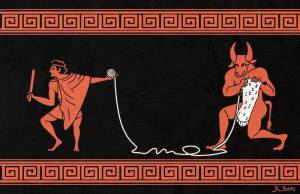
On the arrival in Crete of Theseus, King Minos’ daughter Ariadne fell in love with him and, on the advice of Daedalus, gave him a ball of thread (known as a clew), so he could find his way out of the Labyrinth. I am sure we can imagine Ariadne’s parting words…
“Don’t worry, Theseus, it’s only a Labyrinth – what can possibly go wrong!”

Don’t worry, Theseus…

Click: Return to top of page or Index page

One Day At A Time

22 January 2021

As I wrote the words for the above title, I was reminded of a lovely hymn I used to sing in the various choirs I have had the privilege of being in. I have said before that my asthma wasn’t spotted any earlier than it was, because I was singing so much and exercising my lungs. So it was a good while after I stopped singing, due to work and other things, that I had a major asthma attack. I was also living to work, rather than working to live. It is so easily done. A big surprise was the epilepsy, but that, thankfully, was kept under good control for many years with the necessary medication. Then came the heart attack, when I was just fifty-seven. No warning, it simply happened! After a while the tablets to control my epilepsy had to be changed, but the new ones work well. But in all of these events, all these changes, I was still spending much time around a mix of people. 

There have been quite a few changes in my life over the years and I have tried – no, I have had – to accept that change is a part of my everyday life. It can happen with or without due warning. A car that I really liked was damaged in an accident but I was unharmed, just a bit shaken up. It resulted in me getting a better car afterwards!  A change of job was forced upon myself and others but it created further opportunities for me that gave me much greater experience and, years later, enabled me to start and run my very own business. I have tried my best to see change as a bit of an opportunity to perhaps learn new things, meet new people and see new places. So I try, as best I can, to take a positive view on whatever change does and will occur. Right now I am having to live one day at a time, to take one step at a time – literally. It could be a whole lot worse. I am in this Care Home at the moment, being well looked after and as I write this, an inmate in a room near me is so consumed by dementia that they don’t always know where or perhaps even who they are. They call out for help, and yet there seems to be nothing wrong. When a Carer then comes to sit and talk with them, they do not want to be left on their own and it takes only a short while after the Carer goes before the same inmate calls out yet again. As a result I am learning to be even more thankful that despite my physical disabilities, I am capable of writing these words. There are many who cannot do so.

We know that quite a few folk will not accept change, but like it or not, it does happen. As babies and then children, we are for the most part surrounded by others. We are usually guided and guarded by them and we learn. We learn to be on our own, but we know that usually another is nearby. As we grow older, some prefer their own company, whilst others crave company. As children we have toys, pets, we learn to care for them as our parents and grandparents have done for us. It isn’t always an ideal life, sadly some are taken advantage of, which is wrong. Then the natural order of things is for many, but not all, to meet a partner, get married and have children of their own. I was the youngest of three boys and after a time I too was married for a time, but we had no offspring. I was also very busy at work. It meant that for so many years I was with or around a mix of people. Then things changed.

We all go through ‘dark’ times, when just about everything is seemingly all against us. I am reminded of words I sang so very many times in church, these being  ‘Though I walk through the valley of the shadow of death, I shall fear no evil’. Words taken from Psalm 23. What with work and hobbies, in the past I was usually out and about. I like my own company, but I am not like a good friend of mine who seems to like living on his own, largely in isolation. So it was that about eighteen months ago, when I simply had to keep going to the doctors to get treatment (sometimes twice a week) it meant I wasn’t seeing others. Perhaps I was even feeling a bit sorry for myself as the pain in my legs was bad and I wasn’t sleeping well at all. This meant that by late 2019/early 2020 I was not going anywhere else, I was isolating myself and, sad to say, not letting others know how I was feeling. That was a mistake. I deeply regret that now, I really do.

In March 2020 I was taken to Leicester Royal Infirmary. I have absolutely no memory of my being taken there or the first few days afterwards, but I was then aware of being transferred over to the General. It took a while for me to fully regain my senses. I was moved to one or two Care Homes, it took absolutely ages for me to be declared clear of the Covid-19 that I had caught whilst still in hospital, but in all these hospitals and Care Homes I was interacting with other people. That was the key. We are social animals, like it or not, but we are. I have now seen some film shown on YouTube where elephants greet one another and when another elephant joins them, they are all delighted! So it is with humble thanks that I sit here in this Care Home, where I now interact with others.

Surviving these lockdowns is not easy for any of us, they are putting people on edge over what might have at one time been insignificant things. Even the use of the word ‘jab’ has been scorned by some as apparently it upsets a few folk. We are given the choice as to whether we agree or not to have these latest Covid vaccinations. The last time I looked, the former president of the United States was still in denial over who won the election in November last year. At the moment, holidays have been cancelled or at the very least postponed, families are not visiting their loved ones, it really is a very trying time. So what we must surely do is continue to learn from the past, to live in the present and to look to the future with a smile. Our parents as well as our grandparents survived two World Wars, who knows what will occur in years to come. It is perhaps better that we cannot know. For now, we must be sensible, we must look after ourselves and others as best we can.  

This week, a magic number. There are those who can explain this, but for now, this is, to me, amusing. The number is:
142857

If we add the individual numbers together, the answer is 27. Add these two numbers together and the answer is 9.

Multiply 142857 by any number from two to six and the answer will be an anagram of 142857.

Multiply 142857 by seven and the answer is 999999. Keep adding these nines together and you ultimately end up with 9.

Multiply 142857 by eight and the answer is 1142856. Add all these individual numbers together and the answer is 27. Add these together…

Now multiply 142857 by nine… you get 1285713. Adding the numbers gives us the same result and by simply adding the last two digits together (1+3) you get 128574, which is another anagram of 142857… 
Magic.

Click: Return to top of page or Index page

Holiday Memories

15 January 2021

With Dad being a teacher and me still at school, holidays were at or around the same time each year. I was able to go to Belgium a couple of times on school trips, one year I managed to meet up with an uncle of mine and his wife, they lived in Antwerp. Another time I got to see the Atomium, which is near Brussels. I was probably told much of its history when I visited the place all those years ago, but after a bit of recent research, I re-learned that this Atomium was originally constructed for the 1958 Brussels World’s Fair, Expo 58. It is three hundred and thirty-five feet tall, it consists of nine stainless steel clad spheres which are each sixty feet in diameter and they are all connected, so that the whole structure forms the shape of a cell of an iron (ferrite) crystal, magnified a massive one hundred and sixty-five billion times! Tubes which are ten feet in diameter connect the spheres along the twelve edges of the cube and all eight vertices to the centre. They enclose stairs, escalators and an elevator (in the central, vertical tube) enabling access to the five habitable spheres which contain exhibit halls and other public spaces. The top sphere includes a restaurant which has a panoramic view of Brussels.

Time passed and by now I was at work with British Telecom, so I wasn’t having as many holidays, certainly not abroad. But a while later my parents, who were both now retired, went on holiday to Guernsey. The following year I went to the same place, staying in the same hotel that my parents had been to. It was just for a week, but I went on bus tours around the island as well as a boat trip to Sark. I also drank the local beer! One night the hotel owner, who also served behind the bar, advised me to stay sitting at the bar because a group of actors from the nearby theatre would be in quite soon. They arrived and promptly bought everyone drinks! It was strong beer and I ended up almost crawling up the stairs to my room! A couple of years later I went to Jersey for a week, all pleasant and friendly but I preferred my trip to Guernsey. Then it went quiet for me, holidays were spent at home for a while, I’m still not too sure why, but finance may have had its part to play in it! Then things all changed at work, I moved over to Leicester, I met and married Kate and we went down to Portugal a few times. We even spent our honeymoon there. But a while later we divorced and I’ve not been back since. Mixed memories, perhaps. Anyway, one year I drove over to Wales and had a lovely holiday touring round. Another year I did a tour of the Lake District and saw some amazing views. But all around  there the weather could be changeable, in fact it could be sunshine in one valley and raining in the next. One time it just pelted down and I just had to stop the car as visibility was so bad! 

But I had never been to America, so I decided to visit there. I called in to my local travel agent and booked myself a week in Philadelphia. I didn’t want New York, I felt it wouldn’t be for me and anyway, I had a friend living in Philadelphia. So I went and had a good time, I was very well treated. I met with my friend, she was delighted to see me. The hotel staff though were surprised at how relatively little I wanted to eat. They were wanting me to have absolutely loads of food, but I didn’t. I had all I wanted. A couple of years later I went again, this time I had a week in Washington DC, then a further week in Orlando, Florida. Whilst in Washington I had a guided tour around the White House, as well as a few other places. Then in Florida I went to the Space Centre and met one of the astronauts. I also got to see one of the launch pads. This was something I’d only ever seen on television, but now I was actually there. The other place I wanted to see was Disney World and so I did. In fact I went a few times, so I could see some of the different parks. It was lovely. I went on a ’Star Wars’ ride, it was as if I was Luke Skywalker, where I was destroying the Death Star – all very clever! It meant that I returned home with some great memories.

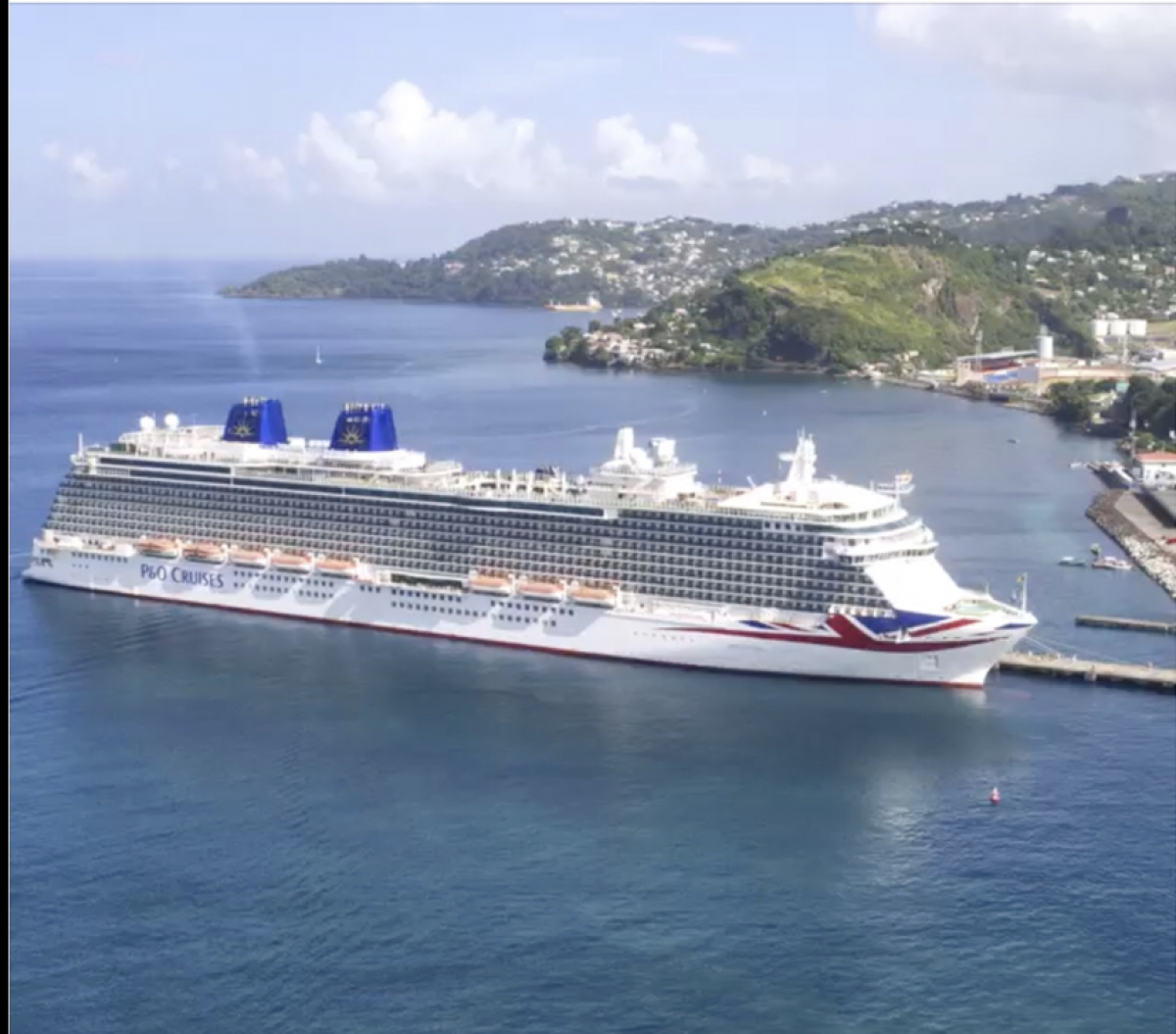
A few years later I saw an advertisement for The Cruise Show at the National Exhibition Centre in Birmingham, where I could look around at what was on offer. I went, I liked what I saw and to this day I don’t know what made me try it but I booked myself onto a four-day ‘taster’ cruise by P&O on the cruise ship Arcadia. The itinerary was simple, to go from Southampton, over to Dunkirk, then along to Le Havre and return to Southampton. So off I went. I found life on board this cruise ship was relaxing as well as enjoyable. A mix of shops were there, they had a whole range of eating options, it really was a floating hotel. However, I found that the weather in the English Channel was not good. Not good at all. In fact the captain had to forego docking at Dunkirk because, as he put it, ‘we might get in, but the weather is so bad we might not get out for a day or two’. This meant that we were simply trundling up and down the English Channel in a force nine gale for a day and a night. Not everyone enjoyed it, but I did. My mother’s father had been at sea for much of his life, either the royal or merchant navy, so it has been said maybe I have at least some sea salt in my veins! I found that whenever the Arcadia turned during the night it rocked a little, but the rocking motion sent me back to sleep! As a result of that, I booked myself on a world cruise lasting one hundred days, which was starting early the following year. It meant that I would be celebrating my sixtieth birthday in Honolulu. Perhaps the hardest part was telling my dear Mum that I would be away for so long and why, as she and I were used to chatting regularly, once a week at least. So I sent her a copy of my itinerary and I learned later that she got to tell the other inmates in the Care Home she was in where I was each day. It gave them all something to talk about together. 

This cruise was organised in a clever way. Some places we stopped at for just a day to see the sights, in others for two days. We went to a few places in South America, across to Australia and down to New Zealand, visiting a few islands on the way. Then back up to Hawaii, on to San Francisco, going a bit further down and through the Panama canal. After stopping off at Curaçao and then Barbados, Ponta Delgada was the final stop before Southampton. Altogether we stopped at thirty-two different places and I crossed the International Dateline twice! Whilst at sea there was as much or as little to do as each person wanted. Shows were put on each night, the entertainment was excellent, I joined a choir and sang in it for a while. Naturally I took loads of photographs! There was a mix of both couples and singles on board, I joined the ‘singles’ group and made a few friends. I still keep in touch with one or two of them. Also a ‘computer help’ group was started and my knowledge was very useful as I knew about both Windows and Apple computers. But I did try to remember that I was actually on holiday, not at work! It was a good holiday, I’m glad to have done it. The idea was to do things whilst I could. I hoped to have memories to look back on in later years, rather than be thinking ‘I wish I’d done that’.

In many ways I was remembering my dear Mum who, after Dad had passed away, started going on holidays. She visited relatives in South Africa, then one year she announced that she was going on holiday to Switzerland. So I asked her ‘why there’ and she promptly replied, “Your Dad promised he would take me there but he never managed to, so I’m going myself”. Then Mum found a lovely place in southern Spain. I went with her one year, it was lovely, we had time together but it was the last holiday she had before passing away a few years later at the grand age of ninety-five. I have no idea what other holidays are in store for me yet, we shall see what occurs!

We are slowly settling in to this new year, so having said about my cruise…

At one time, old warships were armed with cannons. To keep a good supply of iron cannon balls near each cannon, the balls were stored on a square based metal plate which was located next to each cannon. Each plate had 16 circular indentations for the balls to rest in, then more balls were stacked on top of each other in a 16, 9, 4, 1 pyramid format, meaning that thirty cannon balls could all be stacked together by each cannon.  The metal base plate was was called a ‘monkey’. It was found that if the plate was made of iron, then the cannon balls could rust onto it, so the solution was to make the plate out of brass. Except that when temperatures drop, brass will contract faster and greater than iron. This meant that if the temperature dropped too far, the brass indentations would shrink so much that the iron cannon balls would drop off the monkey.

Which meant it was, quite literally, “Cold enough to freeze the balls off a brass monkey”.

Communication Update

08 January 2021

A number of years ago now, additions to my family arrived in the form of twin girls to one of my elder brothers and his wife. It was noticed that the twins were soon talking to each other in a language all of their own. Later they began to learn English and their private language stopped, but I believe this is not uncommon, this ‘private’ language. Whilst looking through YouTube, I then watched a short item about a child who was deaf but went with his older sisters to a local store so they could see Father Christmas. This young child at first took no interest in seeing him, but then, on learning that the child was deaf and just learning to use sign language, Father Christmas motioned to him and began signing to the youngster. It was clear that the young child was really pleased at this, as was his mother.  

Across this world a whole range of ways to communicate have sprung up over many years. From simple animal noises to symbols like Egyptian hieroglyphs, there are so many different forms. Not all are written in a left-to-right way as many of us are used to either. We all know of other physical ways, such as the smoke signals by American Indians, whilst on ships there are flags as well as the lights which use Morse code. We have since progressed with technology, having developed the radio telegraph. I myself lived for a few years opposite the local telephone exchange, little did I realise that years later I would be working for that telephone company! Once in their employ I learned about the telephone network, the bare basics of how it all worked, I even knew the locations for many of the one hundred and twenty-six exchanges that there were in the Peterborough Telephone Area! To aid my career, in order to learn more about the business as a whole I was moved around a few times to different departments. As a result I learned about their billing system, how operator-controlled calls were charged for, I got to help compile as well as ‘proof-read’ telephone directories. That was a task! Though it helped me a great deal, as nowadays I can often recognise spelling or grammatical errors quite quickly and I have been asked to proof-read items before they are sent to print because I can spot errors. Then Sales work gave me more self-confidence, which I did need. But there was a great deal more for me to learn. Computers, for one thing! I found I really enjoyed how they worked, logically. I gained more skills – for a start I learned how to type one-handed. We were now communicating more and in new computer languages. At first there was talk of reducing the amount of paperwork we would be generating by using computers, but I think they probably created and still do create a bit more. But in every change, it was all about forms of communication that we now tend to rather take for granted.

No matter what language we use, what form of communication, the idea is to transmit information one to another. It does not matter whether it be across to another human, or perhaps to another living creature. Often words as we know them are unnecessary. Just as a gesture, a smile, even simply standing still and showing a calmness can make a real difference. When threatened, we do still have that ‘fight or flee’ instinct, although some creatures I believe will just ‘play dead’. Whatever we do, it is a form of communication. It is simply a language. I understand that whales and other sea creatures use sounds to get their message across to others. As I sit here writing this, I look out of my window and can see a weather vane, which indicates which way the wind is blowing. From that I can deduce what the weather may be like. As many of you know, I have for many years been a fan of the Sci-fi series ’Star Trek” and in their time, many of the gadgets they used seemed incredible, yet I have here a mobile phone which connects me to the internet, it has a built-in camera so I can take photos and share them with friends who are thousands of miles away and who will receive these same pictures just seconds after I have sent them. There are wristwatches that will work as a telephone, they can check our health, for example blood pressure, heart rate, how far we have walked, play recorded music and do so much more. Earlier this week I watched a video that a friend had sent to me of light drones which had been programmed to put on a display for the start of this New Year in Scotland. It really was very good, but it did make me wonder quite what our ancestors might have thought of it, had they seen such a thing so many years ago. An invasion of creatures from Mars? The conspiracy theorists of the day would have had a wonderful time! However, it was still communication and the drones would have been using a language to communicate.

There are now many different computer languages, I have said before how I learned some of them. Right now I am using an Apple computer, but I don’t need to know the language it uses, just be aware of it. The same is true in so many different areas of work, simply an awareness of a specialist language. I became very aware of that after my heart attack in 2010. Whilst I was still in hospital, a doctor and several student doctors surrounded my bed and they began talking about me but not to me, which I wasn’t exactly happy about. I was ignored. They talked in medical terminology about me and my condition, then the doctor looked around and said “Right then – any questions?”. So I spoke up and I asked “Very interesting, but what does all that mean to me please?” The doctor apologised, then said to the student doctors “You must be prepared for patients like Andrew here”. He then explained, in non-medical terms, what had happened to me, what had been found and what treatment I would be receiving, both now and in the future. I thanked him very much. These students were taught. They had to communicate, not just between themselves, but also to communicate in a common language that their patients would and could understand.  

Still, I had to smile a few months later when I saw a consultant. He asked me if there were any others in my family with heart problems. I told him about my mothers’ brothers, who had all passed away through various heart problems at fairly early ages. He then, whilst busily writing a few notes, said “Oh, good…”. I replied “I beg your pardon???” but I did smile. I knew he had his ‘clinical’ mind in gear! He then apologised profusely, but I knew it was useful for him to know such things! Knowing there was such a history in my family was an important fact for him.

A friend of mine is learning Hebrew and I happened to find an item on YouTube comparing that with another language. There seemed to me to be quite a few similarities, so I shared that video with my friend. It amazes me how all of these different languages develop. If you have seen the original film “Stargate” that was released in 1994, you will know what I mean. Right now I am continuing with my learning of basic Spanish, it is slow going but I am still enjoying it. There are some fun things to be found too, like I knew that a sombrero was a Mexican hat. But did you know that the Spanish word for ‘hat’ is ’sombrero’? I do now! As a youngster I did so enjoy ‘Cowboys and Indians’ on television, especially the series with the Lone Ranger, featuring Tonto. Except I found out recently that in Italian, Portuguese, and Spanish, “tonto” translates as “a dumb person”, “moron”, or “fool”. In the Italian version of the tv series the original name is retained, but in the Spanish dubbed version, the character is called “Toro”, the Spanish for “bull”. Apparently the creator of the Lone Ranger series grew up in Michigan, USA and knew members of the local Potawatomi tribe, who told him it meant “wild one” in their language. When he created the Lone Ranger, he gave the name to the Lone Ranger’s sidekick, apparently unaware of its negative connotations. There are times when  communication and language can be troublesome!

To close this week…
I have previously mentioned Star Trek and whilst watching an episode recently I was reminded of a race in that series called the Ferengi. They live by their ‘Rules of Acquisition’, but I will say more on those another time.

I must first stress that the following is all very much science fiction!!!

Star Trek features many different races. One are the Ferengi, whose women are referred to simply as “females”. These females are barred from most aspects of society, such as not being allowed to earn profit or to travel. They are not even allowed to wear clothes and are expected to be undressed at all times. As Quark (a well-known character in one of the Star Trek series) once put it, “Thinking about things is not something either expected or desired by females”.

Neither is having opinions or political views. They are not allowed to have any claim to the estate of a husband should the marriage end, as all females are generally required to sign a waiver of property and profit, giving up any such claim. Laws and traditional social values relegate females to the level of property. These females have no valued role in society, except for the propagation of male heirs. If a female is caught earning profit, she is forced to give back all she has earned and then either sign a confession, admitting the error of her ways, or be sold to indentured servitude if she refuses. Her male relatives then have to make restitution. 

This is, of course, thankfully, science fiction!!!

Click: Return to top of page or Index page

Happy New Year!

01 January 2021

So it begins again. A Happy New Year to all of you reading this. These past twelve months have contained many changes as well as experiences, some of which I personally do not wish to repeat. We all make mistakes, but as has been said it is not the falling down, it is the getting up again which is most important. I have seen many things that I never thought I would and I am so very thankful and grateful to each and every one who has brought me to how and where I am today. Right from those friends and neighbours who had not seen or heard from me for a while, to the ambulance people who got into my old flat and got me to hospital and to all who cared and still care for and about me. We may choose the wrong road to travel sometimes, but there is usually a way back. The first steps are often the hardest, but they are indeed well worth the effort. My heart is now working as it should, my diet is very much improved and I am happier in myself than I have been for a while. We can often see the right path for others, yet cannot always see a correct one for ourselves!

Despite our individual difficulties, we have I hope tried to make the best of things at this festive time of year. I have had a delightful time, we were looked after especially well on Christmas Day here in this Care Home, we all received a present from them, mine was shower gel and shower soap. Very nice. I also received quite a few cards and a few other presents. At dinner they made sure that the few of us who are vegetarians were catered for, so whilst others had turkey or gammon we had appropriate dishes. It was all tasty food, along with a bit of good company and some rather fun entertainment! There were six inmates to a table and a bottle of non-alcoholic wine was put on each. Though I had to smile when one inmate immediately opened a bottle and proceeded to pour some into a cup. I think he had most of the bottle to himself! That was not a problem for me, as I was happy with the blackcurrant juice. Our Carers wore Santa style hats, two of them danced to some of the music being played, all good fun, but I know a few of the inmates wondered what it was all about. One dear lady was asking why she was there, so I said “I know why – you are here to enjoy a really lovely Christmas dinner.” She accepted that.

A bit later I returned to my room, where I had a siesta. Then I looked online and saw a question asking ‘Why is Boxing Day so called?’ After a bit of research, I learned that Boxing Day seems to have got its name from when Queen Victoria was on the throne in the 1800s and it has nothing to do with the sport of boxing. The name comes from a time when the rich used to box up gifts to give to the poor. The servants would also go home on Boxing Day to give Christmas boxes to their families.

So as I have mentioned before, now is a time for giving to others as well as us being forgiving towards others. A short while ago I read a lovely story and the gist of it was that if someone tries to give you something and you do not accept it, then that thing stays with them. It is the same with insults. By not accepting insults we cannot be hurt by them, as they stay with the sender. So we should not respond in kind when someone makes nasty, unkind or derogatory remarks to us. Do not accept their unkind words and ways. If someone is short or sharp in their words to me, I try to not do the same back to them, even though I might want to. Instead, I respond in a kindly manner. If I behave like them, I am no better than them and it might then lead me to be unkind to others. Which would be wrong. In my view.

A few years ago, whilst driving along a motorway, I was approaching a slip road where a car was going to join the motorway. We’ve all seen it or done it. There you are, on the slip road and you are wanting to join the motorway. You are indicating, looking for a space, but someone who could let you in closes the gap. Now you have to brake and you are now going slower, thus making the task of joining the motorway that little bit harder. All they probably had to do was to think ahead a little more and leave a gap. So I have always tried to think ahead like that. Obviously if it’s not possible, or to do so might cause an accident, then you just have to be safe. But if they’re also looking ahead far enough, they will realise. One time I let a driver in and he raised his hand in a kindly way to thank me. At the next junction, he let another driver in. A kind act ripples on, just like when a pebble is dropped into water.

We cannot know exactly how long these difficult times may last, but as is already being done, kind words and deeds are being done. They too are rippling through our communities. In my case I try to thank the Carers for all they do for me and every other inmate here. I hope the thanks that we give to them might perhaps ripple through to their families and friends, helping us all to cope in these stressful times. I am reminded of wise words told to me some years ago by a man who I have mentioned before, Srinivas Arka. “In this way, we learn from the past, live in the present and look to the future with a smile.”

Finally for this week…
On a well-known quiz show, contestants were asked to identify deserts around the world from a list of names. They were also warned that at least one of the names was incorrect. Some answers were obvious, others less so, but one contestant chose ‘Kanafeh’ as their answer.

However, that proved to be a dessert…

Click: Return to top of page or Index page

Welcome to Christmas Day!

25 December 2020

A warm welcome to all of you reading this. No matter what culture, creed, colour or belief, we are all human. We may not all celebrate this time of year in the same way, however the world still revolves, I hope for a very long time. As we know, things change and I have no doubt they will continue to do so.

Right now, much is being talked about over all that is going on in the world but no matter if they be local, regional or global, some traditions do remain. It is my view that they should and I sincerely hope that they will. I have read some headlines saying that Christmas is now cancelled, others which say that we are being taken over and being controlled. Over in the United States, some stories are being told about how the election of the new President has been in some way fixed, despite there being no proof to any of it. But our calendars still stay the same and it is still December 25th for Christmas Day! No matter where we are, who we are with, it is surely the fact that we are here and remembering. We may not always have had the happiest of times, we will all have had difficulties to cope with, not least as we are doing right now. But I firmly believe that we should remain positive, stay calm, make the best of things, look after ourselves and not give in to negativity. There are countless conspiracy theories all being bandied about, some will believe them but in time the truth will out. 

For now, no matter what state we find ourselves in, I hope we can all enjoy this festive season, perhaps not as we might like, but with modern technology it is possible for us to have at least some contact with our relatives and friends, in very many cases now seeing them via our computers or mobile phones. What I do hope and pray is that no matter what happens, Christmas will still be celebrated and remembered. Not just as a break from work, or an excuse to sell goods, but to remember times past. I realise that not everyone may always have had good or maybe the happiest of memories, but I feel that we should not dwell on those. They are part of our past and not our present. In fact the only present I am interested in are the ones I shall be opening, one by one, shortly!

I have mentioned in a previous post on here that we as a family moved from London to Whittlesey, then a few years later my grandparents did the same. For a while, Nan and Pop were the live-in housekeepers for a local vicar and remembering that takes me back – I remember the big fireplace at the old vicarage in Whittlesey, where there seemed to always be a huge pot of boiling water on the stove! There were no electric kettles there in those days! The rooms had high ceilings and the washing was hung up on rails above the kitchen table. Washing dried quickly too, as heat rises. Just off the kitchen was a pantry with cobbled stone floors, there wasn’t a refrigerator, food lasted for ages (apart from mince pies!) and it was mostly home grown and home-cooked food.

A school-friend of mine had a fun, family tradition. On Christmas Eve the family would go to a ‘midnight’ church service and as soon as they were back home, as it was now Christmas Day just one present could be opened by each person. Just the one. They had to be patient. Then after they had slept, were up and had their breakfast, all their other presents could be opened! But then times change, children grow up and often move away, have families of their own and the cycle then continues. When dear Nan passed away, Pop would come to our house for Sunday lunch and I remember one year when he was invited to have lunch on Christmas Day with us. He accepted, but asked to be picked up from his local pub as he would be having a few drinks with them first. This was done, Pop had his dinner and promptly fell fast asleep. Later he woke up, asking for his Christmas dinner – sadly he had no memory of eating it. My dear mother was not at all impressed! Over the years our family gatherings became smaller and smaller as aunts and uncles passed away, as sons moved away, including me. Nowadays they do not seem to occur at all, which is a bit of a shame.

For a few years I was regularly visiting my eldest brother and his wife, but they then divorced and what with work and travelling, I was spending more and more time on my own. I remember one Christmas Day when I didn’t want to be on my own, so I drove to the Leicester Forest East motorway services by the M1 and had a delightful Christmas meal there. It meant I was not alone. I sat just where I could overlook the motorway, I enjoyed the time there. I am not likely to ever do that again!

I have no idea what next year will be like, it will not be the same as this year has been. As I have said before, the one constant in this universe is that things change. They will continue to do so. As I have a little more time on my hands it may be that I start looking again at my family history, as it has already turned out to be fascinating! As of course the whole subject of ancestry is. On a small scale, over time many plants & animals have not survived, but their ‘ancestry’ may still be found and traced back. On a slightly larger scale, it is the same with some family names. It would seem that this branch of the Williams name may end at some point, as only girls have been born in recent times! But still the family line continues. It can, is and will be traceable. I have a bit more research to do yet on other sides of the family!

On a bigger scale? That is beyond me. I do know the average human lifespan is currently around seventy-nine years, so it does seem to me how fascinating it might be to return to this Earth in say, a hundred years from now and see how much has changed! I have been taught and firmly believe that we should continue to learn from the past, live in the present and look to the future with a smile. So that is what I plan to do. On that note, may I wish each and every one of you a very Happy Christmas and a good New Year. I will also add: ¡Feliz navidad y próspero año nuevo!

Finally for this festive day…
Santa told me I’d not been bad this year. I told him it was simply a lack of opportunity… 😉

Click: Return to top of page or Index page

A Brief History Of My Time

18 December 2020

Had he still been alive, a few days ago would have been my dear Dad’s 101st birthday. Sadly he passed away many years ago and my dear mother has now been with him for a few years too, they are at peace together. With these family members as well as earlier generations having passed away long since, I feel that some of their story may be shared.

From my research over very many years, I have managed to piece together items from a few sources by chatting to elderly relatives, looking through old registers of Births, Marriages and Deaths and searching a few rather useful websites. I even spent some time down in London, looking through the archives there. It was and still is really fascinating to me to piece various items together and learn how apparently disparate events can lead to such beginnings. In fact, chatting to my dear mother a few years ago I was able to add in an extra piece of this, our family jigsaw puzzle, that she didn’t know.

As you might imagine from my own surname, a few generations back one side of the family originated in Wales. But it seems that when one of my ancestors had a dalliance with a young lady ‘below stairs’, he was sent away in disgrace. This led him to eventually settle in London. Mention was once made of time in Canada, but I’ve never been able to learn any more on that so I’m unsure if that is true or not. This would have been my paternal great-grandfather, so it was in London he met my paternal great-grandmother. Quite where they lived in London I am unsure, I’m still researching that, but I do know that my paternal grandfather went to a school in Westminster.

Meanwhile, another side of the family originated in Cornwall and they were working in the tin mines. When the work there was ending, they moved to the copper and coal mines in South Wales, where it was that my maternal great-grandparents met and married each other. They moved to do chalk mining in Suffolk, before moving to London and that is where my mother was born. So it was London where my paternal grandparents met and then married, as did my parents. That is also where I and my two elder brothers were born.

This means that I and my brothers have a mixture of Welsh and Cornish blood in us. Back in the days of the Spanish Armada, when the Spaniards landed on the English coast, many were simply killed but then some were allowed to stay and live with the locals, integrating themselves into the community. Hence the difference in hair colouring in my two brothers and I, as two of us have very fair hair, whilst the other has black hair, a very different build and quite a different temperament. A sign, I believe, of some Spanish blood!

Looking back at World War One, my maternal great-grandfather was in the Royal Navy as a Leading Stoker on the ‘Tipperary’ at the Battle of Jutland. He was in the engine room of the ship as it was hit by enemy gunfire and began to go down, but he was able to escape. He was in the water for a while, but was then spotted by sailors on a nearby British ship. By this time he was covered in oil and with a heavy beard, along with a weather-beaten face, he was initially thought to be a German and was about to be ignored. However a stream of Anglo-Saxon expletives spoken in a broad, Cornish accent soon informed the British sailors what would happen to them if they did not pick him up! He is in fact named and his rescue detailed by HMS Dublin in the Battle of Jutland Official Despatches, of which I have a copy. What fascinates me even more is that in these Despatches, I read that HMS Dublin actually lost sight of any enemy ships due to the fog. A shell had passed through the chart house and had affected their standard compass, in addition they could not navigate by dead reckoning (estimating course and speed) as their Navigating Officer had been killed and the charts in the chart house badly damaged. So as a result, they did a ‘best-guess’ of what course would bring them in contact with other ships of their squadron. It was only then, whilst on this ‘best guess’ course, that they came across my great-grandfather!

My paternal grandfather was in the Light Infantry. He walked very quickly, so as a child I often had to trot to keep up with him! During World War I he was at the Somme and Ypres (to which he always referred to as ‘wipers’), but he was captured and held in a prisoner of war camp. Whilst there, he and others survived by various means, including diverting the attention of their captors and breaking into the storage sheds where food was kept and then sharing what they had stolen with their fellow prisoners. He worked in a machine shop there and shortly before the end of the war he was injured by a piece of machinery, where he lost the third finger and part of the second finger of his right hand. He was due to return home on a troop ship, but at the last minute a doctor decided that he was not fit to go home, so he stayed for a little while longer. However, the troop ship he was booked on was then sunk, probably by a mine, and his wife was initially told that he had died. A short while later he caught another ship home. One can only imagine what happened when he arrived back home in London and their front door was then opened!

Moving on to World War II. At that time, my father was in the army and therefore was sent on a training course prior to being sent overseas. Except he broke his shoulder on the course, so had to stay in the UK. He learned about various kinds of ammunition, bombs etc and warned my mother (who he was dating at the time) about some bombs having a delayed action. As a result, my mother knew to wait a while when she and her mother, whilst in an Anderson shelter, heard a bomb hit the ground but not explode. They waited and waited, but just as they went to leave the shelter the bomb exploded. My mother had just enough time to turn her back to shield her mother from the blast, but this gave my dear mother a horrific back wound and she was initially told she would never walk again. She told my father to walk away and leave her as he wouldn’t want to marry a cripple, to which my father replied “I’m not marrying a cripple, I’m marrying you.” My mother replied that in that case, she would walk up the aisle of the church. Which she did. In fact, dear Mum bore us three boys and then reached the grand age of 95 before she passed away with, I am told, a peaceful, quiet smile on her face. 

It is a sobering thought to realise that without all these events occurring as they did then I, my brothers, nephews and nieces et al would not be here!

Finally for now, an exercise in logic:
A wife asks her husband, “Would you please go shopping for me, buy one carton of milk, and if they have eggs, get 6.”
A short time later the husband comes back with 6 cartons of milk.
The wife asks him, “Why did you buy 6 cartons of milk?”
He replied, “They had eggs.”

Click: Return to top of page or Index page