
This week I write a little about Attleborough in Norfolk, where one of my older brothers lived with his wife and family for some years. It is also where my parents retired to until they passed away and whose ashes are now adjacent in the local churchyard. Attleborough is a market town and civil parish located on the A11 between Norwich and Thetford in Norfolk. The parish is in the district of Breckland and has an area of 8.5 square miles, ( 21.9 square kilometres). The 2001 Census recorded the town as having a population of 9,702 which was distributed between 4,185 households, increasing to a population of 10,482 in 4,481 households in the 2011 Census. Attleborough is in the Mid-Norfolk constituency of the UK Parliament, represented since the 2010 general election by a Conservative MP. Attleborough railway station provides a main line rail service to both Norwich and Cambridge. As to the town’s history, the Anglo-Saxon foundation of the settlement is unrecorded. A popular theory of the town’s origin makes it a foundation of an ‘Atlinge’, and certainly ‘burgh’ indicates that it was fortified at an early date. According to the mid-twelfth century ‘hagiographer’ of Saint Edmund, Geoffrey of Wells, Athla was the founder of the Ancient and royal town of Attleborough in Norfolk. Incidentally, this taught me a new word, ‘hagiography’ which it seems comes from Ancient Greek ‘hagios’ or ‘holy’, and ‘graphia’ or ‘writing’, which is a biography of a saint or an ecclesiastical leader, as well as, by extension, an adulatory and idealised biography of a preacher, priest, founder, saint, monk, nun or icon in any of the world’s religions. Early Christian hagiographies might consist of a biography or ‘vita’, a description of the saint’s deeds or miracles (from Latin ‘vita, meaning life, which begins the title of most medieval biographies), an account of the saint’s martyrdom (called a ‘passio’), or be a combination of these. Christian hagiographies focus on the lives, and notably the miracles, ascribed to men and women canonised by the Roman Catholic church, the Eastern Orthodox Church, the Oriental Orthodox churches and the Church of the East. Other religious traditions such as Buddhism, Hinduism, Taoism, Islam, Sikhism and Jainism also create and maintain hagiographical texts concerning saints, gurus and other individuals believed to be imbued with sacred power. Hagiographic works, especially those of the Middle Ages, can incorporate a record of institutional and local history, and evidence of popular cults, customs, and traditions.
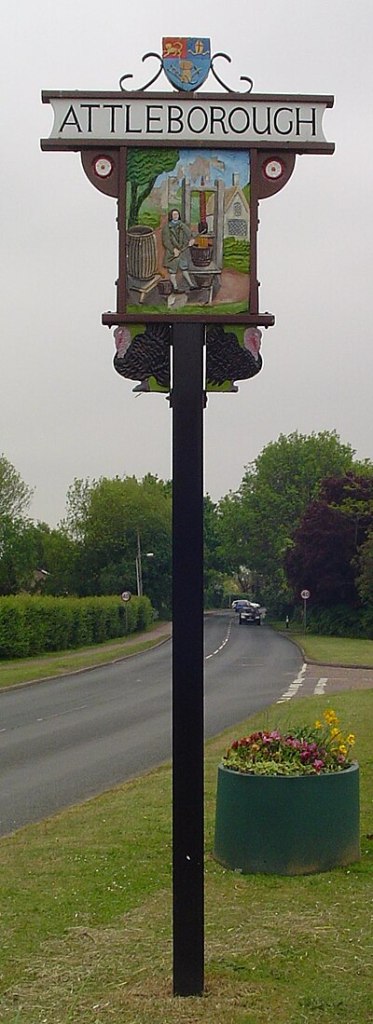
In the Domesday Book of 1086, the town is referred to as ‘Attleburc’, but after the Danes swept across Norfolk and seized Thetford, it is believed that the Saxons rallied their forces at Attleborough and probably threw up some form of protection. Although the Saxons put up a vigorous resistance, they eventually capitulated to the Danes and during the time of King Edward the Confessor, powerful Danish families like Toradre and Turkill controlled local manors. If local records are correct, nothing but disaster was brought to Attleborough by the Danes, and it took the coming of King William the Conqueror to restore some sense of well-being to the area. Turkill relinquished his hold on the area to the Mortimer family towards the end of King William’s reign, and they governed Attleborough for more than three centuries. In the fourteenth century the Mortimer family founded the Chapel of the Holy Cross (being the south transept of Attleborough Church) and about a century later, Sir Robert de Mortimer founded the College of the Holy Cross, then the nave and aisles were added to accommodate the congregation. Then, following King Henry VIII’s Dissolution of the Monasteries, the building was virtually destroyed by Robert Radcliffe, Lord Fitz Walter, Earl of Sussex, and material from the building was used for making up the road between Attleborough and Old Buckenham. However, this left Attleborough Church with a tower at the east end. A great part of the town was destroyed by fire in 1559 and it was during that period that the Griffin Hotel was then built. It was in the cellars of the Griffin hotel that prisoners on their way to the March Assizes in Thetford were confined overnight, tethered by chains to rings in the wall. The arrival of the prisoners aroused a great deal of public interest, and eventually traders set up a fair whenever they came. This became known as the ‘Attleborough Rogues Fair’ and was held on the market place on the last Thursday in March. Also on the market place, festivities took place on Midsummer Day when the annual guild was held. It appears that there has been the right to hold a weekly Thursday market in the town since 1285. A weekly market is still held and has recently (in 2004) returned to Queen’s Square where it is presumed the market was originally held. The first toll or turnpike road in England is reputed to have been created here at the end of the seventeenth century as Acts of Parliament were passed in 1696 and 1709, “For the repairing of the highway between Wymondham and Attleborough, in the County of Norfolk, and for including therein the road from Wymondham to Hethersett”. The first national census of 1801 listed the population of Attleborough as 1,333. By 1845 Attleborough certainly dominated the surrounding parishes with a population of nearly 2,000, and in that year the Norwich to Brandon railway arrived. The town supported six hostelries, these being The Griffin (the oldest), the Angel, the Bear, the Cock, the Crown and the White Horse. The Griffin, the Bear and the Cock still operate but the Crown is now a youth centre and the Angel is a building society branch office. Nothing is known of the fate of the White Horse after 1904, although the White Horse building still exists as a private house. There are currently two more public houses, these being The London Tavern and the Mulberry Tree, which is also a restaurant. At the centre of the town is Queens Square, at one time referred to as Market Hill. In 1863 a corn exchange owned by a company of local farmers was built in the High Street and in 1896 the Gaymer’s cider-making plant was built on the south side of the railway and soon became established as the largest employer in the town. The factory has now closed for cider-making, which has moved to Shepton Mallet in Somerset, but it has since re-opened as a chicken processing plant, and the corn exchange is now a local Indian restaurant. The First World War affected Attleborough probably no better or worse than many similar small towns. Five hundred and fifty men joined the armed forces and ninety-six did not return. The 1920s saw continuing growth as a market centre, held on a Thursday, with the stalls spread along the pavements of Church Street and in an open area by the Angel Hotel opposite the Griffin Inn. It was the turkey sales which made the town a thriving market centre in the 1930s, and thousands were sold each year on Michaelmas Day. Local employment still largely revolved round Gaymer’s cider works. Well into the 1930s lighting was by oil lamps, then came the building of the gas works in Queens Road (since demolished, although the Gas Keeper’s House is still there). Gradually gas was piped into homes, but it was a slow process. In the early 1930s the Corn Hall was sold and became a cinema, reaching its heyday in the early 1940s. During 1939 the old post office was sold and it became the Doric Restaurant in Queens Square and it is now the town hall. The new post office was built in Exchange Street. There were two local airfields during World War II, one at Deopham Green (Station 142) and one at Old Buckenham (Station 144). Structurally the town changed little during the 1950s and there were no great leaps in population growth, other than the arrival of the notorious London gangsters, the Kray twins, who took over a local hostelry. The 1960s were different, the overspill programme and new town development brought new families into south Norfolk. Attleborough had to make decisions for the future and new development zones were designated. The first estate programme began with the building of the council-owned Cyprus Estate, which has since been complemented by other private housing schemes such as Fairfields and Ollands built mainly in the 1970s, and a large estate on the south side of the town in the 1990s. The traditional traffic route along the A11 trunk road became a bottleneck as it ran both ways along High Street and Church Street, so in the 1970s a one-way system was opened and this channelled traffic around the natural ring road surrounding the church. The volume of traffic continued to increase making that change obsolete so the Attleborough bypass was opened in 1984. The bypass was widened and completed in 2007, removing the only single-lane section of the A11 between Thetford and Norwich.

The parish church of the Assumption of the Blessed Virgin Mary is partly Norman and partly fourteenth century. The east end of the church is Norman and the nave is late fourteenth century. In 1368 the College of Holy Cross was founded in the Norman part and at that time the nave was built for the use of the parish. The remarkable rood screen has the loft intact for its full width but has often been restored. It is one of the finest rood screens in Norfolk and above are frescoes of c. 1500, since much-mutilated. Meanwhile the Eastern Baptist Association meets at the Baptist church in Leys Lane and the Methodist church in London Road has stopped holding normal services but still provides rooms to hire for community use. This building was designed by the architect Augustus Scott in Gothic Revival style, and in 1913 replaced the Primitive Methodist building in Chapel Road, since demolished. As for the educational facilities in the town there are three schools, these being Attleborough Academy on Norwich Road, Rosecroft Primary School on London Road and Attleborough Primary School on Besthorpe Road. Wymondham College, a large state boarding school, is located just outside of the town. Industrially, Banham Poultry is based on Station road and has an annual turnover of £100 million. Its chairman was Michael Foulger, who is also deputy chairman of Norwich City football club. There have been a few notable residents of the town, namely the composer Malcolm Arnold who lived in the town from the late 1980s until his death in September 2006, the professional footballers John Fashanu and his brother Justin Fashanu who lived in and went to school in Attleborough, the racing driver Ayrton Senna (1960-1994) who lived in Attleborough during his early years in international motorsport through to his time in Formula One and Brandon Francis, (born Justin Christopher Davis),an actor and writer who lived in and went to school in Attleborough.
This week… a quote.
“Some people drink deeply from the fountain of knowledge. Others just gargle.”
~ Grant M. Bright
Click: Return to top of page or Index page
 Diary of a Care Home Inmate
Concidentally, my newly‐married sister and her husband moved to Attleborough on buying their first home, a newly built bungalow, in 1969-70. Also, our previous labrador, Chips, came from a well-known gun dog breeder near Old Buckenham. Like you, I was born in London. In a round about way my sister’s marriage and move to Norfolk brought the rest of my family here, although Ken and I didn’t arrive until 1999. His RAF career brought us to rest near Norwich by a very differen route!
LikeLike
Thank you. It fascinates me how so much comes back to Norfolk!
LikeLike