
Although not too many may know it, I am from London, as was my father and his father before him. My paternal grandfather was in the light infantry during World War I and caught, but was injured so at the end of the war his return to England was delayed. As a result he survived when others did not. My father was born in 1919 in London and he sadly passed away this day in 1989. I understand that he first got a job in W.H. Smith’s in London, my estimate would be around 1935. He was in the army during the World War II but was injured during his training, so he stayed in England and was involved with munitions, that much I knew though he never talked about his work apart from the odd funny stories. He did say that he was taught to drive, that he went to (I think) Stranraer for a short while and also from what little he did say about that place, I don’t think he enjoyed his visit. After the war, on leaving the army he would have returned to W.H.Smith’s in London. In the meantime my mother was born in 1921, also in London, but my research shows her family, including her older brothers, came from Cornwall, probably working in the tin mines but they then moved for a while to South Wales, then Suffolk and finally London. My mother was determined to work in an office rather than in a local factory, so she got herself a job in W.H. Smith’s, which is where my parents met. Knowing more than a bit about munitions, my father told my mother about the different bombs, but sadly she was badly injured when a delayed-action bomb exploded nearby to where she and her mother were. My mother managed to protect her Mum, except the explosion damaged my mother’s back and she was initially told she would never walk again. At that time, my parents weren’t yet married so my mother told my father to leave her as “he wouldn’t want to be married to a cripple”. My father then said “I’m not going to marry a cripple, I’m going to marry ‘you’. At which my mother said “In that case, I will walk down the aisle”. Which she did. Quite a determined character, my mother. She bore three children, all boys. My two elder brothers were born in 1942 and 1944, then I arrived a while later in 1953. Mum told me later she had hoped for a girl, but when I turned up they decided that was enough!
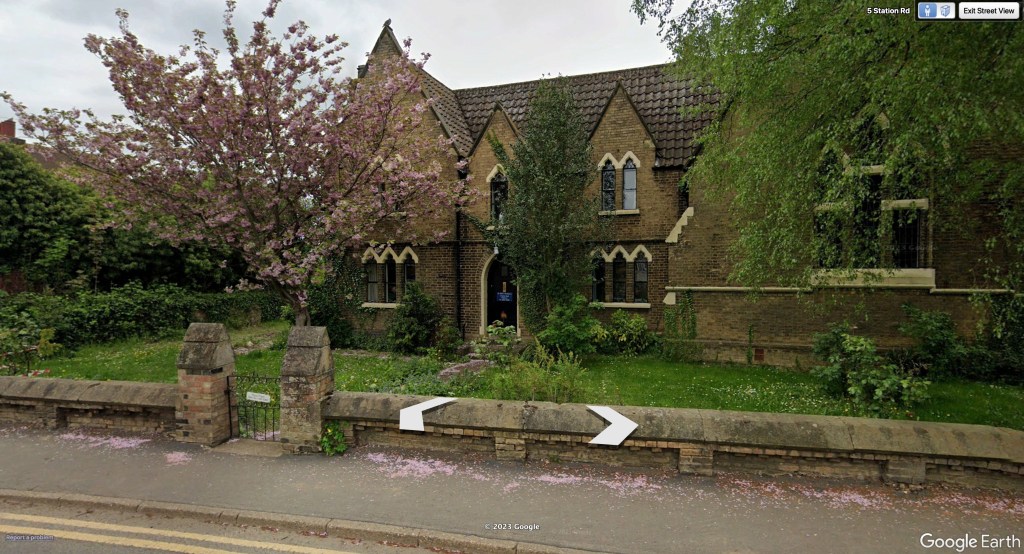
But it seems that my dad had wanted to be a teacher and thinking about it now it must have been quite a challenge for both Mum and Dad to be bringing up young children during and after the war, but they managed. Then in 1952 they learned that l was on the way, but the Great Smog of that year gave my mother health problems and later she had a stroke. This meant that I was born prematurely. So, knowing they had to get out of London my Dad applied for a few teaching jobs outside of the city and one came up in Whittlesey, near Peterborough. This one came with use of the School House, so at less than a year old I, my two brothers and my parents all moved. But it nearly went wrong as Dad, having travelled up to Peterborough by train for a job interview, then headed over to Whittlesey and he almost mistook Kings Dyke for Whittlesey, which he did not like the look of! It is quite fortunate that the bus conductress corrected him and kept him on the bus. Soon afterwards my Dad’s parents were approaching retirement age and I am told that, much to Dad’s surprise, his parents moved to Whittlesey! There they became housekeepers for the local vicar, whose eyesight was failing, I never did know how they managed that. But with his parents now in Whittlesey, it did mean that my Mum and Dad felt they had to stay there. I have an idea that Dad had at first seen Whittlesey as a ’stepping stone’ to other places, but it did not happen. Back then, the town had several small schools, like Station Road, Broad Street, West End and Queen Street. Then the junior school was built, this being the Alderman Jacobs Primary School in Drybread Road, Whittlesey, which opened its school gates in September 1960, when the Beatles were just starting out and John F Kennedy was being elected to the White House. So I went to a few of the infant schools, then went to the Alderman Jacobs school in 1961. My two elder brothers were taught by my Dad, but I never was as I was in a different ‘stream’ at that school. I did not pass my eleven-plus, so went to the secondary modern school nearby, whilst those who passed went to the grammar school in March. At school I then learned much, some things I enjoyed better than others, I got on with some teachers much better than others too. I sang, I learned to play the trumpet, I played chess – I even became a ‘chess monitor’ for a while! I stayed on for an extra year at school, leaving at sixteen. As the years passed a few smaller schools closed as one new one opened, Park Lane, and then the Sir Harry Smith school became a Community College. In 1980 New Road Primary School was opened as a co-educational day school for children aged 4 to 11 years and in 2014 the school then became an academy in partnership with Park Lane Primary School. Both schools joined with Sir Harry Smith Community College to form the Aspire Learning Trust in July 2016.

In our early years at the School House in Whittlesey we were living just across the road from the local St. Mary’s church, so we became involved there. To begin with, the sound of the loud church bells scared me as I did not know what they were. But my father sat me down, quietly and calmly explained the sound, also told me that he himself was a bellringer and I was fine with that. I think it is almost a fear of the unknown that can scare us. When in church, my father and one of my elder brothers sang in the choir, so I wanted to do the same. It seems I was a bit young to join, and as my father was choirmaster, not wanting to show favouritism he asked the other members of the choir their opinion. They all said “Give the boy a voice test and the reading test – if he passes, he’s in!”. I did so and I was in. At the time of course I knew nothing of this, but it makes me smile to think of how it must have been. So I began singing, and as I grew older many of my fellow choristers stopped as their voices ‘broke’. Interestingly my voice didn’t, it simply ‘slid’ as I found I could no longer reach the high notes. So I went from treble to alto to tenor and finally bass! Meanwhile at school there were a few folk beginning to play musical instruments but because of my physical disability, namely using my right hand, I could not manage things like a recorder. I managed a harmonica, but then at secondary school found I could play a cornet. Admittedly I played it ‘incorrectly’, by pressing the valves left-handed, but it worked. This enabled me to join a band, Nassington Brass, which I did for a while, playing a trumpet, but then I was almost ‘ordered’ that I needed to give up singing and play only in the band. But I found I was enjoying singing in a choir far more and I was better at that, so I gave up band work. In the next few years I joined a couple of other choirs, including a male voice choir but I was also picked up by another choir after impromptu voice test by Henk Kamminga, the master of a quite small choir. That really was hard work, but I now sang in various cathedrals around England, where we led the Saturday and Sunday services. Hard work, but rewarding.

I was still working for British Telecom in the Sales department in Peterborough, but as I have said previously my face did not ‘fit’ there, so to gain promotion I got a transfer to Leicester. It meant travelling by train for a few months and during that time I met a lovely lady and we were married for a while. Further transfers and relocations within BT brought me to office work in Nottingham, up to Sheffield, down to Birmingham but eventually I found the travelling simply too much, so agreed a transfer back up to Sheffield. Each move was good, as it expanded my knowledge and the move up to Sheffield gave me the opportunity to go on a Trainer’s course, which I enjoyed. The only side to that was a year later when the department got relocated to Manchester, as the people who were still in Sheffield were given alternative work, which I do not think they enjoyed as much and they perhaps saw me as being part of the unwanted change, even though I had no choice in the decision. Also, the relocation meant I got to help train the new folk on their work in Manchester, so I was not appreciated in Sheffield! I got a transfer to Leicester, where I found I was back working with people I knew from years ago. But time passed, and after 38 years with BT I was shown the door and I left, along with a few others. After a while I then started my own business, teaching people mainly my age and above how to take basic photographs as well as sharing them on the internet with family and friends. But my health deteriorated still further, I also caught Covid-19 and am now residing in a lovely Care home in Leicester, which suits me nicely. Both my parents have passed away, I’ve lost touch with one brother but still have intermittent contact with the other. I have regular contact with good friends and I am content with the research and writing I now do.
This week… a quote I like.
“Do the right thing, because it’s the right thing to do.”
Click: Return to top of page or Index page
 Diary of a Care Home Inmate