Ely

Ely (pronounced Ee-lee) is a cathedral city in the East Cambridgeshire district of Cambridgeshire, England, about fourteen miles (23 km) north-northeast of Cambridge and eighty miles (130 km) from London. Ely is built on a twenty—three square-mile (60 km2) Kimmeridge Clay island which, at eighty-five feet (26 m), is the highest land in the Fens. It was due to this topography that Ely was not waterlogged like the surrounding Fenland, and was an island separated from the mainland. Major rivers, including the Witham, Welland, Nene and Great Ouse feed into the Fens and, until draining commenced in the eighteenth century, formed freshwater marshes and meres within which peat was laid down. Once the Fens were drained, this peat created a rich and fertile soil ideal for farming. The Great Ouse river was a significant means of transport until the Fens were drained in the seventeenth century and Ely ceased to be an island. The river is now a popular boating spot, and has a large marina. Although now surrounded by land, the city is still recognised and remembered as “The Isle of Ely”. There are two Sites of Special Scientific Interest in the city, these being a former Kimmeridge Clay quarry, and one of the United Kingdom’s best remaining examples of medieval ‘ridge and furrow’ agriculture. The economy of the region is mainly agricultural and before the Fens were drained, eel fishing was an important activity, from which the settlement’s name may have been derived. Other important activities included wildfowling, peat extraction, and the harvesting of both osier (willow) and sedge (rush). The city had been the centre of local pottery production for more than 700 years, including pottery known as Babylon ware. A Roman road, Akeman Street, passes through the city with the southern end of this at Ermine Street near Wimpole and its northern end is at Brancaster. Little direct evidence of Roman occupation in Ely exists, although there are nearby Roman settlements such as those at Little Thetford and Stretham. A coach route, known to have existed in 1753 between Ely and Cambridge, was improved in 1769 as a toll road or turnpike. The present-day A10 closely follows this route whilst Ely railway station, built in 1845, is on the Fen line and is now a railway hub, with lines north to King’s Lynn, north-west to Peterborough, east to Norwich, south-east to Ipswich and south to Cambridge then London. King Henry II granted the first annual fair, Saint Etheldreda’s (or Saint Audrey’s) seven-day event, to the abbot and convent on 10 October 1189. The word “tawdry” originates from cheap lace sold at this fair and a weekly market has taken place in Ely market square since at least the thirteenth century. Markets are now held on Thursdays, Saturdays and Sundays, with a farmers’ market on the second and fourth Saturdays of each month. Present-day annual events include the Eel Festival in May, established in 2004, and a fireworks display in Ely Park, first staged in 1974. The city of Ely has been twinned with Denmark’s oldest town, Ribe, since 1956 and Ely City Football Club was formed in 1885.The nearby Roswell Pits are a palaeontologically significant Site of Special Scientific Interest, being just one mile (1.6 km) north-east of the city. The Jurassic Kimmeridge Clays were quarried in the nineteenth and twentieth centuries for the production of pottery and for maintenance of river embankments. Many specimens of extinct marine life have been found during quarrying. There is some scattered evidence of Late Mesolithic to Bronze Age activity in Ely such as Neolithic flint tools, a Bronze Age axe and spearhead. There is also some slightly denser Iron Age and Roman activity, with some evidence of at least seasonal occupation. For example, a possible farmstead, of the late Iron Age to early Roman period, was discovered at West Fen Road and some Roman pottery was found close to the east end of the cathedral on The Paddock. There was also a Roman settlement, including a tile kiln built over an earlier Iron Age settlement, in Little Thetford, three miles (5 km) to the south.

Earliest known map of Ely by John Speed, 1610.

The origin and meaning of Ely’s name have always been regarded as obscure by place-name scholars, and these are still disputed. The earliest record of the name is in the Latin text of Bede’s ‘Ecclesiastical History of the English People’, where he wrote ‘Elge’. This is apparently not a Latin name, and subsequent Latin texts nearly all used the forms Elia, Eli, or Heli with inorganic H-. In Old English charters, and in the Anglo-Saxon Chronicle, the spelling is usually ‘Elig’. It has been said that the name Ely was derived from Old Northumbrian ‘ēlġē, meaning ‘district of eels’. The theory is that the name then developed a vowel to become ‘ēliġē’, and was afterwards re-interpreted to mean ‘Eel Island’ or Isle of Eels. The city’s origins lay in the foundation of an abbey in 673 AD, one mile (1.6 km) to the north of the village of Cratendune on the Isle of Ely, under the protection of Saint Etheldreda, daughter of King Anna. St Etheldreda (also known as Æthelthryth) was a queen, founder and abbess of Ely. She built a monastery in 673 AD, on the site of what is now Ely Cathedral. This first abbey was destroyed in 870 AD by Danish invaders and rededicated to Etheldreda in 970 AD by Ethelwold, Bishop of Winchester. The abbots of Ely then accumulated such wealth in the region that in the Domesday survey of 1086 it was the “second richest monastery in England”. The first Norman bishop, Simeon, started building the cathedral in 1083. The octagon was rebuilt by sacrist Alan of Walsingham between 1322 and 1328 after the collapse of the original nave crossing on 22 February 1322. Ely’s octagon is now considered “one of the wonders of the medieval world”. Building continued until the dissolution of the abbey in 1539 during the Reformation. The cathedral was then sympathetically restored between 1845 and 1870. As the seat of a diocese, Ely has long been considered a city and in 1974, city status was granted by royal charter.

East aspect of St Mary’s vicarage, a Grade II listed building. Oliver Cromwell lived there between 1638 and 1646, and since 1990 the building has been open as the Oliver Cromwell’s House tourist attraction as well as Ely’s tourist information centre.

Cherry Hill is the site of Ely Castle which is of Norman construction and is a United Kingdom scheduled monument. Of similar construction to Cambridge Castle, the 250-foot (76 m) diameter, 40 feet (12 m) high citadel-type ‘motte and bailey’ and is thought to be a royal defence built by William the Conqueror following submission of the Isle from rebels such as the Earl Morcar and Hereward the Wake. This would date the first building of the castle to c. 1070. On 9 April 1224, although Ely had been a trading centre prior to this, King Henry III of England granted a market to the Bishop of Ely using “letters close”, a type of obsolete legal document once used by the Pope, the British monarchy and by certain officers of government, which is a sealed letter granting a right, monopoly, title, or status to an individual or to some entity such as a corporation. Present weekly market days are Thursday and Saturday and seasonal markets are held monthly on Sundays and Bank Holiday Mondays from Easter to November. Following the accession of Mary I of England to the throne in 1553, the papacy made its first effective efforts to enforce the Pope Paul III-initiated Catholic reforms in England. During this time, which became known as the Marian Persecutions, two men from Wisbech were accused of not believing that the body and blood of Christ were present in the bread and wine of the sacrament of mass. This was viewed as Christian heresy and they were condemned and were burnt at the stake. The cathedral itself was dedicated to St Peter at this time and a windmill is shown on Mount Hill where the post-conquest Ely Castle motte and bailey  once stood. In the eighteenth century trees were planted on Mount Hill which was named Cherry Hill since at least since 1821. There was a form of early workhouse in 1687, perhaps at St Mary’s and then a purpose-built workhouse was erected in 1725 for thirty-five inmates on what is now St Mary’s Court. Four other workhouses existed, including Holy Trinity on Fore Hill for eighty inmates (1738–1956) and the Ely Union workhouse, built in 1837, which housed up to three hundred inmates. The latter became Tower Hospital in 1948 and is now a residential building, Tower Court. Two other former workhouses were the Haven Quayside for unmarried mothers and another on the site of what is now the Hereward Hall in Silver Street. Over the years various diarists have written about Ely, for example Daniel Defoe, when writing in the Eastern Counties section of ‘A tour thro’ the whole island of Great Britain’ (1722), wrote “to Ely, whose cathedral, standing in a level flat country, is seen far and wide … that some of it is so antient, totters so much with every gust of wind, looks so like a decay, and seems so near it, that when ever it does fall, all that ’tis likely will be thought strange in it, will be, that it did not fall a hundred years sooner”. The Ely and Littleport riots occurred between 22 and 24 May 1816. At the Special Commission assizes, held at Ely between 17 and 22 June 1816, twenty-four rioters were condemned. Nineteen had their sentences variously commuted from penal transportation for life to twelve-months imprisonment; the remaining five were executed on 28 June 1816. I have also seen it noted that an outbreak of cholera isolated Ely in 1832.
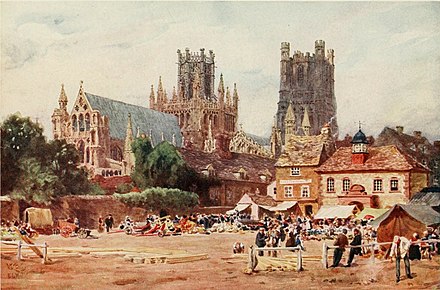
The Market Place, Ely, a pencil and watercolour by W. W. Collins published 1908.

The above shows the north-east aspect of [Ely Cathedral in the background with the Almonry which is now a restaurant and art gallery. In front of that is the 1847 corn exchange building, now demolished, to the right of the picture. Ely Cathedral was “the first great cathedral to be thoroughly restored”. Work commenced in 1845 and was completed nearly thirty years later; most of the work was “sympathetically” carried out by the architect George Gilbert Scott. The only pavement labyrinth to be found in an English cathedral was installed below the west tower in 1870. For over 800 years the cathedral and its associated buildings, built on an elevation sixty-eight feet (21 m) above the nearby fens, have visually influenced the city and its surrounding area. The abbey at Ely was one of many which were re-founded in the Benedictine reforms of King Edgar the Peaceful (943–975). The “special and peculiarly ancient” honour and freedoms given to Ely by charter at that time may have been intended to award only fiscal privilege, but have been interpreted to confer on subsequent bishops the authority and power of a ruler. These rights were reconfirmed in charters granted by King Edward the Confessor and in King William the Conqueror’s confirmation of the old English liberty at Kenford. The Isle of Ely was mentioned in some statutes as a county palatine; this provided an explanation of the bishop’s royal privileges and judicial authority, which would normally belong to the sovereign; but some legal authorities did not completely endorse the form of words. These bishop’s rights were not fully extinguished until 1837.

OpenMap of Ely demonstrating the city boundary and environs.

As the seat of a diocese, Ely has long been considered a city, holding the status by ancient prescriptive right. When Ely was given a Local Board of Health by Queen Victoria in 1850, the order creating the board said it was to cover the “city of Ely”. The local board which governed the city from 1850 to 1894 called itself “City of Ely Local Board”, and the urban district council which replaced it and governed the city from 1894 to 1974 similarly called itself “City of Ely Urban District Council”. Ely’s city status was not explicitly confirmed, however, until 1 April 1974 when Queen Elizabeth II granted letters patent, to its civil parish. Ely’s population of 20,256 (as recorded in 2011) classifies it as one of the smallest cities in England, although the population has increased noticeably since 1991 when it was recorded at 11,291. Its urban area brings Ely into the top ten of smallest sized cities (1.84 square miles, 4.77 km2), but by city council area it is much larger in coverage (22.86 square miles, 59.21 km2) than many others.
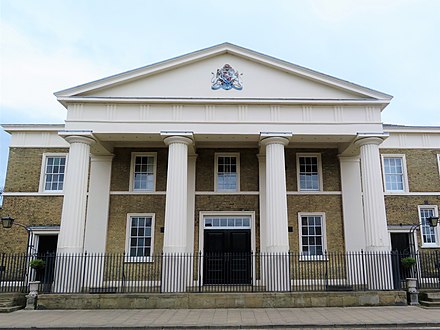
Sessions House (formerly Shire Hall), Lynn Road. Courthouse, built 1821. Since 2013 this has been the headquarters of City of Ely Council.

There are three tiers of local government covering Ely, at parish (city), district, and county level, these being the City of Ely Council, East Cambridgeshire District Council and [Cambridgeshire County Council. In terms of its administrative history, the city was governed by a local board from 1850 until 1894, when it became the City of Ely Urban District Council, which then operated from 1894 to 1974. The Isle of Ely County Council governed the Isle of Ely administrative county that surrounding and included the city from 1889 to 1965. In 1965 there was a reform of local government that merged the county council with that of Cambridgeshire to form the Cambridgeshire and Isle of Ely County Council. In 1974 as part of a national reform of local government, the Cambridgeshire and Isle of Ely County Council merged with the Huntingdon and Peterborough County Council to form the [Cambridgeshire County Council and it was sadly around this time that Whittlesey, where I grew up, ceased to be part of the Isle of Ely. The City of Ely Urban District Council became the City of Ely Council, a parish council which covers the same area but with fewer powers, and the East Cambridgeshire District Council which covers a wider area.

A 1648 drainage map showing the Isle of Ely still surrounded by water. (Joan Blaeu (1648) ‘Regiones Inundatae’.

The west of Cambridgeshire is made up of limestones from the Jurassic period, whilst the east Cambridgeshire area consists of Cretaceous, upper Mesozoic chalks known locally as clunch’. In between these two major formations, the high ground forming the Isle of Ely is from a lower division Cretaceous system known as Lower Greensand which is capped by Boulder Clay and all local settlements, such as Stretham and Littleport, are on similar islands. These islands rise above the surrounding flat land which forms the largest plain of Britain from the Jurassic system of partly consolidated clays or muds. Kimmeridge Clay beds dipping gently west underly the Lower Greensand of the area exposed, for example, about one mile (2 km) south of Ely in the Roswell Pits. The Lower Greensand is partly capped by glacial deposits forming the highest point in East Cambridgeshire, rising to 85 feet (26 m) above sea level in Ely. The low-lying fens surrounding the island of Ely were formed, prior to the seventeenth century, by alternate fresh-water and sea-water incursions. Major rivers in the region drain an area of some 6,000 square miles (16,000 km2), five times larger than the fens, into the basin that forms the fens. Peat formed in the fresh-water swamps and meres, whilst silts were deposited by the slow-moving sea-water. The Earl of Bedford, supported by Parliament, financed the draining of the fens during the seventeenth century, led by the Dutch engineer Cornelius Vermuyden and the fens continue to be drained to this day. As an island surrounded by marshes and meres, the fishing of eels was important as both a food and an income for the abbot and his nearby tenants. Prior to the extensive and largely successful drainage of the fens during the seventeenth century, Ely was a trade centre for goods made out of willow, reeds and rushes and wild fowling was a major local activity. Peat in the form of “turf” was used as a fuel and in the form of “moor” as a building material. Ampthill Clay was dug from the local area for the maintenance of river banks and Kimmeridge Clay at Roswell Pits for the making of pottery wares. In general, from a geological perspective, “The district is almost entirely agricultural and has always been so. The only mineral worked at the present time is gravel for aggregate, although chalk, brick clay (Ampthill and Kimmeridge clays), phosphate (from Woburn Sands, Gault and Cambridge Greensand), sand and gravel, and peat have been worked on a small scale in the past”. Phosphate nodules, referred to locally as coprolites were dug in the area surrounding Ely between 1850 and 1890 for use as an [agricultural fertiliser and this industry provided significant employment for the local labour force. One of the largest sugar beet factories in England was opened two miles (3 km) from the centre of Ely, in 1925. The factory closed in 1981, although sugar beet is still farmed locally. Pottery was made in Ely from the twelfth century until 1860 and records show around eighty people who classed their trade as potters. “Babylon ware” is the name given to pottery made in one area of Ely. This ware is thought to be so named because there were potters in an area cut off from the centre by the re-routing of the Great Ouse river around 1200, by the seventeenth century this area had become known as Babylon. Although the reason for the name is unclear, by 1850 it was in official use on maps. The building of the Ely to King’s Lynn railway in 1847 cut the area off even further, and the inhabitants could only cross to Ely by boat.
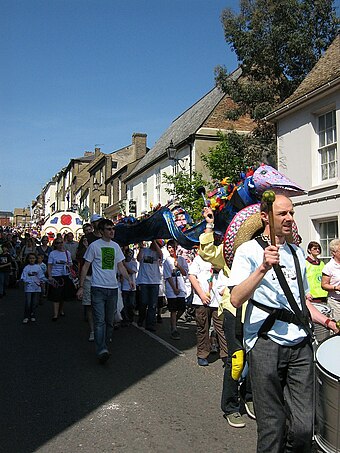
Eel Day carnival procession down Fore Hill, 2007.

Annual fairs have been held in Ely since the twelfth century. Apart from Saint Audrey’s (Etheldreda) seven-day fair, held either side of 23 June, which was first granted officially by King Henry I to the abbot and convent on 10 October 1189, two other fairs, the 15‑day festival of St Lambert, first granted in 1312 and the 22‑day fair beginning on the Vigil of the Ascension, first granted in 1318. Have been held. The festival of St Lambert had stopped by the eighteenth century. St Etheldreda’s and the Vigil of the Ascension markets still continue, although the number of days have been considerably reduced and the dates have changed. Present-day annual events in Ely include Aquafest, which has been staged at the riverside by the Rotary Club on the first Sunday of July since 1978. Other events include the Eel Day carnival procession and the annual fireworks display in Ely Park, first staged in 1974. The Ely Folk Festival has been held in the city since 1985 and the Ely Horticultural Society have been staging their Great Autumn Show since 1927. Interestingly, the children’s book ‘Tom’s Midnight Garden’ by Philippa Pearce is partly set in Ely and includes a scene in Ely Cathedral and scenes inspired by the author’s father’s own childhood experiences of skating along the frozen river from Cambridge to Ely in the frost of 1894–95. Also the first series of Jim Kelly’s crime novels, featuring journalist Philip Dryden, is largely set in the author’s home town of Ely and in the Fens. Graham Swift’s 1983 novel ‘Waterland’ takes place, and recounts several historical events, in and around the town of Ely. The Tales of the Unexpected episode “The Flypaper” was filmed in Ely and the album cover for Pink Floyd’s ‘The Division Bell’ was created by Storm Thorgerson with Ely as the background between two massive sculptures that he had erected outside the city.

This week… A quote from an army officer:

Him? “I wouldn’t trust him with a pea shooter!”

Click: Return to top of page or Index page

Routine

So many things in this world and beyond are governed by routine. That is normal. Yes, things change, in fact that is one of my favourite sayings, that change is the one constant in this universe! But so much of it changes slowly. At least it seems to us, although there are days when we find time seems to have passed by in a flash whilst at other times it simply drags. However, it goes by at the same, steady rate. Whether it be just our world, our planets, our solar system, the Milky Way and so much more, it seems a regular routine. Then, all of a sudden, something occurs and we see change. Like for example where NASA’s Cassini spacecraft has provided the first direct evidence of small meteoroids breaking into streams of rubble and crashing into Saturn’s rings. These observations make Saturn’s rings the only location besides Earth, the moon, and Jupiter where scientists and amateur astronomers have been able to observe impacts as they occur. Studying the impact rate of meteoroids from outside the Saturn system helps scientists understand how different planet systems in the solar system formed. Our solar system is full of small, speeding objects. Planetary bodies are frequently pummelled by them. The meteoroids at Saturn range from about one-half inch to several yards (1 centimetre to several metres) in size. It took scientists years to distinguish tracks left by nine meteoroids in 2005, 2009 and 2012! As to our everyday life, daily life or routine life this comprises the ways in which we typically act, think, and feel on a daily basis. In some forms of life, routine is governed by the seasons, where some animals hibernate, whilst in other creatures their lifespan is relatively short and their lifetime is faster. In many lives on Earth we see ‘diurnality’, a form of plant and animal behaviour characterised by activity during daytime, with a period of sleeping or other inactivity at night. The timing of activity by an animal really depends on a variety of environmental factors such as the temperature, the ability to gather food by sight, the risk of predation, and the time of year. Diurnality is a cycle of activity within a 24-hour period, whilst cyclic activities called circadian rhythms are endogenous cycles not dependent on external cues or environmental factors. Animals active during twilight are ‘crepuscular’, those active during the night are nocturnal and animals active at sporadic times during both night and day are ‘cathemeral’, a term I have never heard of before. Plants that open their flowers during the daytime are described as diurnal, whilst those that bloom during nighttime are nocturnal. The timing of flower opening is often related to the time at which preferred pollinators are foraging. For example, sunflowers open during the day to attract bees, whereas the night-blooming cereus opens at night to attract large sphinx moths. Again, another I did not previously know. Human diurnality means most people sleep at least part of the night and are active in daytime. Most eat two or three meals in a day. Working time, apart from shift work, mostly involves a daily schedule, beginning in the morning. This produces the daily ‘rush hours’ experienced by many millions, and the drive time focused on by radio broadcasters. Evening is often leisure time. Beyond these broad similarities, lifestyles vary and different people spend their days differently. For example, nomadic life differs from sedentary ways amongst the more urban people who live differently from rural folk. In addition, differences in the lives of the rich and the poor, or between labourers and intellectuals, which may go beyond their ‘regular’ working hours. In addition, children and adults vary in what they do each day as their need for sleep changes. In the study of everyday life, gender has been an important factor in its conceptions. Much of everyday life is automatic in that it is driven by current environmental features. Daily life is also studied by sociologists to investigate how it is organised and given meaning. At one time daily entertainment consisted mainly of telling stories in the evening. This custom developed into the theatres of ancient Greece and other professional entertainments. Later, reading became less of a mysterious speciality of scholars and more a common pleasure for people who could read. As time passed, different forms of media became available to more people. Different media forms serve different purposes in the everyday lives of different people, giving them the opportunities to make choices about what forms of media they choose, such as watching television, using the Internet, listening to the radio or reading newspapers as well as magazines. In many cases these help them to accomplish their tasks most effectively, but a great many use them as forms of relaxation as well as learning.

Booked!

Our everyday lives are shaped through language and communication. We choose what to do with our time based on opinions and ideals formed through the discourse we are exposed to. Much of the dialogue people are subject to comes from the mass media, which is an important factor in what shapes human experience. The media uses language to make an impact on our everyday life, whether that be as small as helping to decide where to eat or as big as choosing a representative in government. Interestingly, to improve our everyday life one professor in a Department of Communication and Culture says people should seek to understand the rhetoric that so often and unnoticeably changes their lives. They write that “…rhetoric enables us to make connections… It is about understanding how we engage with the world”. We engage in activities of daily living, a term used in healthcare to refer to daily self care activities within an individual’s place of residence, in outdoor environments, or both. Healthcare professionals routinely refer to the ability or inability to perform these as a measurement of the functional status of a person, particularly in regard to people with disabilities and the elderly. These events are defined as “the things we normally do…such as feeding ourselves, bathing, dressing, grooming, work, homemaking, and leisure”. The ability and the extent to which the elderly can perform these activities is at the focus of ‘gerontology’ another new word to me but which is the study of the social, cultural, psychological, cognitive and biological aspects of aging, along with relative understandings of later life. Indeed, we hear so much in the news about Care homes and that they have changed quite a bit, mainly for the better I am happy to say. This is something that I am planning to research and write a little more about in the future.

This week… Zones.

There are four ‘zones’, that we humans have around us.

Intimate zone: less than 0.5 metres (1.5 feet)
Personal zone: 0.5 to 1.5 metres (1.5 to 4 feet)
Social zone: 1.5 to 3 metres (4 to 12 feet)
Public zone: greater than 3 metres (12 feet)

Fascinating!

Click: Return to top of page or Index page
Tennis

As I guess most people know, tennis is a racket sport played either individually against a single opponent (singles) or between two teams of two players each (doubles). But it has an interesting history. Each player uses a tennis racket that is strung with cord to strike a hollow rubber ball covered with felt over or around a net and into the opponent’s side of the court. The object of the game is to manoeuvre the ball in such a way that the opponent is not able to play a valid return. The player who is unable to return the ball validly will not gain a point, whilst the opposite player will. Tennis is an Olympic sport and is played at all levels of society and at all ages. The sport can be played by anyone who can hold a racket, including wheelchair users. The original forms of tennis developed in France during the late Middle Ages, but the modern form of tennis originated in Birmingham, England, in the late nineteenth century as ‘lawn tennis’. It had close connections both to various field (lawn) games such as croquet and bowls as well as to the older racket sport today called ‘real tennis’, which is one of several games sometimes called “the sport of kings” and is the original racquet sport from which the modern game of tennis is derived. It is also known as ‘court tennis’ in the United States, formerly ‘royal tennis’ in England and Australia, or ‘courte-paume’ in France, to distinguish it from their ‘longue-paume’, and in reference to the older, racquetless game of ‘jeu de paume’, the ancestor of modern handball and racquet games. The rules of modern tennis have changed little since the 1890s, with just two exceptions which are that until 1961 the server had to keep one foot on the ground at all times, and the adoption of the tie-break in the 1970s. A recent addition to professional tennis has been the adoption of electronic review technology coupled with a point-challenge system, which allows a player to contest the line call of a point, a system known as Hawk-Eye and seen as quite an appropriate name. Tennis is played by millions of recreational players and is a popular worldwide spectator sport. The four Grand Slam tournaments (also referred to as the majors) are especially popular, these being the Australian Open, played on hard courts; the French Open, played on red clay courts; Wimbledon, played on grass courts and the United States Open, also played on hard courts.

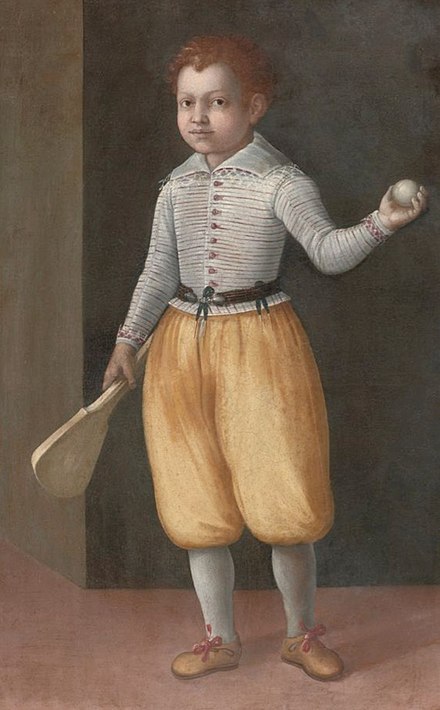
A painting from Cremona from the end of the sixteenth century.
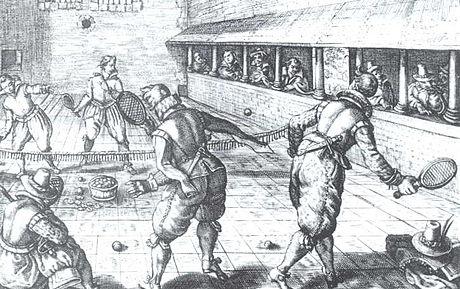
‘Jeu de paume’ in the seventeenth century.

Historians believe that the game’s ancient origin lay in twelfth-century northern France, where a ball was struck with the palm of the hand. King Louis X of France was a keen player of ‘jeu de paume’ (game of the palm), which evolved into real tennis. However, the King was unhappy with playing tennis outdoors and accordingly had indoor, enclosed courts made in Paris around the end of the thirteenth century and in due course this design spread across royal palaces all over Europe. In June 1316 at Vincennes, Val-de-Marne, and following a particularly exhausting game, King Louis drank a large quantity of cooled wine and subsequently died of either pneumonia or pleurisy, although there was also suspicion of poisoning. Because of the contemporary accounts of his death, King Louis X is history’s first tennis player known by name. Another of the early enthusiasts of the game was King Charles V of France, who had a court set up at the Louvre Palace. It was not until the sixteenth century that rackets came into use and the game began to be called ‘tennis’, from the French term ‘tenez’, which can be translated as ‘hold!’, ‘receive!’ or ‘take!’, an interjection used as a call from the server to his opponent. It was popular in England and France, although the game was only played indoors, where the ball could be hit off the wall. Henry VIII of England was a big fan of this game, which is now known as ‘real tennis’. An epitaph in St Michael’s Church, Coventry, written c. 1705, reads, in part:
Here lyes an old toss’d Tennis Ball:
Was racketted, from spring to fall,
With so much heat and so much hast,
Time’s arm for shame grew tyred at last.

During the eighteenth and early nineteenth centuries, as real tennis declined, new racket sports emerged in England. The invention of the first lawn mower in Britain in 1830 is believed to have been a catalyst for the preparation of modern-style grass courts, sporting ovals, playing fields, pitches, greens, etc. This in turn led to the codification of modern rules for many sports, including lawn tennis, most football codes, lawn bowls and others.

Augurio Perera’s house in Edgbaston, Birmingham, where he and Harry Gem first played the modern game of lawn tennis.

Between 1859 and 1865 Harry Gem, a solicitor, and his friend Augurio Perera developed a game that combined elements of racquets and the Basque ball game ‘Pelota’, which they played on Perera’s croquet lawn in Edgbaston, Birmingham and in 1872, along with two local doctors, they founded the world’s first tennis club on Avenue Road, Leamington Spa. This is where ‘lawn tennis’ was used as the name of an activity by a club for the first time. In December 1874, a British army officer, Walter Clopton Wingfield, wrote to Harry Gem, commenting that he (Wingfield) had been experimenting with his version of lawn tennis “for a year and a half”. In December 1873, Wingfield designed and patented a game which he called ‘sphairistikè’, meaning ‘ball-playing’, and which was soon known simply as ‘sticky’, for the amusement of guests at a garden party on his friend’s estate of Nantclwyd Hall, in Llanelidan, Wales. According to Honor Godfrey, museum curator at Wimbledon, Wingfield popularized this game enormously. He produced a boxed set which included a net, poles, rackets, balls for playing the game, and most importantly you had his rules. He was absolutely terrific at marketing and he sent his game all over the world. He had very good connections with the clergy, the law profession, and the aristocracy and he sent thousands of sets out in the first year or so, in 1874. The world’s oldest annual tennis tournament took place at Leamington Lawn Tennis Club in Birmingham in 1874 and this was three years before the All England Lawn Tennis and Croquet Club would hold its first championships at Wimbledon, in 1877. The first Championships culminated in a significant debate on how to standardise the rules.

Tennis doubles final at the 1896 Olympic Games.

Tennis became popular in France, where the French Championships date back to 1891, although until 1925 they were open only to tennis players who were members of French clubs. Thus, Wimbledon, the US Open, the French Open and the Australian Open (dating to 1905) became and have remained the most prestigious events in tennis. Together, these four events are called the Majors or ‘Slams’, a term borrowed from bridge.

Lawn tennis in Canada, c. 1900.

In 1913, the International Lawn Tennis Federation (ILTF), now the International Tennis Federation (ITF), was founded and established three official tournaments as the major championships of the day. The World Grass Court Championships were awarded to Great Britain, the World Hard Court Championships were awarded to France as the term ‘hard court’ was used for clay courts at the time. Some tournaments were held in Belgium instead. The World Covered Court Championships for indoor courts were awarded annually, as Sweden, France, Great Britain, Denmark, Switzerland and Spain each hosted the tournament. At a meeting held on 16 March 1923 in Paris, the title ‘World Championship’ was dropped and a new category of ‘Official Championship’ was created for events in Great Britain, France, the US and Australia, these being today’s Grand Slam events. The impact on the four recipient nations to replace the ‘world championships’ with ‘official championships’ was simple in a general sense as each became a major nation of the federation with enhanced voting power, and each now operated a major event. The comprehensive rules promulgated in 1924 by the ILTF have remained largely stable in the ensuing years, the one major change being the addition of the ‘tiebreak’ system. That same year, tennis withdrew from the Olympics after the 1924 Games but returned sixty years later as a 21-and-under demonstration event in 1984. The success of the event was overwhelming, and the IOC decided to reintroduce tennis as a full-medal sport at Seoul in 1988. The Davis Cup, an annual competition between men’s national teams, dates to 1900. The analogous competition for women’s national teams, the Fed Cup, was founded as the Federation Cup in 1963 to celebrate the 50th anniversary of the founding of the ITF. In 1926, a promoter established the first professional tennis tour with a group of American and French tennis players playing exhibition matches to paying audiences. As a result, players who turned ‘Pro’, were no longer permitted to compete in the major (amateur) tournaments. In 1968, commercial pressures and rumours of some amateurs taking money under the table led to the abandonment of this distinction, inaugurating the Open Era, in which all players could compete in all tournaments, and top players were able to make their living from tennis. With the beginning of the Open Era, the establishment of an international professional tennis circuit, and revenues from the sale of television rights, tennis’s popularity has spread worldwide, and the sport has shed its middle-class English-speaking image, although it is acknowledged that this stereotype still exists.

Racket of Franjo Punčec in a wooden frame dating to the late 1930s.

Part of the appeal of tennis stems from the simplicity of equipment required for play. Beginners need only a racket and balls. The components of a tennis racket include a handle, known as the grip, connected to a neck which joins a roughly elliptical frame that holds a matrix of tightly pulled strings. For the first 100 years of the modern game, rackets were made of wood and of standard size, and strings were of animal gut. Laminated wood construction yielded more strength in rackets used through most of the twentieth century until first metal and then composites of carbon graphite, ceramics, and lighter metals such as titanium were introduced. These stronger materials enabled the production of oversized rackets that yielded yet more power. Meanwhile, technology led to the use of synthetic strings that match the feel of gut yet with added durability. Under modern rules of tennis, the rackets must adhere to a range of guidelines, these being that the hitting area, composed of the strings, must be flat and generally uniform, the frame of the hitting area may not be more than 29 inches (74cm) in length and 12.5 inches (32cm) in width, the entire racket must be of a fixed shape, size, weight, and weight distribution and there may not be any energy source built into the rackets. Also the rackets must not provide any kind of communication, instruction or advice to the player during the match. The rules regarding rackets have changed over time, as material and engineering advances have been made. For example, the maximum length of the frame had been 32 inches (81cm) until 1997, when it was shortened to 29 inches (74cm).

Two different tennis strings of lengths 12m (left), and 200 m (right).

There are multiple types of tennis strings, including natural gut and synthetic stings made from materials such as nylon, kevlar or polyester. The first type of tennis strings available were natural gut strings and they were the only type used until synthetic strings were introduced in the 1950s. Natural gut strings are still used frequently by players such as Roger Federer. They are made from cow intestines, provide increased power and are easier on the arm than most strings.

As you can see, a modern tennis racket and balls.

Tennis balls were originally made of cloth strips stitched together with thread and stuffed with feathers. Modern tennis balls are made of hollow vulcanized rubber with a felt coating. Traditionally white, the predominant colour was gradually changed to optic yellow in the latter part of the twentieth century to allow for improved visibility. Tennis balls must conform to certain criteria for size, weight, deformation and bounce to be approved for regulation play. The International Tennis Federation (ITF) defines the official diameter as 65.41–68.58mm (2.575–2.700in). Balls must weigh between 56.0 and 59.4g (1.98 and 2.10oz). Although the process of producing the balls has remained virtually unchanged for the past one hundred years, the majority of manufacturing now takes place in the Far East and the relocation is due to cheaper labour costs and materials in the region. Tournaments that are played under the ITF Rules of Tennis must use balls that are approved by the International Tennis Federation (ITF) and be named on the official ITF list of approved tennis balls.

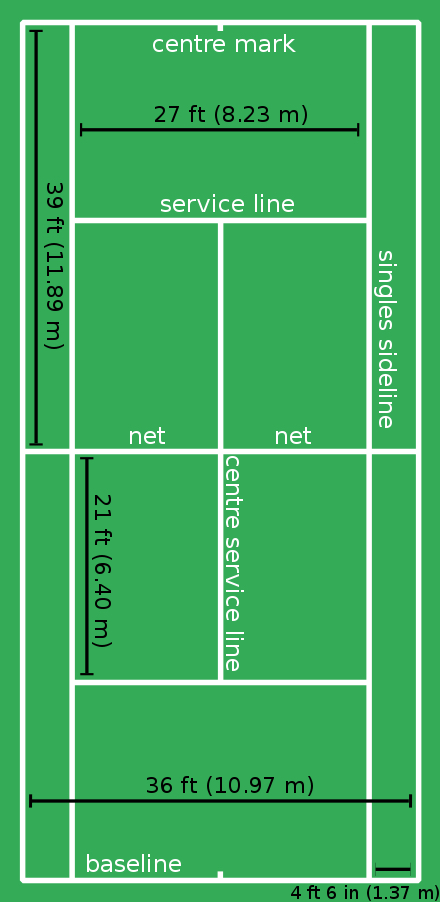
The dimensions of a tennis court.

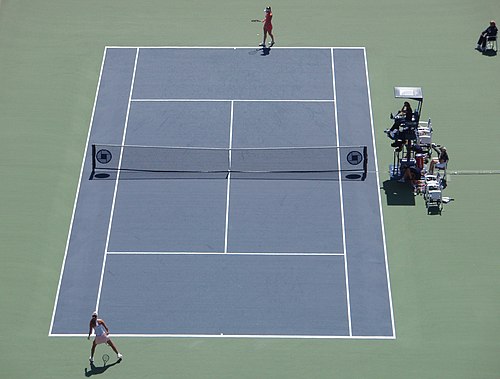
The game of tennis is played on a rectangular, flat surface. The court is 78 feet (23.77m) long, and 27 feet (8.2m) wide for singles matches and 36 feet (11m) for doubles matches and additional clear space around the court is required in order for players to reach overrun balls. A net is stretched across the full width of the court, parallel with the baselines, dividing it into two equal ends. The net is held up by either a cord or metal cable of diameter no greater than 1/3 inch (0.8cm). The net is 3 feet 6 inches (1.07 m) high at the posts and 3 feet (0.91 m) high in the centre. The net posts are 3 feet (0.91m) outside the doubles court on each side or, for a singles net, 3 feet (0.91m) outside the singles court on each side. Tennis is unusual in that it is played on a variety of surfaces, these being grass, clay and hard courts of concrete or asphalt topped with acrylic. Occasionally carpet is used for indoor play, with hardwood flooring having been historically used. Artificial turf courts can also be found. The lines that delineate the width of the court are called the baseline (farthest back) and the service line (middle of the court). The short mark in the centre of each baseline is referred to as either the hash mark or the centre mark. The outermost lines that make up the length are called the doubles sidelines; they are the boundaries for doubles matches. The lines to the inside of the doubles sidelines are the singles sidelines, and are the boundaries in singles play. The area between a doubles sideline and the nearest singles sideline is called the doubles alley, playable in doubles play. The line that runs across the centre of a player’s side of the court is called the service line because the serve must be delivered into the area between the service line and the net on the receiving side. Despite its name, this is not where a player legally stands when making a serve. The line dividing the service line in two is called the centre line or centre service line. The boxes this centre line creates are called the service boxes; depending on a player’s position, they have to hit the ball into one of these when serving. A ball is only ‘out’ if none of it has hit the area inside the lines, or the line, upon its first bounce. All lines are required to be between 1 and 2 inches (25 and 51mm) in width, with the exception of the baseline which can be up to 4 inches (100mm) wide, although in practice it is often the same width as the others.

Two players before a serve.

The players or teams start on opposite sides of the net. One player is designated the ‘server’, and the opposing player is the ‘receiver’. The choice to be server or receiver in the first game and the choice of ends is decided by a coin toss before the warm-up starts. Service alternates game by game between the two players or teams. For each point, the server starts behind the baseline, between the centre mark and the sideline. The receiver may start anywhere on their side of the net. When the receiver is ready, the server will serve, although the receiver must play to the pace of the server. For a service to be legal, the ball must travel over the net without touching it into the diagonally opposite service box. If the ball hits the net but lands in the service box, this is a ‘let’ or ‘net service’, which is void, and the server retakes that serve. The player can serve any number of let services in a point and they are always treated as voids and not as faults. A fault is a serve that falls long or wide of the service box, or does not clear the net. There is also a “foot fault” when a player’s foot touches the baseline or an extension of the centre mark before the ball is hit. If the second service, after a fault, is also a fault, the server ‘double faults’, and the receiver wins the point. However, if the serve is in, it is considered a legal service. A legal service starts a ‘rally’, in which the players alternate hitting the ball across the net. A legal return consists of a player hitting the ball so that it falls in the server’s court, before it has bounced twice or hit any fixtures except the net. A player or team cannot hit the ball twice in a row. The ball must travel over or round the net into the other players’ court. A ball that hits the net during a rally is considered a legal return as long as it crosses into the opposite side of the court. The first player or team to fail to make a legal return loses the point. The server then moves to the other side of the service line at the start of a new point.

The scoreboard of a tennis match.

A game consists of a sequence of points played with the same player serving. A game is won by the first player to have won at least four points in total and at least two points more than the opponent. The running score of each game is described in a manner peculiar to tennis: scores from zero to three points are described as ‘love’, ’15’, ’30’ and ’40’, respectively. If at least three points have been scored by each player, making the player’s scores equal at 40 apiece, the score is not called out as ’40–40’, but rather as ‘deuce’. If at least three points have been scored by each side and a player has one more point than his opponent, the score of the game is ‘advantage’ for the player in the lead. The score of a tennis game during play is always read with the serving player’s score first. In tournament play, the chair umpire calls the point count (e.g., ’15–love’) after each point. At the end of a game, the chair umpire also announces the winner of the game and the overall score. Leading on from that are ‘Sets’. A set consists of a sequence of games played with service alternating between games, ending when the count of games won meets certain criteria. Typically, a player wins a set by winning at least six games and at least two games more than the opponent. If one player has won six games and the opponent five, an additional game is played. If the leading player wins that game, the player wins the set 7–5. If the trailing player wins the game (tying the set 6–6) a ‘tiebreak’ is played. A tiebreak, played under a separate set of rules, allows one player to win one more game and thus the set, to give a final set score of 7–6. A tiebreak game can be won by scoring at least seven points and at least two points more than the opponent. In a tiebreak, two players serve by ‘ABBA’ system which has been proven to be fair. If a tiebreak is not played, the set is referred to as an ‘advantage set’, where the set continues without limit until one player leads by a two-game margin. A ‘love set’ means that the loser of the set won zero games, colloquially termed a ‘jam donut’ in the United States. In tournament play, the chair umpire announces the winner of the set and the overall score. The final score in sets is always read with the winning player’s score first, e.g. ‘6–2, 4–6, 6–0, 7–5’. This leads on to a ‘Match’, which consists of a sequence of sets. The outcome is determined through a best of three or five ‘sets’ system. On the professional circuit, men play best-of-five-set matches at all four Grand Slam tournaments, Davis Cup, and the final of the Olympic Games and best-of-three-set matches at all other tournaments, while women play best-of-three-set matches at all tournaments. The first player to win two sets in a best-of-three, or three sets in a best-of-five, wins the match. Only in the final sets of matches at the French Open, the Olympic Games, and Fed Cup are tiebreaks not played. In these cases, sets are played indefinitely until one player has a two-game lead, occasionally leading to some remarkably long matches! In tournament play, the chair umpire announces the end of the match with the well-known phrase ‘Game, set, match’ followed by the winning person’s or team’s name.

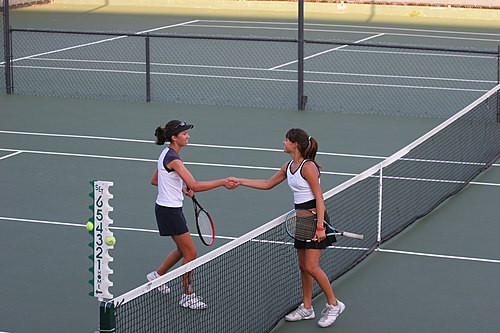
Convention dictates that the two players shake hands at the end of a match, first with each other and then with the Umpire.

A tennis match is intended to be continuous. Because stamina is a relevant factor, arbitrary delays are not permitted. In most cases, service is required to occur no more than 20 seconds after the end of the previous point. This is increased to 90 seconds when the players change ends (after every odd-numbered game), and a 2-minute break is permitted between sets. Other than this, breaks are permitted only when forced by events beyond the players’ control, such as rain, damaged footwear, damaged racket, or the need to retrieve an errant ball. Should a player be deemed to be stalling repeatedly, the chair umpire may initially give a warning followed by subsequent penalties of “point”, “game”, and default of the match for the player who is consistently taking longer than the allowed time limit. In the event of a rain delay, darkness or other external conditions halting play, the match is resumed at a later time, with the same score as at the time of the delay, and each player at the same end of the court as when rain halted play, or as close to the same relative compass point if play is resumed on a different court. Balls wear out quickly in serious play and, therefore, in both ATP and WTA tournaments, they are changed after every nine games with the first change occurring after only seven games, because the first set of balls is also used for the pre-match warm-up. In ITF tournaments like Fed Cup, the balls are changed after every eleven games (rather than nine) with the first change occurring after only nine games (instead of seven). An exception is that a ball change may not take place at the beginning of a tiebreaker, in which case the ball change is delayed until the beginning of the second game of the next set.[66] As a courtesy to the receiver, the server will often signal to the receiver before the first serve of the game in which new balls are used as a reminder that they are using new balls. Continuity of the balls’ condition is considered part of the game, so if a re-warm-up is required after an extended break in play (usually due to rain), then the re-warm-up is done using a separate set of balls, and use of the match balls is resumed only when play resumes. Within the game there are different ways regarding the stance of a player, preparing them in order to best be able to return a shot. Essentially, it enables them to move quickly in order to achieve a particular stroke. There are four main stances in modern tennis: open, semi-open, closed, and neutral. All four stances involve the player crouching in some manner: as well as being a more efficient striking posture, it allows them to preload their muscles in order to play the stroke more dynamically. What stance is selected is strongly influenced by shot selection. A player may quickly alter their stance depending on the circumstances and the type of shot they intend to play. Any given stance also alters dramatically based upon the actual playing of the shot with dynamic movements and shifts of body weight occurring. In a similar way, a competent tennis player has eight basic shots in his or her repertoire: the serve, forehand, backhand, volley, half-volley, overhead smash, drop shot, and lob. In addition, there are different ways that a player may grip their racket. I do not however intend to go into greater detail here on such things as the shots which can be played, or about individual players, but I hope this has been a useful insight into aspects of the game that I certainly did not know until I began my research!

This week… one I could not resist.
Did you hear about the tennis player who was not allowed to take out library books about aces? It was because he never returned them.

Click: Return to top of page or Index page
Musings

It was on this day back in 1969 that I arrived, shortly before 8:30am, at the offices of Post Office Telephones in Trinity Street, Peterborough. I was just sixteen years old and had never had a job of work before. I had previously applied for a job as a Computer Operator at a local engineering firm but had been turned down because “I didn’t have the aptitude for working with computers”. Fascinating – but more on that later. I had finished school the previous week and had applied for a job as a Clerical Assistant with Post Office Telephones a little while before. On passing the exam and interview, I had been accepted. Though I had been told I would not start there until September – so I thought that would be great, a couple of months on holiday and then start! However, there was a chap who was planning on emigrating to Australia, so he did just that without letting his manager know, finally handing in his week’s notice and leaving! As a result I received a letter advising me that my new start date was 7th July and so I began work that day, having ended school the previous week. The first couple of days were a bit of a blur, being introduced around, filling in forms, signing the Official Secrets Act as I was now a Civil Servant (something I am still bound by, even now) and on the Wednesday I sat with a lady who began my training. That was fine, but on the following day when I turned up and sat at my desk, I saw no sign of the lady from the previous day. My manager was an ex-army major and so when I sat there doing nothing, not knowing what to do, I was asked rather sternly by the manager where my trainer was, so I replied that I had no idea and after a short while a chap turned up to continue my training. This he did very well and in fact he and I are still in contact after so many years. I really did have to learn about life outside of school and I enjoyed it for the most part, though it is very different, in the same way as school is a whole lot different now. At work over the next few years I was moved around into different groups learning different aspects of the business, as one senior manager had asked if I planned to make this my career, which I did. I went from Office Services to Accounts, then Directory Compilation and into Sales. As expected I didn’t get on with everyone, but that is life. I also grew in my own self-confidence, which I really needed. Then, when computers were introduced I found I could manage those far better than some of my colleagues, which also helped me and made me smile, given the computer operator job I hadn’t previously got – yet now I was using them! A different kind of computer work though, I guess. As I got older I was offered promotion and that was a challenge which, after a bit of work, I achieved. I was also enjoying these moves as it meant I was dealing with a range of people, both colleagues and customers.

Peterborough General Managers Office, where I first started work. The building was later converted into this hotel.

But there were a few folk in the office who I simply did not get on with and as does happen, unfortunately one was a senior manager. Their ways were not mine and I learned that further promotion was never going to be mine, at least not in that office in Peterborough, even though I was through a promotion board. My face simply did not ‘fit’ as the saying goes. But the company itself was changing, times as well as attitudes were also changing so, when an opportunity came for me to move to Leicester on a higher grade job with the same firm, I took it. For a little while this meant travelling every workday from Peterborough to Leicester and back, but that was good too as I met a lovely lady on the train and a while later we married. Yes, I chatted her up on the train! More work changes a few years later meant moving up to Nottingham and after a while the marriage didn’t work out, but as some of us know that can happen. I was in Nottingham for a few years but again further changes in the firm, which years before had become a private company, meant me moving again, first briefly up to Sheffield then down to Birmingham. I had previously bought a house near Chesterfield, but then house prices fell so I had to stay where I was living and travel every day. That wasn’t easy. I was in Birmingham for another few years but rumours were spreading about more changes, so when it was learned that wherever I went the office would often close (which wasn’t true, by the way!) you can imagine what was being said. However, I had learned on the quiet that we were indeed moving, but to a brand new building across the road from where we were. So when I was asked by colleagues over this rumour about me, I told them that I liked Birmingham and so wouldn’t close them, but simply move them to a better building! A few weeks later the official news broke, so you can imagine how I was viewed! But by now I wasn’t getting any younger and with so much travelling my health had begun to deteriorate. As I have said, because of housing prices I could not sell my property, also I’d had epilepsy from birth, but that was under control fairly well. As a youngster I had developed asthma – I had wondered why I got breathless at times, but I had done a great deal of singing in various choirs, which helped. So it was that I got a transfer back to Sheffield, with an interesting comment from my manager who said, in the nicest, kindest way “Good luck – and don’t come back!”. That transfer was on an initial trial of three months, but after just one month I was called in to see the senior manager there in Sheffield and told not to worry as I was not going back to Birmingham. Over the next few years I became a Trainer and that I thoroughly enjoyed. But my father had been a teacher and an older brother was a driving instructor, so maybe it is in the blood.

Then one day I was called in to see a couple of very senior managers who told me I was to go and train a new team of people in Manchester. This new team would then be doing the work that the team I was presently working with were doing. Furthermore I was not to mention any of this to my existing colleagues. I wasn’t happy, but it had to be done and if I hadn’t, someone else would have been found to be their trainer as the change was going to be made. But at the end of the several months spent with this new team, where I and a couple of other trainers taught the new team, I was advised that me going back to work in Sheffield would not be a good idea. Thankfully I was told of a job opportunity working back in Leicester and I appreciated that very much, as I would be working with people I knew and doing a job I enjoyed. That change wasn’t always easy, as one or two folk there were, to put it mildly, difficult, but I survived. Then the day came when further changes were announced. I naturally thought I would be on the move again, but I was told “Oh no, we have a new team – we don’t want you”. So I accepted the package I was offered, fondly named ’New Start’ and left the firm. I then went out into the big wide world, where I found that just about all of my existing training qualifications with British Telecom counted for nothing. So I went on a full teacher training course, I passed that and with quite a bit of help and guidance started up my own business, teaching people (mainly my age and above) the basics of taking good photographs (which I had done as a hobby since I was a teenager) and how to use computers as well as the ways of sharing photographs with family and friends via the Internet. I did all that until I retired, except then my health deteriorated, I had heart problems and I found myself in this lovely Care home, where I now write my weekly blogs. I am well looked after, I certainly eat far better here than I did at home – I never was any good in the kitchen – and I have also found that consuming milk or cream is not good for me. Add to that I have become vegetarian, so I’ve seen quite a few changes over the years! I cannot live forever, but I hope to carry on for a few more years yet. This is a shorter blog than before, but after the last couple of weeks I too need a break!

This week…
As the saying goes, time flies like an arrow – but fruit flies like a banana!

Click: Return to top of page or Index page