In terms of both structure and equipment of the British Army there is far too much for me to detail here, but I hope to provide more in the future. But at one time there was a definite call for recruitment, as you can see from the poster below, dating back to World War I.

The British Army is the principal land warfare force of the United Kingdom, a part of the British Armed Forces along with the Royal Navy and the Royal Air Force. As of 1 January 2023, the British Army comprises 78,060 regular full-time personnel, 4,060 Gurkhas, 27,570 volunteer reserve personnel, and 4,520 ‘other personnel’, for a total of 114,210. The modern British Army traces back to 1707, with antecedents in the English Army and Scots Army that were created during the Restoration in 1660. The term ‘British Army’ was adopted in 1707 after the Acts of Union between England and Scotland. Members of the British Army swear allegiance to the monarch as their commander-in-chief, but the Bill of Rights of 1689 and Claim of Right Act 1689 require parliamentary consent for the Crown to maintain a peacetime standing army. Therefore, Parliament approves the army by passing an Armed Forces Act at least once every five years. The army is administered by the Ministry of Defence and commanded by the Chief of the General Staff. The British Army, composed primarily of cavalry and infantry, was originally one of two ‘Regular’ forces within the British military, that is those parts of the British Armed Forces tasked with land warfare, as opposed to the naval forces, with the other having been the ‘Ordnance Military Corps’, made up of the Royal Artillery, Royal Engineers, and the Royal Sappers and Miners of the Board of Ordnance, which along with the originally civilian Commissariat Department, stores and supply departments as well as barracks and other departments were absorbed into the British Army when the Board of Ordnance was abolished in 1855. Various other civilian departments of the board were absorbed into the War Office. The British Army has seen action in major wars between the world’s great powers and Britain’s victories in most of these decisive wars allowed it to influence world events and establish itself as one of the world’s leading military and economic powers. Since the end of the Cold War, the British Army has been deployed to a number of conflict zones, often as part of an expeditionary force, a coalition force or part of a United Nations peacekeeping operation.

Until the English Civil War, England never had a standing army with professional officers and careerist corporals and sergeants. It relied on militia organised by local officials or private forces mobilised by the nobility, or on hired mercenaries from Europe. From the later Middle Ages until the English Civil War, when a foreign expeditionary force was needed, such as the one that King Henry V of England took to France and that fought at the Battle of Agincourt in 1415, the army, a professional one, was raised just for the duration of the expedition. During the English Civil War, the members of the Long Parliament realised that the use of county militia organised into regional associations such as the Eastern Association, often commanded by local members of Parliament (both from the House of Commons and the House of Lords), whilst more than able to hold their own in the regions which Parliamentarians controlled, were unlikely to win the war. So Parliament initiated two actions. The Self-denying Ordinance forbade members of Parliament (with the notable exception of Oliver Cromwell) from serving as officers in the Parliamentary armies. This created a distinction between the civilians in Parliament, who tended to be Presbyterian and conciliatory to the Royalists in nature, and a corps of professional officers, who tended to be independent in theology, to whom they reported. The second action was legislation for the creation of a Parliamentary-funded army, commanded by Lord General Thomas Fairfax, which became known as the New Model Army (originally new-modelled Army). Whilst this proved to be a war-winning formula, the New Model Army, being organised and politically active, went on to dominate the politics of the Interregnum and by 1660 was widely disliked, so it was paid off and disbanded at the Restoration of the monarchy in 1660. For many decades the alleged excesses of the New Model Army under the Protectorate of Oliver Cromwell were used as propaganda (and still feature in Irish folklore) and the Whig element recoiled from allowing a standing army. The militia acts of 1661 and 1662 prevented local authorities from calling up militia and oppressing their own local opponents. Calling up the militia was possible only if the king and local elites agreed to do so. King Charles II and his Cavalier supporters favoured a new army under royal control, and immediately after the Restoration began working on its establishment. The first English Army regiments, including elements of the disbanded New Model Army, were formed between November 1660 and January 1661 and became a standing military force for England, financed by Parliament. The Royal Scots and Irish Armies were financed by the parliaments of Scotland and Ireland. Parliamentary control was established by the Bill of Rights 1689 and Claim of Right Act 1689, although the monarch continued to influence aspects of army administration until at least the end of the nineteenth century. After the Restoration, King Charles II pulled together four regiments of infantry and cavalry, calling them his guards, at a cost of £122,000 from his general budget. This became the foundation of the permanent English Army. By 1685 it had grown to 7,500 soldiers in marching regiments, and 1,400 men permanently stationed in garrisons. A rebellion in 1685 allowed King James II to raise the forces to 20,000 men. There were 37,000 in 1678 when England played a role in the closing stage of the Franco-Dutch War and after William and Mary’s accession to the throne, England involved itself in the War of the Grand Alliance, primarily to prevent a French invasion restoring James II (Mary’s father). In 1689, King William III expanded the army to 74,000, and then to 94,000 in 1694. Parliament was very nervous and reduced the cadre to 7000 in 1697. Scotland and Ireland had theoretically separate military establishments, but they were unofficially merged with the English force.

By the time of the 1707 Acts of Union, many regiments of the English and Scottish armies were combined under one operational command and stationed in the Netherlands for the War of the Spanish Succession. Although all the regiments were now part of the new British military establishment, they remained under the old operational-command structure and retained much of the institutional ethos, customs and traditions of the standing armies created shortly after the restoration of the monarchy forty-seven years earlier. The order of seniority of the most-senior British Army line regiments is based on that of the English army. In addition, although technically the Scots Royal Regiment of Foot was raised in 1633 and is the oldest Regiment of the Line, Scottish and Irish regiments were only allowed to take a rank in the English army on the date of their arrival in England (or the date when they were first placed on the English establishment). In 1694, a board of general officers was convened to decide the rank of English, Irish and Scots regiments serving in the Netherlands. The regiment which became known as the Scots Greys were designated the 4th Dragoons because there were three English regiments raised prior to 1688 when the Scots Greys were first placed in the English establishment. In 1713, when a new board of general officers was convened to decide the rank of several regiments, the seniority of the Scots Greys was reassessed and based on their June 1685 entry into England. At that time there was only one English regiment of dragoons, and the Scots Greys eventually received the British Army rank of 2nd Dragoons. After 1700, British continental policy was to contain expansion by competing powers such as France and Spain. Although Spain was the dominant global power during the previous two centuries and the chief threat to England’s early transatlantic ambitions, its influence was now waning. The territorial ambitions of the French, however, led to the War of the Spanish Succession and the Napoleonic Wars. Although the Royal Navy is widely regarded as vital to the rise of the British Empire, the British Army played an important role in the formation of colonies, protectorates and dominions in the Americas, Africa, Asia, India and Australasia.

The British Army was heavily involved in the Napoleonic Wars, participating in a number of campaigns in Europe. The war between the British and the First French Empire of Napoleon Bonaparte stretched around the world and at its peak in 1813, the regular army contained over 250,000 men. The English were involved politically and militarily in Ireland since receiving the Lordship of Ireland from the pope in 1171. The campaign of English republican Protector Oliver Cromwell involved uncompromising treatment of the Irish towns which supported the Royalists during the English Civil War. The English Army (and the subsequent British Army) remained in Ireland primarily to suppress Irish revolts or disorder. In addition to its conflict with Irish nationalists, it was faced with the prospect of battling Anglo-Irish and Ulster Scots in Ireland who were angered by unfavourable taxation of Irish produce imported into Britain.

Inspired by the successes of the Prussian Army, which relied on short-term conscription of all eligible young men to maintain a large reserve of recently discharged soldiers, ready to be recalled on the outbreak of war to immediately bring the small peacetime regular army up to strength, the ‘Regular Reserve’ of the British Army was originally created in 1859 by Secretary of State for War and re-organised under the Reserve Force Act, 1867. Prior to this, a soldier was generally enlisted into the British Army for a 21-year engagement, following which (should he survive so long) he was discharged as a Pensioner. Pensioners were sometimes still employed on garrison duties, as were younger soldiers no longer deemed fit for expeditionary service who were generally organised in invalid units or returned to the regimental depot for home service. The cost of paying pensioners, and the obligation the government was under to continue to employ invalids as well as soldiers deemed by their commanding officers as detriments to their units were motivations to change this system. The long period of engagement also discouraged many potential recruits. The long service enlistments were consequently replaced with short service enlistments, with undesirable soldiers not permitted to re-engage on the completion of their first engagement. The size of the army also fluctuated greatly, increasing in war time, and drastically shrinking with peace. Battalions posted on garrison duty overseas were allowed an increase on their normal peacetime establishment, which resulted in their having surplus men on their return to a ‘Home’ station. Consequently, soldiers engaging on short term enlistments were enabled to serve several years with the colours and the remainder in the Regular Reserve, remaining liable for recall to the colours if required. Among the other benefits, this thereby enabled the British Army to have a ready pool of recently trained men to draw upon in an emergency. The name of the Regular Reserve (which for a time was divided into a First Class and a Second Class) has resulted in confusion with the Reserve Forces, which were the pre-existing part-time, local-service home-defence forces that were auxiliary to the British Army, but not originally part of it. These were consequently also referred to as Auxiliary Forces or Local Forces. Reforms in the late nineteenth century gave the army its modern shape and redefined its regimental system. The 1907 reforms created the Territorial Force as the army’s volunteer reserve component, merging and reorganising the Volunteer Force, Militia and Yeomanry.

By the middle of the nineteenth century, Britain and France were allies in preventing Russia’s appropriation of the Ottoman Empire, although the fear of French invasion led shortly afterwards to the creation of the Volunteer Force. By the first decade of the twentieth century, the United Kingdom was allied with France by the ‘Entente Cordiale’ and Russia (which had a secret agreement with France for mutual support in a war against the Prussian-led German Empire and the Austro-Hungarian Empire. When the First World War broke out in August 1914, the British Army sent the British Expeditionary Force (BEF), consisting mainly of regular army troops, to France and Belgium. The fighting bogged down into static trench warfare for the remainder of the war. In 1915 the army created the Mediterranean Expeditionary Force to invade the Ottoman Empire via Gallipoli, an unsuccessful attempt to capture Constantinople and secure a sea route to Russia. The First World War was the most devastating in British military history, with nearly 800,000 men killed and over two million wounded. Early in the war, the BEF was virtually destroyed and was replaced first by volunteers and then by a conscript force. Major battles included those at the Somme and Passchendaele. Advances in technology saw the advent of the tank, the creation of the Royal Tank Regiment and advances in aircraft design along with the creation of the Royal Flying Corps which would be decisive in future battles. Trench warfare dominated Western Front strategy for most of the war, and the use of chemical weapons in the form of disabling and poison gases added to the devastation. The Second World War broke out in September 1939 with the Soviet and German Army’s invasion of Poland. British assurances to the Poles led the British Empire to declare war on Germany. As in the First World War, a relatively small BEF was sent to France but this was then hastily evacuated from Dunkirk as the German forces swept through the Low Countries and across France in May 1940. After the British Army recovered from its earlier defeats, it defeated the Germans and Italians in North Africa in 1942 and 1943, then helped to drive them from Africa. It fought through Italy and, with the help of American, Canadian, Australian, New Zealand, Indian and Free French forces, took part in the D-Day invasion of Normandy on 6 June 1944, where nearly half the Allied soldiers were British. In the Far East, the British Army rallied against the Japanese in the Burma Campaign and regained British Far Eastern colonial possessions.
After the Second World War the British Army was significantly reduced in size, although National Service continued until 1960. This period saw decolonisation begin with the partition and independence of India and Pakistan, followed by the independence of British colonies in Africa and Asia. Although the British Army was a major participant in Korea in the early 1950s and Suez in 1956, during this period Britain’s role in world events was reduced and the army was downsized. The British Army of the Rhine remained in Germany as a bulwark against Soviet invasion. The Cold War continued, with significant technological advances in warfare, and the army saw the introduction of new weapons systems. Despite the decline of the British Empire, the army was engaged in Aden, Indonesia, Cyprus, Kenya and Malaya. In 1982, the British Army and the Royal Marines helped to liberate the Falkland Islands during the conflict with Argentina after that country’s invasion of the British territory. In the three decades following 1969, the army was heavily deployed in Northern Ireland. Following the 1994–1996 IRA ceasefires and since 1997, demilitarisation has been part of the peace process and the military presence has been reduced. On 25 June 2007 the 2nd Battalion of the Princess of Wales’s Royal Regiment left the army complex in Bessbrook, County Armagh, ending the longest operation in British Army history.

The British Army contributed 50,000 troops to the coalition which fought Iraq in the Persian Gulf War, and British forces controlled Kuwait after its liberation. The army was also deployed to former Yugoslavia in 1992. In 1999, British forces Kosovo and the contingent increased to 19,000 troops. The British Army deployed to Sierra Leone in 1999 under United Nations resolutions, to aid the government in quelling violent uprisings by militiamen. British troops also provided support during the 2014 West African Ebola virus epidemic.

In November 2001, as part of an operation with the United States, the United Kingdom deployed forces in Afghanistan to topple the Taliban. In 2006 the British Army began concentrating on fighting Taliban forces and bringing security to Helmand Province, with about 9,500 British troops (including marines, airmen and sailors) deployed at its peak—the second-largest force after that of the US. In December 2012 the Prime Minister announced that the combat mission would end in 2014, and troop numbers gradually fell as the Afghan National Army took over the brunt of the fighting. Then, following an announcement by the US Government of the end of their operations in the Afghanistan, the Ministry of Defence announced in April 2021 that British forces would withdraw from the country by 11 September 2021 and it was later reported that all UK troops would be out by early July.[114] Following the collapse of the Afghan Army, and the completion of the withdrawal of civilians, all British troops had left by the end of August 2021. The British Army maintains a standing liability to support the civil authorities in certain circumstances, usually in either niche capabilities (e.g. explosive ordnance removal) or in general support of the civil authorities when their capacity is exceeded. In recent years this has been seen as army personnel supporting the civil authorities in the face of the 2001 United Kingdom foot-and-mouth outbreak, the 2002 firefighters strike, widespread flooding in 2005, 2007, 2009, 2013 and 2014, operations following the Manchester Arena bombing in 2017 and, most recently, Operation Rescript during the COVID-19 pandemic.
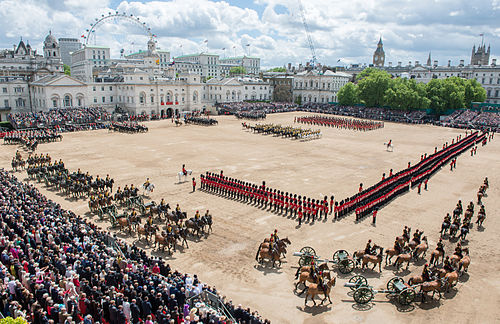
As has been said, the British Army has been a volunteer force since national service ended during the 1960s. Since the creation of the part-time, reserve Territorial Force in 1908 (renamed the Army Reserve in 2014), the full-time British Army has been known as the Regular Army. In July 2020 there were just over 78,800 Regulars, with a target strength of 82,000, and just over 30,000 Army Reservists, with a target strength of 30,000. All former Regular Army personnel may also be recalled to duty in exceptional circumstances during the 6-year period following completion of their Regular service, which creates an additional force known as the Regular Reserve. The British Army primarily recruits from within the United Kingdom, but accept applications from all British citizens. It also accepts applications from Irish citizens and Commonwealth citizens, with certain restrictions. Since 2018 the British Army has been an equal-opportunity employer (with some legal exceptions due to medical standards), and does not discriminate based on race, religion or sexual orientation. Applicants for the Regular Army must be a minimum age of 16, although soldiers under 18 may not serve in operations, and the maximum age is 36. Applicants for the Army Reserve must be a minimum of 17 years and 9 months, and a maximum age of 43. Different age limits apply for Officers and those in some specialist roles. Applicants must also meet several other requirements, notably regarding medical health, physical fitness, past-criminal convictions, education, and regarding any tattoos and piercings. Soldiers & Officers in the Regular Army now enlist for an initial period of 12 years, with options to extend if they meet certain requirements. Soldiers & Officers are normally required to serve for a minimum of 4 years from date of enlistment and must give 12 months’ notice before leaving. All soldiers and commissioned officers must take an oath of allegiance upon joining the Army, a process known as attestation. Those who wish to swear by God use the following words: “I, [soldier’s or commissioned officer’s name], swear by Almighty God that I will be faithful and bear true allegiance to His Majesty King Charles III, his heirs and successors and that I will as in duty bound honestly and faithfully defend His Majesty, his heirs and successors in person, crown and dignity against all enemies and will observe and obey all orders of His Majesty, his heirs, and successors and of the generals and officers set over me.” Others replace the words “swear by Almighty God” with “solemnly, sincerely and truly declare and affirm”.

The British Army’s official flag is the Union Jack. The Army also has a non-ceremonial flag that is often seen flying from military buildings and is used at recruiting and military events and exhibitions. Traditionally most British Army units had a set of flags, known as the colours —normally a Regimental Colour and a King’s Colour (the Union Jack). Historically these were carried into battle as a rallying point for the soldiers and were closely guarded. In modern units the colours are often prominently displayed, decorated with battle honours, and act as a focal point for Regimental pride. A soldier re-joining a regiment (upon recall from the reserve) is described as ‘recalled to the Colours’.
This week… crocodile tears.
Modern English speakers use the phrase ‘crocodile tears’ to describe a display of superficial or false sorrow, but the saying actually derives from a medieval belief that crocodiles shed tears of sadness while they killed and consumed their prey. The myth dates back as far as the fourteenth century and comes from a book called “The Travels of Sir John Mandeville.” Wildly popular upon its release, the tome recounts a brave knight’s adventures during his supposed travels through Asia. Among its many fabrications, the book includes a description of crocodiles that notes, “These serpents sley men, and eate them weeping, and they have no tongue.” Whilst factually inaccurate, Mandeville’s account of weeping reptiles later found its way into the works of Shakespeare, and ‘crocodile tears’ became an idiom as early as the sixteenth century.
Click: Return to top of page or Index page
 Diary of a Care Home Inmate