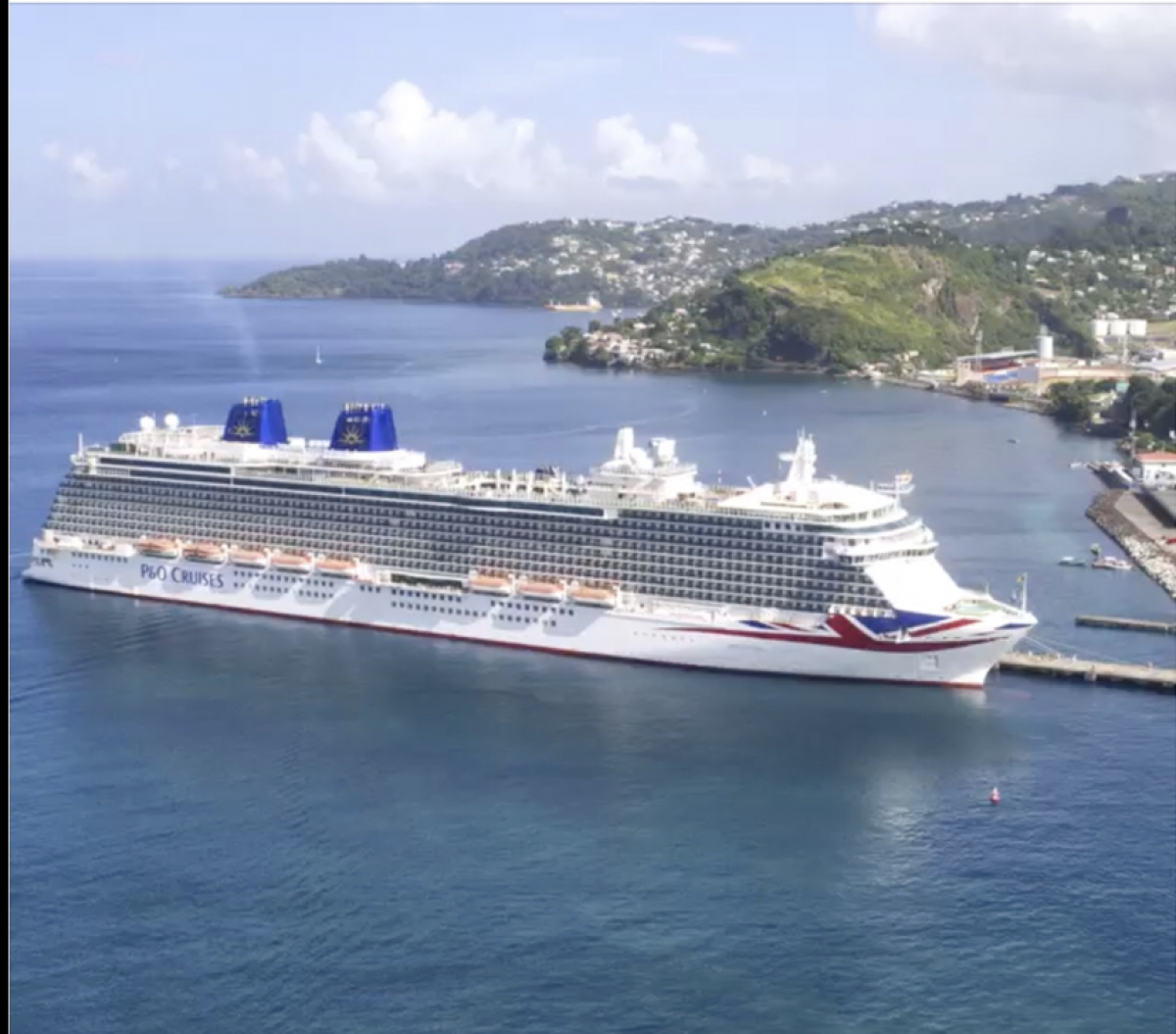
The Royal Navy is the United Kingdom’s naval warfare force and a component of His Majesty’s Naval Service. Although warships were used by English and Scottish kings from the early medieval period, the first major maritime engagements were fought in the Hundred Years’ War against France. The modern Royal Navy traces its origins to the early sixteenth century and is the oldest of the [UK’s armed services. Consequently it is known as the ‘Senior Service’.

The Royal Navy was founded in 1546 as part of the Kingdom of Scotland until 1707, part of the Kingdom of England from 1546 to 1707 and of the Kingdom of Great Britain from 1707 to 1801. From then on it became the United Kingdom. Its role has principally been naval warfare and its motto is ‘Si vis pacem, para bellum’, Latin for ‘If you wish for peace, prepare for war’. From the middle decades of the seventeenth century and through the eighteenth century, the Royal Navy vied with the Dutch Navy and later with the French Navy for maritime supremacy. From the mid-eighteenth century until the Second World War it was the world’s most powerful navy. The Royal Navy played a key part in establishing and defending the British Empire and four “Imperial fortress” colonies which provided not only safe harbours and (with the advent of steam propulsion) coal stores within the area of operation, but also Royal Naval Dockyards where ships of the squadrons could be repaired or maintained without requiring their return to a dockyard in the British Isles. These Imperial fortresses were also locations where military stores were stockpiled and numbers of soldiers sufficient not only for local defence, but also to provide expeditionary forces to work with the Royal Navy in amphibious campaigns and raids on coasts throughout the regions, could be garrisoned, thus securing the Royal Navy’s ability to assert naval superiority globally. Owing to this historical prominence, it is common, even among non-Britons, to refer to it as “the Royal Navy” without qualification. Following World War I, it was significantly reduced in size, although at the onset of World War II it was still the world’s largest. During the Cold War, the Royal Navy transformed into a primarily anti-submarine force, hunting for Soviet submarines. Following the collapse of the Soviet Union, its focus has returned to expeditionary operations around the world. The Royal Navy is part of His Majesty’s Naval Service, which also includes the Royal Marines and the Royal Fleet Auxiliary. As the seaborne branch of HM Armed Forces, the Royal Navy has various roles. Today, it has stated its six major roles as being those of preventing conflict on a global and regional level, providing security at sea to ensure the stability of international trade, supporting international partnerships to help cement the relationship with UK allies such as NATO, maintaining a readiness to fight so as to protect the United Kingdom’s interests across the globe, protecting the economy by safeguarding vital trade routes to guarantee economic prosperity and providing humanitarian aid to deliver a fast and effective response to global catastrophes.
From a historical perspective, the English Royal Navy was formally founded in 1546 by King Henry VIII, though the Kingdom of England had possessed less-organised naval forces for centuries prior to this. The Royal Scots Navy (or Old Scots Navy) had its origins in the Middle Ages until its merger with the English Royal Navy, as per the Acts of Union 1707. During much of the medieval period, fleets or “king’s ships” were often established or gathered for specific campaigns or actions, and these would disperse afterwards. These were generally merchant ships enlisted into service. Unlike some European states, England did not maintain a permanent core of warships in peacetime. England’s naval organisation was haphazard and the mobilization of fleets when war broke out was slow. Control of the sea only became critical to Anglo-Saxon kings in the tenth century and then, in the eleventh century, Aethelred II had an especially large fleet built by a national levy. During the period of Danish rule in the eleventh century, the authorities maintained a standing fleet by taxation, and this continued for a time under Edward the Confessor, who frequently commanded fleets in person. After the Norman Conquest, English naval power waned and England suffered naval raids from the Vikings. In 1069, this allowed for the invasion and ravaging of England by Jarl Osborn (brother of King Svein Estridsson) and his sons. The lack of an organised navy came to a head during the First Barons’ War, in which Prince Louis of France invaded England in support of northern barons. With King John unable to organise a navy, this meant the French landed unopposed at Sandwich in April 1216. King John’s flight to Winchester and his death later that year left the Earl of Pembroke as Regent, and he was able to marshal ships to fight the French in the Battle of Sandwich in 1217, one of the first major English battles at sea. The outbreak of the Hundred Years War emphasised the need for an English fleet, although it was not exactly an apt name for such a long conflict, as it lasted intermittently from 24 May 1337 until 19 October 1453, a period of 116 years, 4 months, 3 weeks and 4 days). French plans for an invasion of England failed when King Edward III of England destroyed the French fleet in the Battle of Sluys in 1340. England’s naval forces could not prevent frequent raids on the south-coast ports by the French and their allies and these raids were only halted with the occupation of northern France by King Henry V. A Scottish fleet existed by the reign of [William the Lion, who reigned as King of the Scots from 1165 to 1214. His 48-year-long reign was the second longest in Scottish history and the longest for a Scottish monarch before the Union of the Crowns in 1603. In the early thirteenth century there was a resurgence of Viking naval power in the region and they clashed with Scotland over control of the isles, though King Alexander III was ultimately successful in asserting Scottish control. The Scottish fleet was of particular import in repulsing English forces in the early fourteenth century.

A standing “Navy Royal”, with its own secretariat, dockyards and a permanent core of purpose-built warships, emerged during the reign of King Henry VIII. Under Queen Elizabeth I, England became involved in a war with Spain which saw privately owned vessels combining with the Queen’s ships in highly profitable raids against Spanish commerce and colonies. The Royal Navy was then used in 1588 to repulse the Spanish Armada, but the English Armada was lost the next year. In 1603, the Union of the Crowns created a personal union between England and Scotland. Whilst the two remained distinct sovereign states for a further century, the two navies increasingly fought as a single force. During the early seventeenth century, England’s relative naval power deteriorated until King Charles I undertook a major programme of shipbuilding. His methods of financing the fleet contributed to the outbreak of the English Civil War and the abolition of the monarchy. The Commonwealth of England replaced many names and symbols in the new Commonwealth Navy associated with royalty and the high church, and expanded it to become the most powerful in the world. The fleet was quickly tested in the First Anglo-Dutch War (1652–1654) and the Anglo-Spanish War (1654–1660), which saw the conquest of Jamaica and successful attacks on Spanish treasure fleets. The Restoration in 1660 saw King Charles II rename the Royal Navy again, and began the use of the prefix ‘HMS’. The Navy remained a national institution and not a possession of the Crown as it had been before. Following the revolution of 1688, England joined the ‘War of the Grand Alliance’ which marked the end of France’s brief pre-eminence at sea and the beginning of an enduring British supremacy.

In 1707, the Scottish navy was united with the English Royal Navy. On Scottish men-of-war, the cross of St Andrew was replaced with the Union Jack. On English ships, the red, white, or blue ensigns had the St George’s Cross of England removed from the canton, and the combined crosses of the Union flag put in its place. Throughout the eighteeenth and nineteenth centuries, the Royal Navy was the largest maritime force in the world, maintaining superiority in financing, tactics, training, organisation, social cohesion, hygiene, logistical support and warship design. The French Revolutionary and Napoleonic Wars (1793–1801, 1803–1814 & 1815) saw the Royal Navy reach a peak of efficiency, dominating the navies of all Britain’s adversaries, which spent most of the war blockaded in port. Under Lord Nelson, the navy defeated the combined Franco-Spanish fleet at Trafalgar in 1805. Ships of the line and even frigates, as well as manpower, were prioritised for the naval war in Europe, however, leaving only smaller vessels on the North America Station and other less active stations, and a heavy reliance upon impressed labour. This would result in problems countering large, well-armed United States Navy frigates which outgunned Royal Naval vessels in single-opponent actions, as well as United States privateers, when the American War of 1812 broke out concurrent with the war against Napoleonic France and its allies. The Royal Navy still enjoyed a numerical advantage over the former colonists on the Atlantic. Between 1815 and 1914, the Navy saw little serious action owing to the absence of any opponent strong enough to challenge its dominance. Throughout the nineteenth century and the first half of the twentieth century, Britain relied on imperial fortress colonies. These allowed control not only of the Atlantic, but it was presumed also of the other oceans. Prior to the 1920s, it was presumed that the only navies that could challenge the Royal Navy belonged to nations on the Atlantic ocean or its connected seas. Britain would rely on Malta, in the Mediterranean Sea, to project power to the Indian Ocean and western Pacific Ocean via the Suez Canal after its completion in 1869 and relying on amity and common interests between Britain and the United States (which controlled transit through the [Panama Canal, completed in 1914) during and after the First World War, on Bermuda to project power the length of the Western Atlantic, including the Caribbean Sea and Gulf of Mexico, and eastern Pacific, from the Arctic to the Antarctic – originally, the area controlled from Bermuda (and Halifax until 1905) had been North America, until the 1820s, then absorbed the Jamaica Station to become the North America and West Indies Station, and after the First World War absorbed the eastern Pacific Ocean and the western South Atlantic to become the ‘America and West Indies Station’ until 1956. During this period, naval warfare underwent a comprehensive transformation, brought about by steam propulsion, metal ship construction and explosive munitions. Despite having to completely replace its war fleet, the Navy managed to maintain its overwhelming advantage over all potential rivals. Owing to British leadership in the Industrial Revolution, the country enjoyed unparalleled shipbuilding capacity and financial resources, which ensured that no rival could take advantage of these revolutionary changes to negate the British advantage in ship numbers. In 1889, Parliament passed the Naval Defence Act which formally adopted the ‘two-power standard’, which stipulated that the Royal Navy should maintain a number of battleships at least equal to the combined strength of the next two largest navies. The end of the nineteenth century saw structural changes and older vessels were scrapped or placed into reserve, making funds and manpower available for newer ships. The launch of HMS Dreadnought in 1906 rendered all existing battleships obsolete.

In terms of exploration, the Royal Navy played an historic role in several great global explorations of science and discovery. Beginning in the eighteenth century many great voyages were commissioned, often in co-operation with the Royal Society, such as the Northwest Passage expedition of 1741. James Cook led three great voyages, with goals such as discovering Terra Australis, observing the Transit of Venus and searching for the elusive North-West Passage itself. These voyages are considered to have greatly contributed to world knowledge and science. In the late eighteenth century, during a four year voyage Captain George Vancouver made detailed maps of the Western Coastline of North America and in the nineteenth century Charles Darwin made further contributions to science during the second voyage of HMS Beagle. In addition, the Ross expedition to the Antarctic made several important discoveries in both biology and zoology. However, several of the Royal Navy’s voyages ended in disaster such as those of Franklin and Scott. Between 1872 and 1876 HMS Challenger undertook the first global marine research expedition. During the First World War, the Royal Navy’s strength was mostly deployed at home in the Grand Fleet, confronting the German High Seas Fleet across the North Sea. Several inconclusive clashes took place between them, chiefly the Battle of Jutland in 1916. The British fighting advantage proved insurmountable, leading the High Seas Fleet to abandon any attempt to challenge British dominance. For its part, the Royal Navy under John Jellicoe also tried to avoid combat and remained in port at Scapa Flow for much of the war. This was contrary to widespread prewar expectations that in the event of a continental conflict, Britain would primarily provide naval support to the Entente Powers whilst sending at most only a small ground army. Nevertheless, the Royal Navy played an important role at the beginning of the war in securing the British Isles and the English Channel, notably ferrying the entire British Expeditionary Force to the Western Front without the loss of a single life. At the end of the war, the Royal Navy remained by far the world’s most powerful navy. But during the inter-war period it was stripped of much of its power. The lack of an Imperial fortress in the region of Asia, the Indian Ocean and the Pacific Ocean was always to be a weakness throughout the nineteenth century as the former North American colonies that had become the United States of America had multiplied towards the Pacific coast of North America, also the Russian and Japanese Empires both had ports on the Pacific and had begun building large, modern fleets which went to war with each other in 1905. Britain’s reliance on Malta, via the Suez Canal, as the nearest Imperial fortress was improved, relying on amity and common interests that developed between Britain and the United States during and after the First World War by the completion of the Panama Canal in 1914, allowing the cruisers based in Bermuda to more easily and rapidly reach the eastern Pacific Ocean. At the start of World War II in 1939, the Royal Navy was still the largest in the world, with over 1,400 vessels. The Royal Navy provided critical cover during the British evacuations from Dunkirk and as the ultimate deterrent to a German invasion of Britain during the following four months. At Taranto, Admiral Cunningham commanded a fleet that launched the first all-aircraft naval attack in history. The Royal Navy suffered heavy losses in the first two years of the war and the Navy’s most critical struggle was the Battle of the Atlantic, defending Britain’s vital North American commercial supply lines against U-boat attack. A traditional convoy system was instituted from the start of the war, but German submarine tactics, based on group attacks by “wolf-packs“, were much more effective than in the previous war, and the threat remained serious for well over three years.
After the Second World War, the decline of the British Empire and the economic hardships in Britain forced the reduction in the size and capability of the Royal Navy. Governments since have faced increasing budgetary pressures, partly due to the increasing cost of weapons systems. In 1981, the Defence Secretary had advocated and initiated a [series of cutbacks to the Navy, however the Falklands War proved a need for the Royal Navy to retain capabilities which, with its resources and structure at the time, would prove difficult. At the beginning of the 1980s, the Royal Navy was a force focused on blue-water anti-submarine warfare. Its purpose was to search for and destroy Soviet submarines in the North Atlantic, and to operate the nuclear deterrent submarine force. The navy received its first nuclear weapons with the introduction of the first of the Resolution-class submarines armed with Polaris missiles. Following the conclusion of the Cold War, the Royal Navy began to experience a gradual decline in its fleet size in accordance with the changed strategic environment it operated in. Whilst new and more capable ships are continually brought into service, the total number of ships and submarines operated has continued to steadily reduce. This has caused considerable debate about the size of the Royal Navy, with a 2013 report finding that the current RN was already too small, and that Britain would have to depend on her allies if her territories were attacked. The financial costs attached to nuclear deterrence have become an increasingly significant issue for the navy.
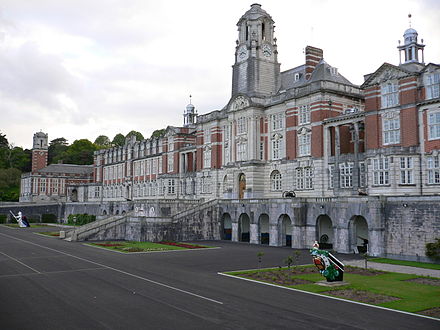
In terms of training, HMS Raleigh at Torpoint, Cornwall, is the basic training facility for newly enlisted ratings. The Britannia Royal Naval College is the initial officer training establishment for the navy, located at Dartmouth, Devon. Personnel are divided into a warfare branch, which includes Warfare Officers (previously named seamen officers) and Naval Aviators, as well as other branches including the Royal Naval Engineers, Royal Navy Medical Branch and Logistics Officers, previously named Supply Officers. Present-day officers and ratings have several different uniforms, some are designed to be worn aboard ship, others ashore or in ceremonial duties. Women began to join the Royal Navy in 1917 with the formation of the Women’s Royal Naval Service (WRNS), which was disbanded in 1919 after the end of the First World War. It was revived in 1939 and the WRNS continued until disbandment in 1993, as a result of the decision to fully integrate women into the structures of the Royal Navy. Women now serve in all sections of the Royal Navy including the Royal Marines. In August 2019, the Ministry of Defence published figures showing that the Royal Navy and Royal Marines had 29,090 full-time trained personnel, compared with a target of 30,600.

There are a range of surface vessels, amongst them aircraft carriers. The Royal Navy has two Queen Elizabeth-class aircraft carriers and each carrier displaces 65,000 tonnes. The first, HMS Queen Elizabeth, commenced flight trials in 2018. Both are intended to operate the Short Take-off and Vertical Landing (STOVL) variant of the F-35 Lightning II. Queen Elizabeth began sea trials in June 2017, was commissioned later that year, and entered service in 2020, whilst the second, HMS Prince of Wales, began sea trials on 22 September 2019, was commissioned in December 2019 and was declared operational as of October 2021. The aircraft carriers will form a central part of the UK Carrier Strike Group alongside escorts and support ships. Meanwhile there is an escort fleet comprising guided missile destroyers and frigates, which are the traditional workhorse of the Navy. As of April 2023 there are six destroyers and eleven frigates in active service. Among their primary roles is to provide escort for the larger capital ships, protecting them from air, surface and subsurface threats. Other duties include undertaking the Royal Navy’s standing deployments across the globe, which often consist of counter-narcotics, anti-piracy missions and providing humanitarian aid. The destroyer is primarily designed for anti-aircraft and anti-missile warfare and the Royal Navy describe the its mission as “to shield the Fleet from air attack”. They are equipped with the Sea Viper integrated anti-aircraft warfare system which incorporates the sophisticated long range radars and associated missiles.

Sixteen frigates were delivered to the Royal Navy, with the final vessel, HMS St Albans, commissioned in June 2002. The 2010 Strategic Defence and Security Review announced that the remaining 13 Type 23 frigates would eventually be replaced by the Type 26 Frigate. There are other vessels such as Mine countermeasure vessels (MCMV), Offshore patrol vessels (OPV) as well as Survey ships.
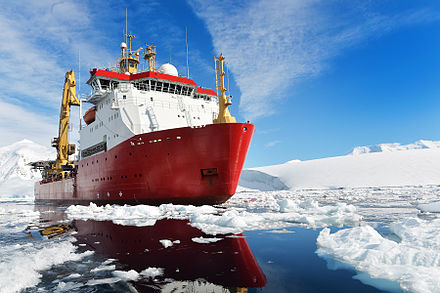
There is also HMS Protector, a dedicated Antarctic patrol ship that fulfils the nation’s mandate to provide support to the [British Antarctic Survey, whilst HMS Scott is an ocean survey vessel and at 13,500 tonnes is one of the largest ships in the Navy. As of 2018, the newly commissioned HMS Magpie also undertakes survey duties at sea. In addition, the Royal Fleet Auxiliary (RFA) provides support to the Royal Navy at sea in several capacities. For fleet replenishment, it deploys one Fleet Solid Support Ship and six fleet tankers (two of which are maintained in reserve). The RFA also has one aviation training and casualty reception vessel. The Royal Fleet Auxiliary plans to introduce two new Multi-Role Ocean Surveillance Ships, in part to protect undersea cables and gas pipelines and partly to compensate for the withdrawal of all ocean-going survey vessels from Royal Navy service. Meanwhile there are amphibious warfare ships in current service including two landing platform docks. Whilst their primary role is to conduct amphibious warfare, they have also been deployed for humanitarian aid missions. There are of course a number of other ships, not forgetting the Submarine Service. The submarine based element of the Royal Navy is sometimes referred to as the ‘Silent Service’, as the submarines are generally required to operate undetected. Founded in 1901, the service made history in 1982 when, during the Falklands War, HMS Conqueror became the first nuclear-powered submarine to sink a surface ship, ARA General Belgrano. Today, all of the Royal Navy’s submarines are nuclear-powered. The Royal Navy operates several ballistic missile submarines displacing nearly 16,000 tonnes and equipped with Trident missiles armed with nuclear weapons and ‘Spearfish’ torpedoes, to carry out the United Kingdom’s Continuous At Sea Deterrent (CASD). The UK government has committed to replace these submarines with four new Dreadnought-class submarines, which should enter service in the early 2030s to maintain this capability. There are also a number of Fleet submarines, including the ‘Trafalgar’ class which displaces approximately 5,300 tonnes when submerged and are armed with Tomahawk land-attack missiles and Spearfish torpedoes. The ‘Astute’ class at 7,400 tonnes are much larger and carry a larger number of Tomahawk missiles and Spearfish torpedoes.
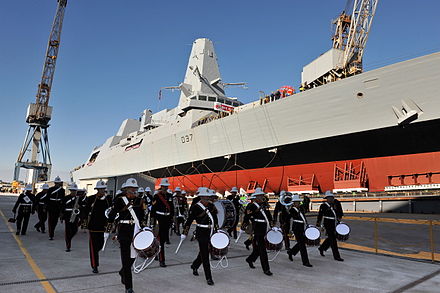
We must also not forget the Royal Marines, who are an amphibious, specialised light infantry force of commandos, capable of deploying at short notice in support of His Majesty’s Government’s military and diplomatic objectives overseas. The Royal Marines are organised into a highly mobile light infantry brigade and seven commando units. The Corps operates in all environments and climates. The Royal Marines are also the primary source of personnel for the Special Boat Service (SBS), the Royal Navy’s contribution to the United Kingdom Special Forces. The Corps includes the Royal Marines Band Service, the musical wing of the Royal Navy. The Royal Marines have seen action in a number of wars, often fighting beside the British Army; including in the Seven Years’ War, the Napoleonic Wars, the Crimean War, World War I and World War II. In recent times, the Corps has been deployed in expeditionary warfare roles. They have international ties with allied marine forces, particularly the United States Marine Corps and the Netherlands Marine Corps. The Royal Navy currently uses three major naval bases in the UK, each housing its own flotilla of ships and boats ready for service, along with two naval air stations and a support facility base in Bahrain. There is more that could be said about the command, control and organisation of the Royal Navy, but that is enough, for now I think!
This week…
Two silk worms had a race, they ended up in a tie.
Click: Return to top of page or Index page
 Diary of a Care Home Inmate